UGC Creator
A UGC creator makes content the brand posts. What that changes, whether you really need followers, and where the work comes from.
A UGC creator makes content that the brand posts. An influencer makes content that they post. That one difference decides what you are selling, who pays you, how much, and whether your follower count matters at all.
It is also the most repeated claim in this field: that you need no audience to do UGC work. We counted the creators actually doing it, and the claim is only half right.
What a UGC Creator Actually Is
UGC stands for user generated content. In practice a UGC creator is a freelance content producer: a brand pays for photos or videos, and then runs them on its own channels and in its own ads. Your audience is not part of the deal.
UGC creator against influencer
| UGC creator | Influencer | |
|---|---|---|
| Who posts it | The brand, on its own channels and ads | You, to your own followers |
| What the brand buys | The content itself, plus the right to use it | Access to your audience |
| Does your reach matter? | Not directly. Quality and turnaround matter more | It is the whole product |
| How it is priced | Per asset, often a bundle of videos or photos | Per post, against reach and engagement |
| Usage rights | The main thing you are negotiating. Paid ad usage is worth far more than organic | Often an add-on to the post fee |
| Repeat work | Common. Brands need content continuously | Campaign by campaign |
The practical consequence: UGC is closer to freelance videography than to influencing. You are judged on whether the footage converts in an ad, not on whether people like you.
The “You Do Not Need Followers” Claim, Checked
This is where the honest answer differs from the usual one. We counted 1,995 creators in our marketplace who put UGC in their display name: 1,254 on Instagram, 663 on TikTok and 26 on YouTube. Here is how the Instagram ones compare with Instagram creators generally.
Follower size of UGC creators against all Instagram creators
| Followers | UGC creators | All Instagram creators |
|---|---|---|
| Under 1,000 | 3.7% | 2.6% |
| 1,000 to 10,000 | 28.7% | 23.3% |
| 10,000 to 100,000 | 61.2% | 60.1% |
| 100,000 plus | 6.4% | 14.0% |
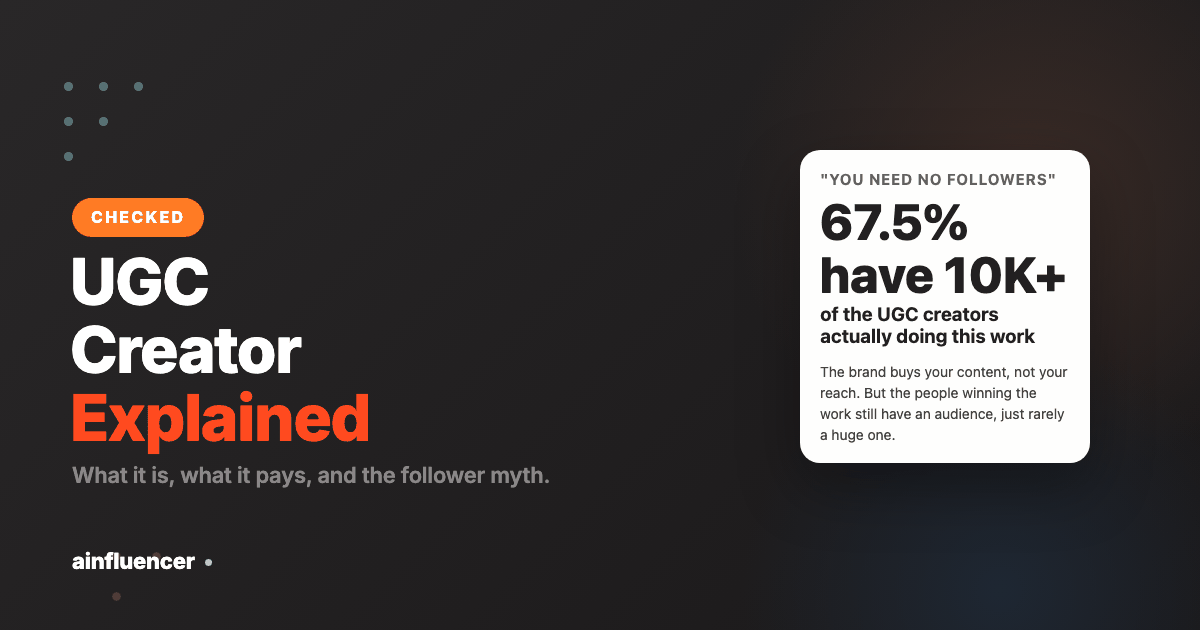
67.5% of UGC creators here have more than 10,000 followers. So the claim is half true and half marketing. It is true that the brand is buying the content rather than your reach, and true that nobody checks a threshold. It is not true that the people winning this work have no audience.
The real difference is at the top: a UGC creator is less than half as likely to be a 100,000 plus account. This is work that mid-sized creators do, not mega accounts, because a brand paying for assets has no reason to pay a celebrity premium for them.
Why the audience still helps even though it is not sold: it is proof. A brand looking at two identical portfolios picks the creator whose own feed shows they can hold attention. Treat your account as the showreel, not the product.
Which Platform the Work Happens On
UGC skews hard toward short vertical video, and the demand follows. Across our marketplace, brand offers per 1,000 creator accounts run at 354 on TikTok, 337 on Instagram and 0.33 on YouTube.
That is not a judgement on YouTube, which pays more per placement and whose deals mostly happen direct or through agencies rather than marketplaces. But if you want a steady flow of inbound UGC briefs, Instagram and TikTok are where they arrive. The split of UGC creators themselves says the same thing: 1,254 on Instagram and 663 on TikTok against 26 on YouTube.
How to Become a UGC Creator
- Make three samples before you pitch anyone. Pick products you already own, and shoot each one as if a brand had briefed it: a hook in the first second, the product in use, a clear reason to buy. This portfolio is the whole application
- Learn one editing tool properly. Turnaround and consistency are what get you rebooked, and both come from knowing your tools rather than from talent
- Decide your deliverable. One video, three variants, or a monthly bundle. Brands buy packages more readily than one-offs because they need volume
- Price usage rights separately from the content. Organic use on a brand’s own feed is one price. Running your face in a paid ad for six months is a different one, and underpricing it is the most common early mistake
- Put yourself where briefs arrive. Cold emailing brands works slowly. A marketplace where brands post what they need works faster
On Ainfluencer there is no subscription and no follower minimum: brands search, send you an offer, and you agree terms and get paid inside the platform, with a $10 minimum collaboration. For what to charge, our data on influencer rates is the starting point, and the follower thresholds brands apply are worth reading even though UGC is the exception to most of them.
Where UGC Work Comes From
The four routes, and what each is good for
| Route | How it works | Best for |
|---|---|---|
| Marketplaces | Brands search and send you offers, or post briefs you apply to | Steady inbound once your profile is set up. The lowest effort per deal |
| Direct outreach | You email brands whose ads you could improve, with a sample attached | Higher rates and better clients, but slow and high rejection |
| UGC agencies | An agency holds the brand relationship and briefs you | Volume without selling, at the cost of a margin. See UGC agencies |
| Inbound from your own content | Brands find you because your feed shows you can make ads | The best clients, but it only starts once the work is already visible |
If you are reading this from the other side, as a brand rather than a creator, how to find UGC creators is the companion piece.
Is UGC Worth It?
Two honest points to set expectations. UGC pays per asset, so your income scales with how much you can produce rather than with how much you are followed, which makes it steadier than influencer work and also capped by your own hours. And it is competitive precisely because the barrier is low: nearly 2,000 creators in this marketplace alone label themselves UGC.
What separates the ones who get rebooked is unglamorous: hitting deadlines, following the brief, shooting in a format the brand can actually run, and pricing usage rights properly. None of that depends on an audience, which is the part of the claim that is genuinely true.
Many creators do both. If you want the audience-led route as well, how to become an influencer covers it, and there are platform guides for getting your first deals on Instagram and TikTok.
Frequently Asked Questions
What is a UGC creator?
A freelance content producer who makes photos and videos for a brand to post on its own channels and run in its own ads. Unlike an influencer, you are selling the content and the right to use it, not access to your audience.
Do you need followers to be a UGC creator?
Not as a requirement, but the claim that it does not help is overstated. Of the UGC creators in our marketplace, 67.5% have more than 10,000 followers. What is true is that they are less than half as likely as other creators to be a 100,000 plus account, because brands buying assets have no reason to pay a celebrity premium.
What is the difference between a UGC creator and an influencer?
Who posts the content. A UGC creator hands it over for the brand to publish; an influencer publishes it to their own followers. That changes the pricing too: UGC is priced per asset plus usage rights, influencer work is priced against reach and engagement.
How do I become a UGC creator with no experience?
Make three samples using products you already own, shot as if a brand had briefed them. That portfolio is your application. Then put yourself where briefs arrive rather than cold emailing, and price usage rights separately from the content itself.
Which platform is best for UGC work?
Instagram and TikTok. In our marketplace they receive about 337 and 354 brand offers per 1,000 creator accounts against 0.33 on YouTube, and the UGC creators themselves are concentrated there: 1,254 on Instagram and 663 on TikTok against 26 on YouTube.
How much do UGC creators charge?
It varies too widely for a single figure, and it depends more on usage rights than on the content. Organic use on a brand’s own feed is one price; running the same video as a paid ad for months is another. Decide both before you quote.
Is being a UGC creator still worth it?
It is steadier than influencer work because it pays per asset rather than per follower, and it is capped by your own hours for the same reason. It is also competitive: nearly 2,000 creators in this marketplace alone label themselves UGC. Deadlines, brief-following and sensible usage pricing are what separate the ones who get rebooked.