Cohley Review 2026: Pricing, Compliance and Who It Is For
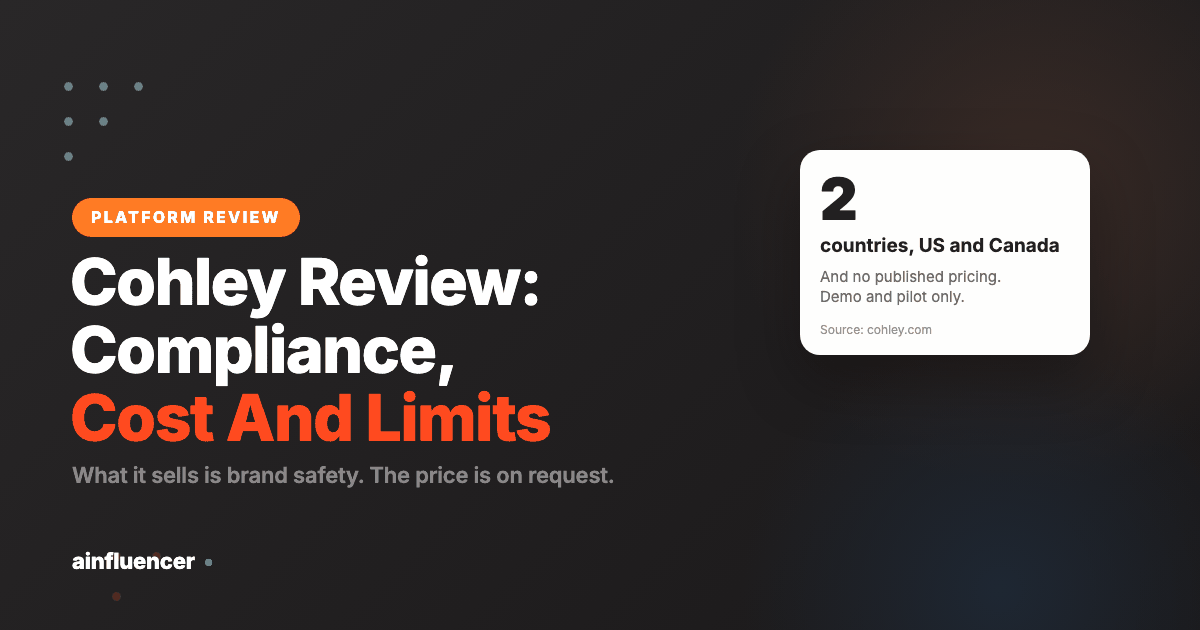
Cohley sits at the enterprise end of creator content. It does the same core job as the cheaper UGC marketplaces, but what it actually sells is compliance: FTC certification, automated asset checks against your brief, music licensing review and SOC 2. That focus explains both its appeal and its price, which it does not publish.
Checked against Cohley’s own site on 5 October 2026.
What Cohley is
A platform connecting brands with a network of 200,000+ vetted creators across four content types: UGC photo and video, influencer partnerships, product seeding and gifting, and text reviews. That last one is unusual; most UGC platforms do not touch written product reviews at all.
The workflow runs the opposite way from cold outreach. You post a Creative Brief with guidelines, deliverables and creator compensation, and vetted creators apply to you. Cohley’s own description is blunt about what that removes: no cold outreach, no rate negotiating, and no individual contracting.
Running it is Finn, their AI agent, which vets applicants against your criteria, organises them for review, checks submissions and processes payments. Worth noting that Cohley labels Finn as in beta on its own homepage and tells you to verify results, which is more honest than most AI feature marketing and should be taken at face value.
Compliance is the actual product
This is where Cohley differs from Billo or JoinBrands, and if it does not matter to you then neither does Cohley.
- FTC disclosure certification. Creators are trained and certified on disclosure requirements before they can enter a brief, rather than being reminded afterwards.
- AI asset analysis. Every submission is scored against your brief’s non-negotiables before it reaches your review queue, so off-brief work is filtered rather than reviewed.
- Music licensing review. Creators pull from licensed tracks for eligible briefs, and submissions are analysed so your team sees what needs changing before it ships. Unlicensed audio in a paid ad is a real and underrated liability.
- SOC 2 and penetration testing. Listed on the plan comparison, which is what enterprise procurement asks for and what smaller platforms generally cannot answer.
For a regulated category, a public company, or an agency carrying client risk, that bundle is the reason to be here. For a DTC brand running TikTok ads, it is overhead you are paying for.
Cohley pricing
Cohley publishes no prices. Its plans page lists two tiers with feature comparisons and a demo request, and there is no figure anywhere on it.
| Plan | What it includes |
|---|---|
| Platform | Platform licence, Finn Agent, perpetual usage rights across all channels, dedicated customer success manager, all seven content types including professional video and photography |
| Managed Services | Everything above, plus campaign strategy and ideation, budgeting and deliverables, creator recruiting, contracting and payments, live creator briefing calls, and customised campaign analysis |
The entry point is an optional three-month paid pilot of either tier with a dedicated customer success manager, which is a sensible structure and also tells you the shape of the commitment: this is bought on a call, not with a card.
Worth putting the three platforms side by side, because pricing transparency tracks almost exactly with who they sell to:
| Platform | Pricing | Creators | Usage rights |
|---|---|---|---|
| JoinBrands | Fully public: 15% fee, $25 video floor | 4 million | Included |
| Billo | Was public, now behind a login | 5,000+ | Priced separately |
| Cohley | Never public, demo only | 200,000+ | Perpetual, included |
The limit that decides it
Cohley states its own scope plainly: it is built for mid-market and enterprise brands selling physical products in the United States and Canada, and the agencies serving them.
Two countries. If you sell into Europe, Latin America, Asia or the Gulf, that is the end of the evaluation regardless of how good the compliance tooling is. It is the same constraint we found on Billo, which covers the US, Canada and the UK, and it is the single most common reason brands outside North America end up looking at a different category of platform entirely.
The second half of that sentence matters too: physical products. If you sell software, a service or anything digital, the seeding and review mechanics that make the platform work do not apply cleanly.
What Cohley reports
From its own customer quotes, so read them as selected best cases rather than averages:
- An agency reporting 75% faster content production and 5x faster creator sourcing
- A brand describing the platform plus strategic support as functioning as its external creative department, with thousands of assets and 500+ creator collaborations
Both point at the same thing, and it is the honest case for Cohley: the gain is operational speed, not cheaper content. If your bottleneck is that briefing, chasing, reviewing and paying creators eats a person’s week, that is what is being sold.
Cohley pros and cons
Pros
- Compliance is the actual product: music licensing review and SOC 2, not a feature list
- G2 sits at 4.4 out of 5 across around 70 reviews
- Reviewers praise high-quality content at scale and a briefing process they describe as simple
- Brief, creator management and payment handled in one place
- A strong fit for agencies, where client brand risk is somebody’s job title
Cons
- The public evidence is thin: around 70 reviews, and none at all in a recent ninety-day window
- G2 does not have enough data to publish a pros and cons breakdown, which is itself a signal about sample size
- Pricing is by demo, so you cannot compare it against anything before a call
- The usual entry is a three-month paid pilot, which is a real commitment
- US and Canada only
- One reviewer reports large content libraries becoming hard to organise
- Overhead rather than value if compliance is not a genuine constraint for you
What real users say about Cohley
Cohley scores, as reported by each review platform
Bar length is the score as a share of 5. Read 5 October 2026. The score is solid and the sample is small, which is consistent with an enterprise tool bought deliberately after a demo rather than signed up for on impulse.
The rating, and the caveat on it
Reported scoring puts Cohley at 4.4 out of 5 on G2 from around 70 reviews. Solid, and consistent with an enterprise tool whose buyers chose it deliberately after a demo rather than signing up on impulse.
The caveat is volume rather than score: review activity is low and recent activity lower still, with reporting noting no new G2 reviews in a recent 90-day window. That is normal for a platform sold through demos to a smaller number of larger accounts, and it is the opposite of a self-serve tool like Publer with 486 reviews. It does mean there is less public evidence to go on, which is itself worth knowing when the entry commitment is a three-month paid pilot.
What reviewers praise
The praise is specific and consistent with the positioning: high-quality content at scale, a briefing process people describe as simple, and the value of handling everything from brief creation through to creator payment in one place. Agencies in particular report using it to keep always-on content flowing across client accounts.
Notice what is absent from the praise. Nobody describes Cohley as cheap or fast to start with, and the reviews do not claim it is. They describe it as removing operational load, which is the same thing the case study figures point at.
What the thin review base means for you
With roughly 70 public reviews and no published pricing, there is less you can learn about Cohley from the outside than about any other platform in this comparison. That puts more weight on the pilot.
So use it properly. A three-month paid pilot with a dedicated customer success manager is long enough to answer the questions the public record cannot: what the all-in cost per usable asset actually is, how fast content comes back, and whether the compliance tooling does work your team would otherwise pay someone to do. Go in with those three measurements defined, because the pilot is the review you will be relying on.
What Cohley’s reviews do not tell you
This section is shorter than it is for every other platform here, and that is the finding rather than an omission. Cohley has around 70 public reviews and asks for a paid pilot, so the honest version of a complaints section is an account of how little there is to read.
Public reviews available before you commit, by platform
Review counts as published by each platform, read 5 October 2026. This is the most important chart in this review and it is not about quality. Cohley asks for a demo and a three-month paid pilot, and offers the least public evidence of any platform here to make that decision on. The absence of complaints is not evidence that there are none; on a sample this size it mostly means nobody has written them down.
| Complaint | What reviewers describe | What to do about it |
|---|---|---|
| Not enough public evidence | Around 70 reviews, no new ones in a recent ninety-day window, and G2 reporting insufficient data to show a pros and cons breakdown. For most tools a thin review profile is a minor annoyance. Here it lands against the highest entry commitment in this comparison. | Ask Cohley for two references in your own category and talk to them without Cohley on the call. That is the only way to get the evidence the review sites do not have. |
| Pricing only by demo | There is no published price list, so you cannot size it against an alternative until you have been through a sales process. | Decide your ceiling before the call and say it early. A quote anchored to your budget is a better use of the meeting than a quote anchored to their tiers. |
| The three-month pilot | The usual entry is a paid pilot of about three months, which means the real evaluation happens after you have paid rather than before. | Go in with three written success criteria and the date you will judge them on. Without those, a pilot renews on momentum. |
| Content library organisation | One reviewer reports that large content libraries become hard to manage and organise. A single report, so treat it as a question to raise rather than a known fault. | If you expect to generate hundreds of assets, ask to see a mature account’s library in the demo, not a clean one. |
| Geographic limit | US and Canada only. The same constraint as Billo, and it is absolute: no amount of compliance tooling helps if the creators are in the wrong country. | Check this first. If you sell outside North America, nothing else in this review matters. |
Cohley is the one platform here where we cannot tell you what the negative reviews say, because there are barely any, and we think saying so plainly is more useful than filling the gap. That is a real finding rather than a missing paragraph. Every other tool in this set can be evaluated from a few hundred strangers’ experiences before you spend anything. Cohley asks for a demo and a paid pilot on the strength of 70 reviews and a sales conversation. If compliance and brand safety are genuine constraints for you, that is a reasonable trade, because very little else solves the problem. If they are not, you are taking the largest evidence risk in the category to buy something you did not need.
Who it suits
A good fit if you are a mid-market or enterprise brand selling physical products in the US or Canada, compliance and brand safety are real constraints rather than box-ticking, and you have the budget for a platform bought through a demo and a pilot. It is also a strong fit for agencies, where client risk makes FTC certification and asset scoring worth paying for.
A poor fit if you want to test UGC with a small budget, you sell outside North America, you need content this week, or you want to see a price before talking to someone. A marketplace with a published fee and a $25 floor will get you content faster and cheaper; it will not give you SOC 2 or certified disclosure.
Cohley alternatives
| Platform | Pick it over Cohley when | Trade-off |
|---|---|---|
| JoinBrands | Cost per asset and speed matter more than compliance tooling | You run the briefing and review yourself |
| Billo | You want produced video with less involvement | Higher price per video, rights priced separately |
| Collabstr | You prefer browsing fixed listings and hiring directly | Far less campaign and compliance tooling |
| Bazaarvoice | Syndicated ratings and reviews across retailer sites is the job | A different product; weaker on creator video |
Where Ainfluencer fits
We build Ainfluencer, so this is positioning, not a verdict. Two differences are worth knowing if Cohley is on your list.
Geography. Cohley is explicitly US and Canada. Our marketplace is global, which is usually the deciding factor for brands selling outside North America rather than any feature comparison.
What you are buying. Cohley generates content you then activate and distribute. A creator marketplace is built around creators posting to their own audiences, so reach comes with the collaboration rather than from a separate media budget. Those are different jobs, and a brand with an enterprise compliance requirement and a large paid budget has a real case for Cohley that we are not going to argue with.
Frequently asked questions
How much does Cohley cost?
Cohley does not publish prices. Its plans page lists two tiers, Platform and Managed Services, with feature comparisons and a demo request, and no figures anywhere. The entry point is an optional three-month paid pilot with a dedicated customer success manager, so it is bought on a call rather than with a card. Expect enterprise pricing to match the enterprise positioning.
What is the difference between Cohley’s Platform and Managed Services plans?
Platform gives you the software: the licence, Finn Agent, perpetual usage rights, a dedicated customer success manager and all content types. Managed Services adds the people: campaign strategy and ideation, budgeting and deliverables, creator recruiting, contracting and payments, live creator briefing calls, and customised campaign analysis. Platform means your team still runs campaigns; Managed Services means Cohley does.
Does Cohley work outside the US?
Only Canada. Cohley states it is built for mid-market and enterprise brands selling physical products in the United States and Canada, plus the agencies serving them. If you sell into Europe, Latin America, Asia or the Gulf, that ends the evaluation regardless of the rest of the platform.
Do you own the content from Cohley?
Yes. Every asset includes perpetual usage rights across all channels, with no licensing fees or expiration dates, listed as included on both plans. That matches JoinBrands and differs from platforms that price organic posting, licensed reuse and paid amplification as separate permissions.
What is Finn, Cohley’s AI agent?
Finn handles the operational work behind a brief: vetting applicants against your criteria, organising them for review, checking submissions against your brief’s non-negotiables before they reach your queue, and processing payments. Cohley labels Finn as in beta on its own site and advises verifying results, which is worth taking at face value when planning around it.
Is Cohley better than Billo or JoinBrands?
They serve different buyers. JoinBrands is cheapest per asset with fully public pricing and four million creators, and you do the briefing and review. Billo sells produced video at a higher fixed price. Cohley sells compliance: FTC creator certification, automated asset scoring, music licensing review and SOC 2, for mid-market and enterprise teams where brand risk is real. If compliance is not a constraint for you, Cohley is overhead.
The summary: Cohley is the right answer when compliance and brand safety are genuine constraints and you have an enterprise budget to match. Check two things first, because neither is negotiable. Whether you sell in the US or Canada, since that is the whole footprint, and whether you are willing to buy through a demo and a three-month pilot, because there is no other way in.