On this page
Billo Review 2026: Pricing, Creators and the Catch
Billo is one of the better known ways to get UGC video ads made without finding creators yourself. It is also harder to evaluate than it used to be, because the company stopped publishing its prices. This review covers what it does, what it costs according to the sources that still quote figures, and the one limitation that decides whether it can work for you at all.
What Billo is
Billo describes itself as a creator marketing platform for UGC. In practice you brief a video, creators in its network produce it, and you receive ad-ready footage you can run as paid social. It sells itself to performance marketers rather than to brand teams, and the positioning is explicitly against AI-generated video: its own comparison table puts “human creators people trust” against “AI avatars”.
From Billo’s own site, the numbers it publishes are:
- 22,000+ brands using it
- 5,000+ vetted creators in the network
- A data layer it calls CreativeOps, built on 326,000 ads representing $500 million in purchase value
The product splits into three parts. Partnerships Hub is the creator side: briefing, selecting and rehiring creators. CreativeOps is the data side: a script generator, creator matching, ad variations from existing footage, and creative analytics. Managed service is Billo running it for you.
Two features are worth separating from ordinary UGC marketplaces. Creators can post to their own profiles for organic reach, and you can then run partnership ads from the creator’s handle rather than your brand account. That second one is the real differentiator, because an ad running from a creator’s handle carries their social proof in a way a reposted video does not.
Billo pricing, and why you cannot look it up
Billo no longer publishes a public price list. We checked on 5 October 2026:
billo.app/pricing redirects to a login screen at
manage.billo.app. You have to create an account to see what anything
costs.
Figures still quoted by third-party reviewers, which we could not confirm against Billo directly, put it at roughly:
| Package | Reported price | Effective per video |
|---|---|---|
| Single video | from $99 | $99 |
| 6 videos | $500 | $83 |
| 14 videos | $1,000 | $71 |
| 37 videos | $2,500 | $68 |
Reviewers also report that add-ons such as expedited delivery or premium creator selection push the real figure closer to $150 per video. Treat all of that as indicative and confirm it in the product, because it is second-hand by necessity.
The model itself is pay per video rather than a subscription, which is genuinely useful: there is no monthly floor if you stop ordering. But a platform whose buyers compare on cost per video, that makes you sign up to see cost per video, has added friction exactly where the decision gets made.
The limitation that decides it
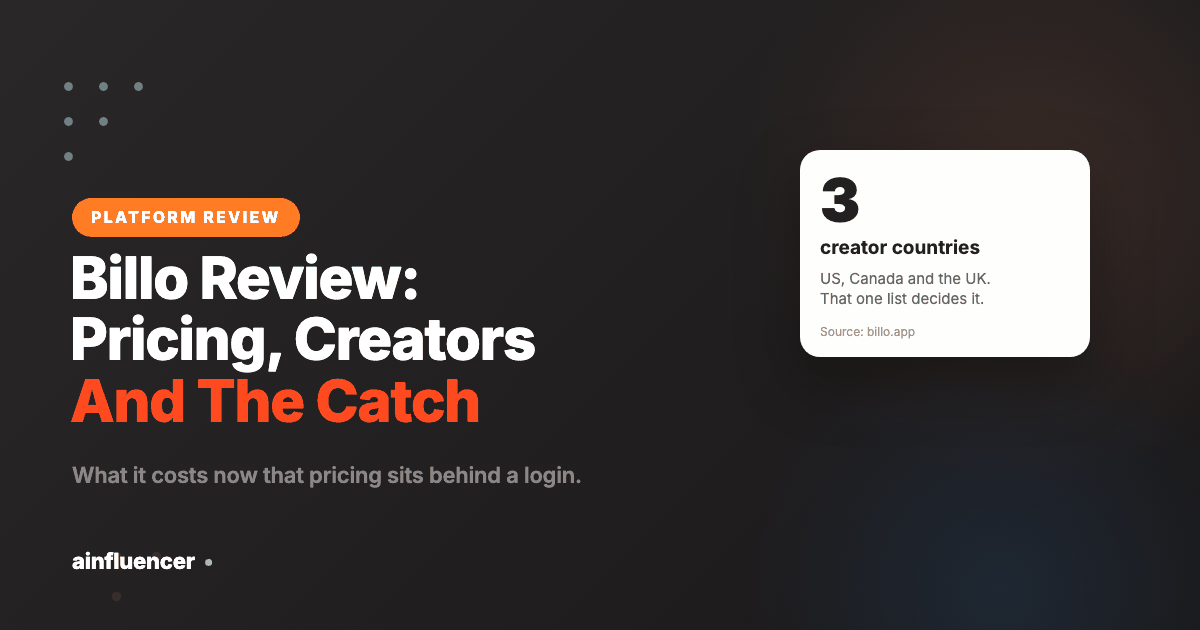
Billo’s creator network covers three countries. Its own site lists creators from the United States, Canada and the United Kingdom.
If you sell into those markets, that is a feature: the accents, the homes and the supermarket shelves in the background all match the audience. If you sell anywhere else, it is the whole decision. A German, Brazilian, Indian or Gulf audience watching an ad filmed in an American kitchen by an American creator does not read as user-generated content, it reads as imported advertising, and the conversion difference is not subtle.
Before anything else about Billo matters, check that list against the markets you actually sell in.
What Billo says it delivers
Billo publishes named case studies with figures attached. These are its numbers, from its customers, selected by Billo, so read them as the best cases rather than the average one:
- A brand reporting a 200% increase in net profit and 120% growth in total sales within two months
- Customer acquisition cost cut from above $220 to consistently under $75, with a $22 CPA on a top testimonial video
- 15% higher click-through and 8% lower CPA on TikTok against non-Billo ads
- A 17.7% click-through rate on a top-performing ad
The pattern across them is consistent and plausible: the gains come from volume and iteration rather than from any single video. That is also the honest read of what a UGC platform buys you. You are purchasing enough variations to find the one that works, not purchasing a winner.
Billo pros and cons
Pros
- Fixed per-video pricing with nothing to negotiate
- Partnership ads run from the creator’s own handle, which few competitors offer
- Reported case figures are strong: customer acquisition cost from above $220 to under $75, and 120% sales growth in two months
- Fast turnaround on standard product video briefs
- Briefs, revisions and payment handled in one place
Cons
- US, Canada and UK only, which ends the evaluation for brands elsewhere
- Reviewers report weak output from verified creators, including one who sent an old portfolio video that Billo had pre-approved
- Communication about delays described as lacking
- A cancelled order reported as refused a refund, though another reviewer reports a fast full refund
- The creator side is strained: one creator reports 47 applications and no jobs in a first month, and payments as low as $20 per video
- A smaller creator pool than the open marketplaces
What real users say about Billo
Billo on Trustpilot, as its regional pages report it
Bar length is the score as a share of 5. All three read 5 October 2026. We are showing three figures rather than one because Billo’s regional Trustpilot pages genuinely disagree, by half a point across samples that differ by only thirteen reviews. That is worth knowing before you quote any single Billo rating: around 4.0 to 4.5 on roughly 515 reviews is the honest version, and anyone citing one decimal place has picked a page.
The brand-side and creator-side experiences of Billo are different enough that they are worth separating, and the creator side tells you something about the brand side.
What brands report
The consistent praise is for the process rather than the price. Reviewers describe getting quality creators without back-and-forth email, with requirements and parameters laid out clearly up front and edit requests handled smoothly. For a brand whose actual problem is the administrative weight of commissioning content, that is the product working as intended.
What creators report, and why it matters to brands
Billo is a competitive marketplace from the creator’s side, and the reported numbers are worth knowing. One creator described applying to 47 briefs in their first month and landing none, before improving their profile and reaching three to four jobs a week. A reviewer tracking their own acceptance rate reported it falling from around 15% in January 2024 to around 8% by October as more creators joined.
That matters to a brand for one reason: it means the creators you work with are selected from a pool competing hard for your brief, which is good for quality, and it means experienced creators have options, which is why the floor price does not buy their time.
Creators also report that what they receive is a portion of the brand’s payment after a platform cut that is not published. That is ordinary marketplace economics, but combined with the pricing page now sitting behind a login, it is part of a pattern of Billo disclosing less than it used to.
The synthesis
Billo’s reviews describe a platform that does the commissioning work properly and charges accordingly. Nothing in them contradicts the verdict above: if you want produced content with minimal involvement and your market is the US, Canada or the UK, it delivers that. The reports are a reason to ask for current pricing in writing before committing, not a reason to avoid it.
Why creator geography matters more than it sounds
A platform sourcing creators from three countries is not only a coverage statement. It shapes the footage you receive in ways that show up in performance rather than in the brief.
- Accent and language. Obvious for a voiceover, and it decides whether an asset can run in a market at all without a rerecord
- What the background says. Kitchens, plug sockets, cars and street scenes read as a place. Viewers rarely notice consciously and frequently respond to it
- Seasonality runs backwards across hemispheres. Summer content filmed in the wrong half of the world is unusable at exactly the moment you need it
- Product availability. A creator can only film what they can be sent, and shipping restrictions quietly narrow your pool further than the country list suggests
So the useful question is not how many countries are covered. It is whether the covered countries match the markets you advertise in. A brand selling only in those three is unaffected. A brand advertising across Europe or Asia is buying footage that will look imported, which is sometimes fine and should at least be a decision.
One obligation that does not vary by country: creators you pay are making endorsements, and the FTC expects the advertiser to train and monitor the people it pays, holding the company responsible for what others do on its behalf. Sourcing through a platform does not transfer that unless the contract says it does.
What Billo’s negative reviews actually say
Billo is reviewed by two populations with opposing interests, brands buying video and creators making it, and averaging them hides the useful part. The complaints below are separated by who is making them, because a creator’s complaint often tells a brand something good.
What one Billo creator reports about getting work
One creator’s reported figures, alongside a separate report of a personal acceptance rate falling from 15% to 8% over ten months. These are individual accounts and we cannot verify them. We include them because they say something checkable about the brand side: the creators you work with are selected from a pool competing hard for each brief, which is usually good for output quality and is the likely reason brands rate Billo above creators do.
| Complaint | What reviewers describe | What to do about it |
|---|---|---|
| Quality from verified creators | The most damaging complaint, because the verification badge is part of the pitch. Reviewers describe submissions as below average, and one reports a creator sending an old video from their own portfolio despite Billo having pre-approved the brief. | Treat the first video from any creator as a test, and use the revision round rather than accepting and reshooting elsewhere. Once you find a creator who delivers, book them again by name. |
| Communication about delays | Reviewers describe poor communication when a video runs late, with the effort to find out falling on the brand. | Build a buffer into the deadline you give your own team. If the video is for a dated campaign, order two weeks earlier than you think you need to. |
| Refunds on cancelled orders | One customer reports cancelling before any work began and being refused a refund. Another reports support providing a full refund quickly on request. Both are in the public reviews, and we cannot verify either. | Ask, and ask in writing. The inconsistency in these reports is itself the useful signal: the outcome appears to depend on who handles it, which means a clear written request is worth making. |
| Geographic limit | Creators cover the US, Canada and the UK. This is the same constraint we found on Cohley, and it is the most common reason brands outside North America end up elsewhere. | If you sell in Europe outside the UK, Asia or the Gulf, stop here and look at a global marketplace instead. No amount of product quality fixes a creator pool in the wrong country. |
| Creator economics | Creators report being rushed and underpaid, with figures as low as $20 per video against Billo’s cut, unprofessional language in video critiques, and a thin pool paid a fraction of what the platform charges. | This affects you indirectly. A platform creators are leaving has a shrinking pool, so check how many creators apply to your brief before you build a programme on it. |
Billo’s reviews are best read as two separate documents. The brand reviews describe a service that works: fixed price, usable video, no negotiation, and the partnership ads feature as the thing people stay for. The creator reviews describe a marketplace where supply far exceeds demand and the rates are low. Those are not contradictory, they are two sides of the same economics, and the honest read is that the brand experience is good partly because the creator side is competitive. The one thing that would change this assessment is pool size, so it is worth watching how many creators apply to your briefs over time rather than treating it as fixed.
Who Billo fits
A good fit if you sell physical products to US, Canadian or UK consumers, you are running paid social already, and your bottleneck is creative volume rather than strategy. The partnership ads feature in particular is worth real money if you have found a creator whose content converts.
A poor fit if your market is outside those three countries, if you want ongoing creator relationships rather than produced assets, or if you need to see pricing before you commit to a signup. It is also not the tool for finding influencers to post to their audiences at scale; it is built around producing ads you then pay to distribute.
Ainfluencer as a Billo alternative
We build Ainfluencer, so treat this section as what it is. The differences that actually matter against Billo are these.
Creator reach. Ainfluencer’s marketplace is global rather than limited to three countries, which is the single most common reason brands outside North America and the UK look past Billo.
Pricing is visible. Brands can browse creators and see the model without creating an account first.
Relationships, not just assets. The marketplace is built around negotiating directly with creators who post to their own audiences, rather than commissioning footage you then have to fund distribution for. If what you need is ad creative and you already have the media budget, Billo’s model is the more direct route to it. If you want creators posting to followings you do not have to pay to reach, that is a different product and this is the one.
The honest framing: these solve adjacent problems. A brand with a large paid social budget and a US audience has a real case for Billo. A brand that wants creator distribution, or sells outside its three markets, does not.
Other Billo alternatives worth knowing
| Platform | Closest to Billo on | Differs on |
|---|---|---|
| Collabstr | Browse and hire creators for produced content | Marketplace listing model, creators set their own rates |
| Insense | UGC for paid social, with ad account integrations | Subscription component, stronger on whitelisting workflows |
| Trend | Per-video UGC production | Smaller network, simpler product |
| Upfluence | Creator discovery at enterprise scale | Built for influencer campaigns rather than ad creative, priced accordingly |
If you are comparing several of these, the two questions that separate them fastest are which countries their creators are actually in, and whether you are buying footage you will pay to distribute or distribution you do not have to buy. Most of the feature lists converge; those two do not.
Frequently asked questions
How much does Billo cost?
Billo no longer publishes a public price list; billo.app/pricing redirects to a login screen, so you have to create an account to see current rates. Third-party reviewers still quote roughly $99 for a single video, with bundles around $500 for 6, $1,000 for 14 and $2,500 for 37, and note that add-ons such as expedited delivery can push the effective cost closer to $150 per video. Those figures are second-hand, so confirm them in the product.
Does Billo have creators outside the US?
Only two others. Billo’s own site lists creators from the United States, Canada and the United Kingdom. If you sell into any other market this is usually the deciding factor, because content filmed by a US creator in a US home does not read as user-generated to a non-US audience.
Is Billo worth it?
It fits brands selling physical products to US, Canadian or UK consumers who are already running paid social and whose bottleneck is creative volume. The partnership ads feature, which runs paid ads from the creator’s own handle rather than your brand account, is the strongest reason to pick it. It is a poor fit outside those three markets, or if you want creators posting to their own audiences rather than footage you pay to distribute.
What is the difference between Billo and an influencer marketplace?
Billo mainly sells you produced ad creative: you brief a video, a creator makes it, and you run it as paid social with your own media budget. An influencer marketplace connects you with creators who post to their existing followings, so the distribution comes with the deal. Billo does offer organic posting and partnership ads, but the core model is production.
What are the best Billo alternatives?
Collabstr and Trend are the closest on per-video production, Insense is the nearest on UGC specifically for paid social with ad account integrations, and Upfluence targets enterprise creator discovery. Ainfluencer is the alternative for brands that need a global creator base rather than three countries, or that want creator distribution instead of footage to fund.
Does Billo use AI-generated video?
No, and it positions against it. Billo’s own comparison puts human creators against AI avatars as the distinction, and its pitch is that content from real people is what audiences trust. Its AI is applied to the workflow instead: a script generator, creator matching and generating ad variations from footage you already have.
The summary: Billo is a solid way to buy UGC ad creative at volume if your customers are in the United States, Canada or the United Kingdom, and the partnership ads feature is the part worth paying for. Check the country list and get a current quote inside the product before you plan around any price you read anywhere, including here.