GRIN Alternatives
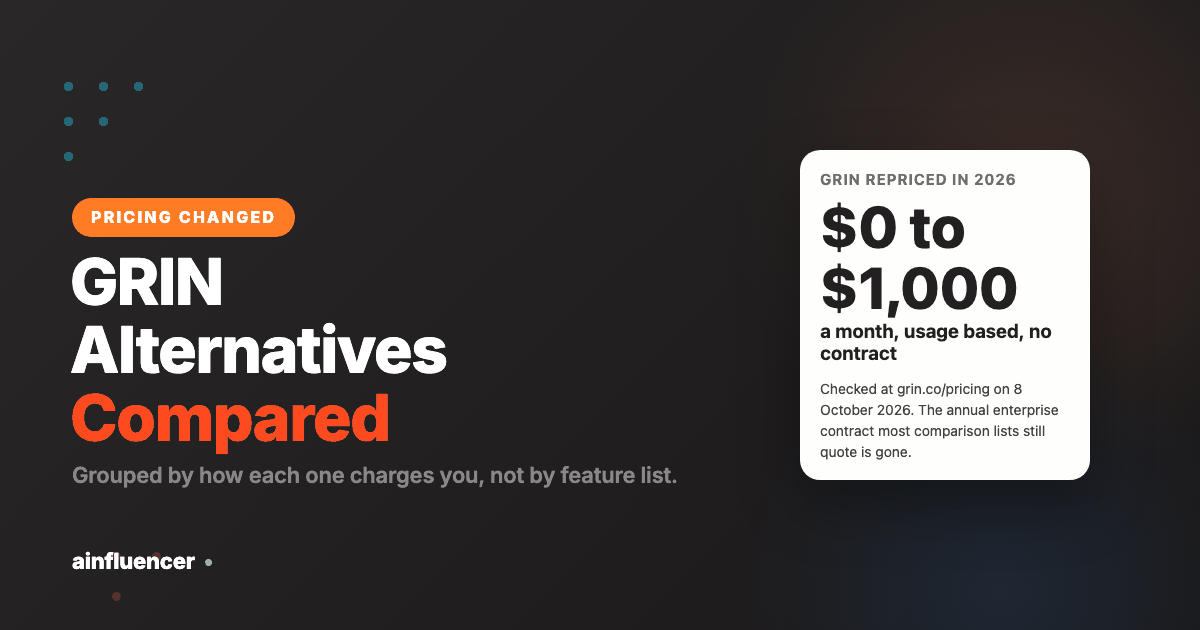
Almost every GRIN alternatives article you will read today is comparing against a price GRIN no longer charges. The annual enterprise contract is gone. GRIN now sells usage-based credits, month to month, self serve, with a genuinely free tier, and that changes which alternatives are actually cheaper.
So this guide starts with what GRIN costs today, checked against grin.co/pricing on 8 October 2026, and then groups the alternatives by how they charge you, because that is the decision you are really making.
GRIN’s 2026 Pricing, Read From the Source
| Plan | Price | Included monthly credits | Cost per bundled credit |
|---|---|---|---|
| Free | $0 a month | 50 | No additional credits can be bought |
| Starter | $200 a month | 2,000 | $0.100 |
| Growth | $500 a month | 7,500 | $0.067 |
| Scale | $1,000 a month | 20,000 | $0.050 |
Four things on that page matter more than the headline prices. It is not priced per seat, and the CRM is unlimited with no per contact billing. Every new account gets a 30 day trial of Starter. Migration from a CSV, a competitor platform or GRIN Classic is free and does not consume credits. And there is no required sales call, which is the single biggest change from the GRIN described in older comparisons.
If you have been quoted $399, $699, $1,149 or $1,799 a month by a comparison site, or told that Complete costs $1,500, none of those tiers appear on the live pricing page. Check the source before you budget against them. Our GRIN review covers the feature set itself.
Why Credits Change the Comparison
A credit is not a seat and it is not a creator. Credits meter the work done by Gia, GRIN’s AI agent, plus a few other operations. That has three consequences a feature table will never show you.
| The detail | Why it matters when you compare |
|---|---|
| Included credits do not roll over. They reset each billing cycle | A seasonal programme pays for capacity it does not use in the quiet months, which is the exact problem a subscription was supposed to solve |
| Creating an affiliate commission payable uses credits | Your affiliate programme has a running meter on it. Paying more creators costs more in platform credits, not only in commission |
| Heavy work costs more per creator. Personas, reporting, gifting workflows and campaign setup are the expensive operations | A small roster you work closely with can burn credits faster than a large roster on simple affiliate links |
| Viewing, filtering, configuration and messages you type yourself are free | If your team wants to do the work rather than supervise an agent, you are paying for automation you will not use |
| Purchased credits do roll over, included ones do not | Topping up is less wasteful than upgrading a tier, which is the opposite of how most software pricing behaves |
Estimate Your Bill Before You Shop
Do this before looking at a single alternative, because most people comparing GRIN are comparing against a number they guessed.
- Count the operations, not the creators. How many creators will Gia find, score, message and report on in a month? That is your credit draw
- Count your commission payables. Every payout you create is a metered event, so a 60 affiliate programme paid monthly is 60 events
- Decide how much the AI does. Supervising an agent and doing the work yourself land on completely different tiers
- Use the 30 day Starter trial to measure it. One real month of your own activity beats any estimate, and it costs nothing
Only once you have that number can you tell whether an alternative is cheaper. For a lot of small programmes GRIN’s own free tier is the cheapest thing on this page, and saying otherwise would be dishonest.
Alternatives With No Meter at All
The first group removes the subscription entirely. You pay only when a collaboration happens, so a quiet quarter costs nothing and there is no capacity to forecast.
Ainfluencer
A marketplace rather than a management layer, which is the structural difference from GRIN. GRIN assumes you already have creators and gives you a system to run them. Ainfluencer is where you find them, agree terms and pay, with no monthly fee at any volume.
| Plan | Collaboration fee | A $2,000 month of creator fees costs |
|---|---|---|
| Free | 25% | $2,500 |
| Starter | 20% | $2,400 |
| Pro | 15% | $2,300 |
| Ultimate | 3% | $2,060 |
The minimum collaboration is $10. On supply, the marketplace held 484,107 YouTube creator accounts, 417,694 on Instagram and 181,950 on TikTok when counted in October 2026, and those creators joined by choice, so a message in the platform is not a cold email.
- Pick it over GRIN when: you do not have a roster yet, or your activity is seasonal
- Do not pick it when: you already manage hundreds of creators and need a CRM and workflow engine around them
Collabstr
Pay per piece of content rather than per month. Good for a one off, poor for a continuing programme. Our Collabstr review has the detail.
Alternatives That Meter Something Else
The second group still charges monthly, but the meter is attached to something you can predict more easily than AI operations.
Metered on searches and seats: discovery tools
If what you wanted from GRIN was finding creators, a discovery tool is a fraction of the price and the unit of cost is a search, not an agent task.
- Modash, reported at $299 a month for Essentials and $599 for Performance, with a 14 day trial. Strongest on audience data
- HypeAuditor, about $299 a month for Basic and $499 for Pro on annual billing. Strongest on fraud and authenticity checks
- Heepsy, from around $89 a month with a free tier. The budget option, and tightly limited at the bottom
None of these runs a campaign or moves money, so you will still need somewhere to transact.
Metered on conversions: affiliate platforms
If the part of GRIN you actually used was links, codes and commission, an affiliate platform does that job without the creator management layer, and without charging credits to create a payout.
- Refersion, built around tracking and paying affiliates
- UpPromote and GoAffPro, the two most common Shopify-first choices
- Levanta, if your sales happen on Amazon rather than your own store
The trade-off is real: a commission-only offer asks the creator to fund their own production, which is why strong creators decline them. Pairing a flat fee with a commission is usually what gets a yes, and that needs somewhere to pay the fee.
Alternatives That Still Sell You a Contract
Some teams leave GRIN because they need governance it does not have, which means going back to an annual contract deliberately rather than by default.
- CreatorIQ, the enterprise standard. Procurement data puts the median contract near $37,000 a year, so budget accordingly. We compare the options in CreatorIQ alternatives
- Aspire, broadly comparable scope at a lower tracked median, around $15,588 a year
- Traackr, measurement and benchmarking led, with third-party estimates of $25,000 to $55,000 a year
- Emplifi, if influencer work belongs inside a wider social suite
What a 50 Creator Programme Costs, Side by Side
A worked comparison, assuming 50 active creators, $2,000 a month paid out in creator fees, and a team that wants discovery plus somewhere to transact. Platform costs only, creator fees excluded except where the fee is the pricing model.
| Option | How it charges | Rough monthly cost | What is missing |
|---|---|---|---|
| GRIN Free | 50 credits a month, no card | $0 | 50 credits is a trial allowance, not a working programme |
| GRIN Starter | 2,000 credits | $200 | Credits do not roll over, and payables consume them |
| GRIN Growth | 7,500 credits, multiple brands | $500 | Likely more capacity than a 50 creator roster needs |
| Ainfluencer | Percentage of each collaboration | $0 subscription, $500 on $2,000 of fees at the free rate | No workflow engine for a large existing roster |
| Modash plus a marketplace | Monthly seat plus a fee | $299 plus the collaboration fee | Two tools to run instead of one |
| Refersion only | Monthly, by order volume | Depends on orders | No discovery, no content workflow |
| CreatorIQ | Annual contract | About $3,000 a month, billed yearly | Nothing. It is the wrong size |
When to Stay on GRIN
Switching costs more than people expect, and GRIN’s 2026 repricing removed the two reasons most teams used to leave. Stay if any of these is true.
- You already have a roster and the relationships are the asset. GRIN is a creator CRM first, and nothing on this page replaces that cheaply
- You left because of the annual contract. That is gone, so the objection no longer applies
- Your programme is affiliate led and the GMV tracking is working
- The free tier covers you. There is no time limit on it and no card is required, so there is no deadline forcing a decision
Leave if the credit meter is unpredictable for how your team works, if you want people rather than an AI agent doing the work, or if you never had a roster to manage in the first place. That last one is the most common, and it means you needed a marketplace, not a management platform. For the wider field, see our guide to influencer marketing platforms.
How much does GRIN cost in 2026?
Checked at grin.co/pricing on 8 October 2026: Free at $0 a month with 50 credits, Starter at $200 with 2,000 credits, Growth at $500 with 7,500 and Scale at $1,000 with 20,000. It is month to month and self serve, with no required sales call. Older comparison sites still quote $399, $699, $1,149 and $1,799 tiers that are not on the page.
Does GRIN have a free plan?
Yes. Free costs nothing, requires no card and has no time limit, with 50 monthly credits. You cannot buy additional credits on it. Every new account also gets a 30 day trial of Starter.
What is a GRIN credit?
A unit that meters work done by Gia, GRIN’s AI agent, plus a few other operations such as creating an affiliate commission payable. Viewing, filtering, configuration, previews and messages you type yourself do not use credits. Included credits reset monthly and do not roll over, while credits you purchase do.
What is the cheapest GRIN alternative?
For a programme without an existing roster, a marketplace with no subscription is cheapest, because you pay a percentage of collaborations rather than a monthly fee. For discovery only, Heepsy starts around $89 a month. GRIN’s own free tier is cheaper than both for very small programmes.
Is GRIN worth it without Shopify?
GRIN’s roots are in ecommerce and its affiliate tooling assumes a store with trackable orders. If you have no store to track GMV against, you are paying for the half of the product you will not use, and a discovery tool plus a marketplace covers the rest for less.
Can I move my creator list out of GRIN?
Export your creator records, contact history and campaign results before closing an account, because the relationships are yours but the records are not portable automatically. GRIN itself offers free migration in the other direction, from a CSV or a competitor platform, which tells you how much the data matters.