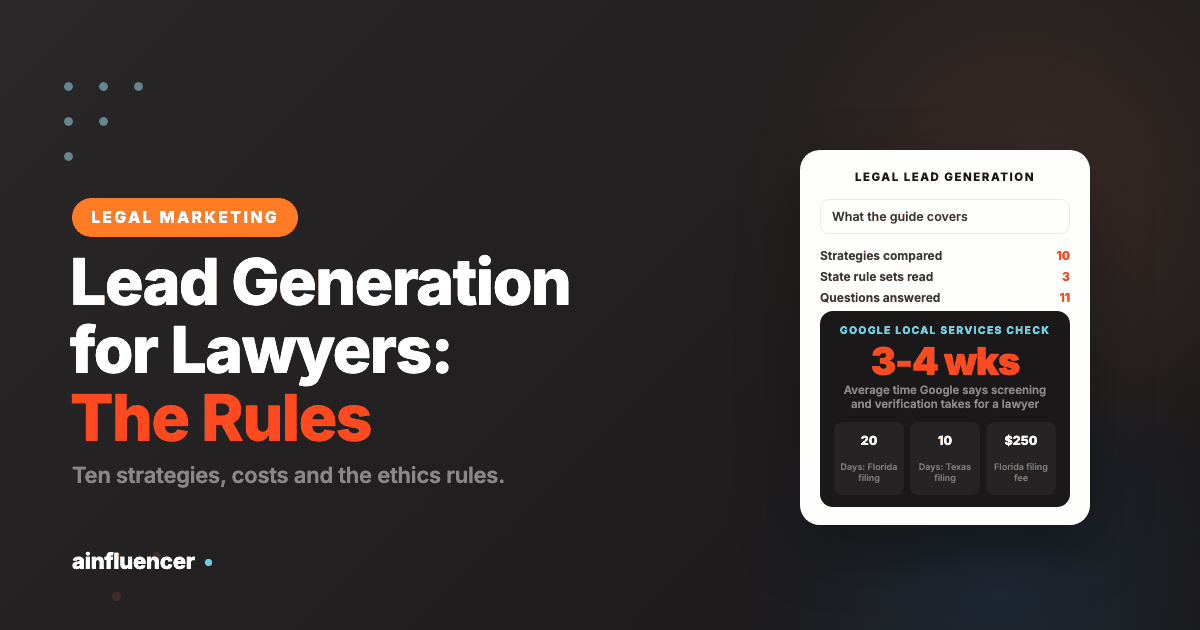
Lead Generation for Lawyers: 10 Strategies, Costs and Ethics Rules
Ten ways to find clients, compared on speed, how each is paid and what the advertising and solicitation rules say, with what to do before you buy a lead.
Most lawyers are good at the law and uneasy about getting the phone to ring, and the usual advice, buy leads, run ads, post on social media, skips the part that can cost you a licence: lawyers are regulated in how they find clients. This guide compares ten ways to generate leads for a law firm, says how each is paid, and sets out what the rules in California, Florida and Texas, the Google help pages and a New York ethics opinion say about each one. Nothing here is legal advice, rules differ by state, and where we could not read a source we say so. One disclosure: Ainfluencer, which publishes this guide, makes contactID, a tool we include for firms that sell to businesses.
What Is Lead Generation for Lawyers?
Lead generation for lawyers is the work of finding people or businesses that need legal help and getting them to contact your firm. A lead is a person who has shown interest, such as calling, filling in a form or replying to a message. A client is a lead who has signed. The gap between the two is where most of the money is lost, so this guide treats intake and measurement as part of lead generation, not an afterthought.
Thomson Reuters’ 2022 State of US Small Law Firms report, which surveyed 400 firms, calls business development the number two challenge small firms face, and says almost 30% planned to increase their marketing and business development budget. It also found the average small firm attorney spends only 56% of their time practicing law. Time is the real cost of every channel below.
The Ethics Rules That Shape Every Channel
Before comparing channels, know the four questions every lawyer has to ask. The table below summarises the text of three state rule sets as read in November 2026. We could not read the American Bar Association’s Model Rules (the ABA site blocked automated access), so nothing is quoted from them, and your state may follow the model rules differently.
| Question | California | Florida | Texas |
|---|---|---|---|
| May I contact a stranger live, by phone or in real time? | No, when a significant motive is pecuniary gain, unless the person is a lawyer or has a family, close personal or prior professional relationship (Rule 7.3(a)) | Solicitation includes in-person, telephone and real-time electronic contact (Rule 4-7.18(a)) | No through in-person, regulated phone, social media or other live or interactive contact, unless the person is a lawyer, a relation, or an experienced user of that type of legal service for business matters (Rule 7.03(b)) |
| What about a written or email message to a specific person? | Allowed, but it must carry the word “Advertisement” at the beginning and end of an electronic message unless an exception applies (Rule 7.3(c)) | Email subject line must begin with “Advertisement”, with a statement of the lawyer’s background, training and experience (Rule 4-7.18(b)) | Must be plainly marked “ADVERTISEMENT” unless the target is a lawyer, a relation or an experienced business user of the service (Rule 7.03(d)(2)) |
| Do I have to file it with the bar? | Not stated in the rule text we read | Yes, at least 20 days before first use, with a $250 fee on the Bar’s coversheet and a $750 late fee (Rules 4-7.19 and the coversheet) | Yes, within 10 days after a solicitation communication is sent (Rule 7.04(a)) |
| May I pay someone for referrals or leads? | Not for recommending you, except the reasonable cost of advertising and the usual charges of a legal services plan or qualified referral service (Rule 7.2(b)) | Not for recommending you, except the cost of advertising and the usual charges of a referral service, directory or qualifying provider (Rule 4-7.17(b)) | Not to a non-lawyer for soliciting or referring clients, except reasonable advertising fees and a lawful referral service (Rule 7.03(e)) |
| What must my advertising include or avoid? | The name and address of a responsible lawyer or firm (Rule 7.2(c)); nothing false or misleading, and a guarantee of results is misleading (Rule 7.1) | Varies by rule, with filing and disclosure duties | Varies by rule, with filing duties and exemptions for website content |
Three points matter across all of them. A website, a billboard or an internet banner is general public communication, which California says is not solicitation. A targeted message to a specific person is different, and every state we read treats it as something to label, and sometimes file. And a person who says they do not want to be contacted must not be contacted again (California Rule 7.3(b)). California has a proposed amendment to Rule 7.3 on its 2025 comment list, and the Texas text we read is the 2022 edition, so check the current version for your state.
What to Look For in a Lead Generation Channel
Cost per signed client
Cost per lead is a vanity number until you divide spend by clients who signed. A cheap lead that never answers the phone costs more than an expensive one that retains.
Speed to first lead
Search and maps work in months, paid channels work in weeks, referrals take a year to compound. Match the speed to your cash position.
Ethics fit
A channel that needs a label, a filing or a licence check is not worse, but it must be planned for. Know the rule before you spend.
Intake load
Every lead has to be answered fast and screened. A channel that floods the phone with poor-fit calls can lose you the good ones.
The 10 Best Lead Generation Strategies for Lawyers
Strategies 1 to 6 bring in people who are already looking for a lawyer, 7 is about buying leads, and 8 to 10 are about relationships and outreach. Each card says how the channel is paid and what to check in the rules.
Google Business Profile and Local SEO
A Google Business Profile with correct practice areas, hours, photos and reviews is how a firm appears on the map when someone searches near them. It is also a requirement for the paid option below: Google says Local Services advertisers must have a public and verified Business Profile.
Ethics check: A profile is general public communication, but Rule 7.1 still applies: nothing false or misleading, including in reviews you respond to or posts you publish.
- Complete every field, including practice areas and service area
- Keep name, address and phone identical on your website and listings
- Ask every happy client for an honest review and respond to all of them
- Add photos of the office and attorneys
- No ad spend, and it supports every other channel
- Reviews and map visibility compound over time
- Prospects can call or message in one tap
- Slow to build, and rankings depend on competitors and reviews
- You cannot buy a position
- A neglected profile with old information hurts you
Google Local Services Ads
Local Services Ads put a firm at the top of results with a badge, and you pay for each valid lead instead of each click. Google has replaced the Google Screened badge with a single Google Verified badge, and lawyers must pass verification, which Google says takes 3 to 4 weeks on average. For a personal injury lawyer that includes identity verification, professional liability insurance where required and a state bar licence check for each lawyer in the firm.
Google says you are charged for each valid lead, and the price varies by location, job type, lead type and bidding mode. It publishes no dollar figure, and a charged lead is reassessed over time and may be credited automatically if judged low quality. Serious or repeated negative customer feedback can lower your ranking or stop the ad appearing.
Ethics check: The ad is advertising, so the name-and-address, no-guarantee and false-or-misleading rules apply, and in Florida an advertisement may need filing with the Bar at least 20 days before first use unless an exemption applies.
- Pay per valid lead, with a weekly budget you set
- Verification and a licence check build trust on the page
- Leads arrive as calls or messages, so intake speed decides the result
- Automatic credits for leads judged low quality
- Fast, with calls in weeks once verified
- You pay only when a valid lead arrives
- The badge signals that Google checked your licence
- Verification takes weeks and varies by practice area
- Price per lead is not published and varies by market
- Reviews strongly affect whether you show
Practice-Area Website and SEO Content
A page for each practice area and city, written to answer the questions a client actually asks, is the foundation of search visibility. Pages that explain the process, costs, timelines and what to bring to a first call convert better than pages that only list services.
Ethics check: California treats a website as general public communication, not solicitation. Florida exempts information on a lawyer’s website from its advertisement filing, and Texas exempts website links and information except the homepage. Rule 7.1 still applies to every claim.
- One page per practice area and location
- Plain answers to common questions, with a clear next step
- Fast, mobile-friendly pages
- Attorney bios and licence details
- Brings in people already searching for help
- Content keeps working without ad spend
- Website content is generally the lowest-friction form of advertising
- Months before it pays back
- Quality content takes real expertise
- Results depend on competition in your area
Reviews and Reputation
People choosing a lawyer compare reviews before they call. A steady flow of honest reviews improves map visibility, and for paid local ads Google says negative feedback can lower your ranking or stop the ad appearing. Ask at the moment a client is happy, make it one click, and answer every review, good or bad.
Ethics check: Do not offer something of value for a review and do not post or encourage false ones. A guarantee of results is misleading under California Rule 7.1, and rules on client testimonials differ by state, so check yours.
- A direct review link sent after a good outcome
- A reply to every review, written without revealing client confidences
- Reviews on the profile where clients actually look
- A routine, so asking is part of closing a matter
- Cheap and compounding
- Improves conversion on every other channel
- Helps local rankings
- Slow to build from zero
- You cannot control what is written
- Confidentiality limits how you reply
Google Ads and Paid Search
Paid search puts an ad above the results for a search like “dui lawyer near me”. You pay when someone clicks, so results depend on your landing page, your intake and the competition. It is fast to start and easy to overspend without tracking.
Ethics check: Paying for advertising is permitted: California Rule 7.2(b) allows a lawyer to pay the reasonable costs of advertisements, and Florida Rule 4-7.17(b) says the same. California Rule 7.2(c) requires the name and address of a responsible lawyer or firm. In Florida, advertisements may need filing 20 days before first use unless exempt.
- Keyword and location targeting
- A dedicated landing page for each practice area
- Call tracking so you know which ads produce signed clients
- A weekly review of search terms to remove poor fits
- Fast, with traffic the day you launch
- Easy to scale up or pause
- You can measure cost per lead precisely
- Costs can rise with competition
- Clicks are not clients, so tracking matters
- Needs a landing page and intake that convert
Email Newsletters and Staying in Touch
Most firms already have the best list there is: past clients, current clients and the people who refer to them. A short regular email keeps the firm in mind when someone they know needs help. This is the lowest-risk form of outbound, because the recipients already know you.
Ethics check: A message to a person with a prior professional relationship is treated differently: California Rule 7.3(c) and Texas Rule 7.03(d)(2) both exempt such recipients from the “Advertisement” labelling. Email law such as CAN-SPAM still applies to commercial messages.
- A simple monthly note with one useful point
- An unsubscribe link in every message
- Segments for past clients, referral sources and prospects who consented
- A reply address that a person reads
- Cheap, and the audience already knows you
- Builds referrals and repeat work
- Easy to measure with replies and consultations
- Takes consistent effort
- Only works if you have a list you may email
- Not a source of strangers
Buying Leads and Lead Services
Lead services sell contact details of people who asked for legal help on a website or in a directory. Whether you may buy them depends on your state and on how the service works. New York State Bar Opinion 1131 (2017) says a lawyer may pay a for-profit lead service if the lawyer is chosen by transparent, mechanical methods that do not purport to analyse the client’s problem, the service does not recommend any lawyer and its website complies with Rule 7.1.
Florida goes further. A seller of leads is a “qualifying provider” with conditions to meet, and the lawyer must report participation to the Florida Bar within 15 days and do due diligence on the provider’s compliance. A lawyer who does not may be responsible for the provider’s breach.
Ethics check: Do not pay a person for recommending you, and do not share fees with a non-lawyer. Read your state’s rules and any opinion on lead generators before you sign, and keep a record of your due diligence.
- Ask how leads are generated and what the person agreed to
- Ask whether a lead is sent to one lawyer or several
- Ask what happens when a lead is a poor fit
- Keep a record of due diligence, as Florida requires
- Fast, with no content or ad skills needed
- Good for testing a practice area quickly
- Cost per lead is predictable
- Quality varies, and many leads are poor fits or shared with competitors
- Rules differ by state and can put duties on you
- Lowest control over brand and message
Referral Partnerships
Referrals are the most-cited channel in every guide we read and the one with the highest trust. Build them deliberately: accountants, financial advisors, doctors, real estate agents and lawyers in adjacent practices all meet people with legal problems. Send work to them as well, and say thank you, not pay.
Ethics check: A lawyer may not give anything of value to a person for recommending the lawyer: California Rule 7.2(b), Florida Rule 4-7.17(b) and Texas Rule 7.03(e) all say so, with narrow exceptions such as lawyer referral services. Nominal gifts of appreciation are treated differently in Texas, so check before you give one.
- A short list of professionals who meet your ideal client
- Regular, useful contact such as a coffee or a joint event
- Refer work back where it fits
- Track which source sent each signed client
- Highest trust and the best retention
- Compounds as the network grows
- Almost no spend
- Slow, and depends on relationships
- You cannot pay for referrals
- Hard to scale beyond a niche
Social Media, Video and LinkedIn
Public posts and short videos that explain a rule or a common mistake build recognition with the people who later search for a lawyer. LinkedIn suits business-facing work, while video suits consumer practices. It rarely produces a signed client in a day, so treat it as a way to be remembered.
Ethics check: A public post is general public communication. Texas bars solicitation through regulated social media or other live or interactive contact with a non-client, and Florida’s Bar lists a targeted social media ad aimed at someone known to have a specific legal matter as a filing item. Do not message a stranger about their legal problem.
- A consistent format, such as one question answered per week
- A profile that says who you serve and where
- Comments on other people’s posts that add value
- A clear call to action in the profile
- Builds authority and recognition
- Helps referral partners remember you
- Content can be reused on the website
- Slow and hard to attribute
- Needs consistent effort
- Direct messaging to strangers is risky under the rules
contactID: Contact Form Outreach to Businesses
contactID is our Chrome extension for sending a message through the contact form on a company’s own website. For a firm that serves businesses, such as corporate, employment, IP or regulatory counsel, it can start conversations with companies you choose without building an email list. It finds the form on each site, fills it, solves the CAPTCHA, submits it and marks a site Sent only after a confirmation. You pay $0.15 per confirmed website pay as you go, or from $29.99 a month, and a failed send costs nothing. Find websites builds a list from Google Maps listings in 20 countries. Our contactID page has the details.
Ethics check: A written message addressed to a specific company that offers legal services can be a solicitation. California defines solicitation as a targeted communication directed to a specific person that offers legal services, and requires the word “Advertisement” on electronic communications unless an exception applies. Florida requires an “Advertisement” subject line and a filing 20 days before first use, which a form message cannot meet, and Texas requires a label and a filing within 10 days unless the recipient is an experienced user of the service for business matters. Check your state first, and do not use this to contact individuals about a personal legal matter.
- Messages go through each company’s own contact form
- A line written for each website with AI placeholders, optional and paid separately
- A status per site, with failures free
- A/B testing and analytics, and a record of every field sent
- Reaches companies with no findable email address
- No sending domain or warm-up
- Pay only for confirmed sends
- Written solicitation rules may require labelling and filing
- Only suits business buyers, not individuals
- Runs in your own Chrome browser and stops when it closes
Our guide to contact form marketing explains the channel and its legal question in depth, and the best AI contact form automation tools compares ten options.
Lead Generation Strategies for Lawyers Compared
| Strategy | Speed | How it is paid | Rules to check | Best for |
|---|---|---|---|---|
| Google Business Profile and local SEO | Months | Free | Rule 7.1 | Every local firm |
| Google Local Services Ads | Weeks after verification | Per valid lead | Name and address, filing in Florida | Consumer practices |
| Website and SEO content | Months | Time or agency fee | Website exemptions, Rule 7.1 | Long-term growth |
| Reviews and reputation | Ongoing | Free | Rule 7.1, testimonials | Every firm |
| Google Ads | Days | Per click | Name and address, filing in Florida | Fast-converting practices |
| Email to existing contacts | Weeks | Low | Prior-relationship exemptions | Firms with a base |
| Buying leads | Days | Per lead | Referral fee rules, Opinion 1131 | Permissive states |
| Referral partnerships | Months | Time | No payment for recommendations | Niche firms |
| Social, video and LinkedIn | Months | Free or paid | Social media solicitation limits | Business-facing firms |
| contactID contact form outreach | Days | Per confirmed send | Written solicitation label and filing | Firms selling to companies |
Which Strategy Fits Which Practice Area?
This table is our reading, not a measured result. Test small before you commit budget.
| Practice area | Channels to lean on | Watch out for |
|---|---|---|
| Personal injury and DUI defence | Local Services Ads, Google Ads, Business Profile, reviews | Waiting periods after an accident or disaster: Florida bars written solicitation within 30 days unless the person asks |
| Family and criminal defence | Local search, reviews, content, Local Services Ads | Confidentiality when replying to reviews |
| Estate planning and immigration | Content, referral partners, reviews | Misleading claims about outcomes |
| Corporate, employment and IP | Referrals, content, LinkedIn, outreach to businesses | Written solicitation labelling and filing |
| Solo and small firms starting out | Business Profile, reviews, referrals, one paid channel | Spreading a small budget across too many channels |
Buying Legal Leads: What to Check Before You Pay
Searches such as “buy lawyer leads” and “free legal leads” show how many firms want a shortcut. Some are legitimate and some are traps. Before you pay a lead vendor, check these points in order.
Check your state’s rule on lead services
Opinion 1131 in New York allows paying a for-profit lead service under conditions. Florida treats lead sellers as qualifying providers with reporting and due diligence duties. Other states differ, and some bar associations have opinions of their own.
Ask how the lead was created
What did the person see and agree to? Did they ask to be contacted by a lawyer? A lead from a form that promised a call is different from a scraped contact.
Ask whether leads are shared
A lead sent to several firms is a race. Ask how many firms receive each one and whether you can set practice area, geography and case type filters.
Start with a small paid test
Spend a small budget, answer every lead fast and record how many reach a consultation and how many sign.
Judge by cost per signed client
A cheap lead that never signs is expensive. Divide total spend by signed clients, and drop vendors whose number is worse than your other channels.
Keep your due diligence on file
Write down what you asked, what you were told and what you decided. In Florida this record protects you if the provider breaks a rule.
Intake: The Step That Decides Whether Leads Become Clients
Leads that wait go cold. Clio’s 2025 Legal Trends Report, in a teaser the State Bar of Texas republished, says half of future clients have already asked AI for legal help before contacting a lawyer, which means they arrive with questions and options. We could not read the full report, so we use no response-time figures from it.
- Answer fast. Decide who answers, including after hours, and how quickly a missed call gets a call back. Google counts a lead as valid when you answer or when a missed call stays on the line more than 20 seconds, so a missed call is still a charged lead.
- Screen with the same short questions every time. Practice area, location, urgency, and whether the matter fits your firm.
- Tell poor fits no, politely, and refer them elsewhere. It protects your reputation and your reviews.
- Record the source of every lead at intake, so cost per signed client is a real number.
How to Measure Lead Generation for a Law Firm
Four numbers tell you whether a channel pays. Track them per channel, not in total.
| Metric | How to calculate it | Why it matters |
|---|---|---|
| Cost per lead | Spend divided by leads | A starting point only |
| Lead to consultation | Consultations divided by leads | Shows lead quality and intake speed |
| Consultation to signed client | Signed clients divided by consultations | Shows how well you convert |
| Cost per signed client | Spend divided by signed clients | The number that decides whether to keep the channel |
An illustration with made-up numbers: if a channel costs $2,000 a month and brings 40 leads, cost per lead is $50. If 10 become consultations and 3 sign, the cost per signed client is about $667, and a channel that costs $100 per lead but signs 1 in 5 consultations could be cheaper. The comparison only works if you record the source of every lead.
A 30-Day Plan for a Firm Starting From Little
Week 1: fix the base
Claim and complete your Google Business Profile, make sure the website has a page for each practice area and a clear way to call or message, and set up call tracking.
Week 2: start reviews and referrals
Ask every recent happy client for a review and list ten professionals who meet your ideal client.
Week 3: choose one fast channel
Pick Local Services Ads or Google Ads, check your state’s advertising and filing rules, and set a small test budget.
Week 4: fix intake and measure
Decide who answers and how fast, record the source of every lead and review cost per signed client at the end of the month.
Conclusion: Which Lead Generation Strategy Should You Choose?
Consumer practice, starting out
Complete your Business Profile, collect reviews and test Local Services Ads with a small budget, after checking your state’s rules.
Business-facing firm
Build referral partnerships and content, use LinkedIn for visibility, and consider contactID for outreach to companies once you have read your state’s rules on written solicitation.
Established firm
Track cost per signed client by channel, move spend to what signs clients and keep the referral base warm with regular contact.
“The best lead generation channel is the one that signs clients at a cost you can measure and a rule you have read.”
Frequently Asked Questions
What is lead generation for lawyers?
It is the work of finding people or businesses that need legal help and getting them to contact your firm, then turning them into signed clients. Channels include search, maps, paid ads, referrals, reviews, content and outreach.
How do lawyers get clients?
Mostly through referrals, search and maps, reviews, paid ads and relationships, with the mix depending on the practice. Consumer practices lean on search and local ads, while business-facing practices lean on referrals and reputation.
Can lawyers pay for leads?
It depends on the state. New York State Bar Opinion 1131 allows paying a for-profit lead service under conditions. Florida treats lead sellers as qualifying providers and puts duties on the lawyer. California, Florida and Texas all forbid paying a person to recommend you, with narrow exceptions. Read your own state’s rules.
Can a lawyer send cold emails or contact form messages?
A written message to a specific person that offers legal services can be a solicitation. California requires the word “Advertisement” on electronic solicitations unless an exception applies, Florida requires an “Advertisement” subject line and a filing before first use, and Texas requires a label and a filing unless the recipient is an experienced business user of the service. Check your state and take advice.
What are Google Local Services Ads for lawyers?
They are ads at the top of results where you pay for each valid lead. Google replaced the Google Screened badge with a Google Verified badge, and lawyers must pass screening that Google says takes 3 to 4 weeks on average, including a state bar licence check for each lawyer in a personal injury firm.
How much does lawyer lead generation cost?
It depends on the channel and the market, and we found no reliable independent figure, so be careful with any number quoted without a source. Google says Local Services Ads lead prices vary by location, job type, lead type and bidding mode. Track cost per signed client to compare channels.
What is the best lead generation strategy for a small law firm?
Start with a complete Google Business Profile, a steady flow of honest reviews and a few referral partners, then add one paid channel to test. Measure cost per signed client before adding another.
How can I get free legal leads?
A complete Business Profile, reviews, useful website content, referral relationships and staying in touch with past clients all cost little or nothing but time. They are slower than paid channels and they compound.
How do I filter lead quality?
Ask the same short screening questions every time, record the source of each lead, and compare lead to consultation and consultation to signed client by channel. A source that sends many calls and no clients is the one to cut.
How do I generate DUI or personal injury leads?
These clients search at the moment of need, so local search, reviews, Local Services Ads and Google Ads work best, and fast intake matters most. Florida bars written solicitation about an accident for 30 days unless the person asked, so check your state’s waiting period.
Do I need to file my advertising with the bar?
In some states, yes. Florida requires most advertisements to be filed at least 20 days before first use, with exemptions such as website content, and Texas requires filing within 10 days after a solicitation communication. California’s rule text we read has no filing duty. Check your own state.
Key Takeaways
- Lawyers are regulated in how they find clients, so check your state’s rules on advertising, solicitation and paying for referrals before you spend.
- A website and a profile are general public communication, while a message to a specific person may need a label and a filing.
- You may not pay a person to recommend you, with narrow exceptions, and lead services are governed by state rules and opinions.
- Pair one fast channel, such as Local Services Ads, with slow ones that compound: reviews, content and referrals.
- Judge every channel by cost per signed client, and record the source of every lead.
- contactID suits firms that sell to companies, after you have read your state’s rule on written solicitation.