Social Snowball Review 2026: Pricing, and the Rating Split That Decides It
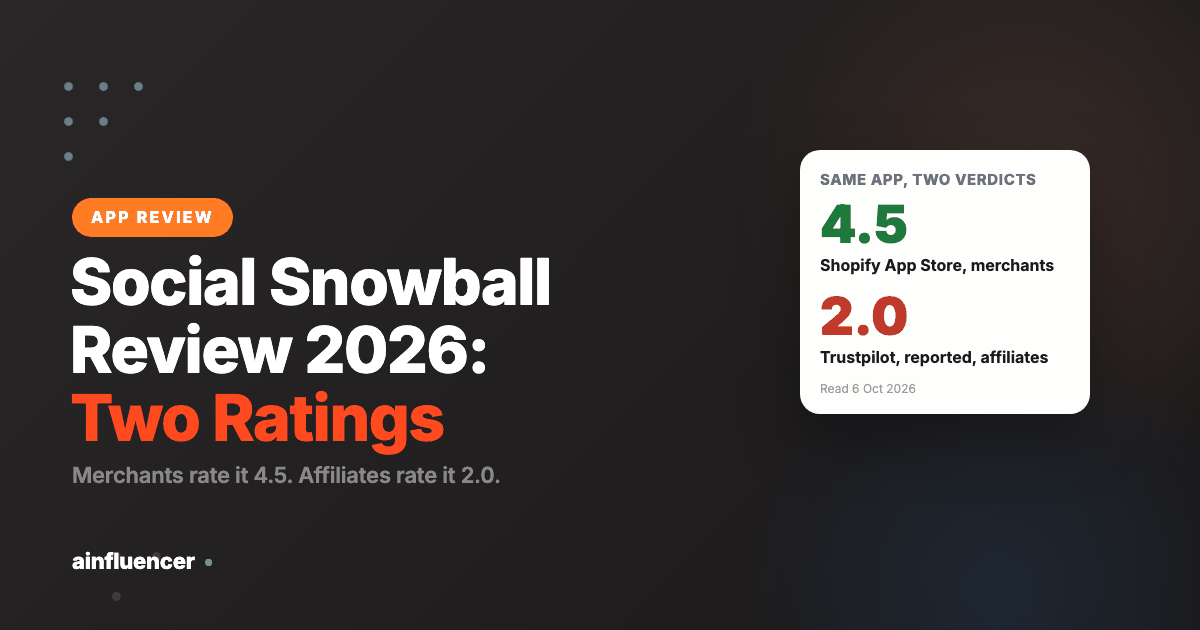
Social Snowball has the most interesting review profile of any app in this category, and it is not a compliment or an insult. It holds 4.5 out of 5 on the Shopify App Store and a reported 2.0 on Trustpilot. Both are real. They measure two different groups of people who sit on opposite ends of the same transaction.
Working out which group you are in answers almost everything else about whether this app is right for you.
Rating and entry price read from the Shopify App Store listing on 6 October 2026. Trustpilot figures are as reported; that site serves an anti-bot challenge and we did not attempt to get past it.
What Social Snowball is built to do
One idea, executed well: every customer becomes an affiliate automatically the moment they buy. No application form, no approval queue, no onboarding email they ignore. They complete a purchase and a personal discount code and tracking link are waiting for them.
Everything else follows from that. Instant payouts exist because you will have thousands of tiny balances rather than a dozen large ones. Coupon-leak protection exists because handing a code to every customer is exactly how codes end up on voucher sites. The app is an answer to one specific question: how do you run a referral programme at customer scale without hiring somebody to administer it.
It is Shopify only, and the model assumes a consumer brand with repeat purchases and a customer base that would plausibly recommend you.
The rating split, and what it measures
Social Snowball, two audiences, two verdicts
Shopify App Store, 4.5 of 5 90% Trustpilot, reported 2.0 of 5 40%
Bar length is each score as a share of 5. The Shopify figure is 4.5 from 211 reviews, read first hand on 6 October 2026. The Trustpilot figure is reported at 2.0 and is attributed rather than verified. The two are not in conflict: Shopify reviews are written by the merchants who install and pay for the app, and Trustpilot reviews are largely written by the affiliates being paid through it.
The merchants are the customers. The affiliates are not. That is the whole explanation. A merchant experiences fast setup, automatic enrolment and responsive support, and rates it 4.5. An affiliate experiences a payout system run by a company that has no contractual relationship with them, and rates it 2.0.
If you are a brand evaluating this app, the 4.5 is the number about your experience. But the 2.0 is a number about your customers’ experience of your programme, and you are the one whose brand is attached to it. That makes it your problem too, which is the part most reviews of this app skip.
Social Snowball pricing
Entry is $249 a month, which the Shopify App Store confirms. The tier structure above that, and the percentage, come from reported figures rather than a public price list.
| Plan | Monthly | Plus | Notes |
|---|---|---|---|
| Snow Day | $249 | Reported 3% of affiliate revenue | The entry tier, confirmed on the app listing |
| Blizzard | Reported $899 | Reported lower or no percentage | Higher limits, reported rather than published |
The 3% is the most cited complaint in its reviews, and the reason is arithmetic rather than principle. At $100,000 of affiliate revenue a year the subscription is $2,988 and the percentage adds $3,000. At $500,000 the subscription is unchanged and the percentage is $15,000. The fee grows precisely as the programme succeeds, which reviewers describe as being charged more for doing better.
That is not automatically unfair, it is how most performance pricing works. It does mean the crossover point matters: somewhere above roughly $150,000 in affiliate revenue, a flat-fee app such as BixGrow at $19.99 a month becomes several thousand dollars a year cheaper for the same job, and the question becomes whether Social Snowball’s automation is worth that difference.
What merchants praise
The positive reviews are specific and they repeat, which is a good sign.
- Setup speed. Reviewers describe getting a working programme live in under an hour, which for this category is genuinely fast.
- The auto-enrolment flow. The feature the app is built around is also the feature people name when asked what they like. That alignment is rarer than it sounds.
- Support responsiveness. Merchant-side support is consistently described as quick and helpful.
Note the shape of that list: it is all about getting started. Across 211 reviews there is much less about what year two looks like, which is worth holding in mind.
What affiliates report, and why it is your problem
The Trustpilot side is dominated by payout disputes rather than by product complaints. The most detailed account we found describes an affiliate with $228 in approved commissions marked ready for payout whose affiliate account was removed before they withdrew, and who was told by Social Snowball support that they could not help because they do not control payouts.
We cannot verify an individual dispute and we are reporting the claim rather than asserting it. The mechanism it describes, though, is checkable and it is structural: the merchant controls the programme, and Social Snowball controls the software. When an affiliate is removed or a commission reversed, the affiliate contacts the company whose logo is on the dashboard, and that company correctly says the decision was not theirs.
It is also reported that Social Snowball has not replied to its negative Trustpilot reviews, which leaves the public record one-sided.
What this means in practice. If you auto-enrol every customer as an affiliate, you have just made thousands of customers into people with a financial claim on you. Decide in advance, in writing, what happens when you deactivate someone with an approved balance, and publish it in your programme terms. The complaints on this app’s Trustpilot page are, in almost every case, a merchant decision that the affiliate had no way to anticipate.
Every recurring complaint, and what to do about it
| Complaint | What reviewers describe | What to do about it |
|---|---|---|
| The 3% on affiliate revenue | The most frequently raised drawback. Reviewers describe it as a cost that scales against them, growing every month the programme improves. | Model your bill at three revenue levels before signing, not one. Above roughly $150,000 a year in affiliate revenue, price a flat-fee app and compare the two totals rather than the two subscriptions. |
| Affiliate payout disputes | Reported accounts of approved commissions becoming unreachable after an account was removed, with support declining to intervene because payouts are merchant-controlled. Reported Trustpilot score of 2.0, with no replies to negative reviews. | Write your deactivation and reversal policy before launch and put it in the affiliate terms. This is the single highest-value thing you can do with this app, and it costs an hour. |
| Depth of programme design | Reviewers note that the focus on simplicity means you lose the ability to go deep. Tiered rewards and multi-level commission structures are where people report hitting a wall. | If your programme needs tiers or levels, this is the wrong tool and no plan fixes it. Look at an app that treats complexity as a feature. |
| Shopify only | No support for other storefronts, and the auto-enrolment model is tied to Shopify’s checkout. | Structural. If a second platform is likely, choose differently now rather than migrating a programme later. |
| Price floor | $249 a month is the entry point, roughly twelve times the cheapest credible app in the category and five times the mid-tier. | Only defensible if auto-enrolment is genuinely the feature you are buying. If you would have recruited affiliates manually anyway, you are paying a large premium for automation you will not use. |
Social Snowball pros and cons
Pros
- Automatic affiliate enrolment at checkout, the best implementation of this idea in the category
- 4.5 out of 5 on the Shopify App Store across 211 reviews
- Setup measured in under an hour, consistently praised
- Instant payouts, including cash and gift cards, in bulk
- Coupon-leak and code-abuse protection built in, which the auto-enrolment model requires
- Attribution for influencer campaigns alongside customer referrals
- Integrations with Klaviyo, TikTok Shop, Instagram and Zapier
- Merchant-side support described as fast and helpful
Cons
- A reported 3% of affiliate revenue on the entry tier, on top of the subscription
- $249 a month entry, the highest floor of the four main Shopify affiliate apps
- A reported 2.0 on Trustpilot, driven by affiliate payout disputes
- Reported to have left negative Trustpilot reviews unanswered
- No tiered rewards or multi-level commission structures
- Shopify only
- Reviews concentrate on setup rather than on long-term operation
Who Social Snowball suits
A good fit if you are a consumer brand on Shopify with repeat purchasers, you want every customer turned into a referrer without administering it, and your affiliate revenue is low enough that 3% is still a small number. The automation is real and nothing else does it this cleanly.
A poor fit if your affiliate revenue is already substantial, where the percentage becomes the dominant cost; if you need tiers or multi-level structures; or if you are not prepared to write and honour a clear affiliate payout policy, because this model creates far more affiliate relationships than a conventional programme and every one of them is a person who can review you.
Social Snowball alternatives
| Tool | Entry | Revenue share | Choose it when |
|---|---|---|---|
| BixGrow | $19.99 | None | You want the same job done at a flat fee, 4.9 from 1,326 reviews |
| UpPromote | $29.99 | 2% | You want the largest review base on Shopify, 4.9 from 3,818 |
| Refersion | $39 | 3% | You want attribution depth and an independent review trail |
| Ainfluencer | Free | None | You want creator campaigns and paid partnerships, not customer referrals |
The verdict
Social Snowball does one thing better than anyone and charges accordingly. If auto-enrolment is the problem you are solving, it is worth the money at small scale and the 4.5 is earned.
Go in with both numbers in mind, not one. The 3% decides whether it stays affordable, and the 2.0 is a warning about what happens on the other side of a programme that turns every customer into a creditor. Neither is a reason to avoid the app. Both are reasons to write your payout policy before you switch it on.
How much does Social Snowball cost?
The Shopify App Store lists it from $249 a month. The entry Snow Day tier is reported to add 3% of affiliate-driven revenue on top, and a Blizzard tier is reported at around $899 a month. There is no public price list beyond the app listing, so the tiers above entry are reported rather than published.
Why is Social Snowball rated 4.5 on Shopify but 2.0 on Trustpilot?
Because the two sites collect reviews from different people. Shopify reviews come from the merchants who install and pay for the app, and they rate setup speed, auto-enrolment and support. Trustpilot reviews come largely from affiliates being paid through it, and they concentrate on payout disputes. Both scores are accurate about their own audience.
Does Social Snowball work outside Shopify?
No. It is a Shopify app and the automatic enrolment model is tied to Shopify’s checkout. If you sell on another platform you need a different tool.
Is the 3% revenue share worth it?
It depends entirely on volume. At $100,000 of affiliate revenue a year it adds about $3,000 to a $2,988 subscription. At $500,000 it adds about $15,000. Above roughly $150,000 a flat-fee app becomes materially cheaper for the same job, so the question is whether the auto-enrolment automation is worth that gap to you.