Stack Influence Review 2026: You Only Pay When Someone Posts
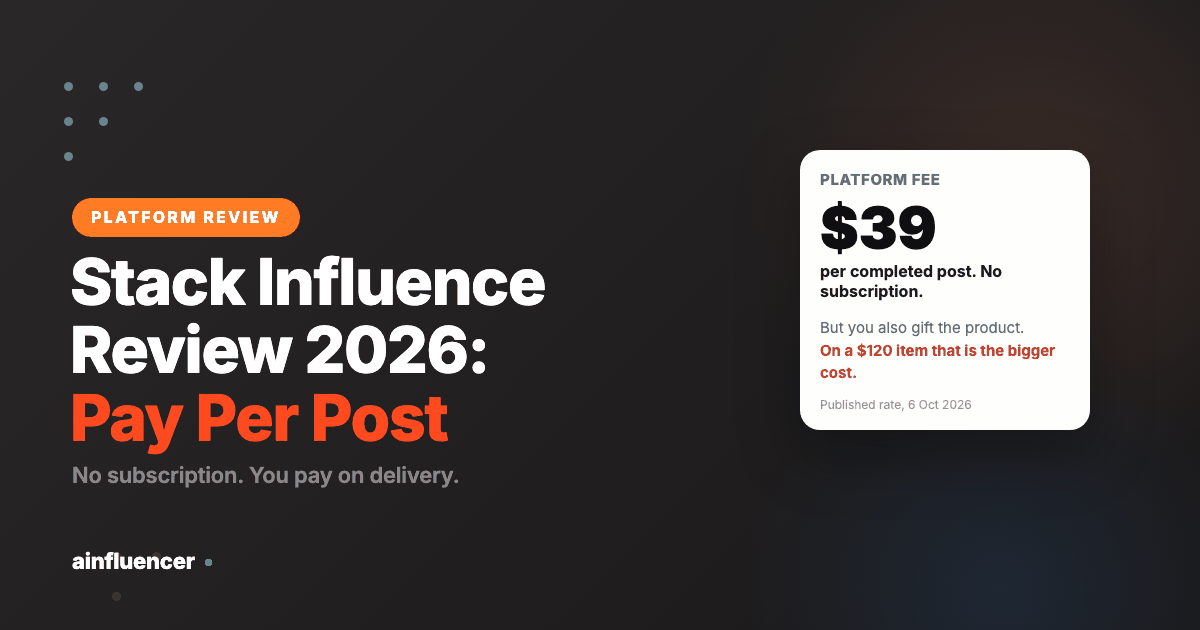
Stack Influence prices itself in a way almost nothing else in influencer marketing does. There is no subscription, no platform fee and no retainer. You pay $39 per completed micro-influencer post, with volume discounts as you scale, and if a creator never posts you are never charged for them.
For an Amazon seller used to paying monthly for a tool whether or not it produces anything, that is a genuinely different proposition. This review is about what that model gets right, and the one thing its marketing blurs.
How the model works
It is gifted-first product seeding, run end to end by the platform rather than by you.
- You set a campaign and a target creator profile.
- Stack Influence sources and vets micro-influencers from its own pool.
- You ship free product to each creator. This is a real cost and it is separate from the $39.
- The creator posts. You are billed for that post, and the platform handles reimbursing the product.
- You receive full-rights UGC: approved images and video you own outright.
There is no per-creator negotiation. That is the main operational saving and the reason the model scales: the thing that makes influencer marketing slow is messaging a hundred people individually, and this removes it.
What a campaign actually costs
The $39 is only part of it. Here is the whole bill for a 100-post campaign at three product price points.
| Your product cost | Posts | Platform fee at $39 | Product cost | Total | Cost per post |
|---|---|---|---|---|---|
| $15 item | 100 | $3,900 | $1,500 | $5,400 | $54 |
| $40 item | 100 | $3,900 | $4,000 | $7,900 | $79 |
| $120 item | 100 | $3,900 | $12,000 | $15,900 | $159 |
Figures use the published $39 rate before volume discounts, and your own cost of goods rather than retail price would lower the product column considerably. The point is the shape: on anything but a cheap product, the gifting is the larger cost.
Where the money goes on a 100 post campaign, by product price
Platform fee held at the published $39 per completed post, product priced at retail. Use your cost of goods instead and the totals drop, which is exactly the calculation to run before committing: a high-margin, low-COGS product makes this model very cheap, and a low-margin expensive one makes it the most costly option on the page.
This is a product-economics decision, not a platform decision. If your cost of goods is low and your margin is healthy, seeding a hundred units is cheap marketing and you get a hundred pieces of owned content out of it. If you sell a $120 item at thin margin, you are giving away $12,000 of stock, and no platform fee comparison matters next to that.
The full-rights UGC, which is the real deliverable
The social posts are what you buy. The content is what you keep.
Full rights means you can reuse the images and video in paid social, on your Amazon listings, in your Brand Store and in A+ content, without going back to negotiate usage. That matters because commissioning UGC directly typically runs from around $100 to several hundred dollars per video, and usage rights are usually the thing that is negotiated separately and costs more.
Judged purely as a content-production channel, a hundred posts at $39 plus product is competitive with dedicated UGC platforms, and you get the social distribution as a bonus rather than the other way round.
The thing its positioning blurs
Social posts are not Amazon sales. Stack Influence’s public positioning moves fairly freely between social UGC, affiliate activity and Amazon revenue attribution, and those are three different things. A micro-influencer posting your product to Instagram produces a post and a piece of content. Whether it produces an Amazon order, and whether you can prove it did, is a separate question the platform does not answer for you.
Two specific limits follow from that, and neither is hidden, they are just easy to miss in the pitch:
- You still do the Amazon work. The assets arrive, but choosing, editing, approving and uploading them to your listings, Brand Store and A+ content is your job.
- Creator Connections does not guarantee placement. Having creator content does not automatically put video on your product detail page.
Go in treating this as a content and awareness channel with measurable output, not as an Amazon revenue channel with measurable attribution. On that basis it is good value. On the other basis you will be disappointed by the reporting.
What to check before committing
| Complaint | What reviewers describe | What to do about it |
|---|---|---|
| Attribution to Amazon sales | The platform produces posts and content. Connecting those to Amazon orders is not something the model solves, and the marketing does not always draw that line clearly. | Set your success measure before you start, and make it content volume and cost per asset, with any sales lift treated as upside. Use Amazon Attribution links if you want a directional read. |
| Product cost is the hidden half | You gift a unit for every post. On a $120 product that is $12,000 across a 100 post campaign, far more than the $3,900 in platform fees. | Model the campaign on cost of goods, not the $39. If your COGS is high this is the most expensive option on this site. |
| You still do the Amazon upload work | Assets are delivered with full rights, but selecting, editing and publishing them to listings, Brand Store and A+ content is on you. | Budget someone’s time for it, or the content sits unused and the campaign produces nothing you can point at. |
| Micro-influencers only | The model is built around a pool of small creators, not named talent. You are buying breadth, not a single high-reach placement. | If you need one recognisable face, this is the wrong tool. If you need a hundred authentic posts, it is the right one. |
| No published review presence we could verify | Unlike the Shopify apps, there is no large independent review base to check this platform against. | Start with the smallest campaign the platform will run. The pay-per-post model makes a small test genuinely cheap, which is its best feature. |
Stack Influence pros and cons
Pros
- No subscription, no platform fee and no retainer, which is rare in this category
- $39 per completed post, with volume discounts as campaigns scale
- You are not charged when a creator fails to post, so non-delivery is their risk not yours
- Full-rights UGC included, reusable on paid social, listings, Brand Store and A+ content
- No per-creator negotiation, which removes the slowest part of influencer outreach
- Sourcing, vetting, coordination and tracking handled end to end
- A small test campaign is genuinely cheap, because there is no fee to commit to
Cons
- You gift a product unit per post, which is usually the larger cost
- Expensive for high cost-of-goods products
- Social posts do not automatically translate into Amazon sales, and attribution is not solved
- You still select, edit and upload the assets to Amazon yourself
- Creator Connections does not guarantee product detail page video placement
- Micro-influencers only, so no single high-reach placement
- Public positioning blurs social UGC, affiliate activity and Amazon revenue
Who Stack Influence suits
A good fit if you sell a physical product with healthy margin and low cost of goods, you need volume content rather than one big name, and you would rather pay for output than for access. The pay-per-post model genuinely transfers delivery risk to the platform.
A poor fit if your product is expensive to give away, or if your objective is attributable Amazon revenue rather than content and awareness. Be honest with yourself about which one you are buying.
Stack Influence alternatives
| Option | Pricing model | Choose it when |
|---|---|---|
| Ainfluencer | Free, campaigns negotiated per deal | You want to negotiate directly with creators and keep gifting optional |
| Billo | Fixed price per video | You want UGC for ads and do not need the social post |
| Levanta | $750/mo plus 3.5% | You want attributable Amazon affiliate revenue, not content |
| JoinBrands | Per video, usage rights included | You want UGC with clear rights at a fixed cost per asset |
The verdict
Stack Influence has the most buyer-friendly pricing model in this category. Paying only for delivered posts removes the thing that makes most influencer platforms risky, which is committing budget before anyone has done anything.
Run the product-cost maths first and decide what you are measuring second. Do both and this is a cheap, low-risk way to produce a hundred pieces of owned content. Skip them and you will have given away a lot of stock for numbers you cannot explain to your finance team.
How much does Stack Influence cost?
$39 per completed micro-influencer post, with volume discounts as you scale and no subscription, platform fee or retainer. You also cover the cost of the product gifted to each creator, which on anything but a cheap item is the larger half of the bill.
Do I pay if an influencer does not post?
No. You are billed only when a post is completed, which is the main advantage of the model: non-delivery is the platform’s problem rather than a cost you have already committed.
Do I own the content?
Yes. Campaigns deliver full-rights UGC, so the approved images and video can be reused in paid social, on your Amazon listings, in your Brand Store and in A+ content without negotiating usage separately.
Will Stack Influence increase my Amazon sales?
It produces social posts and owned content. Connecting those to Amazon orders is a separate problem the platform does not solve, and its positioning does not always make that clear. Treat it as a content and awareness channel with measurable output, and use Amazon Attribution links if you want a directional read on sales.