Tapfiliate Review 2026: Flat Pricing, No Revenue Share, and the Overage Trap
Tapfiliate sells one promise clearly: a flat monthly fee with no success fee and no percentage of your affiliate sales. In a category where most competitors take 2% to 3% off the top, that is a real differentiator and it is the main reason to consider it.
The catch is not in the subscription. It is in the metering underneath it, and specifically in one overage rate that is nearly seven times higher on the expensive plan than on the cheap one. That is what this review is organised around.
Prices, plan limits and overage rates read from the Tapfiliate listing on the Shopify App Store, 6 October 2026. Tapfiliate’s own site blocked both a browser and a direct fetch, so figures come from the listing. The Capterra rating is as reported.
Tapfiliate pricing and what each plan meters
Two published tiers and a custom one. Unlike most of this category, what you are buying is not seats or revenue share, it is volume: clicks and conversions.
| Launch | Scale | |
|---|---|---|
| Monthly | $89 | $179 |
| Affiliates | 50 | Unlimited |
| Clicks a month | 5,000 | 100,000 |
| Conversions a month | 500 | 10,000 |
| Programmes | 1 | Unlimited |
| Team members | 1 | 5 |
| Click overage, per 1,000 | $1.50 | $1.00 |
| Conversion overage, per 1,000 | $1.50 | $10.00 |
| Revenue share | None | None |
Both include a 7 day free trial and more than 30 pre-built integrations.
Conversion overage, cost per 1,000 conversions above your plan limit
From the Shopify App Store listing, read 6 October 2026. Moving up to the more expensive plan multiplies the conversion overage rate by about seven. The Scale plan includes twenty times more conversions, so most merchants never touch it, but anyone who does is charged at the higher rate.
Read that table twice before choosing a plan. Going from Launch to Scale cuts the click overage from $1.50 to $1.00, and raises the conversion overage from $1.50 to $10.00. The higher plan includes twenty times the conversions, so in normal use you will never see it. But if you are the kind of business that has one enormous month, the plan that looks safer is the one that punishes you for it.
The honest framing: this is still cheaper than a revenue share at almost any volume. A 2% fee on $300,000 of affiliate revenue is $6,000. Tapfiliate’s Scale plan is $2,148 a year and you would need 10,000 conversions of overage to add even $100 to that.
What “no revenue share” is actually worth
This is Tapfiliate’s whole argument, so it deserves a number rather than an adjective.
| Affiliate revenue a year | Tapfiliate Scale | Refersion Growth, $199 plus 2% | You keep |
|---|---|---|---|
| $100,000 | $2,148 | $4,388 | $2,240 |
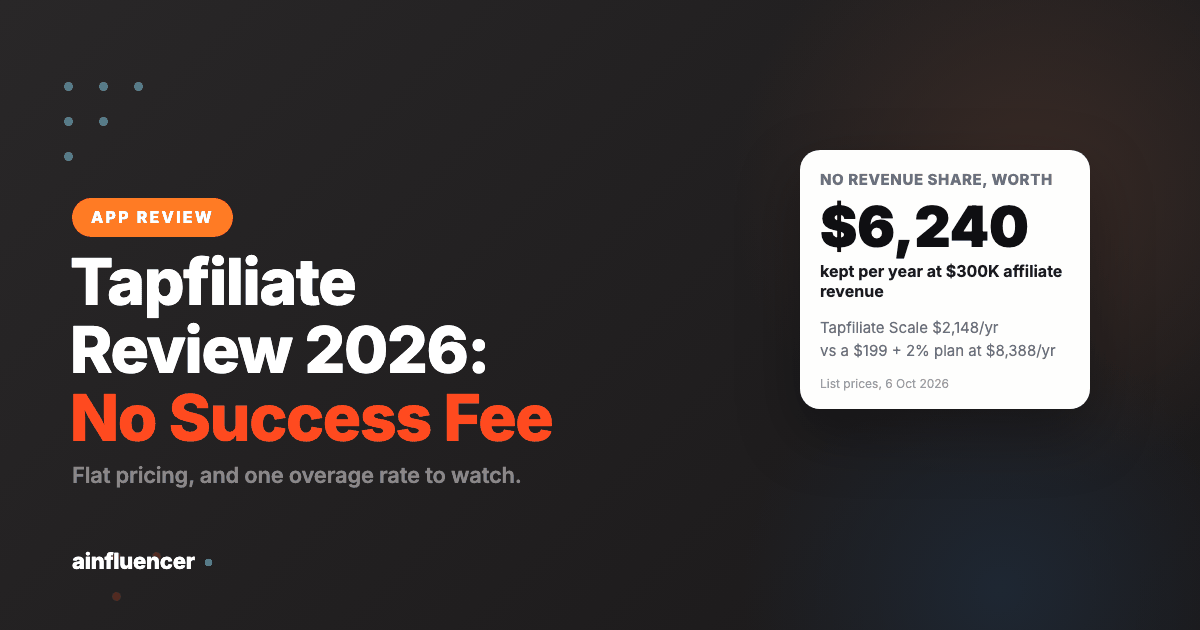
| $300,000 | $2,148 | $8,388 | $6,240 |
| $500,000 | $2,148 | $12,388 | $10,240 |
List prices only, ignoring overage and discounts. The point is the shape rather than the exact figures: Tapfiliate’s line is flat and the alternative’s is not. The more the programme works, the more the flat fee is worth.
That argument weakens at the bottom. At $20,000 of affiliate revenue a year, a 2% fee is $400 and Tapfiliate’s $89 a month is $1,068. Below roughly $60,000 in affiliate revenue, a percentage model is cheaper. Tapfiliate is a tool for programmes that already work, not for testing whether one will.
Where Tapfiliate fits that the Shopify apps do not
The other apps in this category are Shopify apps. Tapfiliate is a platform with a Shopify integration, which is a different thing and the reason to pick it.
It runs on more than 30 pre-built integrations spanning ecommerce and SaaS, and it is built for recurring commissions, which matters if you sell subscriptions rather than one-off products. If your business is a SaaS, or you sell across Shopify and somewhere else, this is the only tool in this comparison that covers you.
The flip side is visible in the numbers: Tapfiliate’s Shopify App Store listing carries a single review, because its customers are not Shopify-first. Its evidence lives on Capterra instead.
What reviewers say
Tapfiliate, as each platform reports it
Read 6 October 2026. The Shopify figure is not evidence of anything at a sample of one, and is shown to make the point: Tapfiliate is not a Shopify-native product and its users do not review it there. Judge it on the Capterra sample.
Praise concentrates on things that are hard to fake: clean tracking, a professional experience for the affiliates themselves, transparent pricing, solid integrations, and setup that does not need a developer. For a tool whose pitch is transparency, it is notable that reviewers list transparency unprompted.
What the negative reviews actually say
| Complaint | What reviewers describe | What to do about it |
|---|---|---|
| Price against what you get | The most common criticism. Reviewers describe pricing that feels high relative to the feature set, and several say they would rather pay 1% to 3% of sales than a monthly fee at all. | That preference is the mirror image of Tapfiliate’s pitch, and it tells you who it is wrong for. Below roughly $60,000 of affiliate revenue a year, those reviewers are arithmetically correct and you should buy a percentage model. |
| No proactive customer success | One reviewer notes there has been no proactive communication or customer success follow-up, concluding that helping customers get results is not a priority. Another describes being disappointed after years of paying without support or return, and being told the fix was a higher tier. | Treat this as self-serve software, not a managed service. If you need someone to help you grow the programme, budget for an agency separately rather than expecting it in the subscription. |
| Dated interface | Described by some reviewers as outdated and not enjoyable to use. A consistent minor theme rather than a dealbreaker. | Use the 7 day trial for your real weekly routine. Interface complaints compound over years. |
| Reporting depth | Reviewers note room for improvement in reporting, which is a common complaint for tools built around tracking rather than analysis. | Check that the reports you need exist before subscribing, particularly if you report to someone else monthly. |
| The Scale conversion overage | Not raised by reviewers, but visible on the price list: $10 per 1,000 conversions on Scale against $1.50 on Launch. | Only bites if you exceed 10,000 conversions a month. Know it is there so a record month does not produce a surprise invoice. |
The pattern is consistent and it is about expectations rather than function. Tapfiliate does what it says, charges a predictable amount for it, and leaves you to run the programme. Reviewers who wanted a partner are disappointed. Reviewers who wanted a tool are not.
Tapfiliate pros and cons
Pros
- No revenue share or success fee at any tier, worth thousands a year on a working programme
- Works well beyond Shopify, with 30+ pre-built integrations across ecommerce and SaaS
- Built for recurring commissions, which suits subscription businesses
- 4.5 out of 5 on Capterra from 66 reviews, with praise for clean tracking
- A professional affiliate-facing experience, which affects partner retention
- Setup that does not require a developer
- Real-time reporting on both plans
- Unlimited affiliates and unlimited programmes from the $179 tier
Cons
- $89 a month entry, more than four times the cheapest Shopify app in this category
- Only 50 affiliates, 5,000 clicks and 500 conversions on the entry plan
- Conversion overage on Scale is $10 per 1,000, nearly seven times the Launch rate
- Reviewers report no proactive customer success or follow-up
- Interface described as dated
- Reporting depth is a recurring criticism
- Effectively no Shopify App Store review base, so evidence is thinner there than for native apps
- Poor value below roughly $60,000 of affiliate revenue a year
Who Tapfiliate suits
A good fit if your affiliate programme already produces meaningful revenue, you sell subscriptions or sell on more than one platform, and you are tired of watching a percentage disappear every time a good month happens. It is the clearest flat-fee, multi-platform option in this comparison.
A poor fit if you are still testing whether affiliate marketing works for you, where a percentage model costs less; if you are Shopify-only, where cheaper and better-reviewed native apps exist; or if you want a vendor who will help you grow the programme rather than host it.
Tapfiliate alternatives
| Tool | Entry | Revenue share | Choose it when |
|---|---|---|---|
| BixGrow | $19.99 | None | You are Shopify-only and want flat pricing far cheaper |
| Refersion | $39 plus 3% | Yes | Your programme is small and a percentage is still cheap |
| PartnerStack | Demo only | Yes | You are B2B SaaS and need partner management, not just tracking |
| Ainfluencer | Free | None | You want paid creator campaigns alongside affiliate links |
The verdict
Tapfiliate is the right answer to a specific question: how do I run affiliate tracking across platforms without paying a tax on success. On a programme doing $300,000 a year it keeps roughly $6,000 that a percentage model would take, and it does so with tracking reviewers trust.
Buy it for that reason or not at all. It will not help you build the programme, the interface will not delight you, and below about $60,000 in affiliate revenue the maths simply favours someone else.
How much does Tapfiliate cost?
Launch is $89 a month and Scale is $179 a month, with a custom Enterprise tier. Both include a 7 day free trial and more than 30 integrations. Tapfiliate takes no percentage of affiliate revenue at any tier, so the subscription plus any volume overage is the whole cost.
Does Tapfiliate charge a commission on sales?
No. There is no revenue share or success fee on any plan, which is its main difference from most competitors. On $300,000 of affiliate revenue a year that is worth roughly $6,000 against a tool charging 2%.
What are Tapfiliate’s plan limits?
Launch includes 50 affiliates, 5,000 clicks and 500 conversions a month with one programme and one team member. Scale includes unlimited affiliates and programmes, 100,000 clicks and 10,000 conversions a month, and five team members. Above those limits you pay overage: on Scale the conversion overage is $10 per 1,000 against $1.50 on Launch.
Is Tapfiliate better than a Shopify affiliate app?
Only if you need what it does differently. If you are Shopify-only, apps such as BixGrow at $19.99 are cheaper and carry far larger review bases. Tapfiliate is the better choice when you sell on more than one platform, sell subscriptions needing recurring commissions, or have enough affiliate revenue that avoiding a percentage fee outweighs the higher subscription.