AI Influencer Agencies: What You Are Really Buying, and Who Sells It
AI influencer agencies sell three different things. Five providers compared on ownership, published pricing from $58K, disclosure and when real creators win.
Search for an AI influencer agency and you will find companies that sell three different things under one name. One builds you a character that your brand owns. One runs dozens of AI-voiced accounts for you. One lends you a character that already has a following. The price, the legal exposure and the result differ more between those three than between any two agencies inside one of them.
So this guide is organised by what you are buying, not by a ranking. Five providers are placed in the right group, with the figures they publish, the ones they do not, and what to ask before you sign. We read each provider’s own public pages on 26 October 2026. None of them paid to be listed, and every number below is the provider’s own claim unless it says otherwise.
The Short Answer
- You want a mascot-style asset you keep for years: a brand-owned virtual influencer. Budget tens of thousands up front and ask who owns the files.
- You want volume of short videos from AI personas: a managed fleet. It is cheap per video, but it is the model with the most disclosure risk.
- You want a famous virtual face for one campaign: license an existing character from a studio.
- You want trust, reviews and sales for a physical product: a real creator, not an AI one. A virtual persona cannot honestly say it tried your product.
Three Products Sold as One
What an “AI influencer agency” can mean
| Brand-owned character | Managed AI account fleet | Licensed existing character | |
|---|---|---|---|
| What you get | A new virtual persona designed for your brand, plus its content | Many AI avatars posting short videos on TikTok, Instagram and YouTube | A famous virtual face in your campaign for a fee |
| Who owns the character | You, if the contract says so | Provider says you do | The studio |
| Cost shape | Large build fee, then monthly management | Monthly, per account | Per campaign |
| Main risk | Uncanny result, build cost sunk if the character flops | Content that reads as human without saying it is AI | Character tied to a studio and its other clients |
| Providers here | Dream Farm, LMG Media | ICG Agency | The Diigitals, and The Clueless as proof of the model |
Brand-Owned Virtual Influencers: Agencies 1 and 2
This is the original idea: you commission a character, you own it, and it becomes a long-lived brand asset instead of a rented face. It is also the most expensive route and the one where a weak brief is hardest to undo.
1. Dream Farm
Dream Farm sells brand-owned virtual and AI influencers from strategy to launch and ongoing management. Its page lays out six stages: a feasibility audit, persona and story, visual design, the technology stack, launch and marketing, and growth. Two details are worth noting. It says the feasibility audit comes first and asks whether a virtual influencer is right for the brand at all, and it says ownership and handover are defined from the start. It also says disclosure and approval rules are set per character, platform and campaign. Its published case is Amaya, a 27-year-old fitness persona launched on Instagram for a San Francisco fitness platform that wanted to grow without traditional ads.
- Best for: brands that want a character and a story, not just posts.
- Pricing: not published. Ask for a build fee and a monthly fee separately.
- Watch for: only one public case study, so ask for results beyond follower count.
2. LMG Media
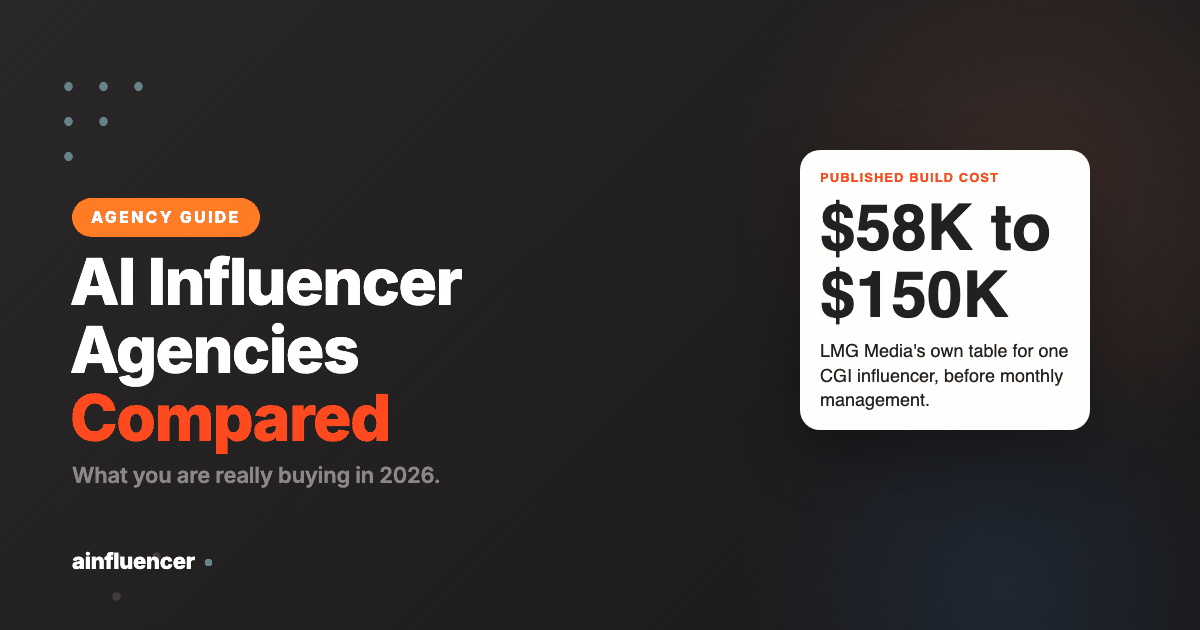
LMG Media creates and manages virtual influencers, covering CGI character design, content production, social media management and brand partnership coordination. It is one of the few providers that publishes a price, and the figures are its own: $15K to $40K for character design, $25K to $60K for 3D modelling, $5K to $15K for personality and backstory, $3K to $10K for social setup and $10K to $25K for an initial library of 20 to 30 posts, for $58K to $150K in total. Treat the market figures on the same page (market size, consumer acceptance, earnings of other influencers) as marketing copy. They are not sourced there and we have not repeated them.
- Best for: brands that want a photoreal CGI character and a quote they can read.
- Pricing: $58K to $150K initial, by its own table. Monthly management is not itemised.
- Watch for: the page compares year one against celebrity posts at $50K each, which is a favourable comparison. Compare against micro-creators too.
Managed Fleets of AI Accounts: Agency 3
3. ICG Agency
ICG Agency runs AI influencer accounts on TikTok, Instagram and YouTube. Its page claims more than 300 active accounts, 60 videos a month per avatar and ownership of the character, accounts and audience for the client, with posting from real phones with dedicated e-sims, one per account. Its sample accounts are mostly AI, tech and business topics, and it publishes no price list.
The pitch to read carefully is that the content is built to be “indistinguishable from human creators”. That is a selling point and also the central compliance question. Under the FTC’s 2023 Endorsement Guides, as summarised by law firms, a virtual influencer is an endorser like any other: a paid post needs a clear disclosure, and a virtual persona cannot claim personal experience of a product. TikTok’s rules also ask creators to label realistic AI-generated people. None of that makes the model unusable, but it means you should settle the disclosure wording in the contract, in writing, before the first video goes live. This is general information, not legal advice.
- Best for: topics where an AI presenter is natural, such as AI news, software and tools.
- Pricing: not published. Its own comparison sets human posts at $5K to $100K+ each, which is its framing, not a quote.
- Watch for: how each account labels itself as AI, and what happens to the accounts if you stop paying.
Licensed Characters That Already Exist: Agencies 4 and 5
4. The Diigitals
The Diigitals is the studio behind Shudu, which it calls the first digital supermodel, and the characters Dagny and Koffi. It develops original AI characters, partners with brands to produce licensed campaign content, and keeps its characters active between campaigns. The difference from the first group is that the character stays the studio’s intellectual property and you license the appearance. That is cheaper to start and gives you a face with an existing audience, but you cannot take it elsewhere.
- Best for: fashion and beauty campaigns that want a recognisable virtual face.
- Pricing: not published.
- Watch for: exclusivity. Ask which competitors the character has worked with.
5. The Clueless and Aitana Lopez (proof of the model, not a booking)
The Clueless, a Barcelona agency, created Aitana Lopez after human influencer projects kept being delayed or cancelled, so it built one it could fully control. Press coverage, including Euronews, reports she can earn up to 10,000 euros a month, with an average nearer 3,000. We could not confirm a public service for outside brands, so it is not listed as an agency to hire. It is useful as the clearest example of the economics: one character, one owner, many sponsors.
The 5 AI Influencer Agencies at a Glance
Comparison, using each provider’s own published claims (26 October 2026)
| Provider | Model | Published price | Ownership claim | Public proof |
|---|---|---|---|---|
| Dream Farm | Brand-owned character | None | Brand owns the character, defined in handover | One case (Amaya) |
| LMG Media | Brand-owned character | $58K to $150K initial | Not stated on the page | Cost table, no named client case on the page |
| ICG Agency | Managed AI accounts | None | Client owns character, accounts, audience | 300+ accounts, live dashboards |
| The Diigitals | Licensed characters | None | Studio keeps the IP | Shudu, Dagny, Koffi |
| The Clueless | Own character (Aitana) | Not applicable | The agency | Press: up to 10,000 euros a month |
What an AI Influencer Costs
Published prices are rare, so use ranges, not a single figure. LMG Media’s $58K to $150K is the most specific number from an agency. A software vendor, Scrile, gives lower bands for a build: roughly $500 to $5,000 for a simple image-based persona, $5,000 to $20,000 for a polished character, and over $20,000 once video, voice and automation are included. Those are vendor estimates, not market prices. They disagree because they describe different scopes, so the first question to any provider is what the quote includes.
Then compare the other side honestly. A real creator is booked per post, with no build cost. Our influencer rates guide shows what that costs by platform and size, and the micro-influencer guide covers the budget tier most small brands should price against first.
Seven Questions to Ask Before You Sign
- Who owns the character files, the model weights and the accounts? Get it in the contract, with a handover list.
- How is every post labelled as AI and as sponsored? Ask for the exact wording per platform.
- What does the quote include? Build, content library, monthly management and revisions are separate lines.
- What happens if you stop? Do accounts and content stay with you, and can you move them?
- Who approves each post, and how fast? A virtual persona still says things on your behalf.
- What proof exists beyond follower counts? Ask for engagement, sales or sign-ups from a named client.
- Which claims will the persona make? A virtual influencer should not say it used your product.
When a Real Creator Is the Better Buy
An AI persona gives you control, consistency and no scandal risk. It does not give you a person who has used the product, which is what a review is. For a physical product, a skincare line, a supplement or anything bought on trust, social proof from real customers and creators usually converts better than a character, and it starts at the price of one product and one post. If you want a brand character as well, test it after you have creator content working, not instead of it.
If you want help running real creator campaigns, read our guides to the best influencer marketing agencies, TikTok influencer marketing agencies and UGC agencies, or hire creators yourself through Ainfluencer, which is free to join. Our guide to finding UGC creators shows how.
Frequently Asked Questions
What is an AI influencer agency?
A company that designs, runs or licenses virtual or AI-generated personas that post on social media and promote brands. The term covers three different services: building a character you own, running many AI accounts for you, and licensing a character the studio already owns.
How much does an AI influencer cost?
It depends on scope. LMG Media publishes $58K to $150K for the initial build of a CGI character. A software vendor estimates $500 to $5,000 for a simple persona and $5,000 to $20,000 for a polished one. These are estimates from providers, so ask what the quote includes.
Do AI influencers have to be disclosed?
A paid post by a virtual influencer still needs a clear sponsorship disclosure, because the FTC’s Endorsement Guides apply to virtual endorsers as well. TikTok also asks creators to label realistic AI-generated content. This is general information, so check your own case with a lawyer.
Who owns an AI influencer?
Whoever the contract says. Some agencies, such as Dream Farm and ICG Agency, say the brand owns the character. Studios that license existing characters, such as The Diigitals, keep the intellectual property. Always get the ownership and handover terms in writing.
Are AI influencers better than real influencers?
They are more controllable and carry no personal-conduct risk, but they cannot honestly claim to have used your product. For reviews and trust-led purchases, real creators usually perform better. Many brands use both.
Can small brands afford an AI influencer?
A custom CGI character is usually a five or six figure project, so most small brands do better booking real micro-creators first. Cheaper AI personas exist, but the content quality and the disclosure obligations still need managing.
How do I find a good AI influencer agency?
Ask for ownership terms, labelling policy, an itemised quote, named client results and what happens if you leave. An agency that answers these clearly is a better sign than a large follower count.