The Best Amazon Affiliate Agencies India Brands Can Hire in 2026
The agencies and managed services that build Amazon affiliate programs for brands selling on amazon.in — compared by focus, local strength, and pricing model.
Selling on amazon.in and wondering who can actually run your affiliate program — recruit the creators, wire up the tracking, and turn external traffic into attributed sales? This guide compares the strongest Amazon affiliate agency options for brands in India, from marketplace-powered managed services to established local specialists.
A quick framing before the list. “Amazon affiliate agency” is a narrower discipline than general affiliate management: attribution runs through Amazon’s own tools, the Brand Referral Bonus reshapes the economics, and the partners that convert best are creators already embedded in Amazon’s ecosystem. Our full guide to the best Amazon affiliate marketing agencies covers the global landscape, and the broader roundup of top affiliate marketing agencies maps the wider industry. This page zooms into what matters for India-based brands and amazon.in sellers specifically.
India combines the world’s fastest-growing creator economy with one of Amazon’s most strategically important marketplaces. The affiliate math is different here — commission rates and order values run lower, but volume and creator reach run enormous — so the agencies that win are the ones built for scale: local Amazon specialists, high-volume affiliate networks, and creator platforms that can activate hundreds of partners rather than a curated dozen.
Why Hire an Amazon Affiliate Agency in India?
Running the program yourself means recruiting partners one outreach message at a time, negotiating every commission, tagging every link, and chasing content that never ships. An agency (or managed service) compresses that into a running system. The payoff is bigger than convenience: consistent external traffic is one of the strongest ranking signals on Amazon, and our playbook on driving external traffic to Amazon shows why listings fed by off-Amazon clicks compound in organic search.
For brand-registered sellers there’s a second payoff: agencies tag external traffic with Amazon Attribution so referred sales qualify for the Amazon Brand Referral Bonus — an average of roughly 10% of driven sales credited back to you, which quietly offsets a large share of what you pay partners. A competent agency treats that bonus as part of the program’s P&L from day one, not a footnote.
How the Amazon Associates Programme Works in India
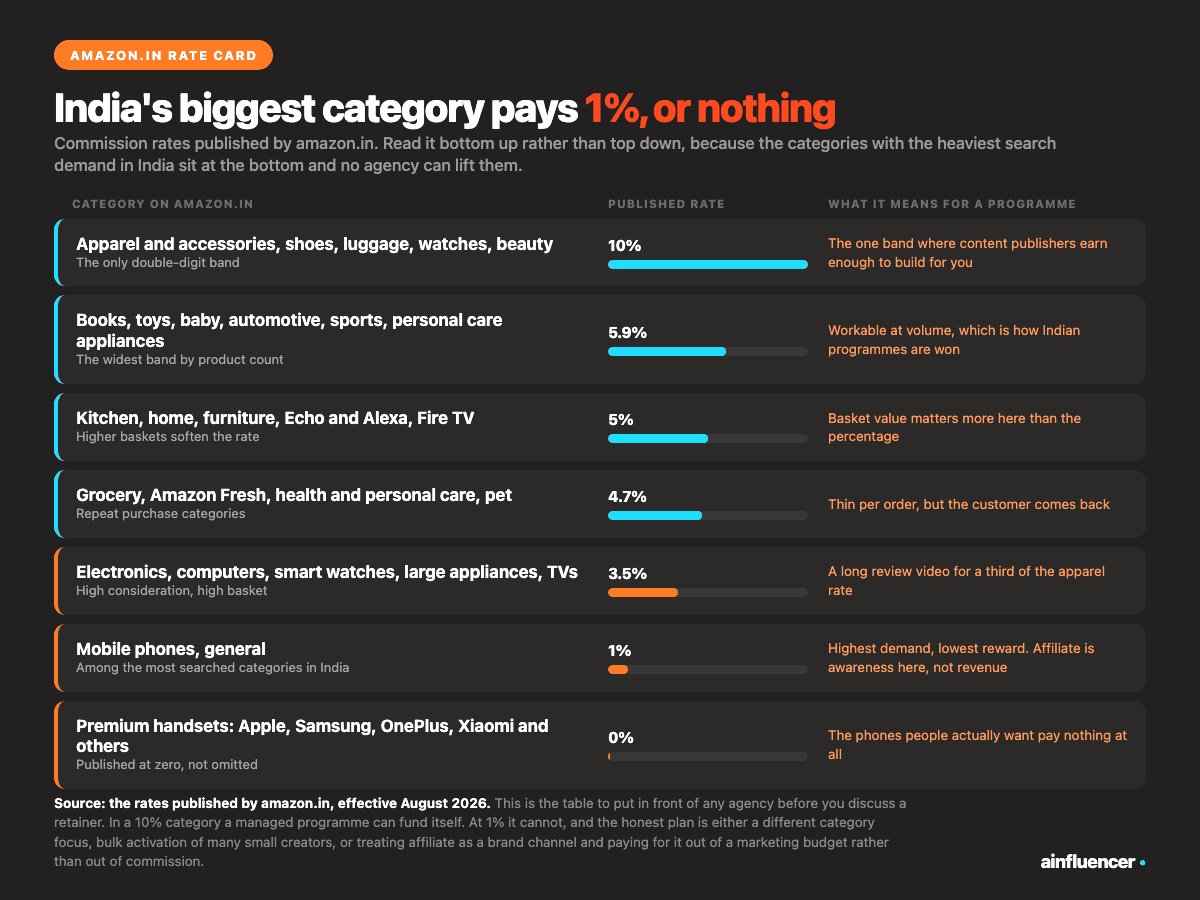
Before hiring anyone, know what the programme pays here, because the Indian rate card is its own thing. Amazon runs a separate Associates programme per marketplace: an account on amazon.com earns nothing on amazon.in, and the categories are priced differently. These are the rates published by amazon.in, effective August 2026.
| Category on amazon.in | Commission |
|---|---|
| Apparel and accessories, shoes, luggage and bags, watches, beauty | 10% |
| Books, toys, baby products, automotive, sports, personal care appliances | 5.9% |
| Kitchen, home, furniture, Echo and Alexa devices, Fire TV devices | 5% |
| Grocery, Amazon Fresh, health and personal care, pet products | 4.7% |
| Mobile accessories | 4% |
| Electronics, personal computers, smart watches, large appliances, televisions, lawn and garden, video games | 3.5% |
| Bicycles and heavy gym equipment, tyres and rims | 2.5% |
| Data storage devices | 2% |
| Mobile phones, general | 1% |
| Premium handsets from Apple, Samsung, OnePlus, Xiaomi and others | 0% |
| All other categories | 5% |
Two things in that table decide most Indian affiliate programmes. Phones, the category with the highest search demand in the market, pay 1% at best and nothing at all on premium handsets, with a handful of mid-range Redmi, OnePlus and Samsung models at 0.5%. And flight bookings, gift cards, gaming consoles, Prime memberships, Kindle eBooks and precious metal coins pay no commission at all, so traffic sent to them is unmonetised however well it converts.
On timing, amazon.in pays approximately 60 days after the end of the month the commission was earned, so January earnings arrive in late March. Plan cash flow two months behind traffic.
If you are a publisher or creator, that is the whole picture, and our guide to Amazon affiliate marketing for beginners covers the rest. If you are a brand that wants hundreds of partners promoting your amazon.in listings, that is what the agencies below do.
All Agencies at a Glance
| Agency | Base / coverage | Best for | Pricing model |
|---|---|---|---|
| Ainfluencer | Global (HQ Toronto) | Creator-driven amazon.in programs | Free platform; managed packages |
| eStore Factory | Ahmedabad, India (global clients) | Full amazon.in account management | Project & retainer |
| SellerApp | Bangalore, India | Data-led Amazon growth | Software + managed tiers |
| Adyogi | Gurugram, India | Automated ads driving marketplace traffic | Software + managed |
| Cuelinks | Mumbai, India | Bulk publisher monetization | Network commission |
| vCommission | Gurugram, India | Managed campaigns at scale | Network + managed |
| Optimise India | India (international group) | E-commerce & app campaigns | Network + managed |
The Best Amazon Affiliate Agencies in India
Ainfluencer — Fully Managed Amazon Affiliate Marketing
Ainfluencer runs Amazon affiliate programs on top of a 5M+ creator marketplace with a native Amazon integration: your catalog syncs in, every creator link is tracked and attributed, and its fully managed service handles recruiting, negotiation, content approval, and payouts. For Indian brands, that means activating creators at the volume amazon.in’s economics reward — hundreds of partners, not a curated dozen.
- End-to-end management from recruiting to escrow-protected payouts
- Amazon catalog sync with attributed links and commission tracking
- Creator traffic that qualifies for the Brand Referral Bonus
eStore Factory
An India-founded agency dedicated entirely to Amazon: account management, listing SEO, advertising, and storefronts, with deep amazon.in familiarity and an international client base — the profile to hire when affiliate is one piece of a full marketplace engagement.
- Amazon-only specialization
- Listings, ads, and account management
- amazon.in-native experience
SellerApp
A Bangalore-based e-commerce intelligence platform offering managed Amazon services on top of its analytics stack — a fit for data-driven sellers who want optimization and external-traffic work grounded in marketplace numbers.
- Analytics-first approach
- Managed services on top of software
- Amazon ads and optimization capability
Adyogi
A Gurugram ad-tech company automating performance ads for Indian D2C brands, including campaigns that drive traffic to marketplace listings — relevant where your external-traffic strategy is paid-media-led.
- Automated performance ad campaigns
- D2C and marketplace focus
- Indian market pricing
Cuelinks
A Mumbai-based affiliate platform that automates affiliate links for thousands of Indian publishers and creators — a high-volume route to partners already monetizing e-commerce traffic, including Amazon.
- Large Indian publisher base
- Automated link monetization
- High-volume partner activation
vCommission
One of India’s established affiliate networks, running managed campaigns for e-commerce advertisers across a broad publisher base built over more than a decade.
- Long-established Indian network
- Managed campaign options
- Broad e-commerce publisher base
Optimise India
The Indian arm of an international affiliate network, pairing network reach with a managed-service layer for e-commerce and app advertisers in the market.
- International network, local team
- Managed service layer
- E-commerce and app campaign experience
How Amazon Affiliate Agencies India Brands Hire Charge
Expect one of three models. Retainers buy dedicated management time and typically start in the low four figures monthly for smaller programs, scaling with scope. Performance models take a percentage of affiliate-driven revenue — healthier alignment, but model the math against your margins and Amazon’s fee stack first. Hybrids blend a smaller retainer with a performance component and are the most common structure for mid-sized amazon.in programs. Marketplace-based managed services sit apart: because recruiting happens on an existing creator network instead of manual outreach, their effective cost per activated partner is usually far lower than a traditional agency’s.
In-house, software, or agency?
Three layers get confused constantly, and India-based sellers waste real money buying the wrong one. In-house means your team recruits and manages partners directly — cheapest on paper, but bandwidth caps most programs at a few dozen partners. Software — the platforms compared in our guide to Amazon affiliate marketing software — provides the tracking, links, and payout rails while you still do the recruiting. Agencies and managed services supply the operators. There’s also the network route: Amazon Associates itself or the Associates alternatives, where affiliates opt in but you control little about who promotes you. Diagnose your bottleneck honestly: if it’s infrastructure, buy software; if it’s hours and relationships, buy the managed layer.
The 4-Step Hiring Process
The 4-step process that avoids a locked-in retainer you regret
What a good first 90 days looks like
Whichever partner you pick, hold them to a concrete first quarter. Month one is setup and recruiting: attribution tagging live on amazon.in, commission structure agreed, and a first wave of partners activated — with creators from platforms like TikTok increasingly leading conversion, which is why we track how to find TikTok influencers for Amazon products separately. Month two is content in market: live placements, first attributed clicks, and weekly reporting at partner level. Month three is the verdict: attributed revenue against target, cost per activated partner, and a keep-kill-scale decision on every partner segment. An agency that resists this cadence is selling activity, not outcomes.
The Amazon Affiliate Landscape in India
India’s landscape splits into three camps: dedicated Amazon agencies (account management, listings, ads) that have added affiliate capability, homegrown affiliate networks with massive publisher bases, and creator platforms tapping the country’s enormous influencer pool. Because unit economics are volume-driven, prioritize providers who can activate partners in bulk and report at partner level — a hundred nano creators moving amazon.in listings will usually beat five premium placements. Brands selling into the Gulf’s diaspora-heavy market should pair this with our UAE guide, and ANZ expansion runs through the Australia guide.
5 Questions to Ask Before You Sign
- How exactly do you track referred sales on amazon.in? The answer must include Amazon Attribution tags — not just network cookies.
- How many creators can you activate in my category, in my market? Ask for numbers and examples, especially for Amazon influencers with storefronts.
- What does month one look like? A credible agency describes recruiting targets, first placements, and a reporting cadence — not a vague “strategy phase.”
- What’s the exit clause? Avoid 12-month lock-ins before a trial period has proven attributed revenue.
- Who owns the partner relationships? If the agency owns them, leaving means restarting from zero. Insist on program ownership staying with your brand.
The Language Question Most Shortlists Never Ask
Comparisons of Amazon affiliate agencies India sellers are shown tend to be written as though the publisher landscape were an English one with more people in it. It is not, and this is the single most consequential difference between running a programme here and running one in the UK or Australia.
The creators who move volume on amazon.in are frequently not publishing in English. Hindi, Tamil, Telugu, Malayalam, Kannada, Bengali, Marathi and Gujarati creators each reach audiences that an English-only recruitment list simply never touches, and the unboxing and review formats that convert well on Indian YouTube are built for those audiences rather than translated into them.
That has four practical consequences for how you brief and how you judge:
- Ask which languages the agency actually recruits in. Not which languages it can support, which is a different sentence. Ask for examples of partners activated in the last quarter and what language they publish in
- Your brand guidelines have to survive translation by someone who was not briefed by you. A claim that is carefully worded in English can become a stronger claim in another language without anybody intending it. Decide in advance which claims are fixed wording and which are free
- You cannot review what you cannot read. If nobody on your side or your agency’s side can check the content in the language it was published in, you are not approving it, you are hoping. Agree who reviews, in which languages, before the first partner goes live
- Performance reporting has to be segmented by language, not just by partner. It is common for one language segment to carry most of the conversions while the English segment carries most of the impressions, and a blended report hides that completely
There is a recruitment implication as well, and it is the strongest argument for hiring locally. The economics above push Indian programmes toward activating many small creators rather than a few large ones, and that is exactly the kind of recruitment where language becomes the bottleneck. The Amazon affiliate agencies India sellers benefit most from are the ones with genuine regional reach, because that is something you could not replicate yourself with an English-language outreach list, and that, far more than its retainer, is what you are paying for.
What to Settle in the Contract Before You Sign in India
Four things are worth fixing in writing with any of the Amazon affiliate agencies India brands shortlist, before work starts. None of them is exotic, and all of them are cheaper to agree now than to argue about later.
- Who holds the Associates account and the tracking IDs. The account should be yours, with the agency as an operator. A programme run entirely inside an agency’s own Associates account takes its reporting history with it when the relationship ends, and you will have no way to prove what any partner produced
- Which currency, and who carries the exchange exposure. If you are a foreign brand paying an Indian agency, say in the contract whether the fee is fixed in rupees or in your own currency, because a retainer that looked settled can move several per cent over a year for reasons neither side controls
- Who is responsible for tax on payments to creators. Payments and free products given to creators carry tax consequences in India for the party making them, and the party who makes the payment is not always the party who thinks they are responsible. Agree explicitly whether the agency pays creators in its own name and invoices you for a gross fee, or whether it merely arranges payments you make, because that distinction decides where the obligation sits
- Which statute the tax clauses are written against. This one is timely rather than permanent. India’s income tax law has been replaced: the Income Tax Department’s own announcement is that the Income-tax Act, 2025 came into force from 1 April 2026, accompanied by new Income-tax Rules notified in 2026. A clause drafted against section numbers from the old Act is not necessarily wrong, but it is no longer self-explanatory, and it should be reviewed rather than copied forward
Two sentences of plain caution, because this is a page about choosing an agency rather than a tax guide. Rates, thresholds and section numbers in India are being renumbered and revised right now, so take the current figures from your own accountant or from the Income Tax Department directly rather than from any article, this one included. What belongs in the agency conversation is not the rate, it is who is responsible for applying it.
The reason to raise all four at shortlist stage rather than at contract stage is that the answers are themselves a filter. An agency that has run cross-border programmes will have settled versions of these clauses ready and will not be surprised by the questions. One that improvises an answer is telling you that you would be its first.
FAQs About Amazon Affiliate Agencies in India
How much do Amazon affiliate agencies in India charge?
Most run retainers (commonly starting in the low four figures monthly), a percentage of affiliate-driven revenue, or a hybrid. Marketplace-based managed services are typically cheaper per activated partner because recruiting happens on an existing creator network rather than through manual outreach.
Should I choose a local India agency or a global one?
Local partners bring market knowledge and language-native recruiting for amazon.in; global firms bring scale and multi-market coordination. The honest tiebreaker is creator capacity: whoever can activate more relevant partners in your category, wherever they sit, wins. Marketplace-powered services often beat both on that metric.
Can I just run the program in-house instead?
You can — our guide to Amazon affiliate marketing for beginners covers the mechanics. The ceiling is recruiting bandwidth: in-house teams typically plateau at a few dozen partners, while managed services scale into the hundreds. Many brands start in-house and add the managed layer once recruiting becomes the bottleneck.
How do amazon.in affiliate economics differ from the US?
Commission rates and average order values run lower on amazon.in, so successful programs are volume games: more partners, more content, more attributed clicks. That favors networks and marketplace services that activate partners in bulk over boutique agencies optimizing a handful of premium placements.
Key Takeaways
- Amazon affiliate programs on amazon.in need Amazon-native expertise: Attribution tagging, the Brand Referral Bonus, and creator recruiting work differently than generic affiliate marketing.
- India-based brands can choose between global agencies with local reach, homegrown specialists, and marketplace-powered managed services — each with a different cost structure.
- Vet every option on attribution method, creator capacity in your category, outcome-aligned pricing, and partner-level reporting.
- Run a 60–90 day trial with clear KPIs before committing to a long retainer, and keep ownership of partner relationships with your brand.
Published on the Ainfluencer Blog. Ainfluencer is an AI-powered influencer marketing marketplace connecting brands with Instagram, TikTok, and YouTube creators for paid collaborations, product gifting, and affiliate deals, with built-in messaging, escrow, and campaign management.