CreatorIQ Alternatives
Nobody searches for CreatorIQ alternatives because the software is bad. They search because the invoice is annual, five figures, and quoted only after a sales call. That makes this a budget question before it is a feature question, so this guide is organised by what you can actually buy at each price level, from free up to a different enterprise contract.
What CreatorIQ Actually Costs
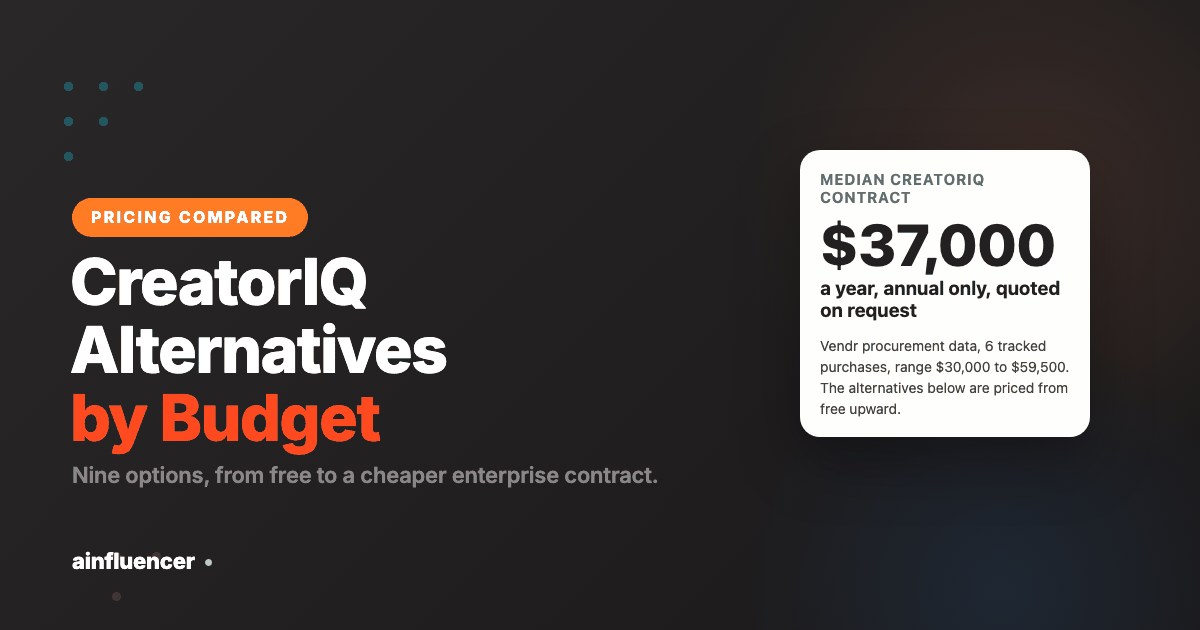
CreatorIQ does not publish a price list, so the honest sources are procurement trackers that record what buyers paid. They agree on the order of magnitude.
| Source | Figure | Sample |
|---|---|---|
| Vendr marketplace | Median $37,000 a year, range $30,000 to $59,500 | 6 tracked purchases |
| Vendr buyer guide | Average contract value $38,850 a year | 10 deals handled |
| Capterra | A $36,000 Basic tier, listed per user per year | Vendor-supplied listing |
Three caveats matter more than the numbers. The samples are small, single digit in one case. Implementation and onboarding are quoted separately, so the first year costs more than the licence. And every contract is annual, which means the cost of discovering it is not the right fit is a full year, not a month.
That is the real complaint behind the search. If your programme genuinely spans several brands, dozens of seats and a reporting line to a CMO, that price is defensible. If it does not, you are buying governance you will never use. Our CreatorIQ review goes through the feature set in detail.
CreatorIQ Alternatives by Price
Set against a $37,000 median, here is what the same money buys elsewhere. Prices are the most recent third-party checks we could find and should be confirmed with each vendor, because most of these companies also quote rather than publish.
| Tier | Platform | Reported cost | What you give up |
|---|---|---|---|
| Free | Ainfluencer | No subscription. A percentage of each collaboration | Enterprise reporting and multi-brand governance |
| Under $300 a month | Heepsy | Starter around $89 a month, free tier available | Campaign management is thin, it is a search tool |
| Modash | Essentials $299 a month | No payments, no content approval workflow | |
| HypeAuditor | About $299 a month Basic, on annual billing | Priced as analytics, not as a workflow | |
| $500 to $1,500 a month | Modash Performance | $599 a month | Still discovery led rather than end to end |
| GRIN | Self-serve from $0 to about $1,500 a month since January 2026 | Heavier setup than a mid-market team expects | |
| Still enterprise | Aspire | Vendr median $15,588 a year, range $11,139 to $36,599 | Less deep on multi-brand reporting than CreatorIQ |
| Traackr | No public price. Estimates of $25,000 to $55,000 a year | Measurement led, lighter on execution | |
| Emplifi | Quoted. Influencer work sits inside a wider social suite | You are buying a social suite, not an influencer tool |
Free: Ainfluencer
The structural difference is not the discount. It is that there is no subscription at all, so a quiet quarter costs nothing. You pay a percentage of the collaborations you actually agree, and the minimum collaboration is $10.
| Plan | Collaboration fee | A $1,000 month of creator fees costs |
|---|---|---|
| Free | 25% | $1,250 |
| Starter | 20% | $1,200 |
| Pro | 15% | $1,150 |
| Ultimate | 3% | $1,030 |
Run that against the CreatorIQ median. At a 25% fee on the free plan, $37,000 of platform spend is equivalent to roughly $148,000 of creator fees paid out. If your annual creator budget is smaller than that, the subscription is the larger half of your programme.
On supply, the marketplace held 484,107 YouTube creator accounts, 417,694 on Instagram and 181,950 on TikTok when counted in October 2026. Creators are on the platform by choice and can be messaged inside it, which is a different proposition from a scraped database you have to cold email.
- Best for: teams whose creator budget is smaller than an enterprise licence
- Watch out for: no multi-brand governance, no custom reporting suite, no dedicated success manager
- Commitment: none
Under $300 a Month
If CreatorIQ was mostly being used to find and vet creators, this is where the money should go. Each of these does one part of the job properly.
Modash
The closest thing to a pure discovery product, with audience data as the main deliverable. Reported at $299 a month for Essentials and $599 for Performance, with an enterprise tier from $14,700 a year, and a 14 day trial. It will not run a campaign or move money. Our Modash review has the detail.
HypeAuditor
Built around audience authenticity and fraud detection, which is the check worth paying for before a large booking. Reported at about $299 a month for Basic and $499 for Pro on annual billing. See our HypeAuditor review.
Heepsy
The cheapest credible search tool of the three, with a free tier and a Starter plan around $89 a month. Read our Heepsy review before buying, because the lower tiers are tightly limited and the advertised prices are often discounted rates.
If You Came Looking for Comment Analysis
This is the most common specific reason people look past CreatorIQ, and it deserves a straight answer rather than a product list. Reading the comments under creator posts is a different capability from influencer management, and most influencer platforms treat it as a reporting afterthought.
Before you buy anything for it, understand the constraint that decides the whole question: comment access depends on platform API permissions, not on the tool. A vendor can only show you what Instagram, TikTok or YouTube lets it read. YouTube comments are broadly accessible. Instagram and TikTok comments on a creator’s own post generally are not, unless the creator connects their account or the post is a paid partnership you are party to. Any tool promising full comment sentiment across all three without creator authorisation is overselling.
| If you need | Look at | Why |
|---|---|---|
| Comment sentiment on YouTube specifically | A YouTube comment tool | YouTube comment data is the most accessible of the three platforms |
| Sentiment across a campaign you ran | A social listening suite such as Brandwatch, Talkwalker or Meltwater | Listening tools are built for this; influencer suites bolt it on |
| Sentiment as part of creator vetting | An audience quality tool such as HypeAuditor | Vetting asks whether the audience is real, which is the adjacent question |
| Comments on posts you commissioned | The platform you commissioned them through, plus the creator’s own data | Authorised access through the creator is the only reliable route |
The practical answer for most teams: do not buy an enterprise influencer platform for comment analysis. Buy the collaborations somewhere cheap, and spend the difference on a listening tool that was designed for it.
Still Enterprise, Different Trade-offs
Some teams leave CreatorIQ sideways rather than downward, because the programme genuinely needs an enterprise platform and this one is not the right enterprise platform.
- Aspire, the most common like for like swap. Vendr tracks a median of $15,588 a year against CreatorIQ’s $37,000, which is the whole argument
- Traackr, measurement and benchmarking led. Choose it if your problem is proving value rather than running workflow
- GRIN, strongest with ecommerce brands managing a large roster, and since January 2026 it has self-serve monthly tiers up to about $1,500 a month, so it can be tested without a contract
- Emplifi, if influencer work belongs inside a wider social media suite rather than beside it
What You Give Up When You Leave CreatorIQ
Every other article on this subject skips this part, which is why people switch and then switch back. These are the things an enterprise contract is actually paying for.
| What you lose | Does it matter to you? |
|---|---|
| Multi-brand governance, separate permissions and reporting per brand or region | Only if you run more than one brand. Most teams do not |
| A named success manager and an implementation team | Matters if nobody internally owns the tool. Buy training instead if so |
| Custom reporting built to a finance or CMO template | Matters when influencer spend is reported upward. Otherwise a spreadsheet does it |
| Procurement and security review already passed | Real cost in large companies, and often the hidden reason the contract renews |
| One system of record across paid, organic and affiliate | Matters at volume. At a dozen collaborations a quarter it does not |
If three or more of those are a yes, stay on an enterprise platform and negotiate the price instead of switching tiers. If none of them are, you were never the customer that pricing was built for.
How to Replace It Without Buying Twice
| Step | What to do |
|---|---|
| 1. Pull your own usage | Seats logged in last quarter, campaigns run, reports actually opened. Enterprise tools are usually bought on a forecast that never arrived |
| 2. Price against creator spend, not features | If the licence is a large fraction of what you pay creators, the ratio is the problem, not the feature list |
| 3. Split discovery from execution | Two focused tools often cost a tenth of one suite and do both jobs better |
| 4. Test on one live campaign | Anything annual gets trialled first. Anything month to month gets trialled for a month |
| 5. Check supply in your niche and country | Run the same three searches in every shortlisted tool and compare the creators that come back |
| 6. Time the exit | Annual contracts have a notice period. Work out the cheapest month to leave before you commit to anything new |
How much does CreatorIQ cost?
CreatorIQ does not publish pricing. Procurement data from Vendr puts the median contract at $37,000 a year across 6 tracked purchases, with a range of $30,000 to $59,500, and its buyer guide reports an average of $38,850 across 10 deals. All contracts are annual and implementation is quoted on top.
Is there a free CreatorIQ alternative?
Yes. Ainfluencer has no subscription at all. You pay a percentage of each collaboration, 25% on the free plan down to 3% on the top plan, with a $10 minimum collaboration. It does not replace enterprise governance or custom reporting.
What is the cheapest like for like CreatorIQ alternative?
Among enterprise platforms, Aspire is the usual answer. Vendr tracks a median of $15,588 a year against CreatorIQ’s $37,000, for a broadly comparable end to end feature set.
Which tool is best for comment analysis?
Not an influencer platform. Comment access is limited by each social network’s API, so a social listening tool such as Brandwatch, Talkwalker or Meltwater is the right category, and for YouTube specifically a dedicated comment tool goes deeper than any influencer suite.
Can I get out of a CreatorIQ contract early?
Contracts are annual, so the practical answer is usually no, and the cheapest exit is at renewal with notice given in time. Check the notice period in your agreement before you sign anything else.
Is CreatorIQ worth it for a small brand?
Rarely. At a median of $37,000 a year, the licence alone is larger than the entire influencer budget of most small brands. The features that justify the price, multi-brand governance and custom reporting, are the ones a small brand never uses.