How Much Do YouTubers Make?
Two channels with the same views can earn ten times differently. What ads pay by market, why brand deals are bigger, and what gates each stream.
Anyone giving you a single number is guessing. Two channels with identical view counts can earn ten times differently, and the reason is rarely talent. It is where their viewers live and how many income streams they run.
This page gives the ranges honestly: what the views themselves pay, what everything else pays, and why ad revenue is the smallest part for most channels that earn a living.
The Four Income Streams
A YouTube income is almost never one thing. Here is what each part contributes and what controls it.
Where a YouTuber’s money comes from
| Stream | What it depends on | Who it works for |
|---|---|---|
| Ad revenue | View count and, far more than people expect, audience country | Everyone in the Partner Program, but it is the smallest stream for most |
| Brand deals | Audience fit and your own negotiation. Priced per video, not per view | The largest stream for most channels that earn a living |
| Affiliate commission | Whether viewers buy what you recommend | Works from the first sale, with no threshold at all |
| Memberships, Super Thanks and merch | How attached the audience is, rather than how large | Small channels with devoted audiences often out-earn larger casual ones here |
The order matters. Ad revenue is automatic and almost entirely outside your control. The other three are things you go and do.
What the Views Themselves Pay
YouTube keeps 45% of long-form ad revenue before you see anything, and what reaches you is measured as RPM, your earnings per 1,000 views. Published estimates vary widely because Google publishes nothing official, so treat these as orders of magnitude and read your own figure in YouTube Studio.
Monthly ad revenue by audience market, at three channel sizes
| Audience market | Reported RPM | 100,000 views a month | 500,000 views a month | 2 million views a month |
|---|---|---|---|---|
| United States | $3 to $15 | $300 to $1,500 | $1,500 to $7,500 | $6,000 to $30,000 |
| Germany | $2 to $6 | $200 to $600 | $1,000 to $3,000 | $4,000 to $12,000 |
| Japan | $1 to $3 | $100 to $300 | $500 to $1,500 | $2,000 to $6,000 |
| Brazil | $0.50 to $1.50 | $50 to $150 | $250 to $750 | $1,000 to $3,000 |
| India | $0.15 to $1.00 | $15 to $100 | $75 to $500 | $300 to $2,000 |
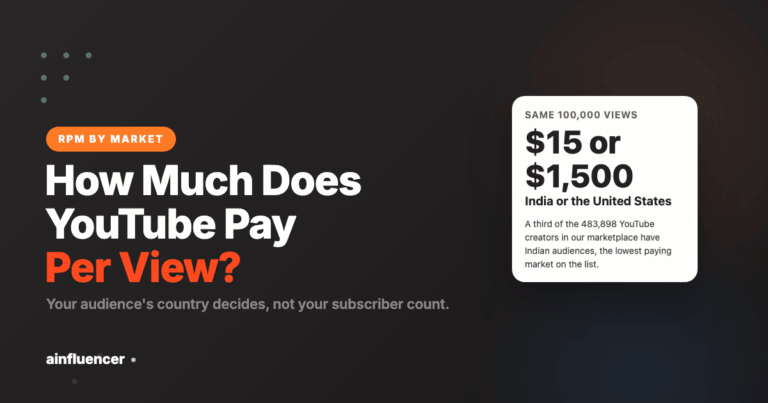
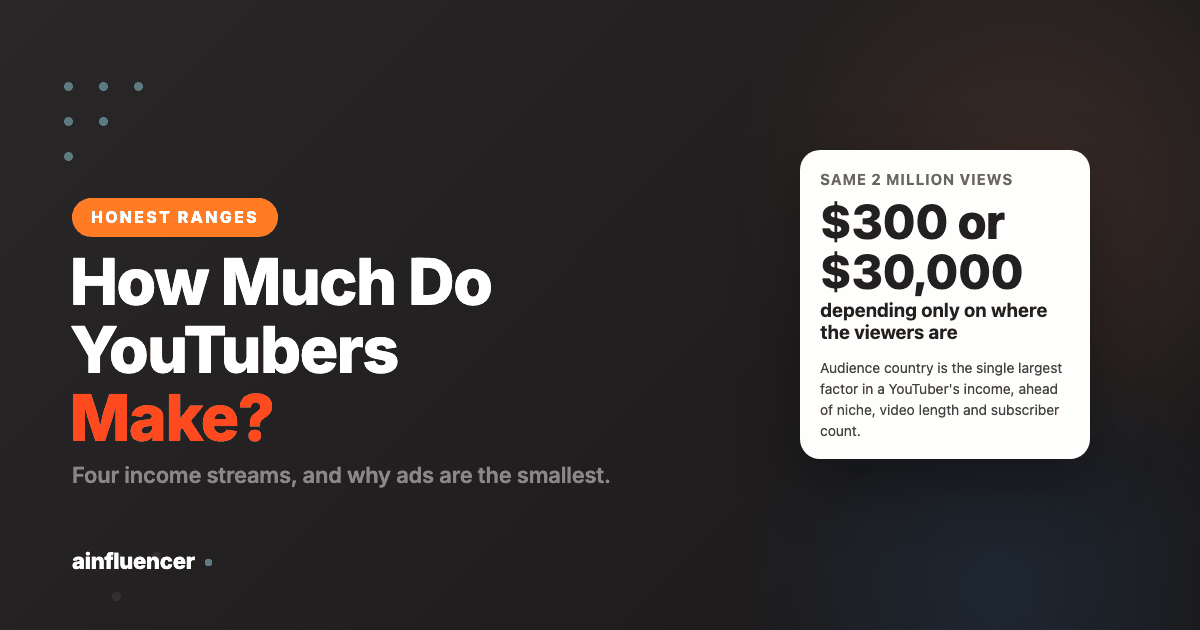
That is the ten times gap, and it is the single most important thing on this page. The same two million views is a serious income with a US audience and pocket money with an Indian one. The mechanics behind it, including why RPM is not simply CPM minus YouTube’s cut, are in how much YouTube pays per view.
Shorts are a separate and much smaller calculation. Creators keep 45% rather than 55%, the money comes from a pooled fund rather than from ads on your video, and the per-view rate is measured in cents rather than dollars. YouTube Shorts monetization works through YouTube’s own example.
Brand Deals Are the Bigger Stream, and the Harder One
For most channels earning a living, sponsorships out-earn ads comfortably, because a brand deal is priced against your audience’s trust rather than against an ad auction. A single sponsored video can pay more than a year of AdSense on the same channel.
But there is a structural catch on YouTube specifically, and it is worth knowing before you plan around sponsorships. We counted brand offers against the platform of the creator who received them:
Brand offers per 1,000 creator accounts in our marketplace
| Platform | Creator accounts | Offers per 1,000 accounts |
|---|---|---|
| TikTok | 181,950 | 354 |
| 417,694 | 337 | |
| YouTube | 484,113 | 0.33 |
YouTube has the most creators and almost none of the inbound demand. One caveat, because the number is easy to misread: this measures a marketplace, not the industry. YouTube sponsorships are real and often large, but they are typically arranged direct or through agencies rather than through platforms where brands browse. The practical consequence for a YouTuber is that sponsorship income is something you have to go and get, not something that arrives.
The good news is there is no threshold on it. Of 204,281 offers we counted across all platforms, 77% went to creators under 100,000 followers, and smaller channels engage better: 5.82% between 1,000 and 10,000 subscribers against 3.22% above a million. Sponsored YouTube videos covers how to price and structure one.
Why Two Channels the Same Size Earn Differently
- Audience country, which is worth up to ten times as shown above and is the largest single factor
- Niche. Finance, software and insurance advertisers pay several times what entertainment advertisers pay for the same viewer
- Video length. Longer watched videos carry more ad slots, so a 12 minute video and a 2 minute one with identical views do not pay the same
- Long-form against Shorts. A million Shorts views and a million long-form views are not comparable income
- How many streams are running. A channel with ads only earns a fraction of an identical channel running ads, sponsorships and affiliate links
What You Need Before Any of It Pays
Ad revenue is gated. You need 1,000 subscribers plus either 4,000 qualified watch hours in the last 12 months or 10 million qualified Shorts views in 90 days. There is also a lower 500 subscriber tier that unlocks fan funding but not ads.
That bar is rising. From 1 February 2027, new applicants will need 8,000 qualified watch hours or 20 million qualified Shorts views, still with 1,000 subscribers. Creators already in the programme are not affected. The full detail, including what counts as a qualified hour, is in YouTube monetization requirements.
Brand deals and affiliate commission have no threshold at all, which is why creators who treat them as the main plan start earning long before the Partner Program lets them touch ad revenue. If you are at that stage, how to become a YouTube influencer is the practical route.
Frequently Asked Questions
How much do YouTubers make per 1,000 views?
Between roughly $0.15 and $15, depending almost entirely on where the viewers are. Published estimates put US audiences at $3 to $15 per 1,000 views and Indian audiences at $0.15 to $1.00. That figure is your RPM, already net of YouTube’s 45% share.
How much does YouTube pay for 1 million views?
Taking the midpoints of the reported ranges, roughly $9,000 with a US audience, $4,000 in Germany, $2,000 in Japan, $1,000 in Brazil and around $575 in India. Treat these as orders of magnitude: the underlying estimates disagree widely and Google publishes no official figure.
How many views do you need to get paid on YouTube?
Views alone do not unlock payment. You need 1,000 subscribers plus either 4,000 qualified watch hours in 12 months or 10 million qualified Shorts views in 90 days. From 1 February 2027 new applicants will need 8,000 watch hours or 20 million Shorts views instead.
Do YouTubers make more from ads or sponsorships?
Sponsorships, for most channels that earn a living. A brand deal is priced against your audience rather than an ad auction, and a single sponsored video can pay more than a year of ad revenue on the same channel. The catch on YouTube is that those deals are usually arranged direct rather than arriving inbound.
How much do small YouTubers make?
From ads, very little, because ad revenue scales with views and a small channel has few. From brand deals, more than people expect: across 204,281 offers we counted, 77% went to creators under 100,000 followers, and channels between 1,000 and 10,000 subscribers engage at roughly 1.8 times the rate of channels above a million.
Why do two channels with the same views earn differently?
Audience country first, which can be a tenfold difference on its own. Then niche, because finance and software advertisers pay several times what entertainment advertisers pay; video length, because longer videos carry more ad slots; and how many income streams the channel actually runs.
Do YouTube Shorts pay well?
Not per view. Creators keep 45% rather than 55%, the money comes from a pooled fund rather than ads on your own video, and the rate is measured in cents per thousand views rather than dollars. Shorts are better understood as a discovery tool that grows the audience the other streams monetise.