Top 9 Influencer Marketing Agencies in China (2026): Compared by Platform and Rules
9 influencer marketing agencies in China compared by platform: Douyin, Xiaohongshu, WeChat and Weibo. Rules, KOL vs KOC and starting prices.
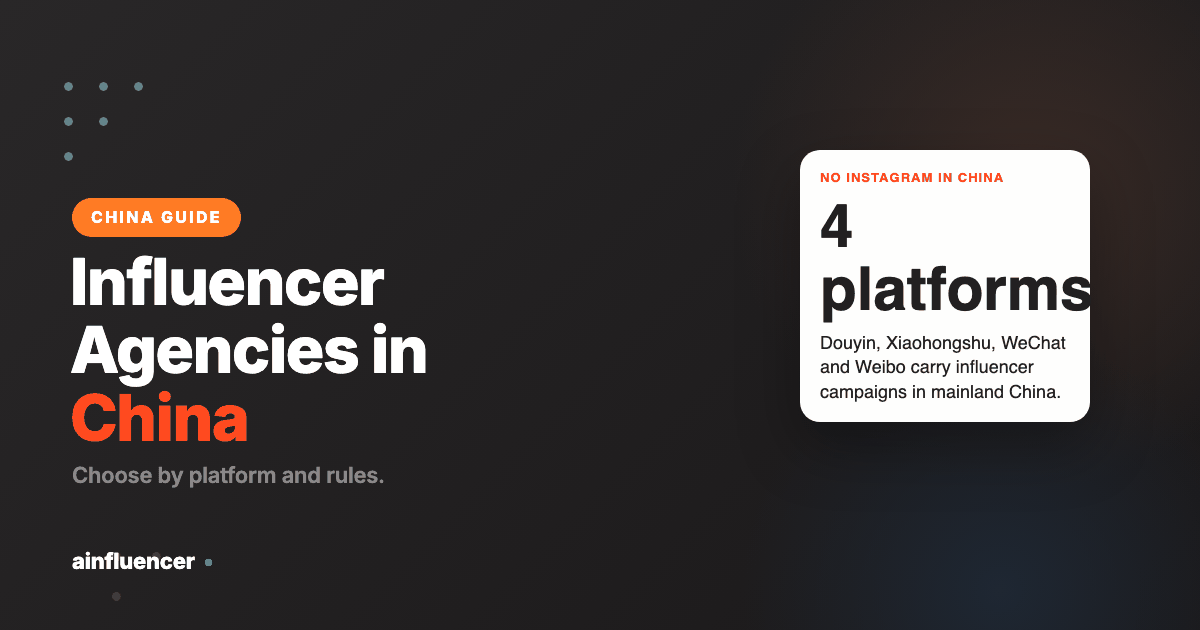
Instagram and Facebook are not available in mainland China, so a Western brand cannot simply move its influencer playbook there. The campaign runs on Douyin, Xiaohongshu (also called RED or Little Red Book), WeChat and Weibo, each with its own creators and habits. That makes the platform, and how an agency handles the rules, the real basis for choosing one.
This guide starts with the platforms and the compliance picture, then lists nine agencies. The agency details come from Influencer Marketing Hub’s Shanghai guide, which carries an advertising disclosure, so treat its order as a starting point. Network sizes and campaign results are the agencies’ own claims. None of the agencies paid to be listed.
Best Influencer Marketing Agency in China: The Short Answer
- Choose the platform first. Douyin suits video, livestream selling and high reach. Xiaohongshu suits beauty, fashion, travel and community-led recommendations. WeChat and Weibo cover owned-audience and news-style content.
- Budget: only four of the nine agencies state a starting price, and those start at $1,000 or $5,000 a campaign. The rest do not publish one.
- Compliance is part of the service. Sponsored content must be clearly labelled, and some topics need credentialed creators. Ask how the agency checks this.
- You do not need a China agency for Instagram, TikTok or YouTube campaigns aimed at the rest of the world.
Which Platforms Are Best for Influencer Marketing in China? (Douyin, Xiaohongshu, WeChat, Weibo)
What the agencies in this guide say each platform is for
| Platform | What it is used for | Agencies in this guide that name it |
|---|---|---|
| Douyin | Short video and livestream selling. Influencer Marketing Hub cites over 300 million monthly active users. It is the Chinese version of TikTok, with a mature, crowded market. | Shanghai Jungle, Hi-com, Digital Crew, Outlandish, RougeLink, InFlu China, Cerberus |
| Xiaohongshu (RED) | Community-led recommendations and micro-creators, especially in e-commerce, travel, beauty and lifestyle. Used for campaigns around 11.11 Singles’ Day. | Shanghai Jungle, Hi-com, Gentlemen Marketing, Digital Crew, Outlandish, RougeLink, InFlu China, Cerberus |
| Owned audience, official accounts and payments. Described as a more curated channel than Weibo. | Shanghai Jungle, Digital Crew, RougeLink, InFlu China, Cerberus | |
| High-frequency public posting and news-style reach. | Shanghai Jungle, Hi-com, Gentlemen Marketing, Digital Crew, InFlu China, Cerberus |
Cerberus Marketing adds a distinction worth knowing. A KOL (key opinion leader) is a creator with a large following who gives reach and credibility. A KOC (key opinion consumer) has a smaller following but more relatability, and drives trust and conversion. Most campaigns mix both. It also notes that TikTok serves a global audience while Douyin runs inside China’s own mature market, so a TikTok campaign does not reach Douyin users.
KOL vs KOC in China: Which Do You Need?
Pick a KOL when you need reach and credibility, a KOC when you need trust and conversion, and most campaigns mix both. Tiers run from mega and macro creators down to micro and nano. The more a brand sells through recommendation and community, as on Xiaohongshu, the more a KOC helps.
Regulatory Landscape and Compliance Issues for Influencer Marketing in China
This is a general overview, not legal advice. The points below come from Chinese official texts, which we link, and from the hub’s guide. The official texts are in Chinese, so confirm them with Chinese counsel or your agency before launch.
Compliance points reported for influencer campaigns in China
| Topic | What is reported |
|---|---|
| Core laws | Influencer marketing falls under the Advertising Law, the E-Commerce Law and the Administrative Measures for Internet Advertising, which require transparency, truthful content and clear labelling of sponsored material, especially in livestreaming. |
| Labelling | The Measures for the Administration of Internet Advertising (SAMR Order No. 72, in force 1 May 2023) say ads must be identifiable as ads. Content that promotes goods through experience sharing or reviews with a purchase link must be marked as advertising (the Chinese label is 广告). |
| Livestream liability | The same Measures give the livestream seller, the room operator and the presenter advertiser, agent, publisher or endorser duties depending on their role. |
| Endorsers | The Advertising Law says endorsers must base what they say on facts and may not endorse a product they have not used. |
| Credentials for regulated topics | Article 13 of the Code of Conduct for Online Presenters, issued on 22 June 2022 by the National Radio and Television Administration and the Ministry of Culture and Tourism, requires qualifications, reported to the platform, for presenters of medicine and health, finance, law and education content. It covers online presenters, not every influencer. Some late 2025 coverage described a new rule from 25 October 2025. A fact-check by Annie Lab in November 2025 found no such new law and traced the requirement to this 2022 code. |
| Health advertising | The Measures ban disguising advertising for medical services, drugs, devices and health foods as health or wellness knowledge. |
| Contracts and fraud | Agencies draft contracts with transparency clauses, run compliance checks and use verification tools against fake influencers. |
The official texts are the Measures for the Administration of Internet Advertising and the Code of Conduct for Online Presenters, both in Chinese.
Livestream Commerce on Douyin: Why a Post and a Live Are Different Budgets
A post builds awareness, while a live session sells, and the two are budgeted and contracted differently. In a livestream the seller, the room operator and the presenter can each carry legal duties, so agree in writing who approves the script and who answers for claims.
How Much Does a KOL Cost in China?
There is no public rate index. Agencies state starting prices only occasionally: the hub lists campaigns from $1,000 or more at Shanghai Jungle and Cerberus Marketing and from $5,000 or more at Digital Crew and Outlandish. Livestream and large KOL campaigns cost more, and costs run higher in peak months such as 11.11.
How to Vet KOLs and Avoid Fake Followers
Check historical engagement, audience location and past sponsored content, and ask the agency for platform back-end data. Creator data on the platforms’ own marketplaces, such as Douyin’s Juliang Xingtu and Xiaohongshu’s Pugongying, is more reliable than screenshots.
How to Measure a KOL Campaign in China
Ask for engagement rate, direct sales through links or live sessions, conversion rate and audience growth, and agree the attribution method before launch. Returns and refunds can reduce what a live sale is worth.
Top 9 Influencer Marketing Agencies in China (2026)
The nine at a glance
| Agency | Known for | Founded | Stated starting price |
|---|---|---|---|
| 1. Shanghai Jungle | European-run agency for Western brands | 2013 | Campaigns from $1,000+ |
| 2. Hi-com | KOL marketing with a large network | 2016 | Undisclosed |
| 3. Gentlemen Marketing Agency | KOL and KOC campaigns | 2012 | Undisclosed |
| 4. Digital Crew | Douyin, WeChat and Xiaohongshu campaigns | 2014 | Campaigns from $5,000+ |
| 5. Outlandish | Founders who were influencers | 2018 | Campaigns from $5,000+ |
| 6. Reflex Group | Premium influencer relations | 1988 | Undisclosed |
| 7. RougeLink | Douyin livestreams and large campaigns | 2020 | Undisclosed |
| 8. InFlu China | Broad network across four platforms | date not stated | Undisclosed |
| 9. Cerberus Marketing | KOL and KOC marketing with video production | 2019 | Campaigns from $1,000+ |
All nine are described by the Influencer Marketing Hub Shanghai guide, so treat the selection as one source’s view. Ainfluencer is not on the list, because it works on Instagram, TikTok and YouTube and does not cover Douyin, Xiaohongshu, WeChat or Weibo.
1. Shanghai Jungle: Douyin and Xiaohongshu KOL Campaigns for Western Brands
European-run agency for Western brands. Founded 2013. A Shanghai-based European agency that helps Western brands build a presence on Douyin, WeChat, Xiaohongshu and Weibo, from account registration to content and campaign execution. Its reported campaign for the city of Warsaw used five influencers and generated more than 20 million organic impressions in two weeks, as stated by the agency.
- Best for: Small and medium-sized businesses entering China.
- Pricing: Campaigns from $1,000+, per the hub
2. Hi-com: KOL Marketing Agency on Douyin, RED and Weibo
KOL marketing with a large network. Founded 2016. A specialist KOL agency that says it has a network of more than 20,000 influencers across Douyin, RED and Weibo. Its reported campaign for the Spanish Travel Association used one travel creator with 61,000 Weibo followers over five days, reaching more than 4 million people and 1.1 million engagements, as stated by the agency. It also handles contracts, copyright and platform requirements.
- Best for: Brands in luxury, travel and fashion, of any size.
- Pricing: Undisclosed
3. Gentlemen Marketing Agency: KOL and KOC Campaigns on Xiaohongshu and Weibo
KOL and KOC campaigns. Founded 2012. Says it has access to more than 3,000 KOLs. It reports a 1:130 return in one month for the UK fashion brand Larizia on Xiaohongshu around Singles’ Day, built on key opinion consumers, and 1,049 posts for the licensing company Smiley on Weibo with more than 1.5 million views. These are the agency’s own figures.
- Best for: Brands of all sizes that want KOC-led campaigns on Xiaohongshu and Weibo.
- Pricing: Undisclosed
4. Digital Crew: Douyin, WeChat and Xiaohongshu Campaigns
Douyin, WeChat and Xiaohongshu campaigns. Founded 2014. Works with KOLs on Douyin, WeChat and Xiaohongshu and emphasises Xiaohongshu’s micro-influencer ecosystem. It reports more than 40 million impressions in five weeks for Study Perth and, for Cebu Pacific Air, an eightfold rise in incremental revenue year on year and 83% better media budget efficiency, as stated by the agency.
- Best for: Enterprises in education, travel, e-commerce and lifestyle.
- Pricing: Campaigns from $5,000+, per the hub
5. Outlandish: Influencer Agency Founded by Former Influencers
Founders who were influencers. Founded 2018. Its founders worked as influencers, and the agency says it has stakes in influencer accounts that help it negotiate terms. It ran a Douyin campaign for FedEx and a tourism campaign for Chongqing that reached more than 600,000 views in China and 300,000 on YouTube, as stated by the agency. It has also launched live retail e-commerce in China.
- Best for: Brands of all sizes that want livestream and viral campaigns.
- Pricing: Campaigns from $5,000+, per the hub
6. Reflex Group: Premium Influencer Relations in China
Premium influencer relations. Founded 1988. A premium agency that emphasises long-term relationships and curated creators over big follower numbers. Its reported work for Yves Saint Laurent’s Rouge Pur Couture launch used a custom influencer PR package, and its network runs from celebrities to micro-influencers.
- Best for: Large luxury and beauty brands.
- Pricing: Undisclosed
7. RougeLink: Douyin Livestream and Large Campaigns
Douyin livestreams and large campaigns. Founded 2020. Says it has a network of more than 500 influencers across Douyin, Xiaohongshu and WeChat. For the Hong Kong Tourism Board it reports 28 influencers, 35 videos, 36.7 million exposures and 342,000 engagements. A Douyin livestream with an essential oils creator is reported to have sold 3 million RMB (about 380,000 euros) in five days. These are the agency’s claims.
- Best for: Large brands that want livestream selling and augmented-reality creative.
- Pricing: Undisclosed
8. InFlu China: Influencer Network Across Four Platforms
Broad network across four platforms. Founded date not stated. Says it has more than 5,000 influencers across Xiaohongshu, Douyin, WeChat and Weibo, from mega creators to micro and nano level, with analytics and KPIs per collaboration. It works in food and beverage, fashion, beauty and tourism.
- Best for: Small and medium-sized brands that want tiered creator selection.
- Pricing: Undisclosed
9. Cerberus Marketing: KOL and KOC Marketing With Video Production
KOL and KOC marketing with video production. Founded 2019. Says it has a network of more than half a million influencers on Xiaohongshu, Douyin, WeChat and Weibo, and offers video production, reputation building and monthly performance reports. Its team includes veterans from 4A agencies and consulting.
- Best for: Brands of all sizes that want both KOL reach and KOC credibility.
- Pricing: Campaigns from $1,000+, per the hub
Common Mistakes Foreign Brands Make in Chinese Influencer Marketing
- Relying on KOLs without building community trust or owning a channel of your own.
- Underestimating localisation in tone, visuals and consumer psychology.
- Treating China as one market, when cities and tiers differ.
- Skipping script approval and a written list of claims you can and cannot make.
Local vs Global Agency: Which Should You Choose?
Shanghai-based agencies say they understand platforms and regulation better, which is their own claim, while global agencies bring brand consistency across markets. Whichever you choose, ask who handles compliance and who holds the creator relationships.
How to Choose an Influencer Marketing Agency in China: Questions, Red Flags and Green Lights
- Ask which platform produced the case study. A strong Douyin result says little about Xiaohongshu.
- Ask for results in your category. Beauty, travel and luxury cases differ from consumer electronics.
- Ask how compliance is handled. Who labels sponsored content, who checks credentials for regulated topics, and who is liable.
- Ask who owns the creator relationship. Some agencies hold stakes in creator accounts, which can help terms but can also create conflicts.
- Be wary of guaranteed follower growth or simple ROI promises. The hub lists these as red flags.
Chinese Brands Selling Abroad: Influencer Marketing Outside China
A Chinese brand selling abroad needs the platforms this guide leaves out. Ainfluencer works with creators on Instagram, TikTok and YouTube through a fully managed service and a self-serve marketplace, and our guides to influencer marketing agencies in Singapore, influencer marketing agencies in India and TikTok influencer marketing agencies cover agencies in other markets. For costs, read influencer marketing agency pricing, and for category specialists see luxury influencer marketing agencies and beauty influencer marketing agencies. The overall shortlist is in the best influencer marketing agencies.
Frequently Asked Questions About Influencer Marketing Agencies in China
Who are the best influencer marketing agencies in China?
Agencies in Influencer Marketing Hub’s Shanghai guide include Shanghai Jungle, Hi-com, Gentlemen Marketing Agency, Digital Crew, Outlandish, Reflex Group, RougeLink, InFlu China and Cerberus Marketing. Which is best depends on your platform, category and budget.
Can I use Instagram influencers to reach China?
Not for audiences inside mainland China. Instagram and Facebook are not available there, so campaigns run on platforms such as Douyin, Xiaohongshu, WeChat and Weibo.
What is the difference between a KOL and a KOC in China?
A KOL, or key opinion leader, has a large following and brings reach and credibility. A KOC, or key opinion consumer, has a smaller following but is more relatable and tends to drive trust and conversion.
Is Douyin the same as TikTok?
TikTok serves a global audience, while Douyin is the Chinese version, run inside China’s own mature and crowded market. A TikTok campaign does not reach Douyin users.
How much does influencer marketing in China cost? What do KOLs charge?
Few agencies publish prices. The hub lists campaigns starting at $1,000 or more at Shanghai Jungle and Cerberus Marketing and at $5,000 or more at Digital Crew and Outlandish. Livestream and large KOL campaigns cost more.
Do influencers in China have to label sponsored posts as advertising?
Yes. The Measures for the Administration of Internet Advertising (in force 1 May 2023) require ads to be identifiable, and content with a purchase link that works as a review or experience share must be marked as advertising. Confirm the current rules with your agency or local counsel.
Do Chinese influencers need credentials to talk about medicine, finance, law or education?
Article 13 of the 2022 Code of Conduct for Online Presenters requires qualifications, reported to the platform, for presenters of medicine and health, finance, law and education content. It covers online presenters, not every influencer. A new Cyberspace Administration rule from 25 October 2025 reported in some coverage was not found by a November 2025 fact-check.
Can influencer marketing in China be livestreamed?
Yes. Douyin and other platforms run livestream selling. The seller, the room operator and the presenter can carry legal duties, so agree in writing who approves scripts and claims.