YouTube Channel Memberships
Twenty five price points from $0.99 to $499.99, up to six tiers, and 70% to you. Except in the iPhone app, where the same membership can land nearer 49%.
A channel membership is a monthly payment from a viewer in return for perks you choose. YouTube’s share figure is 70% to the creator, and that is accurate. It is also the reason most guides to this subject are wrong by about a third, because where the viewer taps Join changes what reaches you.
Every figure below is from YouTube’s own documentation, read on 14 October 2026, and linked where it appears. The third-party guides on this topic contradict each other on the tier cap, the top price and the subscriber threshold, so none of them is used here. Where YouTube publishes nothing, this article says so instead of inventing a number, which happens twice: the app store deduction and the conversion rate.
What a Channel Membership Actually Is
It is a recurring monthly charge that renews until the viewer cancels. In exchange they get a loyalty badge next to their name in comments and live chat, access to custom emoji, and whatever else you configure. It is not the same thing as a tip: Super Thanks and Super Chat are one-off payments, and they unlock at the same point in the Partner Program.
You can create up to six membership levels, and each level must carry between one and five perks, with higher levels including everything below them. That is YouTube’s documented limit, not an estimate.
One restriction decides most perk plans and almost no guide mentions it. Members-only videos must be fully original content, with no copyright claims of any kind, including claims from music partners. Members-only Shorts may not use third-party music at all, and that includes YouTube’s own Shorts music library. So the obvious perk, an exclusive reaction video or a cut with a licensed track, is not available to you.
What You Can Charge, and What Viewers Actually Pay
The price bands YouTube lets you set
In the United States there are 25 fixed price points, and they are not a free choice of any amount. The range moves in roughly one dollar steps up to $9.99, then jumps. There is no $10.99 and no $12.99: after $9.99 the next band is $14.99.
All 25 US price points a creator can choose
| $0.99 | $1.99 | $2.99 | $3.99 | $4.99 |
| $5.99 | $6.99 | $7.99 | $8.99 | $9.99 |
| $14.99 | $19.99 | $24.99 | $29.99 | $34.99 |
| $39.99 | $44.99 | $49.99 | $99.99 | $149.99 |
| $199.99 | $249.99 | $299.99 | $399.99 | $499.99 |
Two things to carry out of that table. Prices differ by the viewer’s country, so the figure a member sees is not necessarily the one you set. And YouTube has been rolling out pricing updates gradually since May 2025, which means what a viewer pays can also depend on when they joined. YouTube’s own advice is to start with two or three levels and to set them above the lowest price point.
What YouTube keeps, and what reaches your bank
YouTube’s documentation is specific: creators get 70% of membership revenue after applicable taxes and fees, and YouTube says it currently covers transaction costs including credit card fees. If you are signed to a multi-channel network your share can be lower, because some networks take a cut on top of YouTube’s.
Now the part YouTube does not document. A membership bought inside the iPhone app is an in-app purchase, and the app store takes its own commission on digital goods. YouTube publishes nothing about this, so treat it as a reported figure rather than policy: creator payout reports put the extra cut at around 30%, which takes the effective share to roughly 49%. The sources disagree about whether the app store fee comes off before or after YouTube’s share, and it does not matter, because 0.70 × 0.70 is 0.49 either way. That is why the number holds even though the explanations conflict.
What one member is worth per month, before tax
| Member pays | You keep on the web or Android | You keep in the iPhone app | The gap |
|---|---|---|---|
| $0.99 | $0.69 | $0.49 | $0.20 |
| $1.99 | $1.39 | $0.98 | $0.41 |
| $2.99 | $2.09 | $1.47 | $0.62 |
| $4.99 | $3.49 | $2.45 | $1.04 |
| $9.99 | $6.99 | $4.90 | $2.09 |
| $24.99 | $17.49 | $12.25 | $5.24 |
| $49.99 | $34.99 | $24.50 | $10.49 |
| $499.99 | $349.99 | $245.00 | $104.99 |
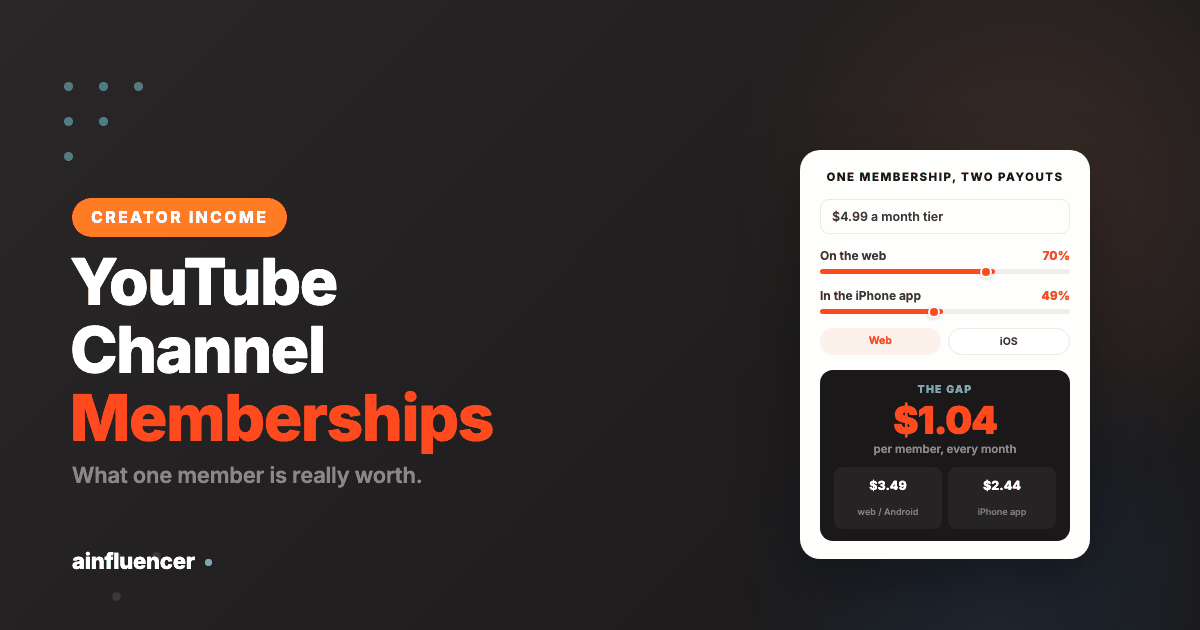
At $4.99, the common tier, the difference is $1.04 per member per month. On 200 members that is $208 a month, or about $2,496 a year, decided entirely by which device your audience happens to use. It is worth one line in a video telling people the browser sends more of the same payment to you.
Who Can Switch Memberships On
The 1,000 subscriber figure everybody quotes is the threshold for ad revenue. Memberships unlock earlier, through the expanded Partner Program, at 500 subscribers.
The two doors into the Partner Program, and what each one opens
| Expanded Partner Program | Full Partner Program | |
|---|---|---|
| Subscribers | 500 | 1,000 |
| Recent uploads | 3 valid public uploads in the last 90 days | Not part of the threshold |
| Watch time, either one | 3,000 valid public watch hours in 12 months, or 3 million valid public Shorts views in 90 days | 4,000 qualified watch hours in 12 months, or 10 million qualified Shorts views in 90 days |
| Memberships | Yes | Yes |
| Super Thanks, Super Chat, Shopping | Yes | Yes |
| Ad revenue | No | Yes |
Three conditions sit outside the table. You have to live in one of roughly 100 eligible locations. Your channel cannot be set as made for kids, and it cannot carry a significant number of videos that are. And some features are unavailable in particular countries for legal reasons, regardless of your numbers. The monetization requirements goes through the thresholds and the February 2027 changes in full.
Building Tiers People Renew
One tier, or several
Six levels are allowed and are usually a mistake below a few thousand subscribers, because every level needs one to five perks that you deliver every month. Six levels is up to thirty standing promises. YouTube recommends two or three, and that advice is about delivery capacity rather than revenue.
Perks that cost you nothing to deliver
- The loyalty badge itself, which is the perk most members actually want, because it is visible to other people
- Custom emoji, made once and used forever
- Members-only posts and polls on the Community tab
- Early access to a video you were publishing anyway, which costs you a scheduling change and nothing else
- A members-only comment thread, which costs nothing and reads as exclusive
Perks that quietly become a second job
- A monthly live Q&A. It holds members superbly, and the first month you skip it is the month they cancel
- Personal replies or direct access. This scales until it does not, and then it fails in public
- A members-only Discord, which is a moderation commitment, not a perk
- Members-only videos, which have to be fully original with no copyright claims, so they cannot reuse footage or licensed music
Memberships Against Patreon
The comparison that actually decides it
| YouTube memberships | Patreon | |
|---|---|---|
| Where the viewer already is | On the video. The Join button sits under it | Somewhere else. You have to send them, and most never arrive |
| Threshold to start | 500 subscribers and the rest of the expanded Partner Program | None |
| Your share | 70% on the web, lower through the iPhone app | Platform fee plus payment processing, set by the plan you are on |
| Content you can put behind it | Must be fully original. No copyright claims, and members-only Shorts cannot use third-party music, including YouTube’s own Shorts music library | Your own rules, within Patreon’s policies |
| If you stop paying YouTube attention | The membership lives inside the channel, so it rises and falls with the channel | Portable. It survives a platform you are leaving |
The honest summary: memberships convert better and Patreon travels better. A membership is part of the channel, so it grows and shrinks with the channel and ends with it. If your plan involves ever leaving YouTube, that matters more than the percentage.
Why Members Leave, and the Churn Nobody Plans For
Memberships are the only YouTube income that can be cancelled by a human decision. Ad revenue falls when views fall. A membership falls when somebody feels they stopped getting what they paid for, which is usually a perk that was promised monthly and delivered twice.
This is also where published figures should be treated carefully. You will see a 1% to 2% conversion rate quoted as though YouTube published it. YouTube publishes no such figure. Every version traces back to a creator-tool vendor, none of them shares a methodology, and between them they range from 0.5% to 5%. Measure your own ratio instead, and measure it against the people who watched you this month rather than your subscriber count, because the subscriber count includes everybody who has not opened the channel in two years.
What Memberships Earn at Different Channel Sizes
Rather than guess a conversion rate, invert the question. Here is how many members a given take-home figure needs, using the 70% web share. These are arithmetic, not forecasts.
Members needed to reach a figure, at 70% on the web
| To take home | at $1.99 | at $4.99 | at $9.99 | at $24.99 |
|---|---|---|---|---|
| $100.00 a month | 72 members | 29 members | 15 members | 6 members |
| $500.00 a month | 360 members | 144 members | 72 members | 29 members |
| $1,000.00 a month | 720 members | 287 members | 144 members | 58 members |
| $3,000.00 a month | 2,159 members | 860 members | 430 members | 172 members |
That table is the reality check. A thousand dollars a month at the $4.99 tier needs 287 paying members, every month, renewing. For most channels that is a larger ask than the same thousand dollars from a single brand deal, which is the comparison worth making before you build six tiers. How much YouTubers make goes through what the other income lines actually pay.
Joining a Membership as a Viewer
If you are on the other side of this and wondering what joining costs: use the Join button under the video or on the channel page, pick a level, and pay. It renews every month until you cancel, which you do under paid memberships in your YouTube settings. The price depends on your country and, because of the gradual pricing rollout, sometimes on when you joined.
One thing worth knowing if your intention is to support the creator: joining in a desktop browser rather than inside the iPhone app sends a noticeably larger share of the identical payment to them. Same money from you, roughly 40% more arriving.
Where Memberships Sit in a Creator’s Income
Memberships are real money and they are capped by two things: the size of your audience and your capacity to keep delivering perks every month. They reward a small, committed audience better than almost anything else on the platform, and they will not replace a job at 2,000 subscribers.
The income lines with no subscriber threshold at all are brand deals and affiliate commission. A channel at 800 subscribers that cannot run ads can still be paid for a sponsored video, and YouTube affiliate programs pay on the sale rather than on the view. If you are earlier than the 500 subscriber mark, that is where to start: how to become a YouTube influencer, and Ainfluencer lists brands looking for creators at any size.