Influencer Relationship Management: The Five-Rung Ladder From Stranger to Ambassador
Most guides to influencer relationship management list steps. This one gives each stage an action and a number to watch, so you can tell whether your creators are becoming partners or one-off posts.
Influencer relationship management, or IRM, is the practice of treating creators as ongoing partners instead of one-off line items. Guides from vendors such as Sprout Social, Aspire and GRIN agree on the idea and mostly stop at a list of steps. This guide turns it into a ladder of five rungs, from a creator who does not know you to one who promotes you for years, and gives every rung one action and one measure, so you can see where relationships stall. One disclosure: Ainfluencer, which publishes this blog, runs an influencer marketplace, and one section shows where it fits. The other sections apply to any tool or none. We quote no cost or response benchmarks, because the figures we found are vendors’ own claims.
What Influencer Relationship Management Is, and What It Is Not
IRM covers how you find creators, talk to them, work with them, pay them and keep them. The goal is a roster of creators who know your product, answer quickly and come back, because a creator you already work with costs less to book than a stranger.
| Term | What it means | How it differs from IRM |
|---|---|---|
| Influencer marketing | The whole practice of working with creators to promote something | IRM is the part about keeping relationships over time |
| Influencer CRM | Software that stores creators, history and deals | IRM is the practice and the CRM is one tool for it. See our influencer CRM guide |
| Influencer relations | Often a PR job: pitching media-minded creators and handling press | Closer to public relations than to managing a paid roster |
| Influencer outreach | The first contact | Rung 2 of the ladder below. See our influencer outreach tools guide |
The Relationship Ladder
| Rung | Where the creator is | The action | The measure |
|---|---|---|---|
| 1. Fit | A name on a list | Check the audience and content match before contact | Share of contacted creators who are a real fit |
| 2. First contact | A stranger | Send a short, specific message that says what is in it for them | Reply rate |
| 3. First collaboration | A new partner | Brief clearly, pay on time, approve fast | Delivery on time, and on brief |
| 4. Repeat | A known creator | Give feedback, share results, rebook | Repeat rate |
| 5. Ambassador | A long-term partner | Offer ongoing terms, early access and a commission | Share of spend on repeat creators |
Most programs are strong on rung 2 and weak on rungs 4 and 5, which is where the savings are. The sections below take each rung in turn.
Rung 1: Fit Before You Reach Out
A relationship that starts with a poor fit never recovers. Before you contact a creator, check four things: the audience matches your buyer, the content style suits your product, the creator has not just promoted a direct competitor, and their past sponsored posts looked honest.
Action: write a one-line fit note for each creator before you message them. If you cannot write it, do not send the message. Measure: of the creators you contact, the share you would still call a good fit a month later. If it is low, your search is the problem, not your messages.
Rung 2: First Contact
Creators receive many pitches, so the first message has to be short and about them. Say who you are in one line, name one specific thing you liked about their content, state exactly what you are offering, and ask one easy question.
| Part of the message | What to write | What to avoid |
|---|---|---|
| Opening | Their name and one specific thing you liked | “Dear creator” or a generic compliment |
| Offer | What they get: product, fee, commission or all three, in plain words | Vague “collaboration opportunity” |
| Ask | One easy question, such as whether they want the product sent | Three questions and a form |
| Close | Your name and how to reach you | A long signature and attachments |
Action: personalize the first line by hand and let a template carry the rest. Our influencer outreach templates give twelve starting points, and our AI influencer outreach guide explains what to automate and what to keep human. Measure: reply rate, tracked per template so you learn which one works.
Rung 3: The First Collaboration
The first project sets the relationship. Three things decide how it goes: a brief that says exactly what you want, fast approvals, and payment on the date you promised.
- The brief: the product, the key points to cover, what must not be said, the deadline and how many revisions are included.
- The approval: reply within a stated number of days. A creator waiting a week for feedback is a creator who will not rebook.
- The payment: state the date and keep it. Late payment is the fastest way to lose a creator.
Action: send the brief in writing before work starts and agree the payment date. Measure: the share of collaborations delivered on time and on brief, and the share paid on the promised date.
Rules check: A creator who has a material connection to your brand, such as payment or free product, needs to disclose it when they promote you. The FTC’s Disclosures 101 guide for influencers says a disclosure is needed when there is such a connection, which does not have to involve payment. We could not open the FTC’s own pages from our environment, so we cite that from a summary and you should read the guide directly. Put the disclosure requirement in your brief. This is not legal advice.Rung 4: Repeat
Rebooking is where relationship management pays for itself, because the creator already knows your product and your process. What turns a one-off into a repeat is feedback.
- Share results: tell the creator how the post performed for you, good or bad. Few brands do.
- Give specific feedback: what worked, what you would change. It makes the next piece better.
- Rebook while it is fresh: within a month of a good post, not a year later.
- Keep a note: in your CRM or sheet, why you would or would not book them again.
Aspire’s glossary page argues that a creator on a fourth post with a brand usually produces better content than on a first, which is the vendor’s claim and not a measured figure, but the logic is sound: familiarity saves briefing time and builds an audience that has seen you before.
Action: after every collaboration, send results and feedback and decide the same week whether to rebook. Measure: the repeat rate.
Rung 5: Ambassador
A few creators become long-term partners. The offer changes at this point from a fee per post to something ongoing: a retainer, a commission on sales through their link or code, early access to products and a direct line to someone on your team.
Action: offer ongoing terms to your three or four best repeat creators and ask what they would want. Measure: the share of your creator spend that goes to creators you have booked before.
The Numbers to Watch
| Metric | Formula | What it tells you |
|---|---|---|
| Fit rate | Creators you still call a good fit divided by creators you contacted | Whether your search is working |
| Reply rate | Replies divided by messages sent, per template | Whether your first message works |
| On-time delivery | Collaborations delivered on time and on brief divided by all collaborations | Whether the process works for creators |
| Repeat rate | Creators booked more than once divided by creators booked | Whether relationships are forming |
| Repeat spend share | Spend on repeat creators divided by total creator spend | How much of your budget sits in proven relationships |
A worked example
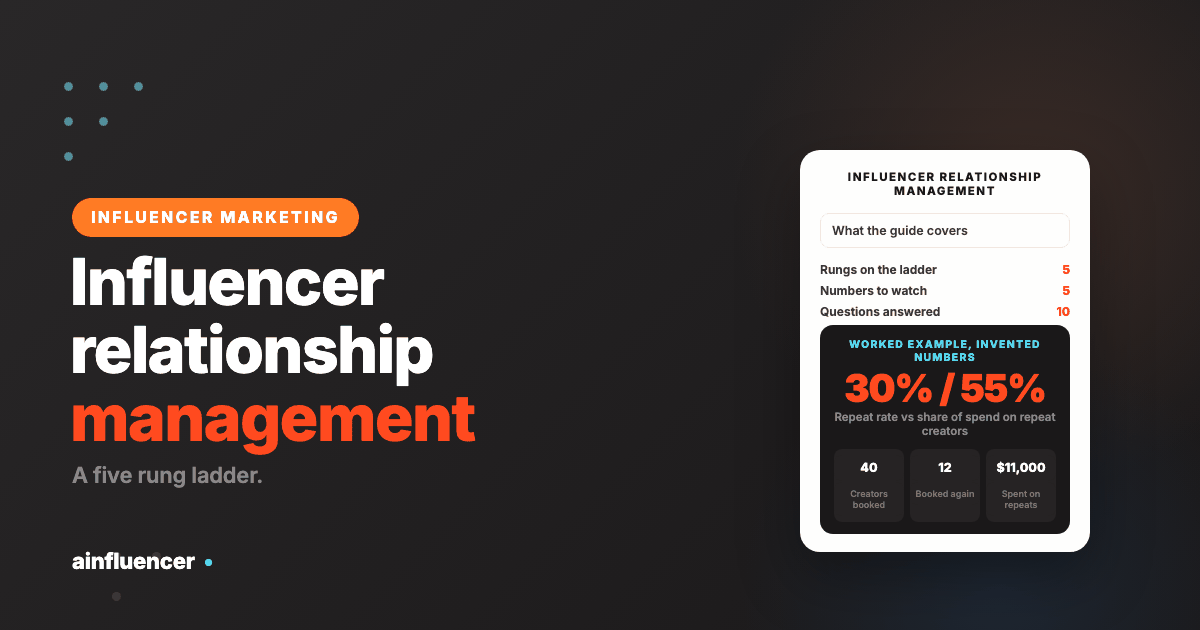
These numbers are invented to show the arithmetic and are not benchmarks. Suppose a brand booked 40 creators in a year, 12 of them more than once, and spent $20,000, of which $11,000 went to the 12 repeat creators.
| Step | Value |
|---|---|
| Creators booked | 40 |
| Booked more than once | 12 |
| Repeat rate | 30% |
| Total creator spend | $20,000 |
| Spend on repeat creators | $11,000 |
| Repeat spend share | 55% |
The two numbers tell different stories. A 30% repeat rate says most creators are one-offs. A 55% spend share says the repeat creators are carrying the budget. If the first is low and the second is high, you have a few strong relationships and a leaky top of the ladder.
A Contact Rhythm That Fits a Busy Program
This is our suggestion, not a measured standard. The point is to have a rule, so no creator is forgotten and none is spammed.
| When | What you send | To whom |
|---|---|---|
| Before the project | The written brief and the payment date | Every creator |
| Within days of delivery | Approval or specific feedback | Every creator |
| Within a month of a good post | Results and a rebooking offer | Creators you would book again |
| Every quarter | A short check-in and any new product or news | Repeat creators and ambassadors |
| When something changes | Rate, product or brief updates | Creators it affects |
Managing Creators at Scale: Three Tiers
Once you work with more than a couple of dozen creators you cannot give everyone the same attention. Sort them into three tiers and set a standard for each.
| Tier | Who is in it | How you treat them | How many |
|---|---|---|---|
| A: ambassadors | Creators you have booked several times who perform | A named contact on your team, direct messages, ongoing terms, early access | A handful, three to five in a small program |
| B: repeat creators | Booked more than once, or booked once and rated highly | Templates with a personal first line, results shared after each post, a quarterly check-in | The core of the roster |
| C: one-offs and prospects | Booked once with no rebooking decision, or not yet contacted | A template and a clear brief, with a rebooking decision within a month | The rest |
The tiers are a working rule, not a measured standard. What matters is that moving a creator up a tier is a decision you make after each collaboration, so the people carrying your results get the attention.
Three Messages to Copy and Adapt
These are examples, not templates to paste unchanged. Replace every bracket with something specific.
| Moment | Example message |
|---|---|
| First contact | Hi [Name], I liked your [specific video or post] on [topic]. I work at [brand], we make [product], and I would like to send you one to try. If you like it we can talk about a paid post. Would you like me to ship one? [Your name] |
| After a post | Hi [Name], thanks for the [post]. It brought [a real result, such as clicks or a number of orders] and the way you showed [detail] worked well. One change I would suggest next time is [specific note]. Would you want to do another in [month]? [Your name] |
| Rebooking an ambassador | Hi [Name], you have been one of our best partners this year. I would like to offer you [ongoing terms, such as a retainer or a commission] and early access to [new product]. What would make that worth your time? [Your name] |
Notice what each one does: it names something specific, offers something concrete and asks one question. None begins with a paragraph about the brand.
When Something Goes Wrong With a Creator
Every program has late posts, off-brief content and slow replies. How you handle them decides whether the relationship survives.
| Problem | What to do first | What to put in place so it happens less |
|---|---|---|
| Content is late | Ask for a new date in writing and ask if anything is blocking them | State the deadline in the brief and send one reminder |
| Content is off brief | Give specific feedback on what to change, pointing to the brief | Say in the brief what must be covered and what must not be said |
| The creator stops replying | Send one short follow-up, then move on and note it in your record | Agree how you will communicate before work starts |
| A payment dispute | Check what the agreement said and when delivery was confirmed | Agree the payment terms before work starts, and consider holding funds in escrow until delivery |
Holding the fee until delivery is confirmed protects both sides. Ainfluencer’s pricing page says influencer fees are held in escrow and released when delivery is confirmed.
If You Are the Creator: What to Ask a Brand
Good relationships run both ways. If you are a creator, asking these questions before you agree to a project makes the relationship better for both sides.
- The deliverable: exactly what you are making, on which platform, and how many revisions are included.
- The rate and the date: what you will be paid and when. Get it in writing.
- Usage rights: whether the brand can reuse your content, where and for how long.
- Exclusivity: whether you are barred from working with competitors, and for how long.
- Disclosure: how the brand wants the partnership disclosed. You are responsible for disclosing a material connection.
- The future: whether there is a chance of ongoing work, so you can plan.
Do You Need Software for This?
Not at first. A spreadsheet with the creator, stage, last contact, what was agreed and what was paid covers a few dozen creators. When conversations get lost or a second person starts editing, a CRM is the next step. We compare twelve options, from a spreadsheet to full platforms, in our influencer CRM guide.
Where Ainfluencer fits
Ainfluencer is the marketplace we run, so weigh this section accordingly. Its page says every message, offer and negotiation sits in one campaign-linked inbox, with templates and bulk messaging, and its pricing page says affiliate commissions pay out automatically while influencer fees are held in escrow until delivery is confirmed. In ladder terms it covers rungs 2 and 3 well, because the first message, the offer and the payment sit together, and it gives you a record for rung 4.
| Plan | Invites a month | Product seeding | Fee on creator payments |
|---|---|---|---|
| Free | 2 | Not included | 35% |
| Starter, $149 a month | 25 | 25 influencers a month | 25% |
| Pro, $249 a month | 250 | 250 influencers a month | 15% |
| Ultimate, $699 a month | Unlimited | Unlimited, with done-for-you outreach | 3% |
These figures come from its public plans feed on 10 November 2026. It tracks creators inside the platform only and cannot hold contacts you meet elsewhere, and its outreach is manual by design according to its FAQ. We make no claim here about sales results. You can start on the free plan at Ainfluencer’s influencer outreach page.
Where Influencer Relationship Management Goes Wrong
Paying late
Late payment is the quickest way to lose a creator you want to keep. State the date and keep it.
Treating every creator the same
A one-off and an ambassador need different attention. Use the ladder to decide who gets more.
Measuring only reach
Views tell you about a post. Repeat rate and on-time delivery tell you about the relationship.
Silence after the post
No feedback and no rebooking offer turns a good first project into a one-off.
Skipping disclosure
Put the requirement in the brief. A creator without a clear instruction can leave the brand exposed.
Chasing new names forever
Finding a stranger costs time every time. A rebooked creator costs less.
For the strategy around creators, see our guide to building an influencer marketing strategy.
Conclusion: Start With the Rung You Are Weakest On
If replies are low
Work on rungs 1 and 2: tighter fit notes and a shorter, more specific first message.
If creators do not rebook
Work on rungs 3 and 4: clear briefs, fast approval, on-time payment and feedback after every post.
If you want one place for it
Try Ainfluencer for the conversation, the offer and the payment, and keep an outside sheet for other contacts.
Frequently Asked Questions
What is influencer relationship management?
It is the practice of managing creators over time, not campaign by campaign. It covers how you find them, contact them, work with them, pay them and keep them, so the best ones come back.
What is IRM in influencer marketing?
IRM stands for influencer relationship management. The term is often used for the practice, and sometimes for the software that supports it, which is also called an influencer CRM.
How do you build relationships with influencers?
Start with a good fit, send a short and specific first message, brief clearly, approve fast and pay on time, then share results and rebook. The ladder in this guide turns that into five rungs with a measure for each.
How do you maintain long-term influencer partnerships?
Give ongoing terms to the creators who perform, such as a retainer, a commission or early access, check in every quarter and keep the payment dates. Treat your best three or four repeat creators differently from one-offs.
What is the difference between IRM and an influencer CRM?
IRM is the practice. An influencer CRM is one tool that supports it by storing creators, stages, history and payments. You can practice IRM in a spreadsheet.
What is the difference between influencer relations and influencer relationship management?
Influencer relations is often a public relations role, pitching and handling creators who cover your brand. IRM is broader and includes paid creators, briefs, payments and rebooking.
What metrics show good influencer relationships?
Repeat rate, reply rate, on-time delivery and the share of creator spend that goes to repeat creators. Reach and views describe posts, not relationships.
Do I need software for influencer relationship management?
Not at the start. A spreadsheet covers a few dozen creators. Move to a CRM when conversations get lost or more than one person manages creators.
Do creators have to disclose brand relationships?
A creator with a material connection to a brand, such as payment or free product, needs to disclose it when promoting the brand. The FTC’s Disclosures 101 guide says the connection does not have to involve payment. We could not open the FTC pages for this guide, so read them directly. This is not legal advice.
How often should I contact creators I have worked with?
A short check-in every quarter is a sensible rule, plus feedback after each project and a rebooking offer within a month of a good post. This is our suggestion, not a measured standard.
Key Takeaways
- Influencer relationship management turns one-off posts into repeat partnerships. Think of it as a ladder: fit, first contact, first collaboration, repeat and ambassador.
- Give each rung one action and one measure: fit rate, reply rate, on-time delivery, repeat rate and repeat spend share.
- Most programs are strong at first contact and weak at feedback and rebooking, which is where the savings are.
- Pay on the date you promised, and put the disclosure requirement in the brief.
- A spreadsheet is enough to start. Move to a CRM when conversations get lost.
- Ainfluencer is ours: it keeps conversation, offer and payment together for creators inside the platform, caps invites by plan and takes a fee on creator payments.