On this page
Acadia Review 2026: What Happened to Bobsled Marketing
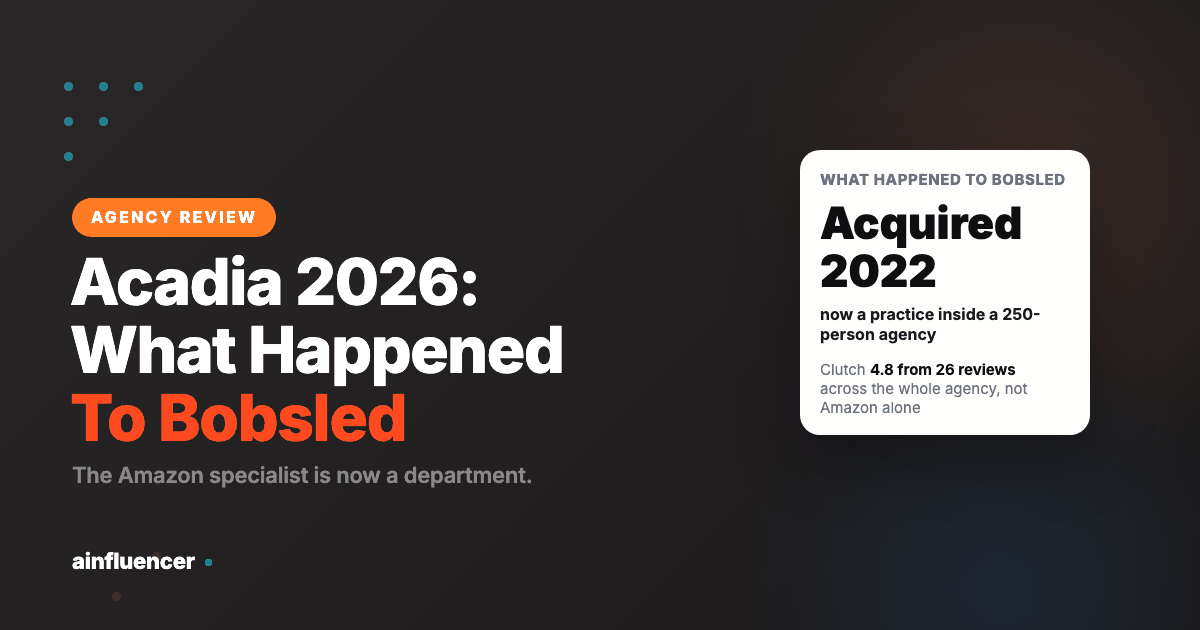
If you came here looking for Bobsled Marketing, you are in the right place and the answer is that it no longer operates independently. Bobsled, for years one of the most respected Amazon marketplace specialists, joined Acadia in early 2022 and its practice now sits inside a much larger full-service digital agency.
That change is the single most important thing to understand before hiring them, because what you get is no longer a boutique Amazon specialist. It is an Amazon team inside a 250-person generalist agency, and whether that is better or worse depends entirely on what you need.
The company behind the name
| Fact | Detail |
|---|---|
| Acadia founded | 2021, in Atlanta, by Sean Belnick and Jared Belsky |
| Bobsled acquired | Early 2022 |
| CRUSH acquired | 2025 |
| Size | 250+ specialists |
| Clutch rating | 4.8 out of 5 from 26 verified reviews |
| Published pricing | None |
Acadia is three years younger than the practice it bought, which is worth noting. This is not an old agency that added Amazon; it is a new agency that acquired an established Amazon team and built outward from there.
The boutique-to-generalist trade
This is the whole decision, so it is worth setting out honestly on both sides.
What you gained. Acadia pairs the marketplace depth it bought with digital media, SEO and analytics under one roof. For a brand whose Amazon business cannot be separated from its paid search, paid social and site performance, that is a real advantage, and it is the argument for consolidating agencies rather than running four.
What you lost. A specialist agency has one practice and everyone in the building wakes up thinking about it. Inside a full-service agency, marketplace is a department competing for attention and talent with every other department. Specialists rarely get sharper after acquisition; they get broader.
The question that settles it. Ask how many people work exclusively on marketplace, and whether your account team works on anything other than Amazon. If the answer is a dedicated marketplace team, you have the best of both. If your strategist also runs paid search for three other clients, you are buying a generalist at a specialist’s price.
What they actually do on Amazon
The marketplace practice is full-service rather than advertising-only, which is less common than it sounds.
- Account management across both Seller Central and Vendor Central. The Vendor Central capability matters: far fewer agencies handle it well and it is where brand manufacturers get stuck.
- Amazon SEO and listing optimisation
- PPC and DSP campaign management, so retail media as well as search
- Brand registry and compliance
- Multi-channel ecommerce strategy beyond Amazon
The combination of Seller Central and Vendor Central under one team is the strongest practical reason to shortlist them over an Amazon advertising specialist.
What clients say
Acadia, as Clutch reports it
Read 6 October 2026. Twenty-six verified client interviews is a solid sample for an agency of this size and better evidence than most Amazon agencies offer. Note that the reviews span Acadia as a whole, not the marketplace practice alone.
That last point is worth holding onto. A 4.8 across a full-service agency tells you the company delivers; it does not isolate how the Amazon team performs. If marketplace is the only reason you are hiring them, ask for references from marketplace clients specifically.
What to write into the contract
Everything above in this Acadia review is diligence before signing. These are the terms that protect you afterwards, and all four cost the agency nothing to agree at the start and are close to impossible to add later.
- Name the people. Put the account lead and the day-to-day contact in the contract by name, with a stated minimum time commitment. Also agree what happens if they leave: usually a right to review the relationship rather than a penalty, which is reasonable to both sides
- Cap the renewal uplift. An uncapped renewal is a blank cheque in year two. The cap costs nothing today, which is exactly why it is available now and not in eleven months
- Agree the exit before you need it. Notice period, what data you get back, in what format, and how long after termination. Account access, creative assets, reporting history and documentation should all be named explicitly rather than covered by a general clause
- Set a short initial term with a review. Three months with a defined checkpoint tells you more than any pitch. An agency confident in its onboarding will usually accept it
A fifth term is worth adding if your programme is seasonal: agree in writing what happens to the fee in your quiet months. Agencies will frequently accept a reduced retainer out of season when asked at signature, and almost never when asked in the quiet month itself, because by then it reads as a request for a discount rather than a scoping decision.
One clause specific to an acquired specialist: ask for a right to review if the service line is restructured or the named lead moves on. You are buying a particular team inside a larger organisation, and organisations reorganise. That is not a reason to avoid them. It is a reason to write down what you are actually relying on, so that if it changes you find out through a contract rather than through your results.
What happens to a boutique after it is acquired
This Acadia review turns on one question, and it is the same question for every acquired specialist: did the thing you wanted survive the purchase? The pattern is consistent enough to be worth knowing.
In the first year, usually very little changes. The team stays, the clients stay, and the acquiring agency has every reason to keep it that way. The changes arrive later and they arrive quietly:
- Senior people leave on their earn-out schedule. Founders and leads typically have two to three year commitments. When those end, departures cluster, and the expertise you were buying frequently leaves with them
- The specialist practice becomes a service line. It stops being the whole company and becomes one department competing internally for headcount against larger revenue lines
- Account allocation changes. In a boutique, a mid-size client gets senior attention because there is nobody else. In a large agency, a mid-size client gets whoever is available
- Process replaces judgement, in both directions. You gain reliability, consistent reporting and someone to call when your contact is on leave. You lose the speed of a small team making decisions without approval
None of that is a criticism. It is the trade a larger agency makes deliberately, and for plenty of clients it is the better deal. It is simply not the thing that was bought.
How to tell whether the specialist team is still there
This is the part of an Acadia review you cannot outsource to a page like this one, because the answer changes month to month. You can settle it in one call if you ask precisely, and precision is what gets you a real answer rather than reassurance.
- “Who would run my account, and when did they join?” A name with a pre-acquisition start date is the strongest signal available. A name with a recent one is not disqualifying, but it changes what you are buying
- “How many people work on this specialism full time?” Not how many are available to it. Full time
- “Which of the original leadership is still here?” Ask it directly. The answer is public enough that nobody can dodge it comfortably
- “What is your longest-standing client on this service, and who has run it throughout?” This one question tests continuity, capability and honesty at the same time
The tell is not the answer so much as the ease of it. An agency that has retained its specialists enjoys these questions. One that has not will redirect to process, documentation and bench strength, all of which are real things and none of which is what you asked.
When a generalist is genuinely the better buy
It would be easy to read this Acadia review as an argument for boutiques. It is not, and the cases where scale wins are specific. Worth noting that much of what an Amazon practice does now runs through Amazon’s own advertising platforms, which are the same tools at any agency size. What differs is who operates them and how much of their week you get.
- You need more than one channel handled coherently. A specialist in one channel cannot coordinate across four, and four specialists coordinating themselves is a job somebody at your company ends up doing
- You need the agency to survive its own staff changes. A boutique losing two people is a crisis. A large agency losing two people is a Tuesday, and continuity of service has real value when your programme cannot pause
- Procurement requires it. Insurance levels, security review, references at your scale and payment terms are routine for a large agency and sometimes impossible for a small one
- Your spend justifies senior attention anywhere. Above a certain budget you get good people at any agency, and the boutique premium stops buying you anything
The honest summary: if you want deep expertise in one channel and you are a meaningful client to a small firm, a boutique is usually better. If you need several channels held together, or you need the relationship to outlast any individual, scale is worth what it costs.
Worth adding one practical note about timing. If you are evaluating an agency within a year or two of an acquisition, you are looking at it during the period when least has changed, which is the least informative moment. The questions above about named leads and start dates matter more in that window than they would at a firm with no recent ownership change, because the answers are about to move.
There is a third situation that catches people out, and it is the most common one of the three. Plenty of brands want boutique attention at generalist scale, and no agency sells that because it does not exist at a price anyone will pay. What you can do is pick the trade deliberately rather than discovering it in month four: decide now whether continuity or depth matters more to you, write that into how you choose, and accept the cost of whichever one you did not pick.
What to press on
| Complaint | What reviewers describe | What to do about it |
|---|---|---|
| Specialist absorbed into a generalist | Bobsled was a dedicated marketplace practice. It is now a department inside a 250-person full-service agency, four years after the acquisition. | Ask how many people work only on marketplace and whether your named team touches other channels. This is the question the rating does not answer. |
| Reviews cover the whole agency | The 4.8 from 26 reviews is for Acadia across all services, not for the Amazon practice in isolation. | Ask for two references who hired them specifically for marketplace work, and speak to them without the agency on the call. |
| No published pricing | No rate card at any level, which is standard for agencies at this size but means the evaluation begins with a sales process. | Decide your ceiling before the first call and say it early, so the proposal is built to your budget rather than to their packages. |
| Acquisition-built organisation | Acadia was founded in 2021 and has acquired at least twice since, Bobsled in 2022 and CRUSH in 2025. Integration is ongoing by definition. | Ask which acquired team your account sits with and how long it has run in its current structure. A specific answer is a good sign. |
| The brand confusion itself | Bobsled’s site and name still circulate, and several agency directories still list them separately, so buyers are not always clear who they are contacting. | Confirm in writing which legal entity you are contracting with and which team delivers. |
Acadia pros and cons
Pros
- 4.8 out of 5 on Clutch from 26 verified reviews, a solid sample for this category
- Inherited Bobsled Marketing, long one of the most respected Amazon marketplace practices
- Handles both Seller Central and Vendor Central, which many Amazon agencies do not
- PPC and DSP together, so search and retail media under one team
- Amazon depth combined with digital media, SEO and analytics in one agency
- 250+ specialists, so capacity is not a constraint
- Brand registry and compliance work included rather than referred out
- Multi-channel strategy beyond Amazon for brands selling in several places
Cons
- The Amazon specialist you may be looking for is now a department inside a generalist agency
- Reviews cover the whole agency, not the marketplace practice specifically
- No published pricing at any level
- Built through acquisition, with at least two since 2021, so integration is continuous
- Brand confusion persists, with Bobsled still listed separately in places
- Likely more agency than a small or single-channel Amazon seller needs
Who Acadia suits
A good fit if you are a brand manufacturer on Vendor Central, or your Amazon business is tangled up with your paid search, paid social and site performance and you want one agency across all of it. The Seller Central plus Vendor Central combination is genuinely hard to find.
A poor fit if you wanted Bobsled specifically, meaning a small dedicated marketplace team where you are a significant client. That agency does not exist any more and no amount of due diligence will bring it back.
Acadia alternatives
| Option | Entry | Choose it when |
|---|---|---|
| Levanta | $750/mo plus 3.5% | You want Amazon affiliate and creator revenue rather than account management |
| Ainfluencer | Free, managed from $1,500/mo | Creator campaigns for Amazon products without an agency retainer |
| Stack Influence | $39 per completed post | You need volume UGC for listings and social, paid on delivery |
| AMZ Tracker | Software subscription | You want tooling and will run the account in house |
The verdict
Acadia is a strong full-service agency that happens to own an excellent Amazon practice. The 4.8 from 26 reviews is earned and the Vendor Central capability is a real differentiator.
Just be clear about which company you are hiring. If you want one partner across marketplace and the rest of your digital marketing, this is one of the better answers available. If you specifically wanted a boutique that does nothing but Amazon, that was Bobsled, and Bobsled became part of something larger in 2022.
What happened to Bobsled Marketing?
Bobsled joined Acadia in early 2022. Its Amazon marketplace practice now operates inside Acadia, a full-service digital agency founded in 2021 in Atlanta with more than 250 specialists. The Bobsled name still appears in some directories, which causes confusion, but it is not an independent agency any more.
How much does Acadia cost?
There is no published pricing at any level. Engagements are quoted per client, which is standard for agencies of this size. Set your budget ceiling before the first call so the proposal is built around it rather than around their standard packages.
Does Acadia handle Vendor Central?
Yes, both Seller Central and Vendor Central. That combination is less common than it sounds and is the strongest practical reason for a brand manufacturer to shortlist them over an Amazon advertising specialist.
Is Acadia’s 4.8 rating about the Amazon team?
Not specifically. The 4.8 from 26 verified Clutch reviews covers Acadia across all its services. If marketplace is the only reason you are hiring them, ask for references from clients who engaged them for marketplace work in particular.