How to Get Sponsored on YouTube
YouTube deals are priced on projected views, not subscribers. The four formats, the pricing formula, where deals come from and the terms that matter.
Most advice on this question is written for Instagram and then relabelled. It tells you to grow your following, build a media kit and wait for brands to find you. On YouTube that advice will cost you a year.
YouTube sponsorship runs on different rails. Deals are priced against the views a video is projected to earn, not against your subscriber count. The deliverable comes in four formats that are worth very different amounts. The video keeps earning for years, which changes what you should argue about in the contract. And almost nothing arrives on its own.
This page covers how the money is actually calculated, which channel sizes really get paid, the four routes to a deal, and the terms that matter when the asset you are selling never expires.
Why YouTube Sponsorship Is Not Instagram Sponsorship
Three structural differences decide almost everything else on this page.
What changes when the platform is YouTube
| Instagram and TikTok | YouTube | |
|---|---|---|
| What the price is based on | Follower count, quoted as a flat fee per post | Projected views over roughly 30 days, quoted at a cost per thousand |
| What you are selling | One post or one video, broadly one shape | Four different formats, from a 15 second mention to a dedicated video, at very different prices |
| How long it earns | Most of the reach lands in 48 hours | A video accumulates views for years, so the brand gets value long after they paid |
| Where the deals come from | A meaningful share arrives inbound through marketplaces and DMs | Mostly outbound. See the numbers two sections down |
The last row is the one creators underestimate, so it is worth putting a number against it.
The Four Sponsorship Formats, and What Each One Sells
A brand is not buying “a video”. They are buying one of these, and knowing which one you are quoting for is the difference between a fair price and a guess.
YouTube sponsorship formats, from cheapest to most expensive
| Format | What it is | What the brand is paying for | Relative price |
|---|---|---|---|
| Pre-roll mention | 15 to 30 seconds at the top of the video, before your content starts | Reach. Everyone who clicks hears it, including the people who leave | Lowest |
| Mid-roll integration | 60 to 90 seconds woven into the video, usually a third of the way in | Attention. Only engaged viewers are still watching, so it converts better than pre-roll | The standard, and usually the best value for both sides |
| Dedicated video | The whole video is about the product | Your credibility, transferred. Also a searchable asset that keeps appearing for product queries | Several times an integration |
| Series or season sponsor | A run of videos over weeks or months | Repetition, which is what actually moves purchase intent | Highest, and the only one that gives you predictable income |
Quote all four when you reply to a brand. It moves the conversation from “what do you charge” to “which of these do we want”, and the second conversation is the one you win.
How a YouTube Sponsorship Is Actually Priced
The formula brands use is simple, and once you know it you stop guessing:
Your fee = projected views ÷ 1,000 × the agreed cost per thousand.
Projected views is the part you control. It is not your subscriber count and it is not your best video. Take the median views of your last 10 videos at the 30 day mark and use that. A median is harder to argue with than an average, because one viral video cannot inflate it.
A worked example
These numbers are an illustration of the arithmetic, not a rate card. Rates vary enormously by niche, and finance, software and education command far more than entertainment.
The same channel, four formats, one worked example
| Format | Projected views | Example rate per 1,000 | Fee |
|---|---|---|---|
| Pre-roll mention | 40,000 | $12 | $480 |
| Mid-roll integration | 40,000 | $22 | $880 |
| Dedicated video | 40,000 | $45 | $1,800 |
| Four video series | 160,000 across 4 | $25 | $4,000 |
Two things fall out of the formula that are worth saying plainly. A channel with 8,000 subscribers whose videos reliably do 40,000 views is worth more than a channel with 80,000 subscribers whose videos do 9,000, and brands who price this way know it. And if your views are climbing, you are entitled to project forward rather than quote your past.
For the wider question of what to charge across platforms, see our guide to sponsored post pricing, and how many views is good for a sponsored YouTube video for the benchmark question brands ask in the other direction.
The Subscriber Count Myth, Measured
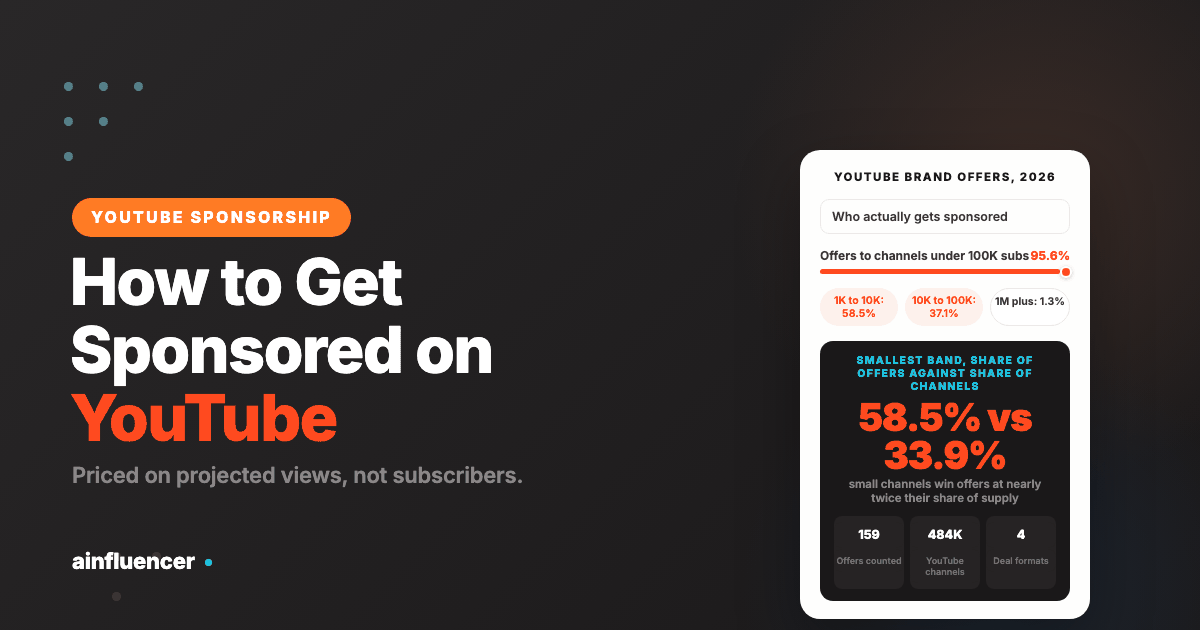
The most expensive belief in this topic is that sponsorship starts at some subscriber threshold. We counted the brand offers that reached YouTube channels on our own platform in 2026 to date, against the number of channels in each size band.
Brand offers to YouTube channels in 2026, by subscriber band
| Subscriber band | Channels on the platform | Offers received | Share of offers | Share of channels |
|---|---|---|---|---|
| 1,000 to 10,000 | 163,945 | 93 | 58.5% | 33.9% |
| 10,000 to 100,000 | 213,020 | 59 | 37.1% | 44.0% |
| 100,000 to 1M | 90,095 | 5 | 3.1% | 18.6% |
| 1M and above | 16,671 | 2 | 1.3% | 3.4% |
95.6% of the offers went to channels under 100,000 subscribers, and the smallest band took 58.5% of all offers while making up only 33.9% of the channels. Being small is not what is stopping you.
The honest caveat: this is 159 offers, which is a small sample, and it measures demand on one marketplace rather than the whole industry. Treat the direction as reliable and the exact percentages as indicative.
If you want the threshold question answered for every platform rather than YouTube alone, we covered it in how many followers you need to get sponsored.
The Four Routes to a YouTube Brand Deal
Here is the number that should change how you spend your time. Across the same marketplace, brand offers sent in the three months to October 2026 split like this: Instagram 4,716, TikTok 4,505, YouTube 159.
YouTube creators get a fraction of the inbound demand that Instagram and TikTok creators get. That is not a judgement about YouTube’s value to brands, which is high. It reflects where brand workflows currently sit. The practical consequence is blunt: on YouTube, waiting is not a strategy.
Where YouTube brand deals come from, ranked by effort
| Route | What it is | Effort | Honest assessment |
|---|---|---|---|
| YouTube Creator Partnerships | YouTube’s own brand matching hub, inside Studio. Formerly called BrandConnect | Low, once you are eligible | Worth switching on and then forgetting about. Demand is not large enough to build a plan around |
| Creator marketplaces | Platforms where brands post campaigns and creators apply or get invited | Low | The fastest way to get a first paid deal on your record, because you can apply rather than wait |
| Direct outreach | Emailing the brands you already use and already talk about | High | Where the real money is on YouTube. Lowest reply rate, highest fees, and the only route that scales with your own judgement |
| Talent agencies and MCNs | Someone sells on your behalf for 10% to 20% | Low for you | Realistic above roughly 100,000 subscribers. Below that, most will not take you on |
Run the first two in the background and spend your actual effort on the third. A sensible rhythm is five well researched emails a week, which is about an hour, and nothing about that hour depends on your subscriber count.
What a Brand Checks Before They Say Yes
When a brand asks for “your numbers”, they are not asking for your subscriber count. These are the figures that decide the deal, and every one of them is in your own YouTube Analytics.
The five numbers that decide a YouTube sponsorship
| What they ask for | Where it lives | Why it decides the deal |
|---|---|---|
| Median views, last 10 videos | Analytics, Content tab | This is the number the fee is calculated from. Give the median, not the best |
| Average view duration and percentage | Analytics, Engagement tab | A mid-roll integration is worthless if viewers leave at minute two. This is what proves they do not |
| Audience geography | Analytics, Audience tab | A brand that ships to the US only cannot use an audience that is 70% elsewhere, whatever the view count |
| Returning versus new viewers | Analytics, Audience tab | Returning viewers are the ones who trust a recommendation. A high share here justifies a higher rate |
| Traffic sources | Analytics, Reach tab | Search-driven views keep arriving for years. Browse-driven views mostly do not. This is your argument for the long tail |
Send these as a short, plain summary in the email body. A brand marketer reading on a phone will not open a PDF before they have decided they are interested.
The Pitch, and Why Video Changes It
An Instagram pitch sells an audience. A YouTube pitch sells a specific video, which is a much easier thing for a brand to say yes to because they can picture it.
Name the video you would make. Not “I would love to collaborate”, but “I am filming a comparison of budget microphones in three weeks and your X200 belongs in it”. That single change does more for reply rates than anything else on this page, because it converts an open-ended request into a decision with a deadline.
What to put in the email, in order
- The video. Title, topic, filming date, publication date.
- Why their product. One sentence proving you know it, ideally because you already use it.
- The numbers. Median views on your last 10, average view duration, top two audience countries.
- The format and the price. Name one, with the fee. Offer the other three as options underneath.
- One link. Your best relevant video, not your channel homepage.
Send it to a brand or partnerships manager, not to the generic info address. If you cannot find a name, the social media manager is a better guess than the inbox nobody owns.
The Contract Terms That Matter on a Permanent Video
This is where YouTube creators lose money quietly, because the asset they sold keeps working for years and most contracts are written as though it stops at day 30.
- Usage rights and the window. Can the brand run your footage as a paid advert, and for how long? Perpetual worldwide usage is not a detail thrown in at the end. It is a separate product and it is worth more than the video itself.
- Exclusivity. Which competitors are you blocked from, and for how long? A twelve month category exclusivity on a mid-roll mention is a year of lost deals for the price of one.
- Takedown and edit rights. Can the brand require you to remove or re-edit the video later? If so, you have sold an asset you may have to destroy.
- Revisions. Agree a number, normally one round, before you film. Unlimited revisions turn a good fee into an hourly rate you would refuse.
- Payment terms. Net 30 from publication is standard. Net 90 is a financing arrangement you are providing for free. Ask for 50% up front on anything above your usual fee.
- Approval before publication. Normal and reasonable. Approval of your opinion is not. Keep the right to say what you actually think.
If you take one thing from this section: the long tail is yours unless you give it away. Price perpetual usage separately, every time.
Disclosure Is Not Optional, and It Is Two Steps
Every paid sponsorship has to be disclosed, and on YouTube that means doing two separate things, because one does not substitute for the other.
- Tick the paid promotion box. In YouTube Studio, under the video’s details, there is a setting that declares the video contains paid promotion. It adds YouTube’s own disclosure card to the start of the video.
- Say it out loud, early. Regulators including the FTC require disclosure that a viewer actually notices. A line in the first fifteen seconds, in your own words, does that. A hashtag at the bottom of the description does not.
Creators sometimes worry this costs them the audience’s trust. The reverse is true in practice. The channels that disclose clearly and still criticise parts of the product are the ones brands pay the most, because their recommendation is worth something.
What Gets a Creator Dropped After One Deal
The second deal with a brand is far easier to win than the first, and it is lost for ordinary reasons rather than creative ones.
- No report afterwards. Two weeks after publication, send views, average view duration, comments mentioning the product, and clicks if you used a tracked link. Almost nobody does this, which is exactly why it works.
- Missing the publication date. Brand campaigns are planned around dates. A week late can mean the campaign is over.
- Burying the segment. If the integration sits at minute 18 of a 20 minute video, the brand sees it in the retention graph.
- Reading the script. The brand hired your voice. Take their talking points and say them the way you speak.
- Going quiet on the invoice. Send it the day the video goes live, with the agreed terms on it.
Frequently Asked Questions
How many subscribers do you need to get sponsored on YouTube?
There is no threshold. Of the brand offers that reached YouTube channels on our platform in 2026, 95.6% went to channels under 100,000 subscribers and 58.5% went to channels between 1,000 and 10,000. What matters far more is whether your views are consistent and your audience is in a country the brand sells to.
How much should I charge for a YouTube sponsorship?
Price it as projected views divided by 1,000, multiplied by an agreed cost per thousand. Use the median views of your last 10 videos at the 30 day mark as the projection, because a median cannot be inflated by one viral video. The rate per thousand varies widely by niche, and a dedicated video is worth several times a mid-roll mention.
What is the difference between a pre-roll, an integration and a dedicated video?
A pre-roll is a 15 to 30 second mention before your content starts, and it sells reach. An integration is 60 to 90 seconds inside the video, and it sells the attention of viewers who stayed. A dedicated video is the whole video, and it sells your credibility plus a searchable asset. Prices rise in that order.
How do I find brands to sponsor my channel?
Four routes, and they are not equal on YouTube. Switch on YouTube’s own Creator Partnerships hub in Studio, join a creator marketplace so you can apply to campaigns rather than wait, and then spend your real effort on direct outreach to brands you already use. Agencies become realistic above roughly 100,000 subscribers. Inbound demand on YouTube is thin: in the three months to October 2026 we recorded 4,716 brand offers to Instagram accounts, 4,505 to TikTok and 159 to YouTube.
Do I have to disclose a paid YouTube video?
Yes, and twice. Tick the paid promotion setting in YouTube Studio, which adds YouTube’s own disclosure card, and say it in your own words inside the first fifteen seconds. A hashtag buried in the description does not meet the standard regulators apply.
What is YouTube BrandConnect called now?
Creator Partnerships. YouTube retired the BrandConnect name in 2026 and the programme now sits under the Earn section of YouTube Studio. It requires YouTube Partner Program membership, which starts at 500 subscribers, three valid public uploads in the last 90 days, and either 3,000 qualified watch hours in 12 months or 3 million qualified Shorts views in 90 days.
Can I get sponsored on YouTube without being monetised?
Yes. Brand deals are a private arrangement between you and the brand, so the Partner Program is not a requirement for them. It is a requirement for YouTube’s own Creator Partnerships hub, and for ad revenue, but a brand can pay you directly whatever your monetisation status.
Start With the Deals You Can Apply For
Direct outreach is where the money is, and it is slow. While you build that habit, the fastest first paid deal on your record comes from a marketplace where brands post campaigns and you apply, instead of waiting to be found. You can list your channel on Ainfluencer free, apply to open campaigns, and negotiate in the platform.
Related reading: how to become a YouTube influencer, YouTube monetization requirements, how much YouTubers make, and the sibling guides for Instagram and TikTok.