Influencer Marketing Campaigns: 12 Proven for 2026
Twelve campaigns with the numbers attached, and one pattern in our own data that contradicts how most brands pick creators.
Most roundups of influencer marketing campaigns list famous brands and leave out the numbers. This one starts with the numbers, because we have 33 campaigns of our own with the results published, and they show something most brands get backwards.
The Pattern in Our Own Campaign Data
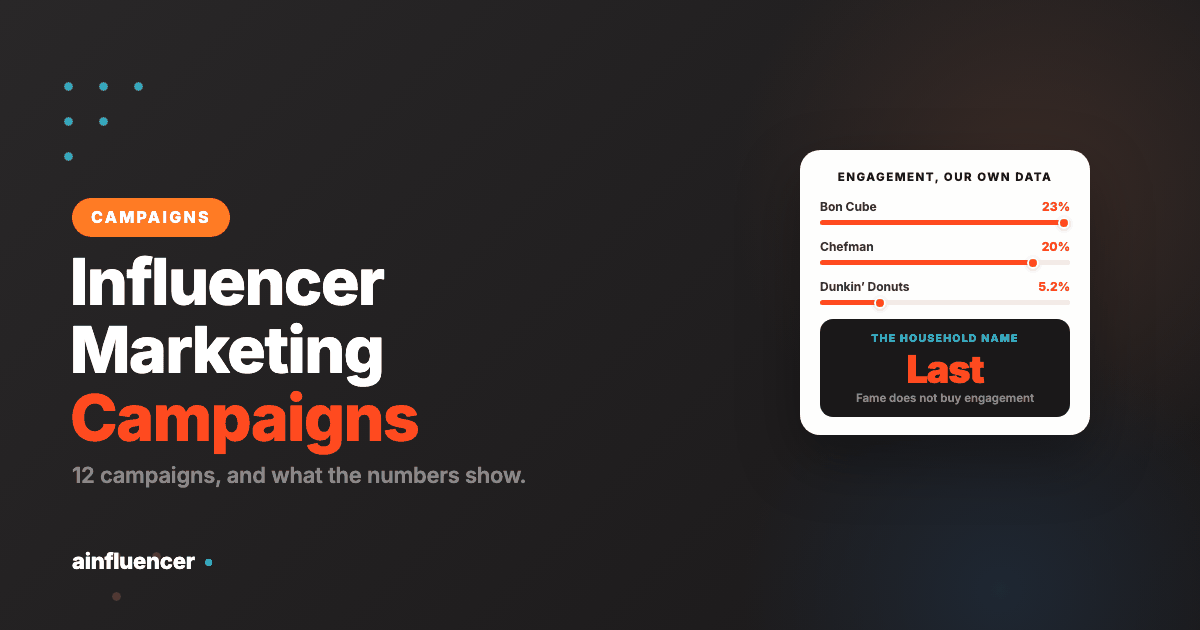
Before the list, the finding. These are engagement rates from campaigns run on our platform, taken from our published case studies. Sorted by engagement rather than by reach, the order is close to the reverse of what brand size would predict.
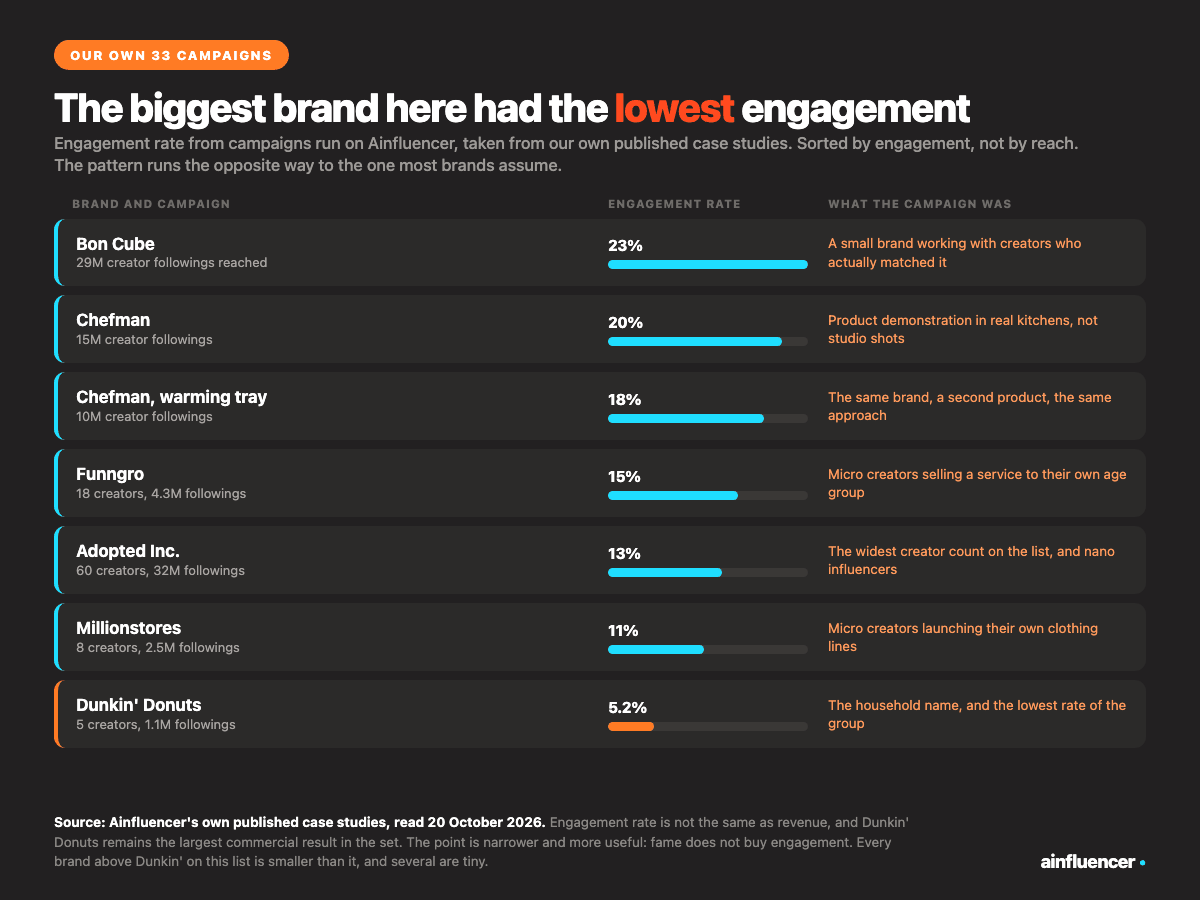
Dunkin’ Donuts is the most recognisable brand in the set and sits last at 5.2%. Bon Cube, Chefman and Funngro, none of them household names, run between 15% and 23%. Adopted Inc. reached 32 million creator followings across 60 nano creators and still held 13%.
Two honest caveats before anyone over-reads this. Engagement rate is not revenue, and the Dunkin’ campaign remains the largest commercial outcome in the group. And a smaller creator audience makes a percentage easier to move. Neither caveat rescues the assumption that matters here, which is that a bigger name buys you a warmer response. In our data it does the opposite.
The useful reading is narrower and more actionable: fit beats fame. Every campaign near the top of that chart put a product in front of an audience that already cared about the category, rather than in front of the largest audience available.
Why the assumption persists anyway
Reach is the number everyone can see before a campaign runs, and engagement is the number you only learn afterwards. So reach gets used as the proxy, budgets get approved against it, and the creator with the largest audience wins the brief. Nothing in that chain is irrational. It is just measuring the input because the output has not happened yet.
The practical escape is to ask every creator on a shortlist for their own recent engagement rate on comparable posts, then judge your result against that number rather than against an industry benchmark. It converts an unknowable outcome into a comparison you can actually make before signing.
12 Influencer Marketing Campaigns Worth Studying
Each of these is on our platform or publicly documented, and each is here for a specific decision it got right rather than for its fame.
One note on how to read them. Reach and engagement are reported as published, and the brands differ enormously in size, category and budget, so these are not like-for-like comparisons and nothing here is a league table. Each entry is worth studying for one decision, which is named in the paragraph.
1. Dunkin’ Donuts: five creators, not five hundred
Promoting its first handcrafted espresso drinks, Dunkin’ worked with five nano and micro creators on Instagram reaching 1.1 million followings, producing five pieces of content at a 5.2% engagement rate. The decision worth copying is the restraint. A brand that size could have bought anyone, and chose a handful of small accounts to make a new product feel discovered rather than advertised.
2. Squarespace: buying the format, not the follower count
Squarespace partnered with 10 YouTube channels across gaming and other niches, reaching 58 million and drawing 34 million views. YouTube integrations are long, spoken and personal, which suits a product that needs explaining. The lesson is that the format did the work, and a shorter format with the same creators would not have.
3. Bon Cube: the highest engagement in our data
23% across 29 million creator followings, the top of the chart above. Worth studying precisely because the brand is not famous, which removes the usual explanation for a strong result.
4. Chefman: the same approach, twice
Chefman ran two campaigns in our data, blenders at 20% across 15 million and a warming tray at 18% across 10 million. The repeat is the interesting part. A result that reproduces on a second product is a process, and a result that happens once is a story.
5. Adopted Inc.: 60 creators for a sensitive subject
A service helping adoptees find birth families, promoted by 60 nano creators across Instagram and TikTok, 32 million followings, 12 pieces of content, 13% engagement. Traditional targeting could not find this audience. Creators could, because their audiences self-select in a way ad targeting cannot replicate.
6. Funngro: creators selling to their own age group
18 creators, 4.3 million followings, 15% engagement, promoting freelance work to 14 to 25 year olds in India. The creators were inside the audience rather than addressing it, which is the single most repeatable thing on this list.
7. Millionstores: making the creator the product
8 micro creators, 2.5 million followings, 11% engagement, launching their own clothing lines with no upfront cost. The campaign worked because the creator had something at stake, which no fee structure reproduces.
8. Side FX Partners: 24 pieces from 4 creators
A production studio working with four TikTok creators across 1.89 million followings, producing 24 pieces of content at 9%. Note the ratio. Six pieces per creator is a relationship, not a transaction, and it costs far less than finding 24 creators.
9. Cosynee Life: a tiny audience, a strong rate
419,000 creator followings and 14% engagement. Included as the counterweight to every campaign on this page with millions in the reach column, because it reached a fraction of them and outperformed most on response.
10. Krudy Monkey: 186,000 followings, 15%
The smallest reach in our published set and among the highest engagement. If you are a brand with a modest budget looking at this list and assuming none of it applies to you, this is the entry that says otherwise.
11. FTR Global: 10% in a category nobody calls exciting
350,000 followings at 10%. Unglamorous categories are consistently underserved by creator marketing, which means less competition for the right creators and lower prices.
12. Canine Journal: 8%, and why it is still here
The lowest engagement rate among the smaller brands in our set. Included deliberately, because a list where every campaign succeeds brilliantly is a sales page. 8% in a crowded pet category is a workmanlike result, and workmanlike results are what most campaigns should be planned around.
What the Strongest Campaigns Had in Common
Reading the twelve against each other, four things separate the top of the chart from the bottom, and none of them is budget.
- The creator was inside the audience. Funngro’s creators were the age of its users. Millionstores’ creators wanted clothing lines. The campaigns at the bottom used creators who were adjacent to the audience rather than part of it
- The product could be shown working. Chefman in a real kitchen. A format that demonstrates beats a format that announces, which is why the same brand repeated it
- Creator count matched the goal. Adopted used 60 creators to find a scattered audience. Dunkin’ used five to make a product feel discovered. Both were deliberate, and a brand that cannot say why it picked its number has not made the decision
- Content volume per creator was high where it mattered. Side FX got 24 pieces from four creators. Repeat appearances from the same person read as endorsement. One post reads as an ad
If you are planning your first campaign rather than studying other people’s, how to create an influencer marketing campaign walks through the build, and B2B influencer marketing covers the version of this where the buyer is a company.
And the thing none of them had
None of the strongest campaigns in this set relied on a single large creator. Even Squarespace, with the biggest reach on the page, spread 34 million views across ten channels rather than buying one enormous placement. That is a risk decision as much as a performance one: one creator having a bad month, or a post that lands wrong, takes the whole campaign with it.
It is also a learning decision. Ten collaborations produce ten readings of what works, and one produces an anecdote. Brands that run creator marketing well treat the first campaign as the instrument that tells them how to run the second.
How to Structure a Campaign That Can Be Judged
The most common failure in this category is not a bad campaign. It is a campaign nobody can evaluate afterwards, because no one decided in advance what would count as working.
- Name the single outcome. Awareness, signups, sales or content you can reuse. Campaigns chasing all four produce enough of none to justify the spend
- Pick the creator count from the goal. A scattered audience needs many small creators. A product that needs explaining needs few, longer collaborations
- Decide the content volume per creator before you negotiate price. It changes the rate, and asking afterwards is how briefs fall apart
- Agree usage rights in writing. Content you can run as paid media afterwards is frequently worth more than the organic reach you bought it for
- Set the measurement window before launch. Engagement lands in days, signups in weeks, search demand in months. Reading all three at the same point tells you nothing
That last point is where most reported results come apart. A campaign judged at day three looks like an engagement play whatever it was designed to do.
A brief the creator can actually use
The best briefs in this set are short and specific in an unusual combination: very clear about the product truth and the few things that must not be said, and very loose about everything else. The instinct to supply a script comes from wanting control, and it removes the only thing you were paying for, which is a voice the audience already trusts.
A workable brief fits on one page: what the product does, who it is for, the one thing you want remembered, anything legally required, a short list of claims not to make, and the deliverables with dates. Everything beyond that is usually the brand writing content it could have produced itself for less.
What to Measure, and What to Ignore
Three numbers earn their place in a campaign report. Several popular ones do not.
- Engagement rate, compared against the creator’s own baseline. A 9% campaign with a creator who normally runs 4% is excellent. The same 9% from someone who normally runs 15% is a warning about fit
- Cost per piece of content, including usage rights. Side FX’s 24 pieces from four creators is a very different cost structure from 24 pieces from 24 creators, and only this number shows it
- Branded search volume during and after. The honest proxy for awareness, and the one metric a creator cannot inflate
What to leave out: follower counts of the creators you worked with, which measure what you bought rather than what happened; impressions without engagement, which is reach you have no evidence anybody processed; and any single viral post treated as the campaign result, because one outlier tells you about that post.
There is also a timing problem specific to this channel that no dashboard fixes. A creator’s audience does not act the moment they see something. They remember it, and they act when the need arises, which may be weeks later and will arrive through search or directly. Any attribution model built on last click will record that as organic or direct and credit the campaign with nothing. This is the single most common reason campaigns that worked get reported as failures.
Where Influencer Marketing Campaigns Fail
Four failures account for most disappointing campaigns, and three of them happen before launch.
- Picking for reach. The whole point of the chart at the top of this page. The largest audience available is rarely the most responsive one
- Over-scripting. A creator whose audience trusts their voice, reading your words, converts worse than the same creator left alone with a clear brief and a short list of things not to say
- One post and out. Single appearances read as advertising. The campaigns here with real repetition per creator outperformed
- No plan for the content afterwards. Most brands buy a month of organic posts and let assets they paid for expire, when the same content could have run as paid media for a year
The pattern underneath all four is treating a campaign as media buying with a person attached. The entries at the top of our chart treated it as a collaboration with somebody whose audience they had to deserve.
The failure that is nobody’s fault
Some campaigns are planned well, briefed well and executed well, and produce a mediocre number because the product was not interesting to that audience. This happens, it is not a marketing failure, and treating it as one leads brands to blame the creator, churn through agencies and repeat the same campaign with new faces. The useful response is to test a different audience before testing a different creator, because the audience is the variable the data above says matters most.
Disclosure, and the Part Brands Get Wrong
Every campaign on this page is advertising, and advertising has to look like advertising. The FTC’s Disclosures 101 for Social Media Influencers is short, free and more specific than most brand guidelines, and it contradicts several habits that are common in this industry.
Four points that most briefs get wrong:
- Free product counts. The FTC states that financial relationships “aren’t limited to money”, and that if a brand gives free or discounted products, a disclosure is needed “even if you weren’t asked to mention that product”. Gifting campaigns are not outside this
- Placement decides whether it counts. Disclosures “are likely to be missed if they appear only on an ABOUT ME or profile page, at the end of posts or videos, or anywhere that requires a person to click MORE”, and should not be mixed “into a group of hashtags”
- Video needs it in the video. The guidance is explicit that in a video the disclosure “should be in the video and not just in the description”, and that in a live stream it should be repeated periodically
- The shorthand everybody uses is named as inadequate. The FTC says not to use “vague or confusing terms like ‘sp,’ ‘spon,’ or ‘collab,’ or stand-alone terms like ‘thanks’ or ‘ambassador’”. Plain words such as “advertisement”, “ad” and “sponsored” are fine
The FTC also notes that a platform’s own disclosure tool should not be assumed sufficient on its own, though it is worth using alongside a proper disclosure. And it is blunt that the responsibility sits with the person posting: “Don’t rely on others to do it for you.”
For a brand, the practical consequence is that disclosure belongs in the brief rather than in the contract’s small print. Tell the creator what wording you expect and where it goes, then check the post. A campaign that performs well and is not disclosed properly is a liability you paid for, and the brands at the top of the chart on this page had nothing to gain by hiding what they were doing.
Rules outside the United States differ and are in places stricter. If you are running the same creative into the United Kingdom, the disclosure standard is set by the CMA and carries penalties calculated on global turnover, which we cover in the UK agency guide.
Frequently Asked Questions
What makes an influencer marketing campaign successful?
On our own data, fit rather than fame. The brands with the highest engagement rates in our case studies are mostly not household names, and the most recognisable brand in the set had the lowest rate at 5.2%. Campaigns that put a product in front of an audience that already cares about the category outperform campaigns that chase the largest available audience.
How many creators should a campaign use?
It depends on whether your audience is concentrated or scattered. Adopted Inc. used 60 nano creators to reach an audience traditional targeting could not find. Dunkin’ Donuts used five. Both were deliberate choices, and the number should follow from the goal rather than from the budget.
Do small brands get worse results?
Not in our data. Krudy Monkey reached 186,000 followings and ran at 15%, higher than campaigns with a hundred times the reach. A smaller base makes a percentage easier to move, but it does not explain the whole gap.
What engagement rate should I expect?
There is no universal benchmark, which is why the comparison worth making is against the creator’s own usual numbers rather than against an industry average. Our published campaigns range from about 5% to 23%.
How long should a campaign run?
Long enough for the measurement you chose. Engagement resolves in days, signups in weeks and branded search in months, so a campaign judged at the wrong point will be misread regardless of how it performed.
Is it better to work with one creator repeatedly or many once?
Repetition from one creator reads as endorsement and single posts read as advertising. Side FX Partners produced 24 pieces from four creators, which is a different and usually cheaper structure than finding 24 people.