The influencer brief ends at the landing page – compliance does not
Review influencer disclosures, landing-page claims and affiliate operator eligibility, using Finland’s gambling rules to show why compliance continues after the click.
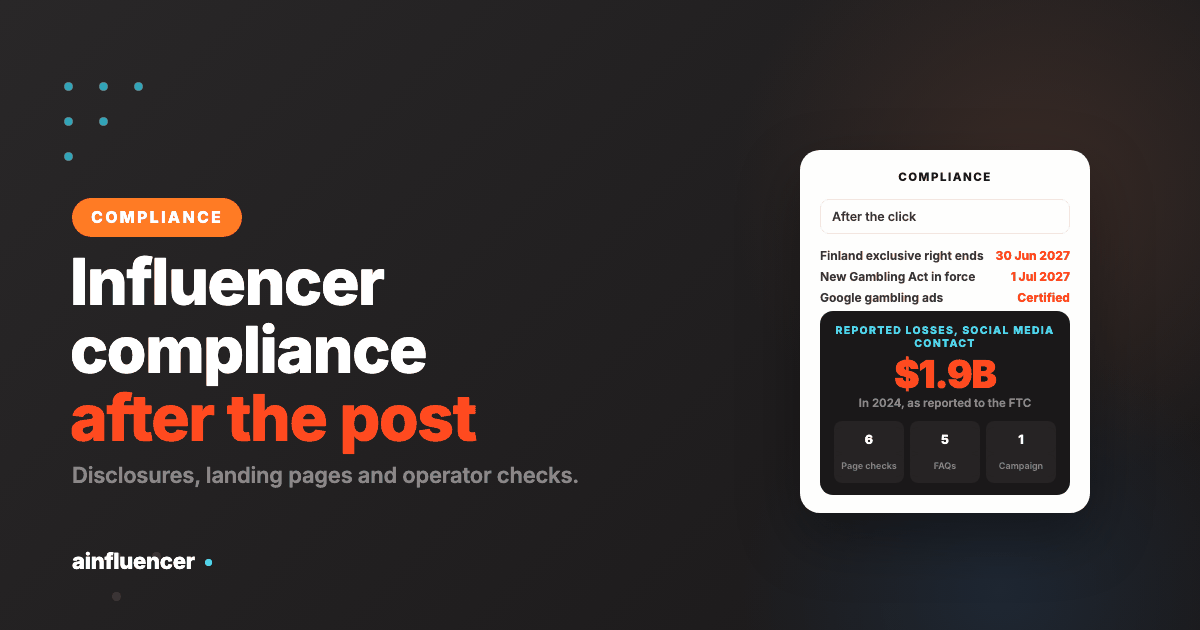
Today, you can achieve everything on the creator side: the post is delivered, the disclosure is in, then the approved link is live. For the people who visit it, that post is just the first step in a more protracted commercial voyage, with the landing page providing new claims, rankings, offers and operator facts that also require inspection. The stakes are tangible, with Federal Trade Commission data recording $1.858 billion in reported fraud losses tied to social media contact during 2024, so there is a significant risk positioned between reading a post and signing up.
That discrepancy shows up across regulated sectors, ranging from finance and healthcare to online gambling. You could endorse every word in a creator’s caption and still send visitors to a page making promises nobody can verify, or pointing them at a service they cannot legally use where they are located. The FTC figure covers social media fraud in general over influencer campaigns, but makes the case for reviewing the entire journey beyond the post itself.
Disclosures travel with the endorsement
In the US, the FTC’s revised 2023 Endorsement Guides outline how advertising law applies to endorsements wherever they are operating. A paid deal, free product, commission or other material connection needs clear disclosure when the audience would not expect it, meaning brands need practical instructions for creators, active monitoring and creator accountability.
If you picture the disclosure on an actual phone screen: a label positioned below the “more” button or concealed by hashtags is easy to miss, with a platform’s partnership tool typically not settling the debate. With video, the disclosure resides in the video itself, spoken aloud when the endorsement is uttered.
Give the landing page its own review
Once someone clicks, confirm that the destination delivers what the endorsement promised. A headline, comparison table or bonus offer can establish an expectation that the fine print discreetly takes back, so read the page as a whole and check the terms, eligibility criteria, fees and significant limitations before you approve it.
Moreover, affiliate setups deserve extra attention, where a comparison site can earn commission when a visitor registers or deposits with an operator. Readers carefully considering its recommendations must know this, so the site should express it candidly and the advertiser should explore how rankings are produced, how claims are supported and if the linked operators can legally serve the target audience.
Affiliate links raise another set of questions
Take the typical Finnish creator, for example: Kasino Ranking is a casino comparison site, listing casino reviews and offers and states that it earns commission when users like you register and deposit through its links. That is useful context for readers, but it does not confirm that every listed operator is authorized for every market or that promoting them is lawful in Finland.
Under Finland’s current rules, the distinction is decisive; the National Police Board states that solely Veikkaus can market gambling services in mainland Finland until June 30, 2027, with its guidance treating affiliate and partner marketing as prohibited gambling marketing. The restriction applies when promotion targets Finnish residents from abroad, so where the creator resides does not make the problem dissipate.
If a Finnish creator directs an adult audience to a comparison service like kasinoranking.com, the campaign review should display the disclosure, age targeting, landing-page claims and operator eligibility in one continuous action. A compliant social post cannot compensate for outdated or market-inappropriate information after the click.
Finland shows why jurisdiction matters
Finland’s new Gambling Act is scheduled to take effect on July 1, 2027, when a licensing framework will let other operators join the market once they have the mandated authorization. Until that date, the future system offers no present-day marketing exemption, so campaigns aimed at Finland get assessed under the law in force on publication day.
The US presents a further test, as online gambling rules vary by state and product. In illustration, a promotion lawful in one state can be ineffective in the next, demonstrating why audience location and operator authorization must be checked in tandem. Google’s current gambling advertising policy also requires certification for covered ads and restricts targeting to approved locations.
The responsibility follows the click
Keep reviewing after launch, because offers pass and operator licenses or market permissions can vary. Put someone on destination appraisals at agreed intervals, keep dated approval records and pause any link whose material details you cannot verify, so your team has a clear response when a live campaign shifts underneath you.
Overarchingly, influencer marketing relies on trust, with that trust bearing harm when a recommendation appears transparent, but the page behind it speaks another narrative. Treat the post, the link and the landing page as interconnected components of a single campaign, where each claim and commercial relationship receives the scrutiny it merits. Ultimately, your brief may close at publication, but the review keeps operating as long as the link is live.