On this page
DMi Partners Review 2026: A Perfect Score, and the Better Signal Behind It
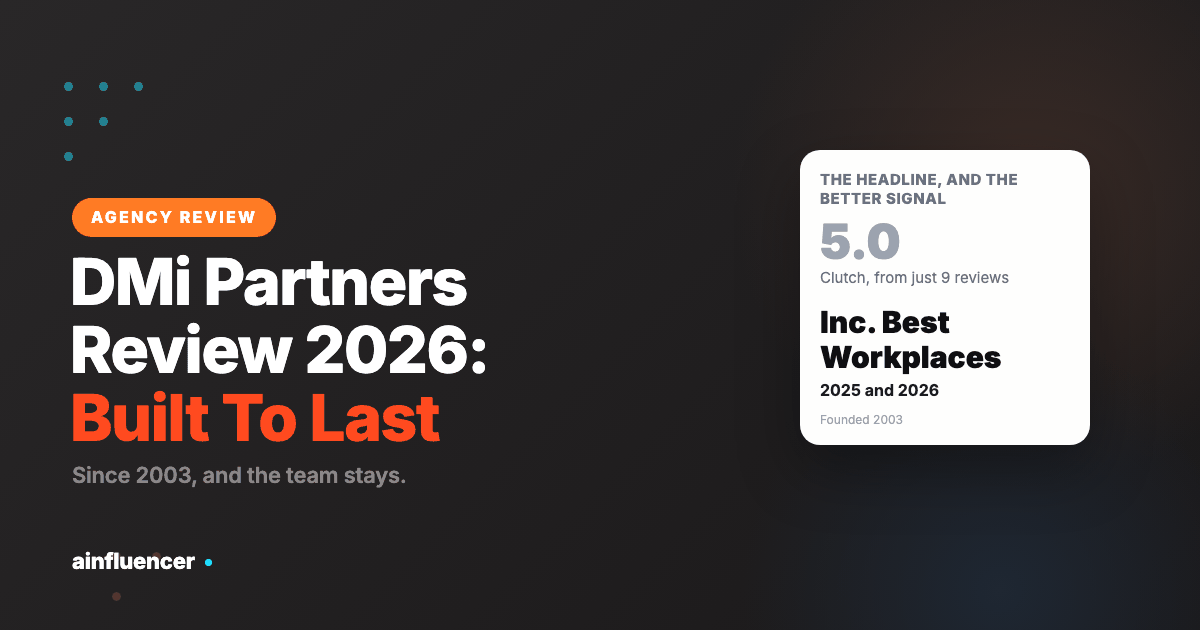
DMi Partners holds 5.0 out of 5 on Clutch. A perfect score is the kind of thing that should make you more sceptical rather than less, and in this case it comes from nine reviews, which is not enough to mean much on its own.
There is a better signal on this agency, and it is one almost no review of an agency bothers to look at. DMi has been named to Inc.’s Best Workplaces list in both 2025 and 2026, and for a business whose product is people, that is worth more than the star rating.
The company
| Fact | Detail |
|---|---|
| Founded | 2003, the oldest agency in this comparison |
| Base | Philadelphia, with staff in California, Georgia and Florida |
| Chief executive | Patrick McKenna |
| Team | 85 people |
| Clients | More than 100 |
| Clutch | 5.0 out of 5 from 9 reviews |
| Minimum project | $5,000+ |
| Hourly rate | $100 to $149, the lowest published in this comparison |
| Reported client spend | Pro bono to over $100,000 a year |
| Partner status | Diamond tier, impact.com Agency Partner Program |
Twenty-three years in a channel that reinvents itself every few years is the most underrated fact on that list. Most of the agencies on this site were founded after 2007 and two were founded after 2020.
Why the workplace award is the useful number
When we reviewed Acceleration Partners the most informative data was not its client reviews, it was its employee reviews: account managers rating the job 3.2 out of 5, with themes of low pay and heavy workload. The conclusion there was that your account lead may not be there next year.
DMi is the same question with the opposite answer. Inc. Best Workplaces is an award based on employee survey responses, and winning it two years running says something specific: the people doing the work intend to stay.
Why a buyer should care. Agency quality is not an abstract property of a company, it is the person who knows your margins, your seasonality and which of your affiliates are worth keeping. Continuity is the single thing that most affects whether year two is better than year one, and it is the thing least visible in a star rating.
What it costs
DMi publishes more pricing detail than most agencies here, and the picture is unusually accessible.
Published hourly rate, agencies compared
Midpoints of the published bands: DMi at $100 to $149 and Gen3 at $150 to $199, both as Clutch lists them, read 6 October 2026. These two are the only agencies in this comparison that publish an hourly rate at all. Everyone else quotes custom.
The $5,000 minimum project puts it in the same band as Gen3 and Envision Horizons, and well above Advertise Purple‘s reported $2,500 a month. But the reported spend range starting at pro bono is unusual and tells you they take work that is not purely commercial.
What they actually do
DMi is not an affiliate specialist. It blends affiliate, influencer and creator marketing, performance PR and TikTok Shop into one model, with SEO, paid media, email and development alongside.
The impact.com Diamond tier is worth noting specifically. Partner tiers are awarded by the platform against performance and certification criteria rather than bought, so it is one of the few independently verifiable signals in agency selection. If you already run on impact.com, this is a direct reason to shortlist them.
Reported results include $17 million in incremental affiliate revenue in year one for clients and a 31% average year-on-year growth rate for new clients. Both are company figures without published methodology. The word “incremental” in the first one is the interesting part, and it is worth asking how they define and measure it.
How to read a perfect rating from a small sample
A 5.0 is the strongest possible score and nine reviews is a small base, and both of those things are true at once. Worth knowing how to weigh it rather than dismissing it or over-reading it.
What a small sample genuinely cannot tell you is the shape of the distribution. An agency with nine perfect reviews and one with ninety averaging 4.6 may be equally good, or the first may simply have asked only the clients it knew were happy. Neither is dishonest. Review collection is a process, and agencies that run it well have more reviews, which is a fact about their marketing rather than their delivery.
What it can tell you, and what is worth reading for:
- Are the reviews recent? Nine reviews spread across six years says something different from nine inside eighteen months
- Do they describe the same service you are buying? A perfect record on affiliate management is weak evidence about paid social
- Are they from companies your size? Agency quality is frequently size-dependent, because a small account at a large agency gets different people
- Do they name a person? Reviews that name the account lead are the ones worth asking about, because you can ask whether that person is still there and whether they would be on your account
That last point connects directly to the continuity record above, and it is the reason the two numbers should be read together rather than separately.
Why affiliate programmes quietly stop growing
Most affiliate programmes do not fail. They plateau, which is harder to notice and harder to fix, and understanding the pattern tells you what you actually need an agency for.
The usual shape: revenue climbs for a year as the obvious publishers are recruited, then flattens. Nothing has broken. The programme has simply recruited everyone who was easy to recruit, and the remaining growth needs work of a different kind.
- The top three publishers become most of the revenue, which looks like success and is concentration risk. If one renegotiates or leaves, the programme halves
- Coupon and loyalty sites absorb the budget, taking commission on sales that were going to happen anyway. Separating incremental from intercepted is the single most valuable analysis in this channel and the one most programmes never run
- Content publishers never get recruited, because they are slow to onboard and slower to convert, and a programme judged monthly never gets to them
- Nobody owns disclosure. Publishers promoting you are making endorsements, and the FTC expects the advertiser to train and monitor the people it pays, saying plainly that a company is responsible for what others do on its behalf. Ask any agency who monitors this and how often
- Commission is flat across every publisher type, which means you are paying the same for incremental revenue and for intercepted revenue
So the question for any agency pitching on an existing programme is not what they would do to grow it. It is: how would you tell which of our current revenue is incremental? An agency with a real answer is worth considerably more than one promising to recruit more publishers, because recruiting more publishers is the part you could do yourself.
What staff continuity actually buys you
The workplace award above is unusual in this category and it is worth translating into something operational, because “good place to work” sounds like a nicety rather than a reason to hire anyone.
Agency churn costs the client specifically, and in ways that are rarely attributed to it:
- Context is rebuilt from scratch. Every handover means re-explaining your margins, your seasonality, the product line that looks like a winner but has a returns problem, the competitor you will not bid against. That knowledge lives in a person, not in a document, whatever the agency says about process
- Judgement resets to cautious. A new account lead will not make the call that the previous one would have made without asking, because they do not yet know whether you want to be asked. Months of small hesitations cost more than one large mistake
- The relationship restarts. The reason you tolerate a bad month is that you trust the person explaining it. A stranger explaining a bad month is just a bad month
So the practical question to ask is not whether the agency has an award. It is: who would be on my account, how long have they been here, and how long has the longest-standing client been with that same person? Any agency that is genuinely strong on continuity can answer all three immediately and will enjoy being asked. One that deflects to process and documentation is telling you something.
Worth balancing honestly, though. Long tenure can also mean an account that has not been rethought in four years, running the same structure because it has always run that way. Continuity is a strength when it is paired with someone senior reviewing the account periodically, and a risk when it is not. Ask when your account was last reviewed by someone who does not work on it.
What to settle before you ask for a quote
Most of the variance between agency quotes for the same work comes from the brief rather than the agency. Four things decide the number, and leaving any vague produces a quote you cannot compare with anyone else’s.
- Scope by channel, named. “Affiliate and paid” is not a scope. A list is
- Who produces creative. Deploying your assets and making new ones are different products
- Reporting cadence and format. A monthly deck and a live dashboard are priced differently
- Whether media spend sits inside the fee. Percentage-of-spend and flat retainer diverge the moment your budget changes, so get both at your current level and at double it
And the question that matters more than any of them: who works on this account every day, and how many others do they hold? The team that pitches is rarely the team that delivers, and that gap causes more agency relationships to fail than pricing ever does.
What to press on
| Complaint | What reviewers describe | What to do about it |
|---|---|---|
| Nine reviews, and a perfect score | 5.0 out of 5 is the highest rating in this comparison and comes from the second smallest sample. A perfect average usually means a small number of happy clients rather than an absence of unhappy ones. | Treat the 5.0 as nine good outcomes, not as a ranking above agencies at 4.8 with thirty reviews. Ask for references at your own spend level. |
| Self-reported performance claims | The $17 million incremental revenue and 31% average growth figures are company claims without stated methodology. | Ask how incrementality is measured and over what period, and whether clients who left are in the growth average. The answer is more revealing than the number. |
| Generalist, not a specialist | Affiliate sits alongside influencer, PR, SEO, paid media, email and development. If affiliate is all you need, some of that breadth is capability you will not use. | Ask how many people work on affiliate specifically and whether your account lead works on other channels. |
| $5,000 minimum | Above Advertise Purple’s reported $2,500 and out of reach for an early-stage programme, despite a reported spend range that starts at pro bono. | If your affiliate revenue is below roughly $250,000 a year, software plus one in-house owner will almost certainly cost less. |
| Mostly US focused | Staff across Philadelphia, California, Georgia and Florida, with no stated international footprint. | If you need multi-market coverage, Acceleration Partners or Gen3 are the better shortlist. |
DMi Partners pros and cons
Pros
- 5.0 out of 5 on Clutch, the highest rating in this comparison
- Named to Inc.’s Best Workplaces list in both 2025 and 2026, which points to team continuity
- Founded in 2003, by some distance the longest-running agency here
- Lowest published hourly rate in this comparison at $100 to $149
- Diamond tier in the impact.com Agency Partner Program, an independently awarded status
- More than 100 clients and 85 staff, so neither tiny nor unwieldy
- Affiliate, influencer, creator, performance PR and TikTok Shop in one integrated model
- Reported client spend starts at pro bono, so the floor is softer than the stated minimum
Cons
- Only nine public reviews behind the perfect score
- Performance claims are self-reported with no published methodology
- A generalist agency, so affiliate is one practice among many
- $5,000 minimum project is out of reach for an early-stage programme
- No stated international footprint, so single-market in practice
- Smaller than Gen3 or Acadia, which matters if you need deep capacity
Who DMi Partners suits
A good fit if you are a US brand running on impact.com, you want affiliate and influencer handled by the same team, and account continuity matters to you more than agency size. The combination of a 2003 founding date and two consecutive Best Workplaces awards is the most reassuring continuity signal of any agency here.
A poor fit if you need multi-market coverage, or if you want to verify an agency through a large body of independent client reviews before committing. Nine will not do that.
DMi Partners alternatives
| Option | Entry | Choose it when |
|---|---|---|
| PartnerCentric | Reported $3,000+/mo plus override | You want incrementality measurement and 30 verified reviews |
| Gen3 Marketing | $5,000+ minimum | You need multi-continent coverage and more scale |
| Advertise Purple | From a reported $2,500/mo | Budget is the binding constraint |
| Ainfluencer | Free, managed from $1,500/mo | Creator campaigns below agency minimums |
The verdict
DMi Partners is the quiet, durable option. It has been doing this since 2003, it charges less per hour than anyone else publishing a rate, and its people appear to want to stay, which is the thing that actually determines whether an agency relationship improves over time.
Do not choose it because of the 5.0. Nine reviews cannot carry that weight. Choose it because the continuity signals are the strongest here and because the impact.com Diamond tier is a real, externally awarded credential. Then ask for three references at your spend level, as you should with any agency on this site.
How much does DMi Partners cost?
Clutch lists a $5,000 minimum project size and an hourly rate of $100 to $149, which is the lowest published rate among the agencies we compared. Reported client investment ranges from pro bono to over $100,000 a year.
Is a 5.0 Clutch rating reliable?
It is real but it comes from nine verified reviews, which is a small sample. Read it as nine clients who had good outcomes rather than as evidence the agency outranks one with 4.8 from thirty reviews. Ask for references at your own spend level.
Why does the Inc. Best Workplaces award matter?
Because it is based on employee survey responses, and at a service agency the people are the product. Winning it in both 2025 and 2026 suggests the team intends to stay, which is the single thing that most affects whether year two of an agency relationship is better than year one.
What is impact.com Diamond tier?
A partner status awarded by the impact.com platform against performance and certification criteria rather than purchased. It is one of the few independently verifiable credentials in agency selection, and a direct reason to shortlist DMi if you already run on impact.com.