Outreach Software: 12 Compared by the Kind of Outreach You Do
Search for outreach software and the first results are one company. The category is wider: sales sequences, cold email at volume, LinkedIn, link building, creators and contact forms each need different software. Here are twelve, priced from each vendor’s own page.
Search for outreach software, an outreach platform or an outreach tool and the top results belong to Outreach, a sales engagement company that shares its name with the whole category. The words mean more than that one product. They cover the sequencer a sales team uses, the cold email tool that sends at volume, the LinkedIn tool, the software a link builder uses to pitch sites, the platform a brand uses to contact creators, and the tool that fills in a contact form. This guide sorts twelve products by the kind of outreach you do, includes Outreach itself as one entry, and prices each from the vendor’s own page. One disclosure: contactID and Ainfluencer, the first two cards, are our own products, and we say what each cannot do. Prices were read on each vendor’s own site on 9 and 10 November 2026.
What Outreach Software Is, and Which Outreach You Mean
Outreach software helps you start conversations with people who do not know you yet: it finds contacts, writes or personalizes messages, sends them, follows up and tracks replies. What changes between products is the kind of outreach they are built for, and that decides almost everything else about price, rules and risk.
| Kind of outreach | Who does it | What the software does | Tools in this list |
|---|---|---|---|
| Sales sequences | Sales teams | Runs emails, calls and tasks as a sequence and logs it to the CRM | Outreach, Mixmax, Apollo |
| Cold email at volume | Founders, agencies, growth teams | Sends from many mailboxes, warms them up and pauses on a reply | Instantly, Saleshandy, Snov.io, Lemlist |
| Sales and recruiting teams | Sends connection requests and messages from LinkedIn accounts | HeyReach | |
| Link building and PR | SEO and PR teams | Finds sites, pitches them and tracks links won | Pitchbox |
| Creators and affiliates | Brands that sell products | Invites creators, negotiates and pays them | Ainfluencer |
| Contact forms | B2B teams | Submits your message through each company’s own contact form | contactID |
Our guide to AI outreach tools compares tools by channel and rules. This one sorts by the job you are hiring the software to do. For the team platforms that run sequences, calls and tasks, see our sales engagement platform guide.
Outreach the Company and the Category
Outreach, the company, describes itself on its homepage as an agentic AI platform for revenue teams. It says it unifies sales engagement, conversation intelligence, deal management and forecasting in one platform, and that it has been recognized as a leader by Gartner, Forrester and IDC, which are its own claims. That is a larger product than most outreach software, aimed at revenue teams and priced by quote.
If you came looking for Outreach itself, it is entry 3 below. If you came for the category, the other entries are what you were looking for, and most of them cost a fraction of an enterprise revenue platform.
The 12 Outreach Software Products
Each card names the kind of outreach it is built for. Where a page did not print a price, the card says so.
contactID
contactID is a Chrome extension and web dashboard from the Ainfluencer team. It sends your message through the contact form on each company’s own website: it finds the form, fills it, deals with cookie banners and CAPTCHAs, submits it and marks a site Sent only after a confirmation. It is ours, so weigh this card accordingly.
It handles one kind of outreach, the first message to companies where no email is findable. Replies go to the email address you give your agent, and it runs no follow-up sequence.
- Find websites: Google Maps listings in 20 countries by category and city
- AI placeholders such as {Opener} write one line per website, optional and billed from a separate AI wallet
- A credit is used only for a send the site confirms
- A/B split testing and analytics showing the exact value typed into each field
- No mailbox to warm up, because the message arrives through the prospect’s own form
- Reaches companies where no email is findable
- 10 free websites with no card, and failed sends are free
- Runs in your own Chrome, Edge or Brave and stops when the browser closes
- Contact forms only, with no follow-up sequence
- Written solicitation rules can apply to targeted messages in some professions and countries
Ainfluencer
Ainfluencer is the influencer marketplace we run. It is outreach software for a brand that sells products and wants creators to promote them: invitations, bulk messages with templates and negotiation happen in a built-in inbox, and its pricing page says affiliate commissions pay out automatically while influencer fees are held in escrow until delivery is confirmed. It is ours, so weigh this card accordingly.
For Instagram and TikTok a free Chrome extension, the AI DM Inviter, drafts a DM from a creator’s profile and you send it yourself. We make no claim here about sales results.
- A built-in inbox with bulk invitations, templates and in-app negotiation
- Automatic affiliate payouts and escrow for influencer fees
- Shopify and Amazon connections for attributing creator sales
- A free Chrome extension that drafts the DM
- A free plan to try it, with no card
- You can pay on commission, so cost follows results
- Outreach, negotiation and payment sit in one place
- Invites are capped by plan: 2 a month on Free, 25 on Starter, 250 on Pro and unlimited only on Ultimate
- The platform takes a fee on creator payments, from 35% on Free down to 3% on Ultimate
- Outreach is manual by design, and it reaches creators, not sales prospects
Outreach
Outreach is the company whose name the category borrows. Its homepage describes AI agents that act across prospecting, deal execution, conversation intelligence, coaching and forecasting, and says the platform unifies sales engagement, conversation intelligence, deal management and forecasting.
We could not find a printed price on the pages we read. Its site names customers such as Avis, which is the vendor’s own choice of reference.
- Sales engagement sequences
- AI agents for prospecting, deal execution and coaching
- Conversation intelligence, deal management and forecasting
- Connections to CRM and other tools
- One platform for the whole revenue motion
- Built for large revenue teams
- Recognized by three analyst firms according to its own page
- No printed price, so you cannot compare it before a sales call
- Far larger than a team that only needs to send sequences
- Its analyst recognition and customer results are the vendor’s own claims
Apollo.io
Apollo combines a B2B database, which it puts at over 240 million contacts, with sequences, a dialer and an AI assistant, so finding a contact and sending to them happen in one tool. Pricing is per seat, with credits shared across the team that expire each cycle.
Rules check: Apollo says it provides tools for GDPR, CAN-SPAM and do-not-call compliance and lists SOC 2 Type II and ISO 27001. Its data page says customers are responsible for lawful use.
- 240M+ contacts with filters and enrichment
- Sequences, a dialer and call recording
- AI research and scoring, with an MCP connection
- Salesforce and HubSpot integrations
- A free plan with no time limit
- Data and sequences in one login
- Easy per-seat forecasting
- Credits expire with no rollover
- Its 98% email accuracy claim has no stated method
- Organization is annual only with a three seat minimum
Mixmax
Mixmax prices by how many recipients you add to automated outreach each month, not by features. Its pricing page says a sequence can mix emails, calls, tasks and LinkedIn steps, and that every plan above the free one has all features included.
Prices are per user a month and billed yearly, and the page offers a 14 day trial.
- Sequences of emails, calls, tasks and LinkedIn steps
- All features included above the free plan
- A recipients slider up to 15,000 a month
- A 14 day free trial on the paid plans
- You pay for volume, not for a feature ladder
- A free plan with 50 recipients a month
- A 14 day trial
- The small plans cap recipients at 100 or 1,500 a month
- Billed yearly, so the monthly price assumes a year
- Calling is billed per minute on top
Instantly
Instantly connects unlimited mailboxes with unlimited warm-up and prices by contacts and emails, not seats. A 450M+ record lead database is sold in credits.
We read its credits and limits in our Instantly alternatives guide.
- Unlimited email accounts and warm-up
- Follow-up sequences and campaign pausing
- A lead database sold in credits
- A reply agent and AI co-pilot
- Price follows contacts and emails, not headcount
- Hypergrowth lists 125,000 emails a month
- No add-on menu for mailboxes
- Email only
- Growth lists only 1,000 contacts and 5,000 emails
- Lead credits are a separate plan
Saleshandy
Saleshandy sells multichannel outreach with unlimited prospect storage and unlimited connected email accounts at no per-inbox fee. Its plans limit active prospects in live sequences and the emails you can send each month across all mailboxes.
A 7 day free trial is listed on every plan.
- Multichannel outreach with unlimited prospect storage
- Unlimited email accounts with no per-inbox fees
- Active prospect limits of 2,000, 30,000 or unlimited
- Monthly send limits of 6,000, 100,000 or 200,000
- Email accounts are unlimited on the plans
- Large send limits at the Pro and Scale tiers
- A 7 day trial on every plan
- Starter caps sending at 6,000 emails a month
- The cheapest price needs annual billing
- The page names a fair usage policy on unlimited prospects
Snov.io
Snov.io combines an email finder and verifier with outreach campaigns. Its plans range from Starter to Ultra, and credits can be split between finding emails and verifying them.
LinkedIn account slots are not included in the price. They are bought separately at $69 a month per slot, according to its page.
- An email finder and verifier with shared credits
- Database search by company and role
- Unlimited prospect storage
- Annual billing with a 25% discount
- Finding and sending in one tool
- A free trial
- A published five-tier price ladder
- LinkedIn slots cost extra, $69 a month each
- Credits are shared between finder and verifier, so you must plan the split
- The Ultra tier is $738 a month
Lemlist
Lemlist covers email, LinkedIn, in-app calls, WhatsApp and SMS, with warm-up included. Its email plan is priced by monthly volume and its multichannel plan by the seat, and enrichment is a separate pack of credits.
We price all three meters in our Lemlist alternatives guide.
- Email, LinkedIn, calls, WhatsApp and SMS in one workflow
- Warm-up and a deliverability hub included
- Enrichment credits and intent signals as add-ons
- MCP and CLI for AI agents
- Cheapest at 50,000 emails in our price comparison
- Warm-up and monitoring come with the seat
- Broad channel mix
- Multichannel is priced per user
- Enrichment and signals cost extra
- Its pricing page gives a 14 day trial and a 30 day banner
HeyReach
HeyReach automates LinkedIn outreach per sender, with unlimited campaigns, a unified inbox and multi-account rotation. It does not send email itself, and finds emails through integrations with Instantly, Smartlead and EmailBison.
Rules check: LinkedIn’s help page says members who use prohibited automation tools risk restriction, and its User Agreement bans bots and unauthorized automated methods. HeyReach’s site says it is not endorsed by LinkedIn and does not describe the risk. Our LinkedIn automation tools guide sets out the rules.
- Multi-account rotation and a unified inbox
- Connection requests, messages, voice notes and profile views
- Integrations with Sales Navigator, Clay and HubSpot
- Teammates and clients are free
- Cost follows senders, not seats
- Flat price at the top tier
- Built for agencies
- No stated position on LinkedIn’s terms
- The unlimited price applies only to the $2,999 tier
- LinkedIn only
Pitchbox
Pitchbox is outreach software built for SEO and link building. Its pricing page lists an email finder and verifier, an outreach platform, AI personalization and an AI reply agent, a CRM and unified inbox, and a link building workflow with link monitoring.
It prices in tiers by users, email accounts and outreach emails. The entry plan is for link builders with a single website.
- A link building workflow with link monitoring
- Email finder and verifier, and an outreach platform
- AI personalization and an AI reply agent
- A CRM, unified inbox and reporting
- Purpose-built for link building and PR pitching
- Annual billing is 30% cheaper
- Higher plans allow unlimited users
- The entry plan is $300 a month on a one-year commitment billed monthly
- Pro is limited to 2 users, 2 email accounts and 2,000 outreach emails
- It is far dearer than sales sequencers
Salesforge
Salesforge runs email and LinkedIn from one sequence with a shared inbox called Primebox. Plans include unlimited mailbox connections and warm-up. Pro is $48 a month ($40 on annual billing) for 1,000 active contacts and 5,000 emails, and Growth is $96 ($80 annual) for 10,000 and 50,000.
We cover its pricing in our Salesforge alternatives guide.
- Email and LinkedIn in one sequence, with Primebox as the shared inbox
- Unlimited mailboxes and warm-up on Pro and Growth
- AI personalization credits and sentiment analysis
- Agent Frank, an optional AI SDR
- Follow-ups across two channels from one sequence
- Warm-up included on every plan
- SOC 2 listed on its site
- Pro is capped at one LinkedIn sender and one user
- Data and infrastructure are separate subscriptions
- Agent Frank needs a demo
What Email Volume Costs at the Plan Cap
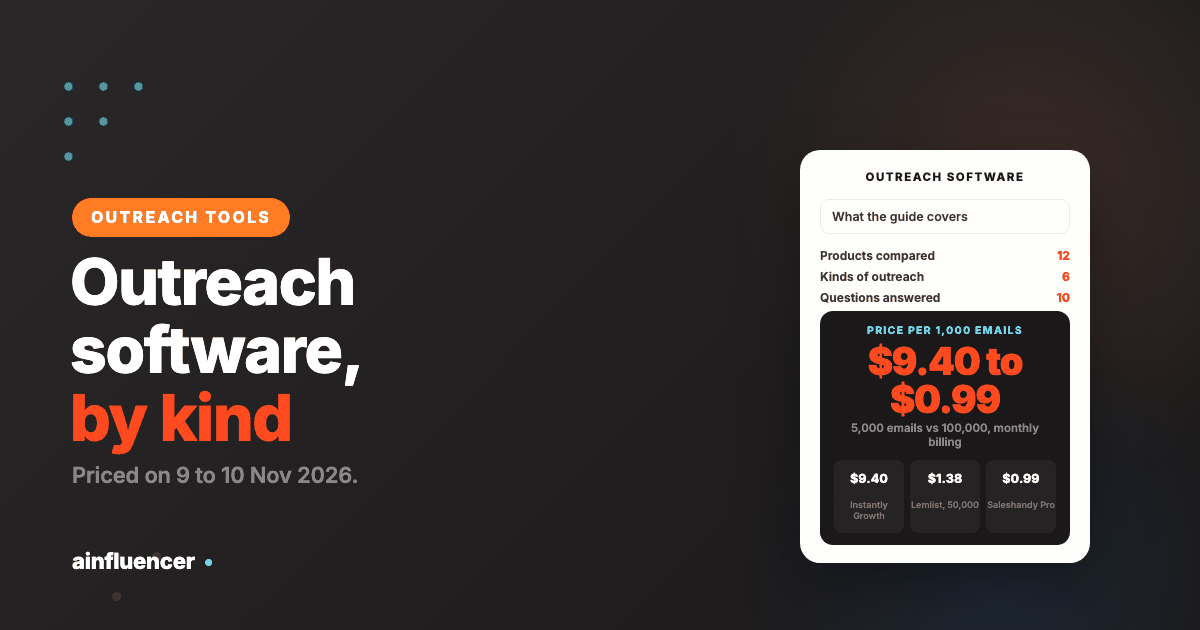
For the cold email tools, the fairest comparison is the monthly price divided by the emails a plan allows, in thousands. This is our arithmetic from the printed limits and monthly-billing prices, and it assumes you use the full allowance. It leaves out data, mailboxes and add-ons.
| Plan | Monthly price | Emails a month | Price per 1,000 emails |
|---|---|---|---|
| Instantly Growth | $47 | 5,000 | $9.40 |
| Saleshandy Starter | $41 | 6,000 | $6.83 |
| Lemlist Email | $69 | 50,000 | $1.38 |
| Saleshandy Pro | $99 | 100,000 | $0.99 |
| Instantly Hypergrowth | $107 | 125,000 | $0.86 |
| Saleshandy Scale | $189 | 200,000 | $0.94 |
Volume lowers the unit price sharply. A plan sized for 5,000 emails costs seven to ten times more per email than one sized for 100,000. The cheapest unit price belongs to the tools with the largest send limits, so match the plan to the volume you will really send before you judge by sticker price.
How to Choose
Name your kind of outreach
Use the table near the top. A link builder and a sales team need different software even though both call it outreach.
Count your real monthly volume
Recipients, emails or invitations: whatever the plan meters. Price that, not the headline.
Check what is on the plan you can afford
Several tools put sequences, workflows or LinkedIn on higher plans. Read the plan table before you start a trial.
Check where replies and records go
The software should write back to your CRM or inbox, or reps will copy by hand.
Test on a small list
Send to fifty contacts, read the replies and the bounces, and fix the message before you scale.
Where Outreach Software Goes Wrong
Buying the platform when you need a sender
An enterprise revenue platform costs far more than a team that only sends sequences will use.
Scaling a weak message
Software makes it easy to send a poor email to thousands. Fix the message at small volume first.
Ignoring the rules
Email, LinkedIn and texts each have consent and opt-out rules, and breaking them costs more than any tool.
Conclusion: Which Outreach Software Should You Choose?
If the buyer publishes a form, not an email
Use contactID for the first message and keep a sequencer for the follow-up.
If you send email at volume
Compare Instantly, Saleshandy and Lemlist at the volume you will really send, using the price per 1,000 emails above.
If a creator could sell for you
Look at Ainfluencer and pay on commission.
Frequently Asked Questions
What is outreach software?
It is software that helps you start conversations with people who do not know you yet: it finds contacts, writes or personalizes messages, sends them, follows up and tracks replies. The kind of outreach differs: sales, cold email, LinkedIn, link building, creators or contact forms.
What is the best outreach software?
It depends on the kind of outreach. Outreach, Mixmax and Apollo suit sales sequences, Instantly, Saleshandy, Snov.io and Lemlist suit cold email, HeyReach suits LinkedIn, Pitchbox suits link building, Ainfluencer suits creators and contactID suits contact forms.
What is an outreach platform?
The term is used interchangeably with outreach software. It tends to mean a product that covers several steps, such as finding contacts, sequencing and tracking, in one place.
What is an outreach tool?
Another word for outreach software, often used for a single-purpose product such as an email sender or a contact finder.
Is Outreach the same as outreach software?
No. Outreach is one company, a sales engagement and revenue platform, that shares its name with the category. Outreach software in general means any product that automates outreach.
How much does outreach software cost?
From free to hundreds of dollars a month. Mixmax starts at $29 a month per user, Saleshandy at $34 a month billed annually, Snov.io at $39, Instantly at $47, Lemlist at $69, and Pitchbox, built for link building, at $300 a month. Outreach and some others do not print a price.
Is there free outreach software?
Yes. Mixmax has a free plan with 50 recipients a month, Apollo has a free plan with no time limit, Ainfluencer has a Free plan limited to 2 invites a month, and contactID gives 10 free websites.
What outreach software is cheapest for sending at volume?
On our price per 1,000 emails at the plan cap, the plans with the largest send limits, such as Saleshandy Scale and Instantly Hypergrowth, have the lowest unit price. Check that you will really send that volume.
Is automated outreach legal?
The same rules apply as for any outreach. The FTC says CAN-SPAM makes no exception for business-to-business email, Canada’s anti-spam law carries penalties up to $10 million for businesses, and France’s CNIL says B2B prospecting can rest on legitimate interest with conditions. This is not legal advice.
What is the difference between outreach software and a CRM?
A CRM stores accounts, contacts and deals. Outreach software sends and tracks the messages. Many CRMs include some outreach features, and most outreach tools sync back to a CRM.
Key Takeaways
- Outreach is one company and also the name of a category. Choose by the kind of outreach you do: sales sequences, cold email, LinkedIn, link building, creators or contact forms.
- Printed entry prices run from free to $300 a month, and Outreach itself prints none.
- Cold email unit cost falls sharply with volume: a 5,000-email plan costs seven to ten times more per email than a 100,000-email plan.
- Read the plan table: sequences, workflows or LinkedIn often sit on a higher plan.
- Test on a small list and read the rules for email, LinkedIn and texts before you scale.
- contactID and Ainfluencer are ours: contactID covers contact forms only, and Ainfluencer limits invites by plan.