Shopify Fulfillment Services: Compare 3PL Options, Costs and Setup in 2026
Shopify fulfillment services compared: how a 3PL connects, every fee on the invoice, the one printed rate card and 14 providers matched to your store.
Shopify fulfillment services are the companies and tools that store your stock, pick and pack each order and hand the parcel to a carrier, so you do not do it from your own shelves. A Shopify store has three routes: fulfill the orders yourself, send them to a third-party logistics company (a 3PL), or let a supplier ship them for you (dropshipping). Most stores start on the first route and look at a 3PL when packing starts to eat the week.
This guide follows one order from checkout to the customer’s door and back, so you can see which job belongs to Shopify, which to the 3PL and where each handover breaks. Then it takes the invoice apart fee by fee, compares 14 providers by the store they suit and walks through the first setup. Every provider fact is what that provider prints on its own site, read on 9 November 2026. Every Shopify fact comes from Shopify’s own pages. Where a page was blocked or two pages of the same company disagreed, we say so instead of picking one. We rank no provider as the best, because the sites give no way to compare results on equal terms.
If you sell products to creators as well as to customers, the last section covers how gifting and seeding shipments behave in a fulfillment center. That is the part no ranking guide covers, and it is where Ainfluencer for Shopify sellers connects to this topic.
Shopify Fulfillment Services at a Glance: The Short Answers
The short version (provider facts are what each provider prints, the arithmetic is ours)
| Question | Short answer | Where it is explained |
|---|---|---|
| Does Shopify offer fulfillment? | Shopify lets you fulfill yourself or connect a service. Its current pages present Shopify Fulfillment Network as a partner network with Flexport as a preferred partner, and do not say Shopify runs warehouses. | Does Shopify offer fulfillment |
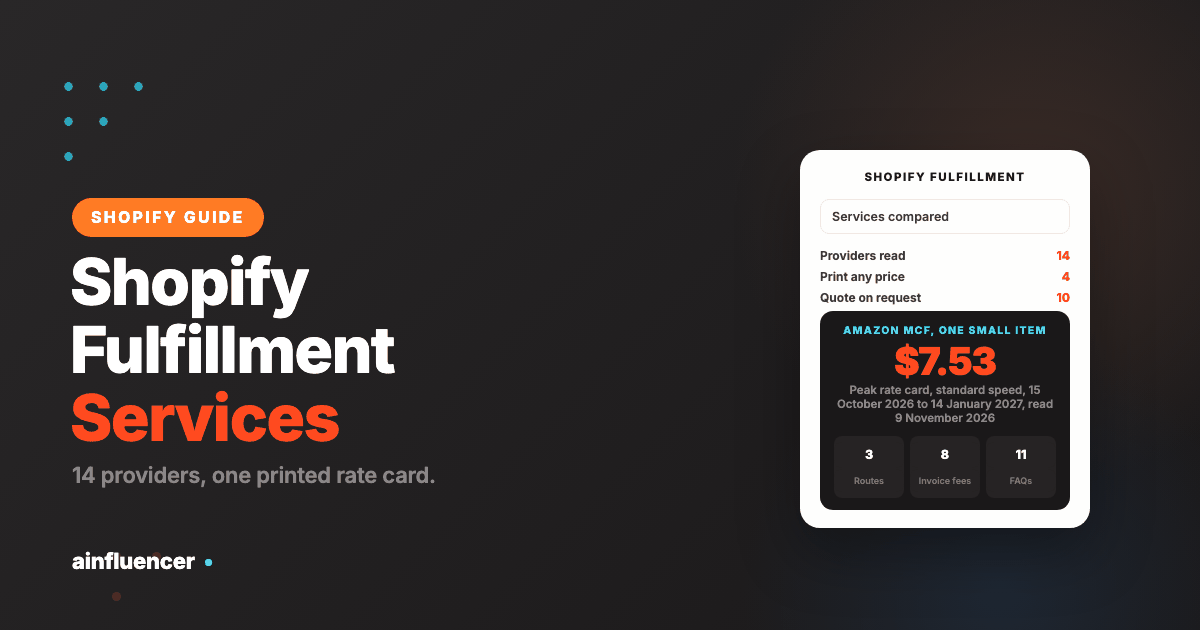
| What do Shopify fulfillment services cost? | Ten of the 14 providers quote on request. Amazon prints a full rate card, from $7.53 for one small item at standard speed (peak rates, 15 October 2026 to 14 January 2027). | How much do Shopify fulfillment services cost |
| How many orders do I need before a 3PL makes sense? | Printed fits run from no minimum (eFulfillment Service) to over 3,000 a month (GoBolt). Cahoot says over 250, Bigblue 500, Shipfusion 2,000 or more. | When should you switch to a Shopify 3PL |
| Can Amazon fulfill Shopify orders? | Yes, through Amazon’s free Multi-Channel Fulfillment app for Shopify. Orders ship in unbranded packaging. | Can Amazon fulfill Shopify orders |
| How does a 3PL connect to my store? | Four ways: an app from the 3PL, Flexport’s built-in connection, an integration the provider builds during onboarding, or an API and file transfer. | How do I connect a 3PL to my Shopify store |
What Are Shopify Fulfillment Services?
Order fulfillment is the work between a paid order and a parcel on a carrier’s truck: receiving stock, storing it, picking the items, packing them, buying postage, handing over the parcel and sending tracking back to the customer. A fulfillment service does that work for you in a building it runs, and reports back to your store through an app or an integration.
What Is Shopify Fulfillment, and What Does Fulfilled Mean on Shopify?
In the Shopify admin, fulfilled means the items have shipped and tracking is attached. Shopify lists these fulfillment statuses on an order: Unfulfilled, In progress, On hold, Scheduled (a prepaid subscription waiting for its date), Partially fulfilled, Fulfilled, and Fulfillment not required. Manual fulfillment is the default, and Shopify suggests it for made-to-order products, pre-orders and stock shortages. Automatic fulfillment is a setting under Settings, then General, then Order processing, and Shopify recommends it when you sell only digital downloads or gift cards, or send every product to a fulfillment service. Shopify warns against it if you pack parcels yourself, because every new order would be marked fulfilled the moment it arrives.
Does Shopify Offer Fulfillment?
Partly. Shopify gives you the order system, shipping rates, locations and a label shop, and it connects to outside services. Its fulfillment overview names three approaches: do it yourself, use a third-party app, or use a fulfillment service “such as Shopify Fulfillment Network”. You can also mix them: Shopify’s help pages say you can use different fulfillment methods for different items in the same order. See Shopify’s own page on fulfilling orders and choosing a method.
What Is Shopify Fulfillment Network, and What Happened to It?
Shopify Fulfillment Network, or SFN, is what many older guides describe as Shopify’s own warehouse network. The first-party record is shorter than those guides suggest. On 4 May 2023 Flexport announced that it was acquiring the assets of Shopify Logistics, including Deliverr, and said its services would be powered by Flexport inside the merchant-facing Shopify Fulfillment Network app. A Flexport post from June 2024 says the deal closed on 6 June. Shopify’s current fulfillment page (the “Fall ’26 Edition”) describes SFN as a way to outsource fulfillment to a 3PL partner network, labels Flexport a preferred partner, and names Amazon, Bigblue, DHL, Flexport, GoBolt, Mayple Global, ShipBob and Shipfusion. It does not mention a sale and does not say Shopify itself runs warehouses.
Two practical points follow. Flexport is built into the Shopify admin rather than installed as a normal app: Shopify’s help page says that once you connect, it creates a location whose name carries both SFN and Flexport, while the other partners install as apps. And Flexport prints no prices, minimums or eligibility rules on its public ecommerce page. One trade report mentions a monthly minimum from 2026, but we could not find it on a Shopify or Flexport page, so we do not state a figure. Ask Flexport for the minimum in writing before you plan around it.
What Is the Difference Between a 3PL and a Fulfillment Center?
A 3PL, short for third-party logistics provider, is a company. A fulfillment center is a building a company uses to pick, pack and ship ecommerce orders. A 3PL usually runs several of them, and the terms get used loosely. A warehouse that only stores pallets and does not pick single orders is not the same thing. When a guide says Shopify 3PL or Shopify fulfillment partner, it means a company that connects to your store and runs this work.
Shopify Order Fulfillment Options: Self-Fulfillment, 3PL or Dropshipping
The three routes side by side
| Self-fulfillment | Third-party logistics (3PL) | Dropshipping | |
|---|---|---|---|
| Who holds the stock | You | The 3PL, in its building | The supplier |
| Who packs and ships | You or your team | The 3PL | The supplier |
| Who buys the postage | You, in the Shopify admin or with your own carrier accounts | The 3PL, on its carrier accounts | The supplier |
| How it appears in Shopify | Your own locations | A dedicated location created for the service | An app location or manual fulfillment |
| Where it usually breaks | Your time and your shelf space | Stock counts, handover and fees | Stock you cannot see and packaging you cannot control |
Self-Fulfillment With Shopify Shipping and Labels
You buy, print and manage labels in the admin from Shopify-supported carriers. Shopify’s shipping guide states maximum label discounts of up to 88% on USPS, 82% on UPS, and 80% on DHL and FedEx, with the real saving depending on the package, route, service and your plan. Labels can be bought for 250 shipments at once. One limit matters when you compare routes: Shopify’s help page says labels cannot be bought for products stocked in or fulfilled from app locations. Once a 3PL holds the stock, its own carrier accounts do the postage.
Third-Party Logistics for Shopify (Shopify 3PL)
You send stock to the 3PL’s building, orders flow to it from your store, and tracking flows back. You pay for receiving, storage, picking, packing, postage and returns, and you give up direct control of the shelf. The rest of this guide is mostly about this route.
Dropshipping Fulfillment, and Is Dropshipping a 3PL?
Not quite. In dropshipping the supplier owns the stock and ships to your customer, so you never hold inventory. A 3PL ships stock that you own. Some services blur the line. Printful makes products to order and prints a free plan, a Growth plan at $24.99 a month and branding fees from $0.99 per label. Zendrop prints Free, Pro and Plus plans and offers a China 3PL service as well as US-based warehouses. Both are covered in the provider tables below.
Hybrid Fulfillment: A 3PL for Best Sellers, You for the Rest
Because Shopify allows different methods for different items in one order, a common starting point is to send your top sellers to a 3PL and keep custom, fragile or low-volume items at home. The risk is split orders: a customer who orders one item from each side gets two parcels, and you pay two shipments. Shopify’s default order routing aims to reduce that by choosing a location that can fulfill the whole order, but it only works when stock counts are accurate.
How Shopify Order Fulfillment Works With a 3PL: The Life of One Order
Follow a single order and the division of labor becomes clear. The table shows each step, what Shopify does, what the 3PL does and where the handover tends to fail.
One order, step by step (Shopify behavior from Shopify’s Help Center and shopify.dev; the failure points are our reading)
| Step | What Shopify does | What the 3PL does | Where it can go wrong |
|---|---|---|---|
| 1. Checkout | Shows shipping rates from your shipping profile: flat, free, or carrier-calculated | Nothing yet | Rates set for the wrong location, weight or zone |
| 2. Routing | Creates the order and, with two or more locations, assigns it by your routing rules | Holds stock at its own location | Stale stock counts, an order split in two |
| 3. Request | Creates a fulfillment order at the service’s dedicated location and sends the request to the service app | Accepts or rejects the request | A rejected request leaves the order unshipped |
| 4. Pick and pack | Waits | Picks the items and packs them to your packaging rules | Mispicks, a bundle that is not defined as a kit |
| 5. Label and carrier | Cannot buy labels for app locations | Buys the label on its own carrier accounts and hands over the parcel | Cheaper postage on paper, slower service in practice |
| 6. Tracking | Receives a fulfillment with tracking details and can notify the customer; a partial fulfillment leaves the rest open | Sends tracking back to Shopify | Tracking that does not sync, so the customer hears nothing |
| 7. Return | You create a return in Orders and refund after inspecting the items | Receives, inspects and restocks or discards | Return fees and a long gap before the stock is sellable again |
The mechanics come from Shopify’s developer documentation. Each fulfillment service gets a dedicated location that Shopify creates automatically, the service receives requests for its assigned fulfillment orders and can accept or reject them, and it returns tracking by creating a fulfillment with the carrier, number and URL. If the service ships only part of an order, Shopify opens new fulfillment orders for the shipped and unshipped items.
How Do I Connect a 3PL to My Shopify Store?
Providers use four methods, and the method decides who owns the problem when it breaks:
- An app from the 3PL. ShipBob, ShipMonk, Stord, Bigblue, Printful and Amazon each publish a Shopify integration or app. ShipBob’s and ShipMonk’s listings are free to install and say additional charges may apply.
- A built-in connection. Flexport is built into the Shopify admin, as covered above.
- An integration the provider builds. Shipfusion says its tech team builds the Shopify connection during onboarding instead of a self-install app, and that orders import every five minutes.
- An API or file transfer. Shopify’s enterprise blog says a 3PL without a dedicated app connects through an API or EDI and FTP transfers, which can need more setup.
If you land on the last method, you may need a developer. Our guide to Shopify development agencies compared lists studios that work on custom integrations and apps.
How Do Inventory and Tracking Sync Back to Shopify?
Shopify’s blog on vetting a 3PL lists the checks that matter: whether the 3PL has a certified App Store app or relies on third-party middleware, who owns the connection when it breaks, whether inventory updates in real time, whether order status and tracking sync back automatically, and whether returns are visible. ShipMonk says orders, inventory and tracking sync both ways in real time and that Shopify tags can hold or reroute orders. Cahoot describes a two-way sync that fetches orders and pushes back inventory counts and tracking. These are provider claims. Test them with real orders before you move your stock.
Can a 3PL Handle Shopify Bundles and Subscription Apps?
Ask, because the sites differ. ShipMonk says it builds bundles and kits with catalog rules by region or stock level, and prints a batching fee for subscription or crowdfunding batches under 50 orders. ShipBob says it can accommodate kitting at an additional cost. Shipfusion lists kitting, subscription box assembly and retail-ready packaging as quoted projects. Stord lists subscriptions as an industry it serves. None of that tells you how your own bundle will be defined, so get the kit rules in writing.
Shopify Plus, Several Locations and Order Routing
Order routing needs two or more active locations. Shopify’s default strategy tries to avoid splitting an order by choosing a location that can fulfill every item, and it favors locations inside the destination market and the closest one. You can write custom rules, and the number of locations you can add depends on your Shopify plan. If your plan needs a fulfillment setup beyond the basics, our guide to Shopify Plus agencies covers what Plus adds.
What a Shopify Fulfillment Center Does: Receiving, Storage, Pick and Pack
A fulfillment center does four jobs for your store, and each one shows up as a line on the invoice.
- Receiving. Your stock arrives, is counted against your shipping notice, and is put on shelves or pallets. Mistakes here become stock-count errors in Shopify later.
- Storage. Billed by the space you use. Shipfusion bills per pallet location, and ShipMonk bases storage on product size, sales and quantity.
- Pick and pack. A worker picks each item for an order and packs it. Several providers price the first item separately from additional items in the same order.
- Shipping. The center buys the label and hands over the parcel, usually on carrier discounts it has negotiated.
Pick and Pack Explained
Pick and pack is the per-order work and the biggest variable in your bill. Shipfusion prints that the first pick is priced separately from consecutive picks, which are discounted. ShipMonk’s monthly minimum is described as your monthly order volume multiplied by its first-item pick fee, minus 20%, though no dollar figure is printed. That is why a store with one item per order and a store with four items per order pay differently on the same rate card.
Kitting, Bundles and Custom Packaging
Kitting means combining items into one sellable bundle before shipping. ShipBob lists a Customization Suite covering branded packaging, marketing inserts and custom gift notes with a logo, and says standard packing supplies are free while storing your own custom boxes and inserts costs extra. eFulfillment Service lists custom and black packaging and branded inserts such as thank-you cards and reorder prompts. Shipfusion lists branded boxes, custom inserts and stickers. Red Stag lists bundling, relabeling, repackaging and light assembly. Amazon is the exception: its Shopify app ships in unbranded packaging, and branded packaging is not offered through it.
Warehouse Technology Worth Asking About
You do not need a tour of the software, but a few capabilities matter for specific products. Red Stag lists lot and serial tracking. ShipBob lists lot tracking, expiration date management and temperature-controlled storage on its Shopify partner page. Bigblue lists expiring-lot alerts. If you sell supplements, food or cosmetics, ask which of these the center runs in production and not only on a brochure page.
How Much Do Shopify Fulfillment Services Cost?
Ten of the 14 providers print no price at all. They quote on request, and several print how the fees are built without amounts. That is not unusual for a 3PL, but it means the comparison has to start with the structure of the bill, then use the few prices that are public.
Every Fee on a 3PL Invoice
The fee lines and how providers describe them (amounts are quoted, not printed, unless noted)
| Fee line | What it pays for | What providers print | Question to ask |
|---|---|---|---|
| Onboarding | Integration and setup | ShipBob lists implementation. eFulfillment Service prints “No Set-Up Fees”. | Is there a setup or integration fee, and when is it due? |
| Receiving | Counting stock in | ShipBob, ShipMonk and Shipfusion list it. Shipfusion says single-SKU pallets cost least. | How is it priced: per pallet, per carton, per unit, per hour? |
| Storage | Space on shelves or pallets | Shipfusion bills per pallet location. ShipMonk bases it on size, sales and quantity. | What happens to slow movers and to stock older than a set age? |
| Pick and pack | The work per order | Shipfusion: first pick priced apart from consecutive picks. ShipMonk: first-item fee drives the minimum. | What do I pay for item one, item two and a kit? |
| Packaging | Boxes, mailers, inserts | ShipBob says standard supplies are free and custom storage costs extra. ShipMonk bills custom packaging as an item. | Which supplies are included, and what do inserts cost? |
| Postage | The carrier label | ShipBob and GoBolt claim negotiated carrier discounts. GoBolt claims 30% or more average savings. | Is postage billed at cost or with a markup? |
| Returns | Receiving and processing returns | ShipBob charges a flat fee on arrival. ShipMonk charges per carton and per additional item. Shipfusion charges once for the first item. | What does a return cost, and who decides restock or dispose? |
| Minimums and software | Account fees | ShipMonk prints its minimum formula. Bigblue prints a monthly app plan. Others print none. | What is the monthly minimum, and does it count against usage? |
How Much Does Shopify Fulfillment Cost Per Order?
The only complete printed rate card among the 14 is Amazon’s, and it is useful as one real reference even if you never use Amazon. Its Multi-Channel Fulfillment rate card, effective 15 October 2026 to 14 January 2027, lists standard-speed (3 business days) peak fees in four columns, 1, 2, 3 and 4 or more, which we read as the number of units in the order. A 3.5% fuel and logistics surcharge applies to US fulfillment fees on top.
Amazon MCF peak fees, standard speed, in USD (Amazon’s own rate card, 15 October 2026 to 14 January 2027, before the 3.5% surcharge)
| Size and weight | 1 | 2 | 3 | 4 or more |
|---|---|---|---|---|
| Small standard, 4 oz or less | $7.53 | $5.17 | $4.29 | $3.83 |
| Small standard, over 12 to 16 oz | $8.88 | $6.12 | $5.10 | $4.60 |
| Large standard, over 1 to 2 lb | $10.97 | $7.52 | $6.23 | $5.58 |
| Large standard, over 2 to 3 lb | $12.16 | $8.54 | $7.20 | $6.36 |
Expedited, two-business-day delivery costs more: $10.89 for one small standard item of 4 oz or less. Return processing is charged per unit by size tier, from $3.22 for a small standard item of 4 oz or less to $4.70 for a large standard item over 1 to 2 lb. These are Amazon’s fees, not a benchmark for any other 3PL, and they include postage. A traditional 3PL splits pick, pack and postage into separate lines.
Other prices providers print (check each page before relying on a figure)
| Provider | What it prints | What it does not print |
|---|---|---|
| Bigblue (GBP) | App plans at GBP 49 and GBP 149 a month, lower with a 3-year commitment. Per-order packs of GBP 0.49, 0.39 or 0.35 for conversion, and GBP 1.50, 1.20 or 1.00 per return. | Pick, pack, storage and shipping fees |
| Printful | Free plan, Growth at $24.99 a month, branding fees from $0.99 per label, embroidery digitization $2.95 to $6.50 per design. | Product prices were not read |
| Zendrop | Free, Pro at $49 a month, Plus at $79 a month. The page lists Plus above Pro with the same features, so recheck it. | Product costs per item |
Worked Example: Quote Against Real Bill for a 300 Order Month
A quote usually shows the per-order fee. The bill adds everything around it. The table is a template, with no assumed rates. Fill the third column from the provider’s written quote, and keep the formula in the second.
Build your own monthly bill (formula and the figure you ask for)
| Line | Formula | Where the figure comes from |
|---|---|---|
| Pick and pack | Orders x first-item fee, plus extra items x additional-item fee | The quote’s pick fees |
| Packaging | Orders x supplies per order, plus any custom-box storage | The quote’s packaging lines |
| Postage | Orders x average label cost, plus any markup | A sample label quote for your average parcel |
| Storage | Pallet or shelf locations x monthly rate | The quote, plus your stock plan |
| Receiving | Inbound shipments x receiving fee | The quote |
| Returns | Returns x return fee | Your return rate times the quote |
| Minimum or software | The greater of usage and the monthly minimum, plus any app plan | The contract |
| Your time saved | Hours you stop packing x what an hour of your time is worth | Your own number |
To keep the comparison honest, compare against your current cost in the same shape: your own packing materials, your label cost, your shelf or rent cost and the hours you spend. A 3PL that is cheaper per order on paper but adds a minimum, a returns fee and a storage fee can still cost more than self-fulfillment below a certain volume.
Minimums, Setup Fees and Contract Terms
eFulfillment Service prints “No Set-Up Fees”, “No Minimum Order Requirements” and “Pay-As-You-Go”, and says it does not lock you into a long-term deal. Red Stag’s site is inconsistent: a West Coast page says it uses a variable cost model with no monthly minimums, while another page shows an order minimum of 200 a month, and its home page says clients can choose month-to-month or a long-term contract. ShipMonk prints the minimum formula above. Bigblue prints a 3-year commitment that lowers its monthly plan. Cahoot says it publishes no generic rate card and writes custom proposals. For the rest, contract length and notice terms were not stated on the pages we read.
When Should You Switch to a Shopify 3PL?
Signs You Have Outgrown Self-Fulfillment
The numbers vary by provider, so start with your own signs. Packing takes more hours a week than you can spare. Stock fills a room. Mispicks and late parcels are costing you refunds and reviews. Or you want delivery in two days to most of the country and cannot reach it from one address. Then look at what each provider itself says about fit.
Order volume and fit as each provider prints it
| Provider | What the provider’s site says about fit |
|---|---|
| eFulfillment Service | First-time sellers to high-volume merchants. “No Minimum Order Requirements”. |
| Red Stag Fulfillment | Heavy, bulky and high-value items. A West Coast page says it is a fit when more than 30% of orders ship west of the Mississippi, average shipping exceeds $8 or products cost $50 or more, and less suited under 200 orders a month. |
| Cahoot | Its Shopify page targets merchants shipping over 250 orders a month. |
| Bigblue | From 500 orders a month to 150,000, and its calculator targets 500 or more. |
| Stord | A 2024 press release for its accelerator program names about a thousand orders or more a month. Its current status is not stated. |
| Shipfusion | Typically brands shipping 2,000 or more orders a month, and not short-term or seasonal arrangements with no volume commitment. |
| GoBolt | Its home page says over 3,000 monthly orders, and its fulfillment page headline says $10M+ brands. |
| ShipBob | Designed for small and mid-market brands, and no order minimum is printed. |
| ShipMonk | High-growth brands, and no volume minimum is printed. |
Is a 3PL Worth It for a Small Shopify Store?
Sometimes. The honest test is arithmetic, not a headline order count. If you ship under about 200 orders a month, you are below the floor several providers describe, and your own shelf may be cheaper. If your volume is small but your products are bulky, or your time is the constraint, a provider with no printed minimum such as eFulfillment Service is worth a quote. If you sell made-to-order products or dropship, your route is different, and print-on-demand and dropshipping services ship without you holding stock.
When Not to Outsource Fulfillment
- Made-to-order or pre-order products. Shopify itself suggests manual fulfillment for these.
- An unstable catalog. If SKUs, sizes and kits change monthly, the setup and the stock-count errors cost more than they save.
- Unboxing is the product. If packaging is central to your brand, check what the provider actually prints about custom packaging, and note that Amazon’s Shopify app ships unbranded only.
- Shipping is not your bottleneck. If sales, not parcels, are the limit, a 3PL will not fix it. Our guide to Shopify marketing agencies compared on fees and terms covers the growth side.
Best Shopify Fulfillment Services Compared: 14 Providers
How We Chose These Providers, and What We Could Not Verify
We started from the names that kept appearing across the pages ranking for these searches and from Shopify’s own partner list, then read each provider’s own site: home page, pricing or quote page, Shopify page, locations and FAQ. Review sites and ranking blogs were used only to find names, never as evidence about a provider. Nearly every ranking list is written by a provider that ranks itself first, so we treat those numbers as claims.
Dropped: DHL Fulfillment Network (its pages timed out), Byrd (an empty page), CJdropshipping (an unrendered page in German) and Mayple Global (not researched). ShipHero and ShipStation are warehouse and label software, not fulfillment services. Rakuten Super Logistics redirects to ShipNetwork, which is listed once. ShipMonk calls itself a certified SFN partner, but Shopify’s partner list does not name it.
How each provider connects and where it ships from (as printed on its own site)
| Provider | Type | How it connects to Shopify | Where it ships from |
|---|---|---|---|
| ShipBob | 3PL network | Shopify app “ShipBob Fulfillment”, free to install | US, Canada, UK, EU and Australia. The count is printed as 60+ in places and “over 50” elsewhere. |
| ShipMonk | 3PL | App “ShipMonk | Order Fulfillment”, two-way sync, Shopify locations mapped to its centers | 10 centers: Las Vegas (2), Dallas-Fort Worth, Pittston PA (2), Louisville KY (2), Ontario, Cheb in the Czech Republic and Coalville in the UK |
| Red Stag Fulfillment | Premium 3PL | Says it connects directly with no middleware. App name not printed. | Two US sites: Sweetwater TN and Salt Lake City UT |
| Stord | 3PL plus software | Shopify App Store listing “Stord”, linked to its order and warehouse systems | Claims 15 key North American nodes and 80+ network facilities. No addresses on the pages read. |
| Flexport | 3PL, Shopify’s preferred partner in SFN | Built into the Shopify admin, which creates a location named for SFN and Flexport | US hubs near Newark, Atlanta, Chicago, Dallas and Los Angeles, plus Canada and the UK |
| Amazon Multi-Channel Fulfillment | Marketplace network | Free Shopify app, you map your catalog to Amazon’s | “Hundreds of fulfillment centers”. The app supports the US, UK, Canada, Germany, France, Italy, Spain, Japan and India. |
| eFulfillment Service | Small-business 3PL | Shopify named among 40+ integrations, set up free by its IT team after you sign up | One site in Traverse City, Michigan |
| Cahoot | Network of merchant warehouses plus software | Cahoot app in the Shopify App Store, two-way sync | Claims 100+ US warehouses, run by merchants rather than Cahoot |
| ShipNetwork | 3PL | Its blog names SmartFill for Shopify sellers. Whether that is an app or API is not stated. | 10 US centers from Anaheim to Atlanta, including Las Vegas, Reno, Salt Lake City, Houston, Chicago, Scranton, West Hazleton and Olean |
| GoBolt | 3PL plus last mile | Listed as a Shopify and Shopify Plus partner. Method not stated. | Claims 12 warehouses: Toronto, Vancouver, Montreal, Ottawa and Calgary, and key US states |
| Shipfusion | Mid-market 3PL | Built by its tech team during onboarding, not a self-install app | Chicago, Las Vegas and York PA, plus Toronto. Dallas is listed as coming soon. |
| Bigblue | Europe and UK 3PL | Free Shopify integration, “connect in less than 30 seconds” | Germany, France, the UK and Spain. No US site is printed. |
| Printful | Print on demand | The Printful app from the Shopify App Store | Locations not listed. Its shipping page says multiple locations such as the USA and Europe. |
| Zendrop | Dropshipping | One-click connection from its Shopify listing | US-based warehouses with no cities printed, and a China 3PL service |
What each provider prints about fit, price and speed (speed figures are claims, not guarantees)
| Provider | Prices printed | Speed claim | What is not stated |
|---|---|---|---|
| ShipBob | None. Custom quote. Standard packing supplies stated as free. | 2-day shipping badging | Contract terms |
| ShipMonk | None. Minimum formula only. | 2-day shipping listed | Contract terms, delivery days |
| Red Stag Fulfillment | None. Variable cost model. | Claims 96% of US households in two days or less | Rates, contract length, hazmat |
| Stord | None | Claims 99.5% 1 to 2 day ground coverage, and 99% under 2 days elsewhere | Prices, contract terms |
| Flexport | None | Claims 87% of US consumers within two days on one page and three days on another | Prices, minimums, eligibility |
| Amazon Multi-Channel Fulfillment | Full rate card, see above | Standard 3 business days, expedited 2 business days | Branded packaging, B2B |
| eFulfillment Service | None. No setup fees, no minimum, pay as you go. | Ships within 1 business day, most US addresses in 2 to 4 days | Hazardous and refrigerated handling |
| Cahoot | None. Claims up to 30% lower cost than a previous 3PL. | Claims nationwide 2-day shipping | Special handling, contract terms |
| ShipNetwork | None. Request a quote. | Claims 98% of the continental US in 1 to 2 days by ground | Kitting, contract terms |
| GoBolt | None. Claims 30% or more shipping savings. | Orders received by 1pm ship the same day | Delivery times, kitting, B2B |
| Shipfusion | None. Structure printed, no amounts. | Claims 95% of US and Canadian customers in 1 to 2 days by ground | Hazmat, contract terms |
| Bigblue | App plans and packs in GBP, see above | Claims 98% first-attempt delivery in the UK | Fulfilment fees, US coverage |
| Printful | Plans and branding fees, see above | 2 to 5 business days to produce, then 3 to 4 days standard in the US | Return terms, packing slips |
| Zendrop | Plans, see above | Claims fast shipping from US warehouses, no days printed | Delivery times, contract terms |
The labels below are fit labels drawn from those printed statements. They are not a ranking.
What Is the Best 3PL for a Small Shopify Store?
The providers that print no order minimum are the natural first quotes: eFulfillment Service (“No Minimum Order Requirements”), ShipBob and ShipMonk. If you do not want to hold stock at all, Printful and Zendrop are the print-on-demand and dropshipping routes, with prices printed. Ask each for a written quote on your real order profile, not on a sample.
What Is the Best 3PL for Heavy or Bulky Products?
Red Stag’s own pages are built around big, heavy and bulky items, and it says it is less suited to low volume. Amazon’s rate card prices size tiers up to extra-large and 150 lb or more, with the cost rising by weight. For bulky goods, compare the cost per order by weight tier, not the headline pick fee.
Best Shopify 3PL for Omnichannel and Higher Volume
Several providers say they handle B2B and retail routing alongside direct-to-consumer: ShipBob (EDI and retailer compliance), Red Stag (EDI, LTL and FTL), Shipfusion and Bigblue (wholesale and retail), ShipNetwork (EDI retail fulfillment) and Stord. Flexport and Cahoot list B2B in less detail. If your retail partners fine you for late or wrong shipments, ask each for its compliance process and for who pays when a retailer chargeback arrives.
Which Provider Fits the UK and Europe?
Bigblue ships from sites in Germany, France, the UK and Spain and prints no US warehouse. ShipMonk lists a UK and a Czech center, and ShipBob says it has UK and EU centers. If you sell across borders with Shopify Markets, ask each provider how customs and duties are handled at checkout, because none of the pages we read answered that in full.
Can Amazon Fulfill Shopify Orders?
Yes. Amazon’s Multi-Channel Fulfillment app for Shopify is free, and you do not need to sell on Amazon to use it. You install it, log in with an Amazon account, map your Shopify catalog to Amazon’s and set shipping preferences. Tracking and inventory sync back to the Shopify admin. Fees are variable per shipment and are billed by Amazon, not on your Shopify invoice. Amazon says orders ship in unbranded packaging at no additional cost, and that branded packaging is not offered through this app. Check the current terms for your account before promising a branded unboxing. If you run Amazon inventory as well, see our guide to Amazon FBA agencies for the Amazon-side partners.
How to Choose a Fulfillment Center for Your Shopify Store
Location and Number of Fulfillment Centers
Distance decides delivery time and postage zones. Red Stag runs two US centers on purpose and says so. ShipMonk lists ten, ShipNetwork ten, Shipfusion four and GoBolt twelve. More centers mean shorter average distance but more places your stock sits. Red Stag’s West Coast page gives one test worth borrowing: if over 30% of your orders ship west of the Mississippi, a western center matters.
Shopify Integration: Native App or Fragile Connector
Ask four questions from Shopify’s own vetting list. Is there a certified Shopify App Store app, or middleware? Who owns the connection when it breaks? Does inventory update in real time? Does tracking sync back automatically? Then run a test order through the connection before you move any stock.
How Do I Know If a Shopify App Is a Real 3PL?
Shopify’s App Store has a third-party logistics category, which showed 246 apps when we read it, and a Built for Shopify filter. Shopify says that badge signals its quality standards for apps, such as ease of use, safety and performance. It says nothing about a provider’s service quality or price. Cahoot is a useful example of why you should still ask whose building holds your stock: it describes a network of merchant warehouses, not warehouses it owns.
Accuracy, On-Time Rates and Service Claims
Providers print accuracy and on-time figures such as 99.9% order accuracy and 99% on-time shipping, and they rarely say how the figure is measured or over what period. Red Stag prints a guarantee of zero late shipments, “Guaranteed. Or we pay you”. Ask for the measurement method, the period and the credit you receive when the number is missed.
Contract Terms to Check Before You Sign
- The monthly minimum and whether it counts against usage.
- Setup, onboarding and integration fees.
- Notice period to leave, and how fast your stock is returned.
- Who owns the inventory data and the carrier accounts on exit.
- Peak-season surcharges and inbound cutoff dates.
- Credits for lost, damaged or late orders.
- What a return costs and who decides to restock or discard.
- Whether pricing changes at renewal.
How to Set Up Your First 3PL for Shopify, Step by Step
What to Send Out of Shopify Before You Ship Stock
Export a clean product list first: SKU, barcode, weight and dimensions for every variant, and how each kit or bundle is built from component SKUs. A 3PL cannot pick a bundle it does not know how to assemble. Then send a shipping notice for each inbound delivery with counts by SKU, so receiving can check the delivery against it.
Sending Inventory In and Cutting Over Live Orders
- Connect the 3PL and map your Shopify locations. A dedicated location is created for the service.
- Ship a first, small inbound delivery and wait for receiving to confirm counts.
- Move only the SKUs you are ready to cut over, so the rest keep shipping from home.
- Decide how orders for stock the 3PL does not hold will be handled. Shopify Flow has actions to hold a fulfillment order and release the hold.
- Check the order processing setting. Shopify recommends automatic fulfillment when every product goes to a service, and warns against it if you also pack parcels yourself.
Testing Before You Switch
Place two or three real orders, including one with several items and one that should split. Check that each arrives at the 3PL, that tracking returns to Shopify, and that the customer email goes out. Then check your promises. The FTC’s Mail, Internet, or Telephone Order Merchandise Rule says that if you state no shipping time you must reasonably expect to ship within 30 days, and that you must offer a delay notice and a refund if you cannot. Read the rule on the FTC’s business guidance page and make sure your 3PL’s cutoffs and inbound lead times fit the delivery times you advertise.
How Returns Work With a Shopify Fulfillment Service
On the Shopify side, you manage returns from the Orders page: create a return, send shipping instructions with optional return labels and tracking, and issue the refund after inspecting the items. Self-serve returns let customers request a return from their order status page. On the 3PL side, the return arrives at its building, and the real questions are who inspects it, whether it is restocked or discarded, and what each step costs.
What providers print about returns
| Provider | Returns, as printed |
|---|---|
| ShipBob | Flat fee when a return arrives at a center, with a Loop Returns integration mentioned |
| ShipMonk | Charged per carton and per additional item, with a Loop Returns integration |
| Red Stag Fulfillment | Loop Returns and Redo listed as integrations. Process and fees not described. |
| Shipfusion | First item has one charge, additional items are discounted. Processed, then restocked, quarantined or discarded per your policy. |
| Flexport | Processing, inspecting and restocking. No fees printed. |
| Amazon MCF | Per-unit fee by size tier, from $3.22 for a small standard item of 4 oz or less |
| Bigblue | Customers choose exchange, store credit or refund. Per-return pack of GBP 1.50, 1.20 or 1.00. |
| GoBolt | Claims legitimate returns go back to sellable stock within 48 hours |
Fulfilling Influencer Gifts and Seeding Shipments From a 3PL
If you send free products to creators, a gifted parcel is still a parcel: it costs picking, packing and postage, and it needs an address and a tracking number. No provider in this guide prints support for influencer gifting or sample orders. eFulfillment Service lists content creators only as a customer type, and Printful prints sample-order discounts, which is a different thing. So treat gifting as something to confirm in writing, not to assume. If you are still choosing between one-off gifts and repeating sends, our guide to product gifting versus product seeding explains the difference.
$0 Orders, Tags and Pick Lists
Shopify’s draft orders let you add products, a customer, a custom discount (a currency amount or a percentage), tags and a note, then create an order when you accept payment. A common pattern is to build a draft order for each gift, take the product price to zero with a discount, and tag it with the campaign name, so the order reaches the 3PL like any other and your reports can separate gifted from sold. Accepting payment on a draft creates the order on the Orders page, and Shopify deletes drafts created on or after 1 April 2025 after a year of inactivity, so do not leave gift drafts sitting. Shopify’s pages do not describe a 100% discount as a gifting feature, so test the flow with your own store before you rely on it. A free product is not free to ship, and the 3PL will still charge pick, pack and postage for a $0 order.
In Ainfluencer the brand ships the product and shares the tracking number in the deal chat, as described on our Ainfluencer’s product fulfillment workflow page. Ask your 3PL four things before the first campaign: will it accept $0 orders, will it ship single units to individual home addresses, will it add a note or insert, and how does it handle address errors?
Batching, Personalization and Timing
Small gifting batches can carry fees: ShipMonk prints a batching fee for subscription or crowdfunding batches under 50 orders, which shows how a provider can price small runs. Personalization is where errors creep in. ShipBob lists custom gift notes with a logo, ShipMonk lists gift messages for a small fee, and eFulfillment Service lists branded inserts. Time the shipment so the product lands before the content deadline, and keep tracking in the creator’s thread.
Where to Start
Work from your own numbers. Count orders, items per order, average parcel weight, stock on hand and hours spent packing. Ask three providers for a written quote built on those numbers, plus the fee template above filled in. Test the connection with real orders before you move stock. If you want hands-on help choosing partners for the rest of your store, our guide to Shopify agencies and what each type does shows which specialists fit which problem.
Frequently Asked Questions About Shopify Fulfillment Services
What is the best fulfillment service for Shopify?
None wins for every store. Heavy and bulky goods point to Red Stag or Amazon’s size-tier rate card, small stores to providers with no printed minimum such as eFulfillment Service, UK and EU sellers to Bigblue, and higher-volume multichannel brands to ShipBob, Stord, Flexport or Shipfusion. Ask each for a written quote on your own orders.
Does Shopify own warehouses?
Shopify’s current fulfillment page presents Shopify Fulfillment Network as a 3PL partner network and does not say Shopify runs warehouses. Flexport announced in May 2023 that it was acquiring the assets of Shopify Logistics.
Does Shopify Fulfillment Network cost extra?
A Shopify blog says the SFN app is free to install, and no SFN fees are published on the Shopify pages we read. Ask Flexport for its fees and any monthly minimum in writing.
What does 3PL mean in shipping?
Third-party logistics. It is an outside company that stores your stock, packs your orders and ships them, so you do not do it from your own shelves.
How much does a Shopify 3PL cost per order?
Most providers quote on request. Amazon prints a rate card with peak fees from $7.53 for one small item at standard speed, including postage, effective 15 October 2026 to 14 January 2027. A traditional 3PL splits pick, pack, packaging and postage into separate lines, so compare the whole monthly bill, not one fee.
How do I connect a 3PL to my Shopify store?
Install the 3PL’s Shopify app, use Flexport’s built-in connection, have the provider build the integration during onboarding, or connect by API and file transfer. Test with real orders before moving stock.
When should I move from self-fulfilling to a 3PL?
When packing time, storage space or late parcels are costing more than a 3PL’s bill. Printed fits run from no minimum to over 3,000 orders a month, so test your own numbers against each provider’s quote.
Can Amazon fulfill my Shopify orders?
Yes, through Amazon’s free Multi-Channel Fulfillment app for Shopify. Orders ship in unbranded packaging, and branded packaging is not offered through the app.
What is a micro fulfillment center?
A small facility near customers that holds a limited range of stock for fast local delivery. Most Shopify merchants never need one.
Why might a business choose not to use a 3PL?
Low order volume, made-to-order or pre-order products, a catalog that changes often, or packaging that is central to the brand. In those cases self-fulfillment or a print-on-demand service can fit better.
Can I ship influencer gifts through a 3PL?
Possibly, but none of the 14 providers prints support for it. Ask whether it accepts $0 orders, ships single units to home addresses and adds notes or inserts, and remember that a free product still costs picking, packing and postage.