Shopify Development Agency and App Development Company: 23 Sorted by the Layer They Build
Shopify development agencies and app development companies sorted by layer: themes, apps, Functions and Hydrogen, with costs, review and ownership.
Ask ten agencies for a Shopify development quote and you get ten ways of saying it depends. It depends on the layer. A store has several parts a developer can change, from a theme you can edit alone in the theme editor to a storefront that has nothing to do with a theme at all, and the price, the skills and the risks differ at every step.
Pay for the lightest layer that does the job. This guide goes through the layers in that order, with full sections on app development, theme development and headless Hydrogen builds, then covers pricing, how to choose and what happens after launch. It compares 23 companies read on their own sites. What a company says about its own results is its claim, repeated here without an audit.
What Does a Shopify Development Agency Do?
A Shopify development agency writes and maintains the code and integrations around a store: custom themes, apps, checkout extensions, Functions, API connections to other systems and, in some cases, a separate storefront. It differs from a marketing agency, which buys traffic and runs email, and from an SEO agency, which works on search. The Shopify marketing agency comparison covers that side.
Shopify development services at a glance (Shopify’s developer and help pages, read 5 November 2026)
| Service | What you are changing | Can you do it alone? | Plan gate Shopify states |
|---|---|---|---|
| Theme development | Layout, sections, blocks, styling, Liquid code | Sections and settings, yes, in the theme editor. Code, no | None stated |
| App development | Features installed on the store, or built for it | Public apps, yes. A custom app needs development knowledge | Level 2 customer data access needs Grow or higher |
| Extensions | App blocks in the theme, extra interface in checkout | App blocks, yes. Checkout extensions, no | Information, shipping and payment steps: Plus only |
| Functions | Back-end logic for discounts, delivery, payment and validation | No | Custom apps with Function APIs: Plus only |
| API integration | Order, stock and customer links with an ERP or warehouse | No | Rate limits scale by plan |
| Headless storefront | A separate front end built on the Storefront API | No | Oxygen public environments: 25 on Plus, 1 elsewhere |
When to Hire a Shopify Development Agency
Shopify’s own customisation guidance points merchants to the theme editor and installed apps first. It says that knowing how to code is necessary when the theme does not expose the change you need. That is the dividing line.
- A new look on the same store: theme development. A theme shop, not an engineering firm.
- A feature the App Store almost covers: try the app first, then consider a custom app.
- A custom discount or delivery rule: extensions and Functions, and check the plan.
- Orders and stock syncing with an ERP: API integration, and ask about rate limits.
- An experience a theme cannot hold: a headless storefront, and prove the case first.
- Moving from another platform first: start with the Shopify migration agency guide.
Shopify Theme Development Services
How Shopify Theme Customisation Works
Shopify’s architecture page describes JSON templates as wrappers for sections, and sections as reusable modules that merchants can customise. A merchant can rearrange sections in the theme editor without a developer. Anything the theme does not expose needs code.
Developers work with Shopify CLI. The command that creates a development theme does not count toward your theme limit, and Shopify deletes it after seven days of inactivity. To work on a live store, a developer asks for collaborator access with the Themes permission, pulls the theme, edits locally and pushes it unpublished until you approve it. Shopify’s help page says to hire a Shopify Partner if you need help customising a theme. The Theme Store minimums, a Lighthouse performance score of 60 and an accessibility score of 90, apply to themes submitted to the store, not to a custom theme built for one merchant.
Shopify Theme Development Agency: What a Custom Theme Build Includes
A theme development agency designs a theme, or takes your design, and turns it into code: Liquid templates, sections and blocks that you can rearrange in the theme editor, styling and page speed work. Shopify’s theme architecture sets the frame. JSON templates can render up to 25 sections each, a section can hold up to 50 blocks, and a theme can contain up to 1,000 JSON templates, so a layout that you edit yourself is the default shape and not an extra.
Premade theme or custom theme
| Premade theme | Custom theme | |
|---|---|---|
| Starting point | A Theme Store or purchased theme that you configure | Built from your design or from the agency’s |
| Editing | Sections and settings in the theme editor | The same editor, plus code that your team or agency owns |
| Quality floor | Themes in the Theme Store must average a Lighthouse performance score of 60 and an accessibility score of 90 | No such floor applies to a custom theme built for one merchant |
| Upkeep | Updates come from the theme author | You or your agency carry updates and fixes |
| Cost | The theme price plus any configuration work | Codersy prints custom themes from 8,000 euros and A Bunch of Creators prints $15,000 to $50,000 or more |
A premade theme with careful configuration is often enough, and if the design itself is the open question, our Shopify web design agency guide covers it. A custom theme earns its cost when the layout or the content model cannot be reached with sections and settings.
Custom Shopify Theme Development Agencies
A Bunch of Creators, a small New York team, quotes a custom theme at 6 to 8 weeks from design approval, a template-based setup at 3 to 4, redesigns on a template from $5,000 to $8,000 and custom design and development from $15,000 to $50,000 or more, with a year of support in every build. Codersy in Belgrade prints the clearest ladder in euros: a store build from 3,000, a custom theme from a client’s design from 8,000 and a design in Figma plus the theme from 9,000, though it states no timelines and shows a team of six on one page and sixteen on another. Realm Web Design, Shopify-only since 2012, lists packages from $20,000 and $40,000 and names the kinds of sites it refuses, among them adult, CBD and vaping. Charle Agency separates bespoke themes at about 6 to 8 months from template themes at about 8 to 12 weeks and publishes no prices. Byteex works in Liquid sections and speed, with launches given as 14 to 30 days on one page and 2 to 4 weeks on another. WebSenor, with a claimed 140 engineers, prices a Theme Sprint from 3 lakh rupees (300,000) and says themes take 4 to 6 weeks.
Custom Shopify Theme Development Cost and Timeline
The agencies above print their theme figures in different units, so the table lines them up. Each is the agency’s own claim.
Printed custom theme prices and timelines
| Agency | Price printed | Timeline printed |
|---|---|---|
| Codersy | Custom theme from a client’s design from 8,000 euros, with design in Figma from 9,000 | Not stated |
| A Bunch of Creators | Template redesigns $5,000 to $8,000, custom design and development $15,000 to $50,000 or more | 3 to 4 weeks on a template, 6 to 8 weeks custom |
| Realm Web Design | Packages from $20,000 and $40,000 | Larger projects average 60 to 90 days |
| WebSenor | Theme Sprint from 3 lakh rupees | 4 to 6 weeks |
| Byteex | No price | 14 to 30 days on one page and 2 to 4 weeks on another |
| Charle Agency | No price | Bespoke about 6 to 8 months, template about 8 to 12 weeks |
What to Ask a Shopify Theme Developer
Is the theme built from my design or yours, who owns the Git repository, and how will my team edit sections without a developer afterwards? Theme weight also feeds search performance, so if speed is the real reason for the rebuild, the Shopify SEO agency guide lists teams that fix technical issues.
Shopify App Development Company: Custom and Public App Services
A Shopify app development company builds software that runs next to your store. It is either an app for your own operations, called a custom app, or a product other merchants install from the Shopify App Store, called a public app. Custom Shopify app development is the usual first project, because it needs no approval from Shopify and answers one store’s problem. This section covers what such a company builds, how an app is made, what it costs, what publishing a public app involves and who owns the result.
What a Shopify App Development Company Builds
Shopify’s developer pages list the places an app can put something: the admin, checkout, customer accounts, the online store, point of sale, Shopify Flow and payments. Shopify hosts the extensions and Functions that run in those places. The companies on this list describe their app work in four groups.
- Connections to other systems. ERP, CRM, warehouse and shipping links. Metizsoft, Rocketify, Script Engine, Folio3 and MageDelight all list this work, and Webkul sells its own Odoo connector on the App Store. The API integration section below goes deeper.
- Checkout and discount logic. Extensions and Functions, covered in their own sections below. Script Engine, Dynamic Dreamz and MageDelight list them.
- Admin tools for one store. Dashboards, workflows and internal approvals, which MageDelight describes as custom private apps.
- Public apps. Products sold to many merchants. Webkul lists 52 apps on its Shopify App Store developer page, including a multivendor marketplace and a product auction app, and Script Engine launched its own wishlist app.
One more request hides inside the same search. A mobile app for your shoppers is a different project from an app for your Shopify admin. Shopify’s headless pages describe native iOS, Android and React Native storefronts built on the Storefront API and Checkout Kit, which belong in the headless section below.
Custom Shopify Apps vs Public Apps
A public app is listed on the App Store and approved by Shopify. A custom app, in Shopify’s words, is built exclusively for your store. A custom app cannot charge merchants through Shopify’s billing system, and the distribution choice cannot be changed afterwards. Since 1 January 2026 you can no longer create new custom apps in the Shopify admin. A developer builds them in the Dev Dashboard and installs them on your store, while existing custom apps keep working. Shopify says creating one “requires development knowledge and can be challenging”.
Shopify defines custom distribution as an app installed on a single store, on several stores in the same Plus organization, or on development stores, with no approval step. Public distribution can reach any store but needs Shopify’s approval and a one-time registration fee. Older private apps were converted to custom apps on 20 January 2023. Because a custom app cannot become a public one later, a company that expects to sell the idea to other merchants should say so before the first line of code. Custom apps do not need Plus, but Shopify says a store needs the Grow plan or higher to use a custom app with Level 2 protected customer data.
Shopify App Development Agencies
Folio3 claims more than 50 custom apps delivered and names NetSuite, Dynamics and SAP integrations, but it publishes no price and its client counts disagree (200 merchants on one page, 2,000 clients on another). Digittrix in India prints app tiers of $1,499 for an MVP and $1,500 to $2,499 for an advanced app, with focused apps at 2 to 4 weeks and connected business apps at 6 to 12 or more, although the case studies on its site, including IKEA, are not Shopify projects. Metizsoft quotes 3 to 5 weeks for a simple app and 6 to 10 for one with ERP or shipping integrations, plus 2 to 4 weeks for public app review. It says code and IP pass to you at the end, but several of its case metrics are not tied to a named Shopify merchant. Script Engine in Surat builds custom and public apps and has launched its own, including a wishlist app rated 4.8 from more than 275 reviews and labelled Built for Shopify. Its contact form offers budget bands from under $1,000 to $15,000 or more, which are form options and not prices. Codersy sells custom apps from 3,000 euros and publishes seven of its own.
Six more companies that build Shopify apps, read on their own sites on 9 November 2026:
Six more Shopify app development companies (each figure is the company’s own claim)
| Company | What it says it builds | Proof printed on its own site | Price or timeline printed | Not stated |
|---|---|---|---|---|
| Webkul | Custom apps, connectors and public apps. Its page says Shopify Select Partner. | 52 apps on its App Store developer page. Case studies name USHOP and Distacart. | No price. A custom app takes “anywhere from a few weeks to a few months”. | Minimum budget, team size, Built for Shopify badge |
| Whidegroup | Custom apps, changes to existing apps, public apps with submission guidance | Claims 36+ public and custom apps and names none. Case studies include Postfly. | No price. Up to 3 months of free support after release. | Partner tier, tech stack, code ownership |
| MageDelight | Custom private apps, public apps, Plus extensions | None named. Its partner badges are Adobe, none are Shopify. | $30,000 to $80,000+ for a full public app. Simple apps 4 to 8 weeks, mid-complexity 8 to 16, public and mobile 16 to 24+. | Shopify partner tier, a named client, location |
| Techtic | Custom and public apps, Hydrogen and Next.js storefronts | Claims to be a Shopify Plus Partner. Names store cases, no app. | No price. Retainers by hours a month. | App timeline, a named app, code ownership |
| Magebit | Hydrogen and Oxygen storefronts, custom apps and middleware to ERP, CRM, PIM and 3PL | A blog post calls it an official Shopify Plus Partner. No app named. | The same blog post says monthly engagements typically start around 3000 EUR or USD. | Project timelines, an app example |
| DigitalSuits | Hydrogen storefronts, a modernized public app, a custom app for a Plus store | Links a live App Store listing for its Zip Co client, and says the Zip project ran from August 2023 to March 2025. | No price, no hourly rate. | Minimum budget, its own App Store listings |
Custom App or Existing App: What to Ask
Would an existing app do this, who pays for the Shopify API changes every year, and what happens to the app if you stop working with the agency? Byteex says on its own pages that it will recommend an app over custom code when an app is the better answer. That is the right instinct to test for. A fair rule of thumb: check the App Store first, build when the workflow is unique or the data must stay in your own systems, and expect a mix of installed apps and one or two custom builds. MageDelight says on its own page that it will not push custom development when an existing Shopify solution will do.
How to Build a Shopify App: Process, Stack and Timeline
Companies describe the same path under different names: discovery, scoping, design, build, testing, launch and support. The technical part is the one Shopify documents.
- Choose the distribution first. Custom for one store or public for the App Store. The choice cannot be changed later.
- Scaffold with Shopify CLI. The command
shopify app initcreates the app, and Shopify calls its React Router template the recommended path for most apps. - Build the interface with Polaris and App Bridge. Shopify says all app surfaces use Polaris, its UI framework built on web components, and App Bridge is the JavaScript SDK that connects the app to the admin.
- Use the GraphQL Admin API. All new public apps have had to use it exclusively since 1 April 2025, and the REST Admin API has been a legacy API since 1 October 2024.
- Host the server yourself. Shopify does not host app servers. Its deployment page lists Vercel, Google Cloud Run, Fly.io and Render as common hosts, while Shopify hosts extensions and Functions.
- Handle the privacy webhooks. Shopify sends a customer redaction payload 10 days after the request and a shop redaction payload 48 hours after an uninstall, and the app has 30 days to act.
- Test on a development store, then release a version and install it. A Dev Dashboard app needs at least one released version before it can be installed.
The timelines below are each company’s own estimate, and they follow the size of the app more than the company.
Printed app timelines
| Company | Simple app | App with integrations | Public app |
|---|---|---|---|
| Metizsoft | 3 to 5 weeks | 6 to 10 weeks | Plus 2 to 4 weeks for review, its estimate |
| Digittrix | 2 to 4 weeks for a focused app | 6 to 12 weeks or more for a connected business app | Not stated |
| MageDelight | 4 to 8 weeks | 8 to 16 weeks | 16 to 24+ weeks, public and mobile apps |
| Whidegroup | A few weeks | Several months for a more complex app | Not stated |
| Webkul | A few weeks to a few months, no split by size | Not stated | Not stated |
Shopify App Development Cost: Custom App vs Public App
Few companies print an app price, and those that do measure different things.
- Digittrix: $1,499 for an MVP and $1,500 to $2,499 for an advanced app.
- Codersy: custom apps from 3,000 euros, and an ERP or POS integration from 2,500.
- MageDelight: $30,000 to $80,000+ for a full public app built for multi-merchant distribution, Shopify compliance and subscription billing. It says it prefers estimates based on development effort to fixed prices.
- Magebit: a blog post says monthly engagements typically start around 3000 EUR or USD.
- Folio3, Metizsoft, Webkul, Whidegroup, Techtic and DigitalSuits: no price printed.
Cost guides published by agencies fill the gap, and they disagree. The five we read put a simple app between about $2,000 and $15,000 and a complex one anywhere from $20,000 to over $200,000, and none says how its figure was measured. Use them to see how wide the range is, not to budget.
What an app bill contains
| Cost line | What it covers | What Shopify or the companies print |
|---|---|---|
| Build | Scoping, design, code and testing | The prices above |
| Hosting | The app server, because Shopify does not host it | Shopify lists Vercel, Google Cloud Run, Fly.io and Render. No fees quoted. |
| API upkeep | Moving to a supported API version each year | A new version every three months, each supported for at least 12 months |
| Registration, public apps | The Partner account | A one-time $19 per Partner account |
| Billing fees, public apps | Shopify’s share of app income | 100% of the first $1,000,000 in lifetime gross app revenue, 85% above it, plus a 2.9% processing fee on billing |
| Support | Fixes after launch | Whidegroup includes up to 3 months of free support. Retainers are in the cost section below. |
Publishing a Public Shopify App: App Store Review and Revenue Share
A public app goes through Shopify’s review. The requirements page has five sections: policy, functionality, security, the listing, and category rules. Among the rules, an app must bill through the Shopify Billing API or Shopify App Pricing, request only the access scopes it needs, and use theme app extensions instead of editing theme code. Submission runs in steps: set the app URLs, compliance webhooks and a 1200 by 1200 pixel icon, create the listing, handle protected customer data, pass the automated checks, then submit. Only one new app can be in review at a time, and an organization with published apps needs 10 or more installs from active paid stores on each of them before it submits another.
Shopify prints no review turnaround on the pages we read. Metizsoft adds 2 to 4 weeks for public app review in its estimates, which is a company’s figure and not Shopify’s. On the listing form in our own Partner account, the app name is limited to 30 characters, the intro to 100, the details to 500, each feature to 80, the subtitle to 62 and image alt text to 64. Screenshots are rendered at 1600 by 900 pixels, and each language is a separate draft until it is published.
Shopify’s revenue share page says you keep 100% of the first $1,000,000 in lifetime gross app revenue and 85% of earnings above that, counting only revenue earned from 1 January 2025. Developers who earned $20,000,000 or more through the App Store in the prior calendar year, or have $100,000,000 or more in company revenue, pay 15% on all app revenue. Built for Shopify is the top recognition level. Its criteria include at least 50 net installs from active shops on paid plans, at least five reviews, a minimum recent rating, and admin Web Vitals at the 75th percentile of 2.5 seconds or less for LCP, 0.1 or less for CLS and 200 milliseconds or less for INP. Shopify reviews those apps each year and gives one that falls short 60 days to fix it.
Who Owns the Code, and What App Maintenance Looks Like After Launch
Settle five things in writing: the code repository, the hosting account, the Partner or Dev Dashboard organization that owns the app, the API credentials, and the documentation. Shopify’s Dev Dashboard page says apps belong to your organization. Metizsoft says you receive the full code and the project board. Webkul says IP stays yours under an NDA on request. Digittrix lists accounts, code, notes and training in its handover. Whidegroup, Techtic, MageDelight and Magebit state nothing on ownership on the pages we read.
An app nobody updates stops working with the platform. Shopify releases a new API version every three months, supports each for at least 12 months, and its CLI refuses deploys that target a version older than that. Shopify also retires features: script tags cannot be created or updated after 1 October 2026 and stop being added to storefronts on 1 March 2027. That is the work a maintenance retainer covers.
Shopify Checkout and Theme App Extensions
What Theme App Extensions and Checkout UI Extensions Need
Theme app extensions do not edit theme code, which is why they survive theme updates. Checkout UI extensions on the information, shipping and payment steps are available only to Plus stores, and Shopify caps the compiled bundle at 64 KB and merchants at three extensions in the same block target. Standard checkout customisation, such as the branding editor and eligible apps on the thank you and order status pages, is open to Basic and above. For the wider Plus picture, read our Shopify Plus agency guide.
Agencies That Build Shopify Extensions
Script Engine names theme app extensions and API version upgrades for existing apps. Dynamic Dreamz lists Checkout Extensibility, Functions and Markets. Byteex and Digittrix list checkout extensions as Plus work. Ask whether your need is an app block, which any plan can use, or a checkout extension, which needs Plus on the key steps.
Shopify Functions Development
Shopify Functions Limits and Plan Rules
Shopify lists nine Function APIs, covering discounts, delivery and payment customisation, cart transforms, order routing and validation. Functions are written in anything that compiles to WebAssembly, with templates for Rust and JavaScript and a strong recommendation for Rust. A compiled function cannot exceed 256 kB and gets 11 million instructions on carts up to 200 line items. Public apps containing Functions work on any plan, while custom apps with Function APIs are Plus only, as set out in Shopify’s Functions developer documentation.
Agencies That Build Shopify Functions
Script Engine lists Functions for discounts, payment and delivery customisation and cart validation. Dynamic Dreamz and Byteex list them too. Two agencies in this guide, A Bunch of Creators and WebSenor, still list Shopify Scripts among their Plus work, but Shopify’s changelog says Scripts were switched off on 30 June 2026, so that wording is out of date. Ask which language the function will use, and whether it is a custom app (Plus only) or a public app that does the same job.
Shopify API Integration and ERP Development
Admin API Rate Limits by Plan
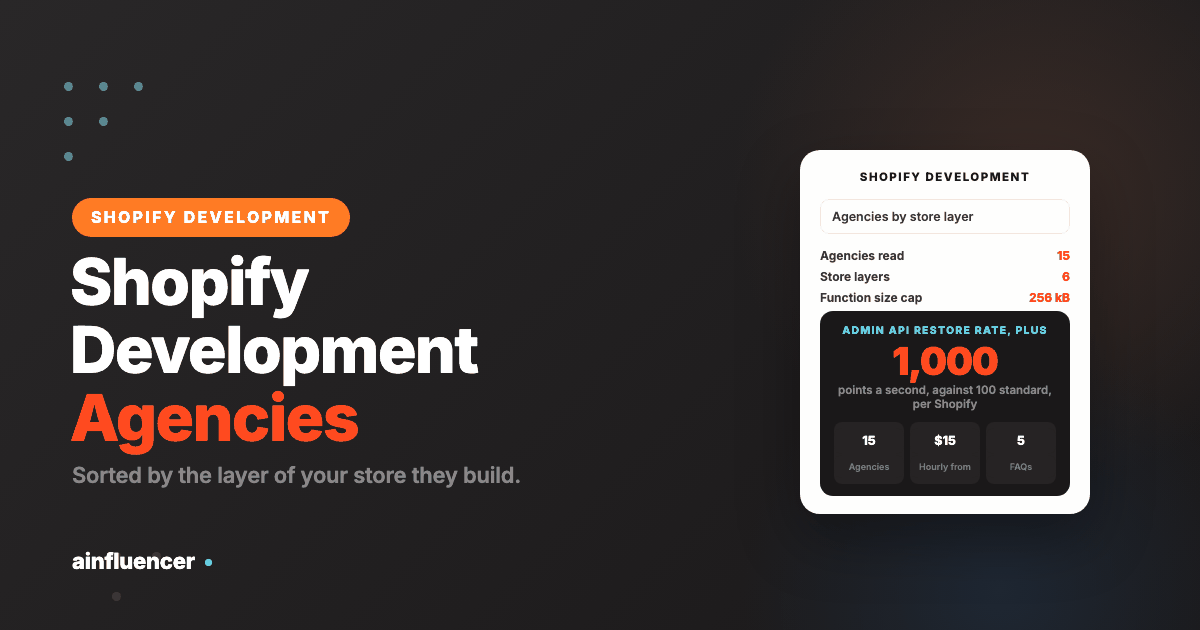
The GraphQL Admin API restores 100 points a second on standard plans, 200 on Advanced, 1,000 on Plus and 2,000 on enterprise, and no single query may cost more than 1,000 points. The REST Admin API has been legacy since 1 October 2024, with 2, 4, 20 and 40 requests a second across the same plans. A sync that works at 500 products can fail at 50,000, and that is why this is a different skill from a theme change.
Shopify ERP and Integration Agencies
Rocketify in Paris is the narrowest and the most candid: it builds ERP connectors, for systems such as Sage and Cegid, and custom apps, and says plainly that it does not do stores, themes or SEO. Its profile on a developer marketplace shows an unexplained $3,000+, which its own site never mentions. Folio3 and Metizsoft publish the broadest app and integration scope, Script Engine lists ERP, CRM and shipping integrations, and Codersy prices an ERP or POS integration from 2,500 euros. Digittrix names React, Polaris, App Bridge, Node.js and the GraphQL Admin API as its stack. Ask how the agency will stay inside your plan’s rate limit, who monitors failed syncs, and who upgrades the API version when Shopify retires the old one. If the integration is with a warehouse, our guide to Shopify fulfillment services explains the four ways a 3PL connects to a store.
Headless Shopify Development with Hydrogen
Do You Need Headless Shopify? Hydrogen vs a Theme
Usually not. Shopify’s own guidance says to consider headless when your needs cannot be met with its sales channels, themes and apps. Its examples are an experience the existing tools cannot support, a front end that does not use Liquid, commerce added to infrastructure you already run, selling through channels Shopify does not support out of the box, and storefront content that lives in a CMS. It also says plainly that a headless storefront costs more to build and run than a theme, and that you should make sure the merchant accepts the added cost and has developers to maintain the storefront after launch.
Shopify’s headless page says to stay with a theme when your deadline or budget leaves little room for custom development or your team relies on the built-in visual editing tools, and to fix performance first when the problem comes from images, apps or theme code. The agencies that sell headless say much the same. DigitalSuits answers “Is Shopify Hydrogen right for small or simple stores?” with “Not usually” and says clients need an in-house team or dedicated Hydrogen developers. Techtic says it will advise against headless when a well-optimized theme performs comparably. Ask Phill recommends native Shopify Plus for budgets under 100,000 euros.
A checklist for the decision (our reading of Shopify’s wording; the more rows point right, the stronger the case)
| Question | Points to a theme | Points to headless |
|---|---|---|
| Can sections, settings and apps deliver the experience? | Yes | No, and you can say exactly what is missing |
| Does your content live in a separate CMS? | No | Yes, and editors need it there |
| How many storefronts or front ends do you run? | One | Several, or one inside an existing stack |
| Who maintains the code after launch? | Nobody in house | Developers you employ or retain |
| Is the problem speed? | Probably fixable in the theme, apps and images first | Only after those are fixed |
| Does your team use the theme editor every day? | Yes | No |
Mixing is possible: Shopify’s headless page says retailers can use a mix of headless and traditional storefronts, and gives Sennheiser as an example of headless storefronts alongside themes for smaller markets. That is the safe route to test a headless idea on one market before committing to all of them.
Hydrogen, Oxygen, a Headless CMS and Next.js
A custom storefront reads products, collections, search and the cart through the Storefront API, and hands the customer to Shopify checkout. The Customer Account API handles sign-in, orders and addresses. Shopify’s Headless channel allows up to 100 active storefronts and access tokens per shop. Real buyer traffic is not subject to a fixed request-per-minute limit on the Storefront API.
Hydrogen is Shopify’s headless toolkit. Its 2026-10 release, generally available on 14 October 2026, turned it from a React Router framework into a library that Shopify says works with any JavaScript framework. The two starter templates are React Router, deployed to Oxygen, and a Next.js template from Vercel Shop, deployed to Vercel. Shopify’s Hydrogen page lists Next.js, React Router, Nuxt, Astro and SvelteKit as frameworks that work with it.
Oxygen is Shopify’s serverless hosting for Hydrogen. Its documentation says it is available at no extra charge on paid Shopify plans (Starter, Basic, Grow, Advanced, Plus, and Pause and build) and not on Agentic plans. It caps the worker at 10 MB and startup at 400 milliseconds, and allows 25 public environments on Plus and one on the other plans. You can host Hydrogen elsewhere. Ask Phill budgets 500 to 2,000 euros a month for Vercel or alternatives. On the content side, Commerce-UI and Ask Phill pair Hydrogen with Sanity, and Ask Phill also uses Contentful.
Shopify Hydrogen Agency and Headless Shopify Agencies
Codersy prices a Hydrogen storefront at 10,000 to 20,000 euros. WebSenor gives 8 to 14 weeks for Plus or Hydrogen builds. A Bunch of Creators lists Hydrogen and Next.js builds, and Aureate Labs shows two headless cases without figures. Ask which part of your brief cannot be done in a theme, and what it will cost to run this storefront in year two.
Five more companies that build headless Shopify storefronts (each figure is the company’s own claim)
| Company | What it says it builds | Named live example | Price printed | Not stated |
|---|---|---|---|---|
| Commerce-UI | Hydrogen and Oxygen storefronts, Next.js, Sanity, Liquid to Hydrogen migrations | Carhartt WIP North America, with a 6-day release window and 20,000+ SKUs migrated | None. A free Hydrogen consultation. | Price, team size, maintenance terms |
| Ask Phill | Headless storefronts with Hydrogen as the default, Next.js for content-heavy builds | Denham and Veloretti, in a blog post on its own site | Ranges in a blog post, see the cost section | Team size, code ownership, a rate card |
| DigitalSuits | Hydrogen storefronts on Oxygen, replatforming to headless | Innovative Beauty Company, a Hydrogen project on Plus | None. Estimates follow a requirements review. | Hydrogen timeline, minimum budget |
| Techtic | Hydrogen, Next.js with the Storefront API, custom front ends | None named for headless | None. Estimate after a discovery call. | A named headless client, location |
| Magebit | Hydrogen and Oxygen storefronts | Tara Formula, a headless example in a blog post | Monthly engagements typically start around 3000 EUR or USD, per a blog post | Timelines, a named merchant beyond that one |
Headless Shopify Cost and Timeline
Shopify says budget should cover development, integrations and ongoing maintenance, plus headless CMS subscriptions, paid apps and external hosting. Only a few companies put numbers on it. Ask Phill’s blog post on its own site, updated in May 2026, puts a headless MVP at 100,000 to 150,000 euros over 4 to 5 months, a standard build at 150,000 to 350,000 euros over 5 to 7 months, and an enterprise build from 350,000 euros, possibly above 500,000, over 6 to 10 months.
- Shopify Plus: from 2,300 euros a month, per the same post.
- Hosting: included on Oxygen, or 500 to 2,000 euros a month on Vercel or alternatives.
- Maintenance and development: 2,000 to 5,000 euros or more a month.
- A headless CMS: 300 to 3,500 euros a month, depending on plan and usage.
These are figures from one blog post and not a rate card, and the spread against Codersy’s top Hydrogen price of 20,000 euros is large. Compare any quote with a theme build on the same brief, using the theme costs above.
Headless Shopify SEO and Migration Risk
A theme gets sitemaps, canonical tags and hreflang from Shopify automatically. On a custom storefront, ask who produces each of them, who owns the redirect map and who checks rendering. Before launch, ask for a redirect map from every old URL, and for a crawl of the new storefront. After launch, watch indexation for as long as it takes to be sure nothing dropped. A redirect should only go to a page that answers the same question, so check each pair one by one. The Shopify SEO agency guide lists teams that handle technical migrations.
How to Check a Shopify Hydrogen Agency’s Real Experience
A service page is not proof. Ask for a named, live Hydrogen storefront the agency can be credited with, and open it. Commerce-UI, for example, links Carhartt WIP North America’s live site and case study. Do not treat a partner tier as evidence either: Shopify’s own directory page says tiers reflect commercial activity, not code quality. Four questions are enough for the first call:
- Which live Hydrogen storefronts did you build, and may I speak to the client?
- Which part of this brief cannot be done in a theme?
- What will it cost to run this storefront in year two: hosting, CMS, engineering?
- Who owns the code, the hosting account and the credentials on the day we part?
How Much Does a Shopify Development Agency Cost?
Most of the 23 print nothing. Those that do measure different things, so compare the unit, not the headline. App prices and headless prices have their own sections above, with a table of what an app bill contains and a year-two cost list for headless.
Shopify Development Agency Hourly Rates
- Aureate Labs: $15 to $30 an hour, with pre-paid bundles of 80 or 160 hours and a 7-day trial. It is not Shopify-only and states no Shopify partner status.
- Dynamic Dreamz: support from $25 an hour, with a white-label model for agencies.
- Binaery: a $135 hourly trial with a $500 deposit.
Shopify Development Project Prices
- Codersy: store build from 3,000 euros, custom theme from 8,000, custom app from 3,000, ERP or POS integration from 2,500, Hydrogen storefront 10,000 to 20,000.
- A Bunch of Creators: template redesigns around $5,000 to $8,000 and custom design and development $15,000 to $50,000 or more.
- Realm Web Design: packages from $20,000 and $40,000.
- WebSenor: Theme Sprint from 3 lakh rupees, a Plus build from 9 lakh and migrations from 2,50,000.
- Digittrix: apps at $1,499 and $1,500 to $2,499.
Folio3, Metizsoft, Byteex, Charle, Script Engine and Rocketify publish no price, and Script Engine, like several others, only lists budget bands on its contact form.
Shopify Development Retainer Costs
- Binaery: $2,000 for 10 hours, $5,500 for 20 and $8,500 for 30 a month. Unused hours expire at the end of the next billing cycle, and its pricing page advertises unlimited revisions while its FAQ says revisions use your hours.
- Dynamic Dreamz: a dedicated developer from $2,000 a month.
- WebSenor: a Growth Retainer of 1 lakh rupees a month for 20 to 40 hours.
- Codersy: optimisation and support from 500 euros a month.
- XgenTech: tiers of about 20, 40 and 80 hours a month, month to month with 30 days’ notice and no rollover, with no dollar amounts. It promises 24/7/365 support while its own guide sets response times of 1 hour for critical issues and 24 to 48 hours for normal ones.
How Long a Shopify Development Project Takes
Stated timelines vary with the layer. A Bunch of Creators says 3 to 4 weeks for a template setup, 6 to 8 for a custom theme and 12 to 20 for complex builds. Binaery says a full site takes roughly 6 to 8 weeks and Realm Web Design says larger projects average 60 to 90 days. For apps, Digittrix quotes 2 to 4 weeks for a focused one and Metizsoft 3 to 5 weeks for a simple one.
Shopify Development Agency vs Marketing Agency vs Freelancer
An agency suits work that spans layers, and a marketing agency does not write code. A freelancer suits a single, well-defined job. Several agencies here offer a middle route, a dedicated developer or a block of pre-paid hours, which is why Dynamic Dreamz and Aureate Labs sit in the hourly list above. To compare freelancers, matchmaking services and the Partner Directory, use our guide on how to hire a Shopify expert. The agencies that say what they will not do help here: A Bunch of Creators states it does not run paid media, social or email in house, and Rocketify says it does not build stores or themes.
How to Choose a Shopify Development Agency
Shopify’s Partner Directory page says partners in the directory work independently, and tells you to check reviews, work samples and certifications. Its tiers reflect commercial activity, not code quality. A few concrete checks, drawn from what these sites actually show:
- Look for a directory link. Only Codersy, A Bunch of Creators, Realm Web Design, Dynamic Dreamz and Script Engine link their Shopify Partner Directory profile from their own sites. Charle links a Shopify Experts page instead, and the others show badges only.
- Ask for per-client results. Codersy and Byteex name clients with conversion figures. A Bunch of Creators, Realm and Charle publish few or none tied to a client, and the figures that exist are agency claims.
- Distrust counters that disagree. Codersy shows a team of six and sixteen. Byteex and Charle show placeholder zeros on their about pages. Folio3 gives 200 merchants and 2,000 clients.
- Read what an agency refuses. Realm lists sites it will not build, and Rocketify says what it does not do. That is easier to trust than an agency that says yes to everything.
- For an app company, ask to see a live listing. Webkul links 52 apps on its App Store developer page and DigitalSuits links a client’s live listing. Whidegroup claims more than 36 apps and names none.
- For an app company, ask for the ownership and upgrade terms in writing. Most of the new companies state neither, and an app that nobody upgrades stops working with Shopify’s API.
- For a headless build, ask for a live storefront the company built. A partner tier is not proof.
If none of these fits yet because you are still working out what kind of agency you need, start with our guide to Shopify agencies and what each type does.
Shopify Maintenance, Support and Handover
Who Holds the Code, the Access and the Bill
Shopify’s help page on hiring a partner says a partner bills you directly, and the charge does not appear on your Shopify bill. A partner may ask for a collaborator account, and a collaborator who has not logged in for 90 days loses access automatically. You can also remove the account when the work ends.
Settle the rest in writing. Metizsoft says you receive the full code and the project board, and that it keeps no licence. Digittrix lists accounts, code, notes and training in handover, with support under a separate agreement. Byteex documents the handover and works on a version-controlled development theme.
What Maintenance Covers
Maintenance is the quiet cost. Shopify retires API versions and changes checkout rules, as the checkout.liquid and Scripts shutdowns showed. Script Engine lists API version upgrades for existing apps as a service, and XgenTech and Binaery sell ongoing hours for fixes. A Bunch of Creators includes a year of support in every build, then offers monthly maintenance.
Frequently Asked Questions
Do I need a Shopify development agency, or can I use the theme editor?
Often the theme editor is enough. Shopify’s theme editor lets merchants add, remove and reorder sections and change settings. Changes the theme does not expose need code, and that is when a developer helps.
How much does a Shopify development agency cost?
Few publish a price. Printed figures include Aureate Labs at $15 to $30 an hour, Digittrix apps from $1,499, Codersy’s store builds from 3,000 euros and custom themes from 8,000, and Binaery’s retainers at $2,000, $5,500 and $8,500 a month.
Do custom Shopify apps need Plus?
No. A custom app can run on other plans. What needs Plus is a custom app that contains Shopify Function APIs, and checkout UI extensions on the information, shipping and payment steps.
Who pays a Shopify development agency, me or Shopify?
You do. Shopify’s hiring page says the partner bills you directly, and the charge does not show on your Shopify bill.
How long does an agency keep access to my store?
Until you remove it. A collaborator account that has not logged in for 90 days loses access automatically.
How much does it cost to build a Shopify app?
Few companies print a price. Digittrix prints $1,499 for an MVP and up to $2,499 for an advanced app, Codersy custom apps from 3,000 euros, and MageDelight $30,000 to $80,000+ for a full public app. Agency cost guides run from about $2,000 for a simple app to over $200,000 for a complex one. Add hosting and yearly API upkeep.
How long does it take to build a Shopify app, and how long is App Store review?
Printed estimates run from 2 to 4 weeks for a focused app at Digittrix to 16 to 24+ weeks for a public app at MageDelight. Shopify prints no review turnaround on the pages we read, and Metizsoft adds 2 to 4 weeks for review in its own estimate.
What is the difference between a custom Shopify app and a public app?
A custom app is built for your store, or several stores in one Plus organization, needs no approval and cannot charge through Shopify’s billing. A public app can be installed by any store, goes through Shopify’s review and must bill through Shopify. The choice cannot be changed afterwards.
Do we own the code after a Shopify app is built?
Only if the contract says so. Metizsoft says you receive the full code, Webkul says IP stays yours, and Whidegroup, Techtic and MageDelight state nothing. Also settle who owns the hosting account, the Partner or Dev Dashboard organization and the API credentials.
When should I build a custom Shopify app instead of using an App Store app?
When the workflow is unique or the data must stay in your own systems. Check the App Store first, and expect a mix of installed apps and one or two custom builds.
How much does a custom Shopify theme cost, and how long does it take?
Printed figures: Codersy from 8,000 euros, A Bunch of Creators $15,000 to $50,000 or more, Realm Web Design packages from $20,000. Timelines run from 4 to 6 weeks at WebSenor to 6 to 8 weeks at A Bunch of Creators.
Is Shopify Hydrogen worth it, or is a theme enough?
Usually a theme is enough. Shopify says a headless storefront costs more to build and run than a theme and needs developers to maintain it, and DigitalSuits says Hydrogen is not usually right for small or simple stores.
How much does a headless Shopify or Hydrogen build cost?
Codersy prints 10,000 to 20,000 euros for a Hydrogen storefront. Ask Phill’s blog puts an MVP at 100,000 to 150,000 euros and a standard build at 150,000 to 350,000, plus monthly hosting, CMS and maintenance. Shopify says Oxygen hosting is free on paid plans.