Affiliate marketing is no longer the spare growth lever sitting next to paid ads. In 2026, it is the channel where some of the fastest-growing DTC, SaaS, and ecommerce brands are reinvesting first. The reason is simple: it pays for outcomes, not impressions. But the moment a program gets past twenty partners, the spreadsheets crack. Attribution disputes pile up. Payouts stall. Top performers churn. That is where the right affiliate management software tools decide whether your program scales or quietly dies.
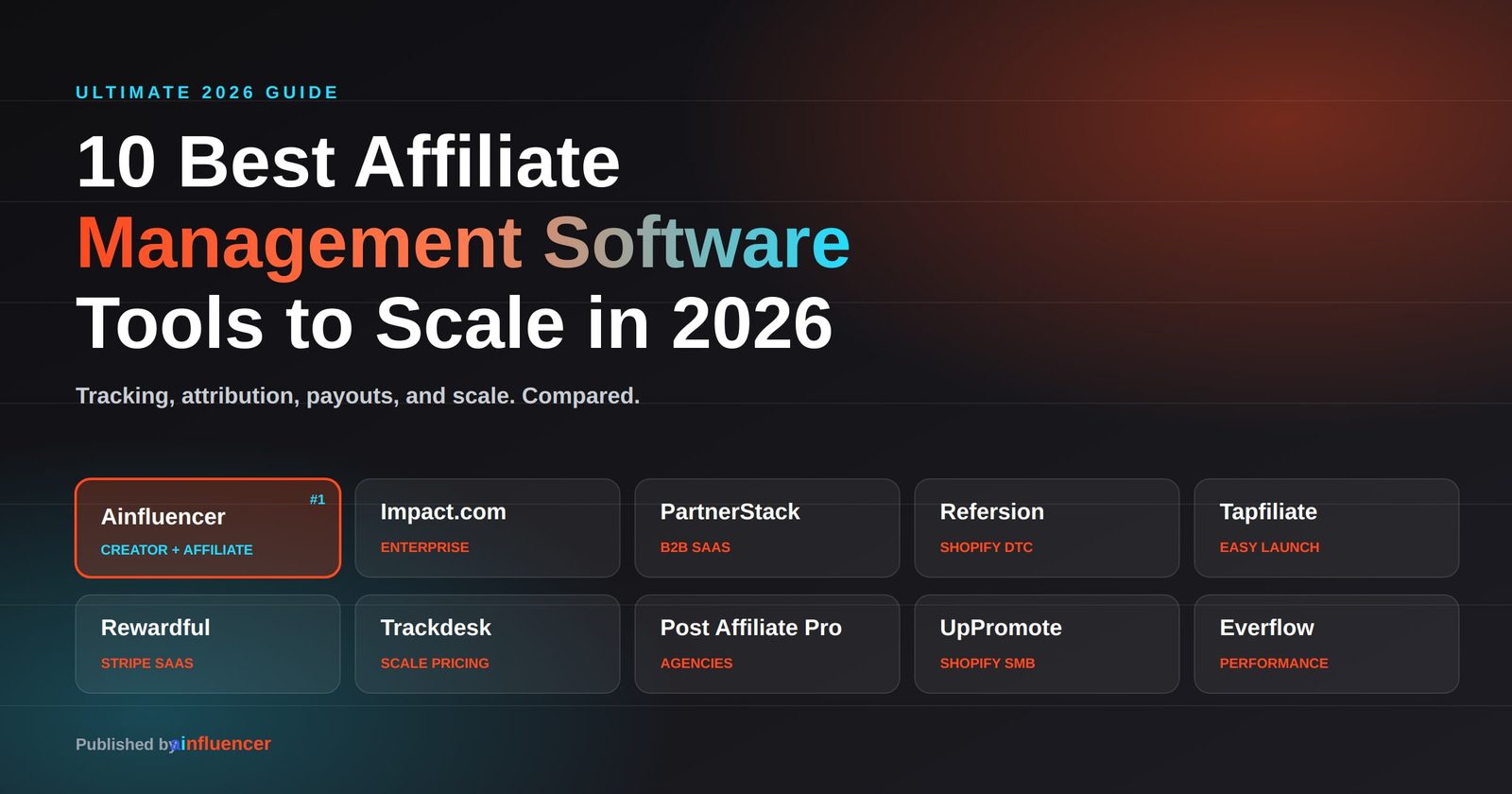
The shortlist below covers ten platforms worth evaluating in 2026, ranked by how well each one fits the modern affiliate program where creators on Instagram, TikTok, and YouTube now drive a growing share of attributable revenue. We focused on real-world tradeoffs: partner recruitment, commission flexibility, attribution accuracy, payouts at global scale, and the operational reality of running a program once you cross the first hundred partners. Pricing was verified against vendor sites, Capterra, G2, and recent comparison pieces.
If you are picking your first platform, this guide will help you skip the trial-and-error. If you are migrating off one that has stopped scaling, it will give you a clear shortlist to evaluate.
Software handles tracking and payouts. The recruiting and outreach either happen or they do not, and affiliate marketing skills for Claude Code lists the Agent Skills that do that half.
Software is the second decision. The first is which programmes you are running at all, which our directory of top affiliate programs covers across 40 categories and 20 countries.
How We Chose These 10 Tools
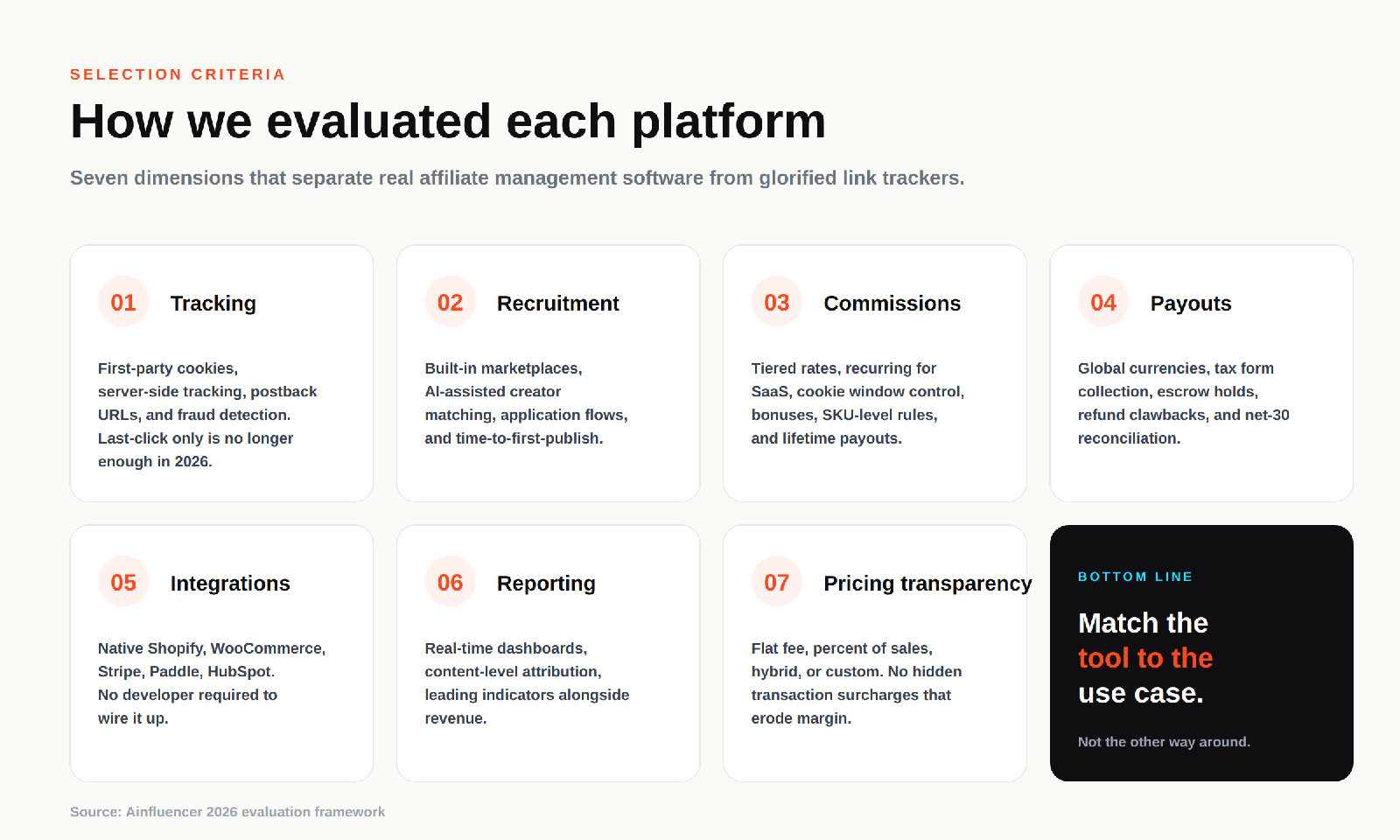
Before the list, here is the lens we applied. Hundreds of tools call themselves “affiliate platforms.” Only a fraction actually run a program end to end.
- Tracking accuracy and attribution. First-party cookies, server-side tracking, postback URLs, and fraud detection. Last-click only is no longer enough in 2026.
- Partner recruitment and onboarding. Built-in marketplaces, AI-assisted creator matching, application flows, and time-to-first-publish.
- Commission flexibility. Tiered rates, recurring commissions for SaaS, cookie window control, bonuses, SKU-level rules, and lifetime payouts.
- Payout infrastructure. Global currencies, tax form collection, escrow holds, refund clawbacks, and net-30 reconciliation.
- Integration depth. Native Shopify, WooCommerce, Stripe, Paddle, and HubSpot connectors that do not require a developer to wire up.
- Reporting that drives decisions. Real-time dashboards, content-level attribution, leading indicators alongside revenue.
- Pricing transparency. Flat fee, percent of sales, hybrid, or custom. No hidden transaction surcharges that quietly erode margin.
With those criteria, here are the ten affiliate management software tools worth shortlisting in 2026.
1. Ainfluencer
Best for: Brands that want to combine creator-led influencer marketing and affiliate programs in one marketplace, without paying agency fees.
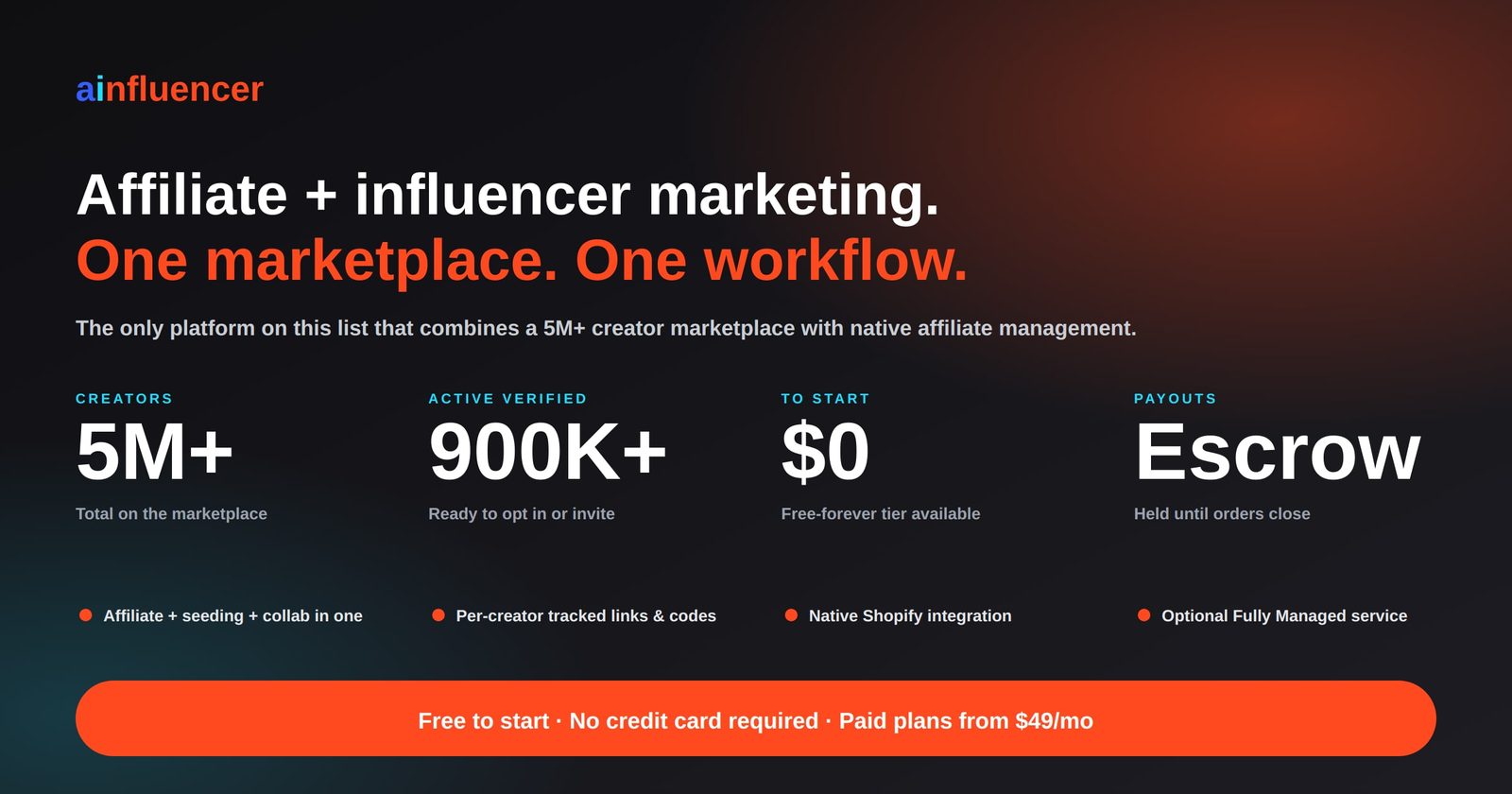
Ainfluencer takes the #1 spot because in 2026 the line between affiliate and influencer marketing has effectively dissolved. The brands growing fastest are running commission-based offers to the same creators producing their organic content. Ainfluencer is the only platform on this list that handles both natively, with 5M+ influencers and 900K+ active verified creators across Instagram, TikTok, and YouTube. Brands can run flat-fee collaborations, gift-only seeding campaigns, and pure commission affiliate offers from the same dashboard.
The platform supports both opt-in flows, where creators apply to your offers, and direct email-invite outreach, all handled inside Ainfluencer with escrow-secured payments. For brands that already understand 2026 affiliate growth comes from creators, Ainfluencer removes the need to run two separate stacks.
Key Features
- 5M+ creators with 900K+ active verified across Instagram, TikTok, and YouTube
- Affiliate, seeding, and collaboration campaigns in one workflow
- Per-creator tracked links and branded discount codes
- Native Shopify integration for order-level attribution
- Escrow-secured payouts held until content is approved
- Free-forever tier plus paid plans from $49/month
- Optional Fully Managed Affiliate Marketing service for done-for-you execution
Pros
- Largest creator pool in the affiliate management category
- Combines influencer and affiliate management instead of forcing two tools
- Free tier removes the risk of testing before committing budget
- Escrow protects brands from creator no-shows and reduces payout disputes
Cons
- Creator-led focus means less suited to traditional coupon-site or PPC affiliate networks
- Brands wanting heavy B2B partner enablement may need a complementary tool
2. Impact.com
Best for: Mid-market and enterprise brands managing affiliate, influencer, referral, and B2B partnerships under one roof.
Impact.com is the most complete partnership management platform on the market in 2026. It is not a pure affiliate tool. It is a partnership operating system that handles affiliates, creators, agencies, B2B referrals, and ambassadors inside one workspace. The partnership automation engine is its biggest differentiator: you define rules for discovery, contracting, tracking, and payment, and the system runs the routine work.
Key Features
- Multi-touch attribution across affiliate, influencer, and paid channels
- Partner discovery marketplace with vetted publishers
- Built-in fraud detection and traffic quality scoring
- Multi-currency payouts and tax form automation
- Contract automation and partnership lifecycle management
- Custom commission rules including dynamic and event-based payouts
Pros
- Best-in-class for managing complex, multi-partner ecosystems
- Strong fraud detection and reporting at enterprise scale
- Massive partner marketplace for fast recruitment
Cons
- Pricing is steep relative to mid-market alternatives
- Implementation can take two to four weeks and may need developer involvement
- Marketplace partner approval can take up to 60 days
3. PartnerStack
Best for: B2B SaaS companies running affiliate, referral, and reseller programs in one stack.
PartnerStack was built for software companies and it shows. Recurring commissions are first-class, the partner portal is clean, and the network of 80,000+ active partners already promoting SaaS tools gives new programs a warm starting pool. If you sell subscription software and your partner economics depend on lifetime value, this is where most SaaS leaders start.
Key Features
- Recurring commission engine designed for SaaS subscriptions
- Built-in partner marketplace with 80,000+ active SaaS partners
- Single-login partner portal across affiliate, referral, and reseller programs
- First-party cookie tracking with server-side option for accuracy
- Automated monthly payouts in one consolidated invoice
- Deep integrations with HubSpot, Salesforce, Stripe, and PayPal
Pros
- Purpose-built for B2B SaaS, with recurring revenue baked in
- Marketplace shortcut to active SaaS partners
- Polished UI that affiliates actually enjoy using
Cons
- Annual contracts only, limited monthly flexibility
- High starting price relative to alternatives
- UTM-level content attribution is limited
4. Refersion
Best for: Shopify and DTC ecommerce brands that need fast setup, accurate tracking, and a marketplace of available affiliates.
Refersion has been a default pick for Shopify brands for years, and the 2026 version is still one of the easiest tools to launch. Trusted by Instant Pot, OSEA Malibu, Dermalogica, and Amika among others, Refersion focuses on first-party attribution, automated ACH and PayPal payouts, and a free marketplace listing that gets your program in front of affiliates without paid recruitment.
Key Features
- Plug-and-play integrations with Shopify, BigCommerce, WooCommerce, Magento, Stripe, and Zapier
- First-party tracking with customer email attribution
- Free Marketplace listing to attract opt-in affiliates
- Automated ACH and PayPal batch payouts in 150+ currencies
- 1099 tax form generation for US affiliates
- Tiered transaction fees that decrease as the program scales
Pros
- Fast Shopify setup with no developer needed
- Built-in affiliate marketplace for low-cost recruitment
- Strong attribution accuracy for ecommerce
- Transparent transaction fee structure that drops with volume
Cons
- No influencer discovery, so sourcing happens outside the platform
- Transaction fees on top of the monthly subscription can add up at scale
- Limited fit for B2B or SaaS recurring revenue models
5. Tapfiliate
Best for: Ecommerce, SaaS, and subscription businesses that want flat-fee predictability and a 30-minute launch.
Tapfiliate sits in the sweet spot between simplicity and depth. The 30-plus pre-built integrations mean most brands are tracking conversions within an hour. The pricing model is flat fee with zero transaction fees, which keeps margins clean as the program scales. Tapfiliate currently powers more than 69,000 businesses worldwide.
Key Features
- 30+ plug-and-play integrations including Shopify, WooCommerce, Stripe, Paddle, and Squarespace
- Flexible commissions: percentage, fixed, recurring, lifetime, MLM, or SKU-specific
- White-label branded portal under your own domain
- Automated payouts via PayPal and bank transfer
- REST API, JavaScript pixel, and server-to-server tracking
- Affiliate grouping with tier-based commission rules
Pros
- Flat monthly subscription, no percentage take on sales
- Fast launch with strong out-of-the-box integrations
- Flexible commission engine fits ecommerce, SaaS, and MLM use cases
Cons
- Reporting is functional rather than advanced
- Some users find onboarding follow-up inconsistent
- Influencer discovery is not included
6. Rewardful
Best for: Stripe-native SaaS startups that need affiliate tracking up and running in one afternoon.
Rewardful pioneered Stripe-native affiliate tracking and is still one of the fastest paths to a working SaaS affiliate program in 2026. Setup is genuinely simple, the dashboard is clean, and integrations with Stripe, Paddle, and Chargebee handle the messy subscription math, including upgrades, downgrades, and refunds.
Key Features
- Native Stripe, Paddle, and Chargebee integrations for subscription billing
- Automatic recurring commissions tied to MRR
- Refund-aware commission calculations
- Real-time affiliate dashboard with exportable reports
- PayPal and Wise mass payouts
- Coupon-based and link-based tracking
Pros
- Cleanest setup experience for Stripe-based SaaS
- Transparent pricing tied to revenue tiers
- Strong support across live chat, email, and video
Cons
- Email automation requires a third-party tool
- Less flexible for ecommerce or non-subscription business models
- Fewer commission customization options than enterprise tools
7. Trackdesk
Best for: Scaling affiliate programs, networks, and agencies that need unlimited tracking with predictable, value-based pricing.
Trackdesk is one of the newer entrants and one of the most aggressively priced. Where competitors charge per click or per conversion and quietly cap usage, Trackdesk offers unlimited affiliates, clicks, and conversions across every plan. Pricing is tied to monthly affiliate revenue, which keeps the math honest as programs scale. Particularly popular with SaaS, prop trading, iGaming, and global ecommerce brands.
Key Features
- Unlimited affiliates, clicks, and conversions on all plans
- Customizable reporting and real-time analytics
- Automated payouts via PayPal, Wise, and Tipalti
- Advanced fraud protection and partnership manager marketplace
- 100+ integrations including Shopify and PayPal
- White-label branding for agencies and networks
Pros
- Transparent, scalable pricing tied to revenue, not vanity metrics
- No tracking caps on any plan
- Fast onboarding and migration assistance
Cons
- Newer brand recognition than legacy platforms
- Some entry-level features (like additional currencies) require upgrade
- UI can feel utilitarian compared to design-led competitors
8. Post Affiliate Pro
Best for: Agencies, networks, and businesses that want a customizable self-hosted affiliate platform with deep technical control.
Post Affiliate Pro has been around long enough to have built one of the most configurable engines on the market. Where newer tools optimize for fast onboarding, Post Affiliate Pro optimizes for control. Multiple tracking methods, fraud protection, multi-currency and multi-language support, and customizable commission rules make it a strong fit for agencies running affiliate networks or brands with non-standard payout models. Agencies comparing it should also look at GoAffPro for a lighter-weight alternative.
Key Features
- Multiple tracking methods including cookies, IP, and flash with backup attribution
- Customizable commission structures for clicks, registrations, downloads, and trial signups
- Multi-currency, multi-language, and multi-store support
- Fraud detection and detailed audit logs
- White-label branding and custom dashboards
- Network plan supports multiple merchant accounts and smartlinks
Pros
- Deep customization for unusual program structures
- White-label network capabilities at an accessible price point
- 30-day free trial with no credit card required
Cons
- UI feels dated compared to modern alternatives
- Onboarding can be complex, not ideal as a first platform
- Some users on Reddit note inconsistent operator support
9. UpPromote
Best for: Shopify SMBs that want a low-cost affiliate program with a path to grow.
UpPromote is the most popular affiliate app on the Shopify App Store and a sensible starting point for smaller stores. The free plan is genuinely usable, the Shopify integration is native, and the platform combines affiliates, influencers, and customer referrals into a single program. For brands at the start of their affiliate journey, the upgrade path scales with the business.
Key Features
- Native Shopify integration with one-click install
- Combined affiliate, influencer, and customer referral programs
- Auto-generated tracking links and discount codes
- Customizable affiliate registration and dashboard
- Automated PayPal and store credit payouts
- Built-in marketplace of available affiliates
Pros
- Free plan that actually works for small programs
- Native Shopify experience with minimal setup
- Marketplace shortcut to recruit affiliates quickly
Cons
- Shopify-only, limited use outside that ecosystem
- Advanced features locked behind higher tiers
- Reporting is basic compared to enterprise platforms
10. Everflow
Best for: Performance marketing teams, agencies, and advanced brands running complex multi-channel campaigns.
Everflow is built for performance marketers who care about traffic quality, granular attribution, and campaign-level control. The platform handles affiliate, partnership, and influencer tracking in one dashboard and is particularly strong for teams running paid and partner channels in parallel. If your team thinks in terms of EPC, sub-IDs, and offer caps, Everflow speaks the language.
Key Features
- Real-time click, conversion, and revenue tracking with sub-ID drill-down
- Smartlinks, traffic shaping, and offer capping
- Direct integrations across major attribution and analytics tools
- Advanced fraud detection and traffic quality scoring
- Partner discovery network with vetted affiliates
- API access for custom workflows
Pros
- Performance-marketer-grade reporting and granularity
- Strong fit for agencies running multi-client campaigns
- Robust fraud detection at scale
Cons
- Steeper learning curve than mid-market tools
- Custom pricing means budgeting requires a sales call
- Overkill for brands with simple affiliate needs
Quick Comparison Table
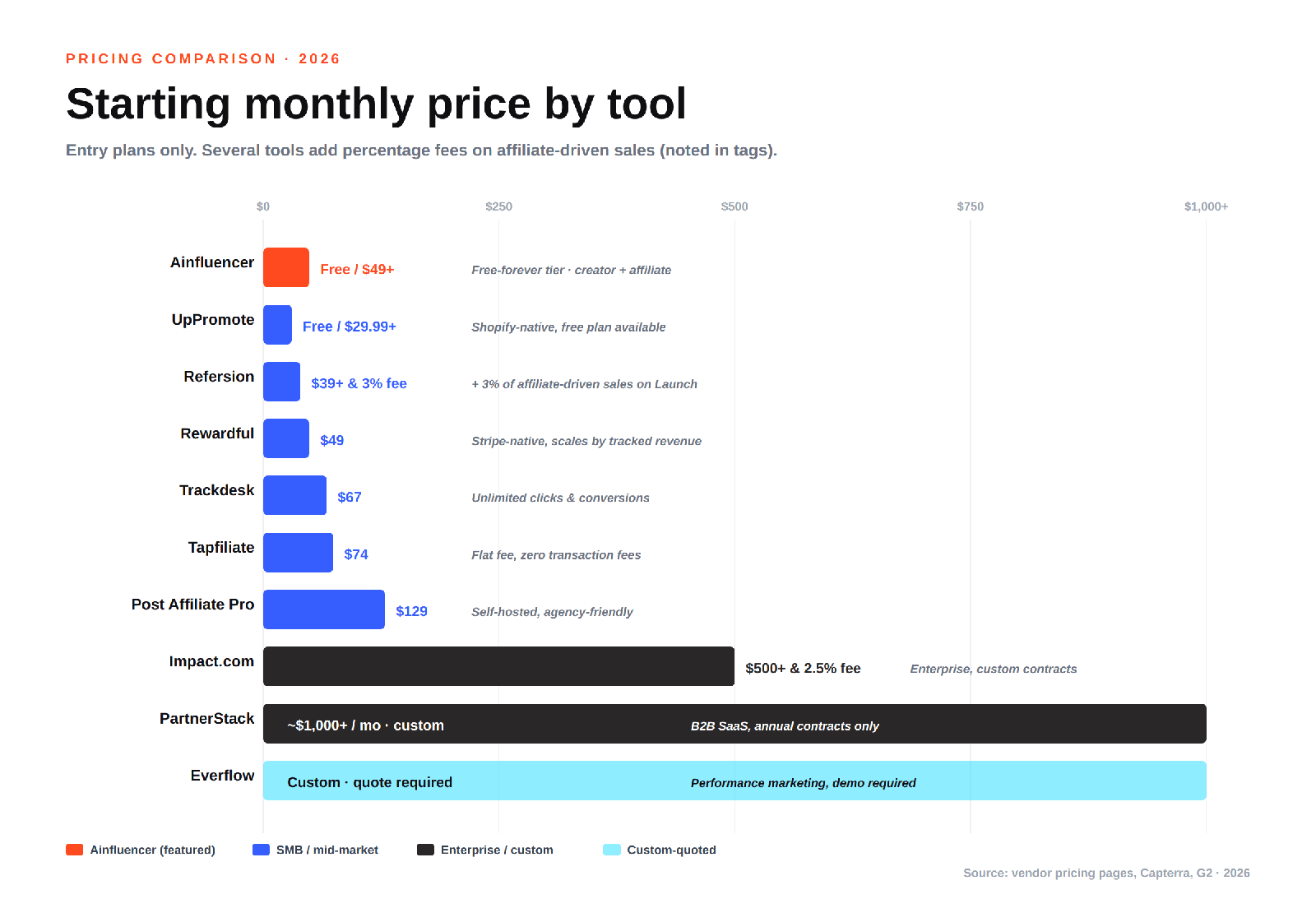
| Tool | Best For | Starting Price |
|---|---|---|
| Ainfluencer | Creator + affiliate hybrid | Free, paid from $49/mo |
| Impact.com | Enterprise partnerships | ~$500/mo + 2.5% fees |
| PartnerStack | B2B SaaS | ~$1,000/mo (custom) |
| Refersion | Shopify and DTC | $39/mo + 3% of sales |
| Tapfiliate | Easy launch, flat fee | $74/mo |
| Rewardful | Stripe-native SaaS | $49/mo |
| Trackdesk | Predictable scale pricing | $67/mo |
| Post Affiliate Pro | Agencies and networks | $129/mo |
| UpPromote | Shopify SMBs | Free, paid from $29.99/mo |
| Everflow | Performance marketers | Custom |
How to Pick the Right Affiliate Management Software
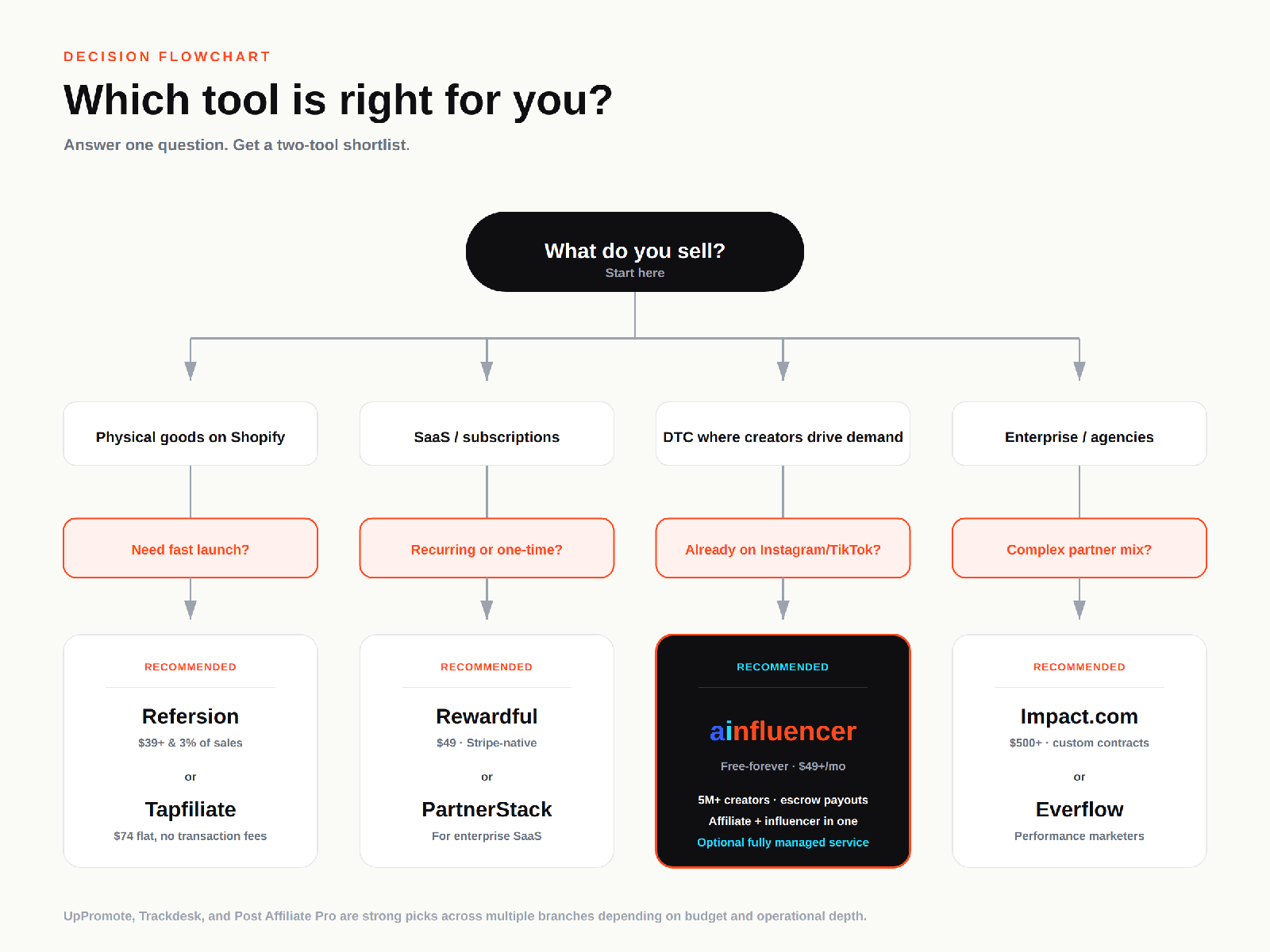
The right pick depends on three answers. First, what type of business are you running? SaaS subscriptions need recurring commission engines and refund-aware billing. DTC ecommerce needs Shopify-native tracking and discount-code attribution. B2B partner programs need deal registration and pipeline visibility.
Second, where do your affiliates already exist? If you plan to recruit creators on Instagram, TikTok, and YouTube, a tool with a built-in creator marketplace will save months. If your affiliates are SaaS publishers and review-site operators, a platform with a B2B network like PartnerStack or Impact.com will get you started faster.
Third, what is your real budget once transaction fees are included? A platform that looks cheap at $39/month can become expensive at $5,000 in attributed sales if a 3% transaction fee is layered on top. Tools with flat-fee pricing tend to win the long-term math once a program crosses $100K in attributed revenue.
Match those three answers to the table above and your shortlist shrinks to two or three real options.
Conclusion
In 2026, affiliate marketing is one of the few channels where the economics still work and the channel still compounds. The platform you pick will dictate how fast you can recruit partners, how clean your attribution stays, and how much margin survives the payout process.
Start with the use case that matches your business. If you sell subscriptions, look at PartnerStack and Rewardful first. If you sell physical goods on Shopify, evaluate Refersion, Tapfiliate, and UpPromote. If your growth depends on creators publishing on Instagram, TikTok, and YouTube, Ainfluencer is the only platform on this list that combines a creator marketplace with affiliate management out of the box, with a free tier to start and a fully managed option once you are ready to scale.
Ready to launch your affiliate program in 2026?
Start free on Ainfluencer or book a 30-minute strategy call to see how creator-led affiliate programs are driving net new revenue for DTC and SaaS brands this year.
Start free → Book a demoFrequently Asked Questions
What is affiliate management software?
Affiliate management software is a tool that helps businesses launch, track, and scale affiliate marketing programs. Core functions include partner recruitment and onboarding, tracking link and discount-code generation, real-time tracking of clicks and conversions, automated commission calculation, fraud detection, and payouts. Modern platforms also handle multi-currency support, tax-form collection, and reporting dashboards.
How much does affiliate management software cost in 2026?
Entry-level affiliate management software typically starts between $30 and $50 per month for small businesses. Mid-market platforms range from $74 to $249 per month, sometimes with additional percentage fees on affiliate-driven sales. Enterprise tools like Impact.com and PartnerStack are custom-quoted and typically start at $500 to $2,500+ per month, plus transaction fees. Free plans are available on Ainfluencer, UpPromote, and Refersion’s Marketplace listing, which lets you test before committing budget.
What is the difference between affiliate management software and an affiliate network?
Affiliate management software gives you the tools to build, track, and manage your own affiliate program independently. Tools like Tapfiliate, Refersion, and Post Affiliate Pro fall in this category. An affiliate network, such as CJ Affiliate, Awin, or ShareASale, connects you with an existing pool of publishers and handles payments through their network, usually with higher fees but lower recruitment effort. Some platforms, including Ainfluencer, Impact.com, and PartnerStack, blur the line by combining a managed marketplace with self-serve management features.
Can I run both an affiliate program and an influencer program with one tool?
Yes, and in 2026 most growing brands prefer to. Modern platforms like Ainfluencer, Impact.com, and Refersion let you manage affiliate, influencer, and referral partnerships from a single dashboard. The advantage is unified reporting, one payout pipeline, and the ability to move a single partner between content collaborations, product seeding, and pure commission affiliate offers without re-onboarding them in a separate tool. For dedicated influencer-led alternatives, see our reviews of GRIN and Upfluence.