What Is the Amazon Buy Box? The Complete 2026 Guide
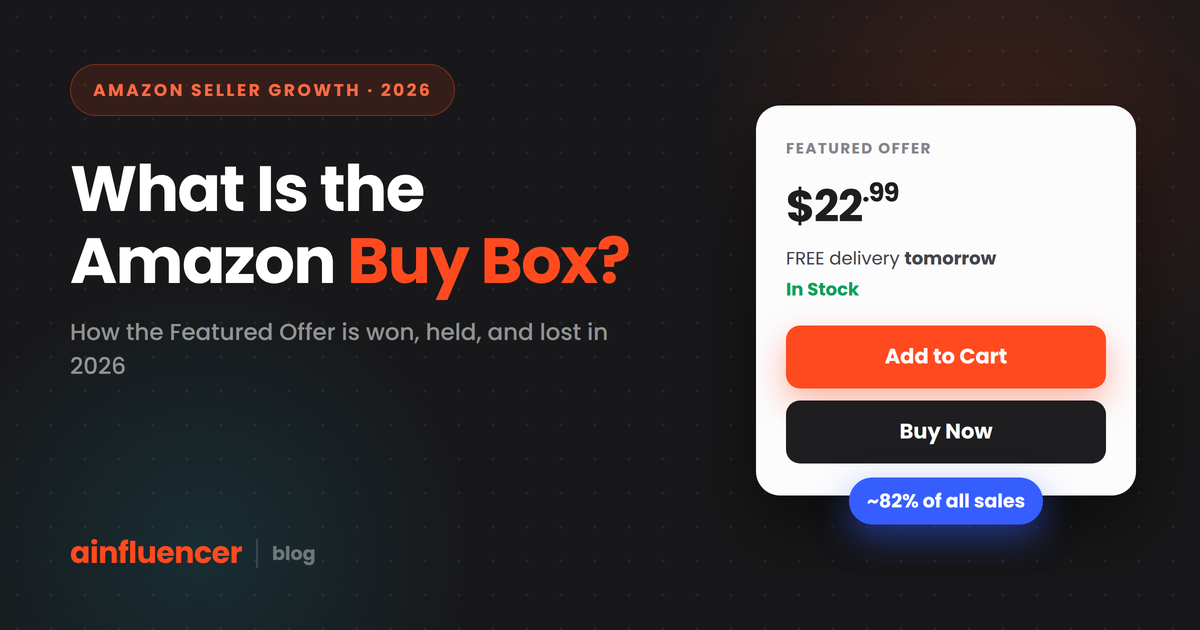
Roughly 82% of all Amazon sales flow through one small white panel. What the Featured Offer is, how the algorithm picks a winner, and exactly how to win it and keep it in 2026.
The Amazon Buy Box is the white panel on a product detail page that holds the price, delivery estimate, seller name, and the “Add to Cart” and “Buy Now” buttons. When several sellers offer the same product, Amazon’s algorithm picks one to feature there, and that winner captures the overwhelming majority of sales. Understanding how that choice is made is the single biggest lever for sales volume and profitability on the platform. This guide covers exactly what the Buy Box is, how much it drives, who’s eligible, how the 2026 algorithm decides, and the playbook for winning it and holding it.
What Is the Amazon Buy Box, Exactly?
The Amazon Buy Box is the section near the top-right of a product detail page where customers complete their purchase. When multiple sellers list the same product, Amazon evaluates each offer and selects a single winner to feature in that panel. Everyone else gets pushed to the “Other Sellers on Amazon” section (sometimes labeled “Buying Options”), which most shoppers never open.
Buy Box or Featured Offer? Both.
Amazon officially renamed the Buy Box to the “Featured Offer” back in 2023, and that’s the term you’ll see throughout Seller Central reports and Amazon documentation today. But most sellers, tools, and publications still say Buy Box, so this guide uses both interchangeably. If you’re managing your store from the dashboard, our guide to Amazon Seller Central pairs perfectly with this one, since that’s where you’ll check your eligibility and win rate.
Why placement decides the sale
The default buyer choice is always the offer in the box: if a customer doesn’t actively hunt for alternatives, the Buy Box winner gets the order. On mobile, which accounts for the majority of Amazon traffic, the Buy Box holder is essentially the only visible option, with other sellers buried behind an extra tap most people never take.
How Much Does the Buy Box Drive Sales?
The headline statistic has held steady for years: roughly 82% of Amazon sales flow through the Buy Box, and the share runs even higher on mobile, with some category estimates reaching 80 to 90%. If a listing gets 100 orders a day, around 80 of them go to whoever holds the box, while the rest are split among every other seller. The gap between holding the Featured Offer and sitting under “Other Sellers on Amazon” isn’t an 80/20 split; it’s closer to brutal.
The knock-on effect most sellers miss
Sponsored Products ads only run for the seller who holds the Buy Box on that ASIN. Lose the box, and your paid traffic on that listing stops the same day. For private-label sellers especially, this is decisive: you can’t advertise on your own listing without owning the Buy Box, which welds your Amazon PPC strategy directly to your Featured Offer share.
Who Can Win the Buy Box?
Not every seller or product is eligible. Before the algorithm even considers you, you need to clear a few gates:
| Requirement | Detail |
|---|---|
| Professional seller account | Only Professional accounts ($39.99/mo) compete; Individual accounts are excluded |
| New or like-new condition | Used items compete in a separate used Buy Box; some media categories are excluded |
| Healthy account metrics | Low order defect rate, on-time shipping, and good feedback keep you in rotation |
| Sufficient inventory | Low-stock signals reduce your rotation share before a stockout even happens |
To check eligibility, open Inventory, then Manage All Inventory in Seller Central, and review the Featured Offer eligibility status shown per ASIN. A green indicator means you’re in the running.
How the Buy Box Winner Is Chosen
Amazon never publishes the exact formula, and it weighs at least a dozen factors. But years of seller data point to a clear hierarchy, and the most important shift to internalize is this: the cheapest offer rarely wins by itself. The 2026 algorithm weighs fulfillment speed and seller health as heavily as price.
Landed price, not item price
This trips up more sellers than anything else. Amazon evaluates your total landed price, meaning item price plus shipping, not your sticker price. A $19.99 item with $3.99 shipping (landed: $23.98) loses to a $22.99 Prime offer with free shipping. The competitive window has also narrowed in 2026: you used to be able to price a few points above the lowest landed price and still earn decent rotation, but that tolerance has tightened to roughly a 5% band. The wider pricing context lives in our Amazon pricing strategy guide.
Fulfillment method and delivery speed
Amazon heavily favors fast, reliable fulfillment. FBA sellers can often price 10 to 15% higher than FBM sellers and still win, because Prime-eligible speed lifts the offer. With the return of Seller-Fulfilled Prime, merchants who ship themselves to Prime standards can compete on equal footing, but the October 2025 move to 0-day handling time for premium shipping turned the Buy Box into a genuine logistics competition.
Seller performance and conversion signals
Feedback score, order defect rate, late-shipment rate, and cancellation rate all feed the decision. Listing content doesn’t directly enter the algorithm, but it lifts conversion rate, and Amazon increasingly reads improving conversion as a sign customers prefer your offer, rewarding it with better treatment over time. That’s why optimizing your Amazon listing is a Buy Box tactic, not just an SEO one.
⚡ The 2026 reality
Brief performance dips cause immediate Buy Box loss: the algorithm has no memory of past wins. Track your win rate by SKU weekly and tighten whichever metric moved when your share slipped.
The Factors That Move Your Share, Ranked
| Factor | Why it matters | What to optimize |
|---|---|---|
| Landed price | Item + shipping is compared, not sticker price | Track total customer cost; stay within ~5% of lowest |
| Fulfillment method | FBA and SFP get a speed advantage | Use FBA, or meet SFP and Prime standards |
| Delivery speed | Weighted ~25-30% in many markets in 2026 | Faster handling and shipping times |
| Seller metrics | ODR, feedback, late and cancel rates | Keep ODR under 1%; protect account health |
| Inventory level | Low stock signals future stockouts | Maintain consistent, healthy stock |
| Conversion rate | Improving conversion earns better treatment | Stronger listings, reviews, and external traffic |
How to Win the Buy Box in 2026: The 5-Step Playbook
Winning the Featured Offer isn’t a trick you pull on Amazon; it’s something you earn through consistent operational excellence. Eligibility gets you into the rotation. These five steps decide how often you actually hold the box.
Confirm eligibility on every ASIN
Professional account, new condition, healthy metrics, and real stock. Audit the Featured Offer eligibility column across your catalog first, because no optimization below matters on an ASIN that isn’t even in the rotation.
Price on landed cost, inside the 5% band
Set a hard profit floor, then reprice on item plus shipping rather than sticker price. Manual repricing can’t keep up with a window that shifts all day, which is why automated repricers that adjust against competitors and Buy Box status in real time turn occasional rotation into consistent share.
Win on fulfillment speed
FBA or Seller-Fulfilled Prime for the Prime badge, and the tightest handling time you can operationally sustain. In 2026’s logistics-weighted algorithm, a faster delivery promise routinely beats a slightly cheaper offer.
Protect account health like revenue
Keep your order defect rate under 1%, ship on time, and answer feedback issues fast. Because the algorithm has no memory, one bad week costs you the box immediately; the sellers who hold it treat metrics dashboards as a daily habit, not a monthly report.
Lift conversion with external traffic
DifferentiatorThe May 2025 algorithm update made external traffic and customer satisfaction count for more. Qualified outside visitors, especially from creators whose audiences already trust them, lift conversion rate and signal demand to Amazon, which compounds your share. This is the differentiator most sellers skip, and the next section covers exactly how to build it.
The External Traffic Lever, Step by Step
Start with creators: our guides on finding TikTok influencers for Amazon products and building an Amazon Live influencer outreach strategy show how to recruit them, and you can route their traffic through your storefront by inviting creators to your Amazon brand store. The full channel-by-channel system, tracking setup included, lives in our playbook on driving external traffic to Amazon listings, and if Meta is your channel, Facebook ads for Amazon products covers the creator-handle creative rule that decides performance.
Amazon even pays you for this traffic: the Brand Referral Bonus rebates roughly 10% of attributed external-traffic sales back to enrolled brands, and Amazon Attribution closes the measurement loop. So the same external push that lifts your conversion signal also discounts your fees, while adding sales velocity your PPC auction never taxed.
Up to $500K of our ad spend behind your creator collabs
On the Ultimate plan, the Amazon Creator Boost Program funds up to $500,000 in ad spend to run your influencer posts as whitelisted ads. December 2025: $800K of funded spend, $13.4M in product sales, 16.8x blended ROAS. Conversion-lifting external traffic at $0 media cost to your brand.
See the $500K Boost Program →Why You Lost the Buy Box (and How to Recover)
Losing the box is rarely random; it’s almost always one of five causes: an uncompetitive landed price, weaker seller metrics than a competitor, low or out-of-stock inventory, a slower or non-Prime fulfillment method, or external price inconsistencies, since a lower price on another site can trigger suppression. Diagnose which one moved, fix it systematically, and the Buy Box follows.
When there’s no Buy Box at all
Sometimes Amazon replaces the buy buttons entirely with a “See All Buying Options” link. This is Buy Box suppression, and it usually means Amazon thinks your price is too high relative to other sites. Lowering price to a competitive level typically restores the panel within hours.
What’s a good Buy Box percentage?
Benchmarks depend on your model. Private-label brands and sole sellers should aim for 90%+ and often sit near 100%. Competitive resellers sharing a listing consider 70 to 89% strong, with 60 to 70% common in rotation. Below 50% signals an urgent problem, usually unauthorized sellers or slipping metrics. Track it in Seller Central under Business Reports, where it appears as “Featured Offer %”, and fold it into the dashboard from our guide on how to track marketing KPIs.
Frequently Asked Questions
Is the Buy Box the same as the Featured Offer?
Yes. Amazon renamed the Buy Box to Featured Offer in 2023. The terms are interchangeable: your dashboard says Featured Offer, most sellers still say Buy Box.
Can a third-party seller beat Amazon for the Buy Box?
Yes. Amazon doesn’t automatically win its own listings. Third-party sellers who stay competitive on landed price, maintain strong metrics, and offer fast shipping can and do win the box.
Does winning the Buy Box require the lowest price?
No. The cheapest offer often loses. Fulfillment speed and seller health can let a higher-priced FBA offer beat a cheaper FBM one, and the 2026 algorithm weighs delivery speed heavily.
Does external traffic help you win the Buy Box?
Indirectly but powerfully. External traffic lifts conversion rate and sales velocity, both signals the 2026 algorithm rewards with better Featured Offer treatment, and attributed external sales also earn the roughly 10% Brand Referral Bonus, so the same traffic pays you twice.
How do I check my Buy Box percentage?
In Seller Central, open Business Reports and look for the Featured Offer % column by ASIN. Review it weekly by SKU: sudden drops almost always trace to one of the five causes covered in this guide.
Published on the Ainfluencer Blog. Related reading: Amazon Seller Central, drive external traffic to Amazon, and Amazon sales increase strategies.