GRIN vs Aspire
GRIN repriced to self-serve credits from $0 in 2026. Aspire is still an annual contract at a $15,588 median. How the two actually compare.
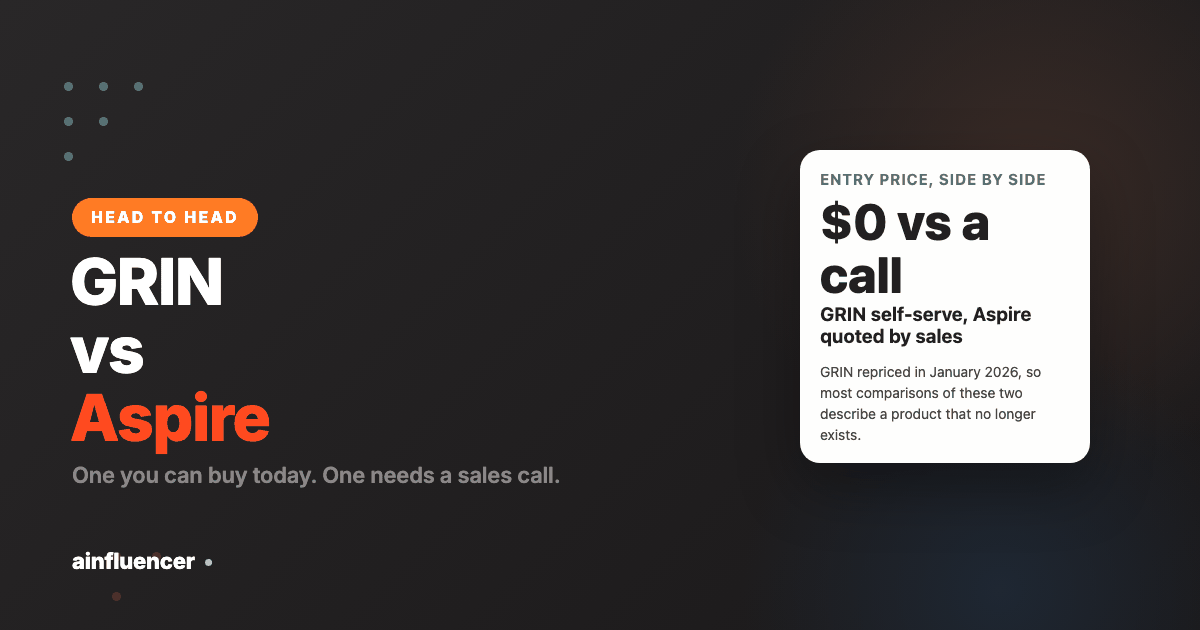
The short answer: GRIN you can buy this afternoon, Aspire you have to book a call for. GRIN repriced in January 2026 to self-serve, month-to-month usage credits starting at $0. Aspire still quotes through sales, and procurement data puts its median contract at $15,588 a year.
That difference is recent enough that most comparisons of these two are describing a GRIN that no longer exists. Everything below about GRIN was read from grin.co/pricing directly. Everything about Aspire is third-party and labelled as such, because Aspire publishes no prices.
Pricing Side by Side
What each one costs to start
| GRIN | Aspire | |
|---|---|---|
| Entry price | $0, a real free tier | Reported at about $2,000 a month, with other sources saying $2,499 per user or closer to $1,000 |
| How you buy it | Self serve. No required sales call | Sales call. No self-serve sign-up |
| Commitment | Month to month | Annual contract. Sources disagree on whether a monthly option exists |
| Priced by | Usage credits, not seats. Unlimited CRM with no per-contact billing | Quoted by seats, creator volume and modules |
| Try before buying | Free tier with no card, plus a 30 day Starter trial | Reported as no free trial |
| Tracked contract value | Enterprise tiers still exist above the self-serve ladder | Vendr median $15,588 a year, range $11,139 to $36,599 |
GRIN’s published ladder is Free at $0 with 50 monthly credits, Starter at $200 with 2,000, Growth at $500 with 7,500 and Scale at $1,000 with 20,000. Those are the numbers on the page today, and they are the reason the comparison has changed.
How Each One Meters Your Cost
This is where the two differ most, and it decides which is cheaper for you far more than the headline price does.
Two different meters
| GRIN | Aspire | |
|---|---|---|
| The unit | A credit, which meters work done by Gia, its AI agent | A seat, plus creator volume and module choices |
| What is free | Viewing, filtering, configuration, previews and messages you type yourself | Not applicable. The contract covers the whole thing |
| What costs more | Personas, reporting, gifting workflows, campaign setup, and creating an affiliate commission payable | More seats, more active creators, more modules |
| Rollover | Included credits reset monthly and do not roll over. Purchased ones do | Not applicable |
| Who it punishes | Seasonal programmes, which pay for capacity they do not use in quiet months | Small teams, who pay an annual contract priced for a larger one |
The practical reading: if your activity is lumpy, GRIN’s free and Starter tiers let you ride it out. If your team is large and busy, Aspire’s flat contract stops being the expensive option. The crossover is somewhere around the point where you are running creators continuously rather than in bursts.
Where Each One Is Genuinely Stronger
Our full write-ups go deeper than a comparison can: the GRIN review and the Aspire review.
GRIN
- You can test it properly. A free tier with no card and a 30 day Starter trial, against a competitor with no free trial, is a real advantage and not a marketing one
- No per-seat tax. Pricing is usage based and the CRM is unlimited with no per-contact billing, so adding a colleague does not reprice the tool
- Migration is free, from a CSV, a competitor platform or GRIN Classic, and it does not consume credits
- Ecommerce roots. It was built around DTC brands and the affiliate tooling reflects that
Aspire
- Community management at scale is its stated focus: maintaining large ongoing rosters rather than running one campaign at a time
- The Shopify integration is the most praised feature in its reviews. It bulk-generates unique promo codes and affiliate links per creator and ties influencer traffic to actual checkouts, with WooCommerce and TikTok Shop also supported
- A creator marketplace is reported in its entry tier, which GRIN does not have in the same shape. Confirm it in a demo, since sources do not agree
- Review scores are strong, reported at 4.5 to 4.8 on G2 from 112 to 120 or more reviews, a larger sample than most tools in this category
Which to Pick, by Situation
The honest decision table
| Your situation | Pick | Why |
|---|---|---|
| You want to try before committing any budget | GRIN | A free tier with no card. Aspire is reported to have no free trial |
| You run campaigns in bursts, not continuously | GRIN | Month to month, and a quiet quarter can sit on the free tier |
| One or two people will use it | GRIN | Not priced per seat, and an annual contract priced for a team is poor value for two |
| You manage hundreds of creators continuously | Aspire | Its stated focus, and a flat contract stops being the expensive option at that volume |
| Shopify affiliate tracking is the core job | Aspire | Its most consistently praised feature, though GRIN’s affiliate tooling is also ecommerce led. Test both |
| Procurement needs one annual line item | Aspire | Usage-based billing is harder to get through some finance teams than a fixed contract |
| You do not have a creator roster yet | Neither | Both are management layers that assume you already have creators. See below |
What Neither of Them Does Well
Worth saying plainly, because a head-to-head comparison naturally implies one of the two is the answer. Both GRIN and Aspire are creator relationship management tools. They assume you already have creators, or that you will go and find them, and then give you the machinery to run them.
If your actual bottleneck is that you do not have a roster, or that the creators you contact do not reply, neither tool addresses it. That is a sourcing problem and it belongs in a different category: a database to research them, or a marketplace where creators opted in to receive offers.
On Ainfluencer there is no subscription and no contract: brands search, send offers, and agree terms and pay inside the platform, with a $10 minimum collaboration and a fee from 25% on the free plan down to 3%. It is a different product from both of these, which is the point. Influencer marketing platforms sets out the four categories, and influencer rates covers what creators actually charge once you find them.
One more honest note: we publish a competing marketplace, so treat our view of both tools the way you should treat every comparison in this category, including the ones written by Aspire’s and GRIN’s other competitors. The GRIN prices here are checkable on their own page, which is why they are the ones quoted first hand.
If Neither Fits
- CreatorIQ is the enterprise tier above both, with a Vendr median near $37,000 a year. See CreatorIQ alternatives
- Upfluence is broader on networks and reported from $649 a month on a three month commitment
- Traackr if proving value matters more than running the work
- Modash if what you needed was discovery and audience data rather than workflow
- The full field is in GRIN alternatives, which covers GRIN’s credit model in more depth than a comparison allows
Frequently Asked Questions
Is GRIN or Aspire cheaper?
GRIN, clearly, at the entry point. It has a free tier at $0 and a published self-serve ladder up to $1,000 a month, while Aspire is reported at around $2,000 a month on an annual contract with procurement data putting the median at $15,588 a year. At large, continuous volume the gap narrows because GRIN’s credits scale with usage.
Can I try GRIN or Aspire for free?
GRIN has a free tier that needs no card and no sales call, plus a 30 day trial of its Starter plan. Aspire is reported to have no free trial and no self-serve sign-up, so testing it means a sales process first.
What is the main difference between GRIN and Aspire?
How you buy them and how they meter cost. GRIN is self-serve, month to month, and priced by usage credits rather than seats. Aspire is an annual contract quoted through sales and priced by seats, creator volume and modules. GRIN moved to this model in January 2026, which is why older comparisons describe it differently.
Which is better for Shopify?
Aspire’s Shopify integration is the single most praised feature in its reviews, bulk-generating promo codes and affiliate links per creator and tying traffic to checkouts. GRIN is also ecommerce led with affiliate tooling built in. If this is the deciding factor, test both against your own store rather than taking either review at face value.
Does GRIN or Aspire find influencers for me?
Both are primarily management layers that assume you have creators or will source them. Aspire reports a creator marketplace in its entry tier, though sources disagree, so confirm it in a demo. If sourcing is your real bottleneck, a discovery database or a marketplace is the right category rather than either of these.
What happened to AspireIQ?
It is the same company. AspireIQ rebranded to Aspire, which is why both names still appear in search results and in older comparisons.
Do GRIN credits roll over?
Included monthly credits reset at the start of each billing cycle and do not roll over. Credits you purchase on top of a paid plan do roll over. That asymmetry makes topping up less wasteful than upgrading a tier, which is the opposite of how most software pricing behaves.