How to Get More Views on YouTube
Views are impressions times click-through rate. Find which of the three is broken on your channel, and the fix for each, from your own Analytics.
“How do I get more views” is the wrong question, and that is why the answers you have read did not work. There is no single thing called views. There is an arithmetic, and it has exactly two terms:
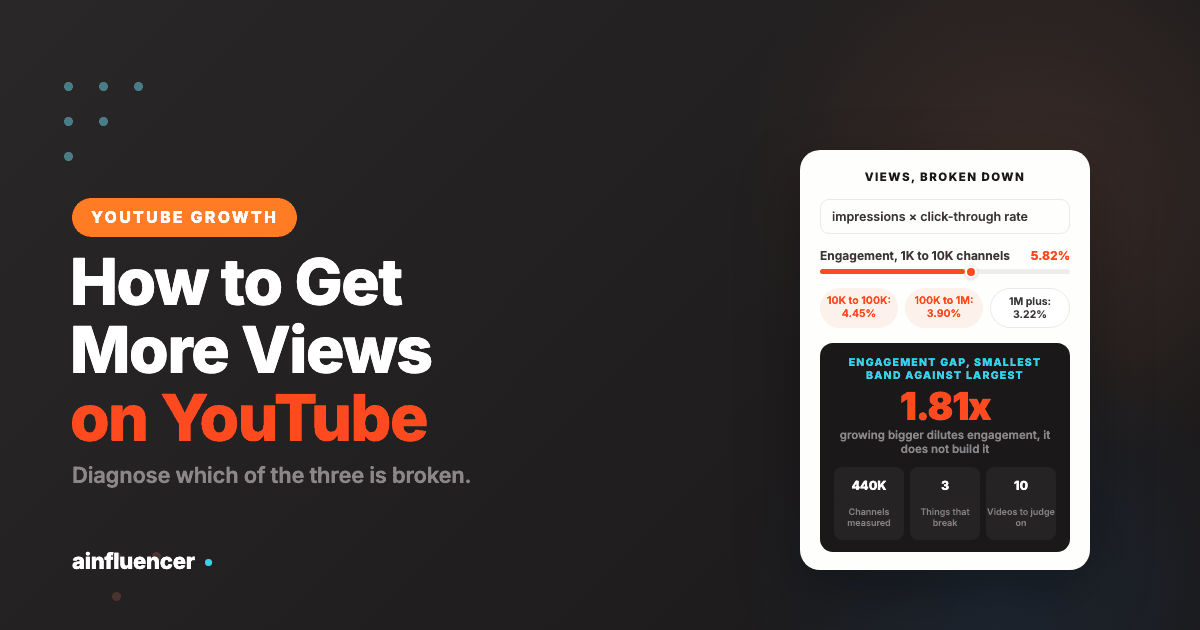
views = impressions × click-through rate
YouTube shows your video to some number of people. Some fraction of them click. That is your view count, and nothing else produces it. A third number, how long people stay, does not create views directly but decides whether YouTube keeps producing impressions tomorrow.
So a channel that is not getting views has one of three specific problems, not a vague one. This page shows you how to tell which, using numbers that are already in your own YouTube Analytics, and what to do about each.
First, Find Out Which of the Three Is Broken
Open YouTube Studio, go to Analytics, then the Content tab, and look at your last 10 videos. You need three columns: impressions, impressions click-through rate and average view duration. Then read your channel off this table.
What your numbers are telling you
| What you see | What is actually wrong | Where to go next |
|---|---|---|
| Few impressions, decent CTR | YouTube is barely showing the video. The problem is distribution, not packaging | The impressions section below. Usually topic, search demand or a cold start |
| Plenty of impressions, CTR under about 2% | YouTube is showing it and nobody is clicking. The problem is the thumbnail and title | The click-through section below |
| Good CTR, retention falls off a cliff early | People click and leave. YouTube stops showing it after the first push | The retention section below. Fix the first 30 seconds |
| Everything decent, views still low | Nothing is broken. Your topic has a small audience, or the channel is new and has no history to recommend from | The search versus browse section. Pick topics with existing demand |
| One video did well, the rest did not | Normal. YouTube tests each video semi-independently | Do not rebuild the channel on one result. Look at the median of 10 |
Use the median of your last 10 videos, never your best video. One outlier tells you nothing about what to change.
Impressions: Getting YouTube to Show the Video at All
An impression is YouTube putting your thumbnail in front of someone. You do not control this directly, but you control almost everything it depends on, because it is driven by where your video can appear.
The two engines, and why they behave differently
Search traffic against browse traffic
| Search | Browse and suggested | |
|---|---|---|
| What triggers it | Someone types a query your video answers | YouTube decides to recommend you to someone already watching |
| Who it reaches | People actively looking. Smaller, but intent is high | People scrolling. Much larger, and far less predictable |
| How fast it starts | Slowly, over weeks, as the video ranks | Immediately or not at all. The first 24 hours decide most of it |
| How long it lasts | Years. A search video keeps earning impressions indefinitely | Days, usually. Then it stops |
| What you need for it | A topic people search for, and a title that matches the query | A thumbnail that beats what else is on the page, and retention that holds |
This distinction decides your strategy. A new channel should aim at search, because browse recommendations need a history YouTube does not have for you yet, while search only needs your video to be the best answer to a question. Search also compounds: the video is still earning impressions in two years.
How to pick a topic that can get impressions
- Search YouTube for your topic before you film. If the top results have 2,000 views each, the demand is not there. If they have 200,000 and were posted three years ago, it is there and it is stale.
- Use YouTube’s own autocomplete. Type your topic in the search bar and read what it suggests. Those are real queries.
- Answer one question per video. A video titled for one query ranks for that query. A video covering five things ranks for none of them.
- Check what you can realistically beat. If the first page is all channels with a million subscribers covering it well, pick the narrower version of the question that nobody has covered.
Posting time is a real but small lever here, and it matters most for the first few hours of browse traffic. We tested what the published studies actually say in the best time to post on YouTube.
Click-Through Rate: the Fastest Number to Move
CTR is the share of people who saw your thumbnail and clicked. It is the single most improvable number on this page, because unlike retention it does not require you to make a better video, only a better package for it.
YouTube shows your channel’s own CTR range in Analytics, and comparing yourself to it is far more useful than any published benchmark, because CTR varies enormously by niche and traffic source. Read your own range, then work on the videos sitting below it.
The thumbnail
- It is competing, not displaying. Your thumbnail appears next to ten others. The question is not whether it looks good, it is whether it looks different from the nine around it.
- Three elements maximum. A face, an object, three or four words. Anything more is unreadable at the size it is actually shown.
- Check it at phone size. Shrink it to roughly 2cm wide and look at it. Most of your audience will never see it larger.
- Do not repeat the title in the thumbnail. They sit next to each other. Use the thumbnail to say the thing the title cannot.
The title
- Front-load the query. Titles are truncated, and the first five words do the work in both search and browse.
- Match the words people type. “How to get more views on YouTube” is a title. “My journey to growth” is not.
- Make a promise you keep. A title that overpromises buys a click and loses the retention, which costs you the impressions that would have followed.
Test on your existing videos. Changing the thumbnail and title of a video that already has impressions is the fastest experiment available to you, because the distribution is already there. A video with 10,000 impressions at 2% CTR that reaches 4% has doubled its views without a single new minute of filming.
Retention: What Decides Whether It Keeps Being Shown
Retention does not produce views directly. It produces the next round of impressions. A video people stay with gets shown more; a video people leave stops being shown, whatever its CTR was.
In Analytics, open the Engagement tab and look at the retention graph for a video. The shape tells you more than the number.
Reading the retention curve
| Shape | What it means | What to change |
|---|---|---|
| Steep drop in the first 30 seconds | The opening did not deliver what the title and thumbnail promised | Cut the intro entirely. Start with the thing they came for |
| Gentle, steady decline | Normal and healthy. Every video does this | Nothing. This is what a good video looks like |
| A sharp dip partway through | A specific section is losing them. Scrub to that timestamp and watch it | Cut or shorten that section in the next video |
| A bump upward | People are rewatching or skipping back. Something there was useful | Do more of that, and consider putting it earlier |
| High percentage, short duration | The video is short and people finish it. Fine for Shorts, limiting for long-form | If you want watch time, the video needs to justify being longer |
The highest-value 30 seconds of any video are the first 30. Most creators spend them on an intro animation, a greeting and a description of what the video will cover. Delete all three. Start with the answer, the result or the most interesting moment, and explain afterwards.
Growing Bigger Does Not Mean Getting More Engaged
One assumption underneath most growth advice is that subscribers and views move together, so chasing subscribers is chasing views. We measured engagement rate across the YouTube channels on our platform and that is not what the data shows.
YouTube engagement rate by channel size
| Subscriber band | Channels measured | Average subscribers | Average engagement rate |
|---|---|---|---|
| 1,000 to 10,000 | 148,108 | 3,745 | 5.82% |
| 10,000 to 100,000 | 192,597 | 35,210 | 4.45% |
| 100,000 to 1M | 84,262 | 297,573 | 3.90% |
| 1M and above | 15,861 | 3,301,856 | 3.22% |
Engagement falls steadily as channels grow, from 5.82% in the smallest band to 3.22% in the largest, a factor of 1.81. A channel with 3,700 subscribers engages its audience at nearly twice the rate of one with three million.
The honest reading: this is engagement rate, which is a ratio, and a larger channel’s smaller ratio still represents far more people. What it does mean is that subscriber count is not the lever you think it is. Views come from impressions and clicks on individual videos, not from the size of the number under your channel name. Work on the videos.
What Does Not Work, and Costs You
- Buying views. They do not watch, so they destroy your retention, which is the signal that would have earned you real impressions. You pay to make the problem worse.
- Sub4sub. Subscribers who do not watch make your notifications and browse performance worse, because YouTube learns your subscribers ignore you.
- Tag stuffing. Tags are a minor signal at best. The title, the thumbnail and the first lines of the description do the work.
- Posting more often when retention is the problem. Five bad videos a week teaches YouTube faster that your videos are not worth recommending.
- Rebuilding the channel after one flop. Judge on the median of ten, never on one.
- Chasing a trend outside your topic. It can bring one spike of views and then confuses who YouTube thinks your channel is for.
A 30 Day Plan That Fixes the Right Thing
- Days 1 to 2. Pull impressions, CTR and average view duration for your last 10 videos. Write down the median of each. This is your baseline and you will compare against it.
- Days 3 to 5. Using the diagnostic table above, decide which of the three is your bottleneck. Pick one. Not three.
- Days 6 to 10. If it is CTR: make new thumbnails and titles for your three videos with the most impressions and the worst CTR. If it is retention: watch your own retention graphs and write down the exact timestamp where each one drops. If it is impressions: research five topics with proven search demand.
- Days 11 to 25. Publish three videos applying only that one fix. Keep everything else the same, otherwise you will not know what worked.
- Days 26 to 30. Compare the new medians with your baseline. If the number you targeted moved, keep going. If it did not, you diagnosed the wrong bottleneck, so go back to step 2.
Thirty days is long enough to see CTR move and short enough that you do not spend a quarter on the wrong problem. Retention changes take longer to show in impressions, so give that one 60 days before judging.
Frequently Asked Questions
Why am I not getting views on YouTube?
Because one of three specific things is failing, and they have different fixes. Either YouTube is barely showing your video, which is an impressions problem caused by topic or a cold channel; or it is showing it and nobody clicks, which is a thumbnail and title problem; or people click and leave, which is a retention problem in your first 30 seconds. Open Analytics, look at impressions, click-through rate and average view duration across your last 10 videos, and the one that is out of line is your answer.
What is a good click-through rate on YouTube?
Compare against your own channel rather than a published benchmark, because CTR varies enormously by niche and traffic source. YouTube shows your channel’s typical range in Analytics next to each video. Work on the videos sitting below your own range, and treat any video with plenty of impressions and an unusually low rate as a packaging problem rather than a content one.
How does the YouTube algorithm decide what to show?
The practical answer, from what you can see in your own Analytics, is that YouTube tests a video with a batch of impressions and watches two things: whether people click, and whether they stay. Click-through rate and average view duration are both visible to you, and both behave like gates. A video that passes gets more impressions, and a video that fails stops being shown. Nobody outside YouTube knows the internal weights, and anyone quoting them precisely is guessing.
Should I focus on search or on recommended videos?
Search, if your channel is new. Browse and suggested recommendations rely on a history YouTube does not have for a young channel, while search only requires your video to be the best answer to a question people are already typing. Search traffic is also permanent: the video keeps earning impressions for years, where a browse push lasts days.
Do more subscribers mean more views?
Less than people assume. We measured engagement rate across YouTube channels by size and it falls as channels grow, from 5.82% in the 1,000 to 10,000 band to 3.22% above a million. Views come from impressions and clicks on individual videos, so a strong video on a small channel outperforms a weak video on a large one.
How long does it take to get more views?
Changes to thumbnails and titles can show within days, because you are changing the click rate on distribution that already exists. Retention changes take 30 to 60 days to feed through into impressions, because YouTube needs several videos to update its view of your channel. Topic changes take longest of all, because search rankings build over weeks.
Does changing the thumbnail on an old video help?
It is the fastest experiment available to you. A video that already has impressions does not need new distribution, only a better click rate on the distribution it has. Doubling CTR on a video with 10,000 impressions doubles its views with no filming at all.
Is buying views ever worth it?
No, and it is actively harmful. Bought views do not watch, so they drag down the retention that is the exact signal YouTube uses to decide whether to keep showing your video. You pay money to make your distribution worse.
Views Are Not the Finish Line
Views matter because of what they let you do next. A channel with consistent views, even at a few thousand per video, can be paid by brands, and the deals are priced against the views you reliably get rather than your subscriber count.
You can list your channel on Ainfluencer free, with no subscriber threshold, and apply to brand campaigns rather than wait to be found.
Related reading: how to get sponsored on YouTube, the best time to post on YouTube, YouTube monetization requirements, how much YouTubers make, and how to become a YouTube influencer. Starting from nothing? How to create a YouTube channel.