Real Estate Lead Generation Ideas: 12 Proven for 2026
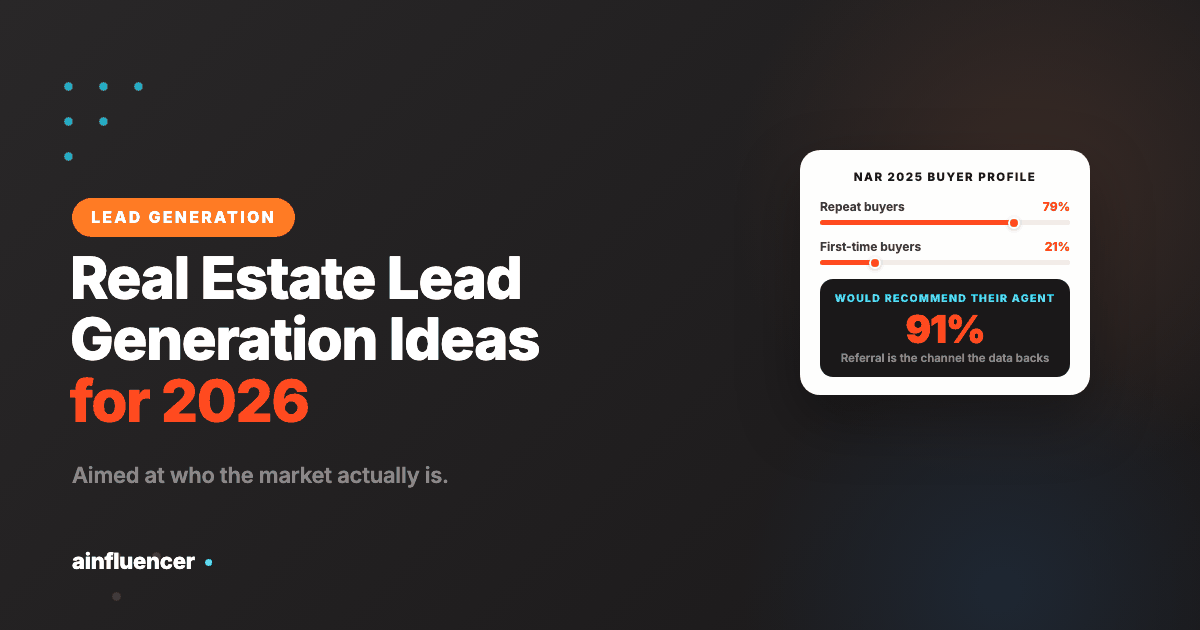
Most advice in this category aims at first-time buyers, who are now 21% of the market and falling. Here is what the data says to do instead.
Most real estate lead generation ideas are aimed at the wrong person. They assume a young first-time buyer who needs a mortgage calculator. The National Association of Realtors has measured who is actually transacting, and it is not that person.
Start With Who Is Actually Buying
Before any tactic, the composition of the market. These are figures from NAR’s 2025 Profile of Home Buyers and Sellers, covering transactions between July 2024 and June 2025.
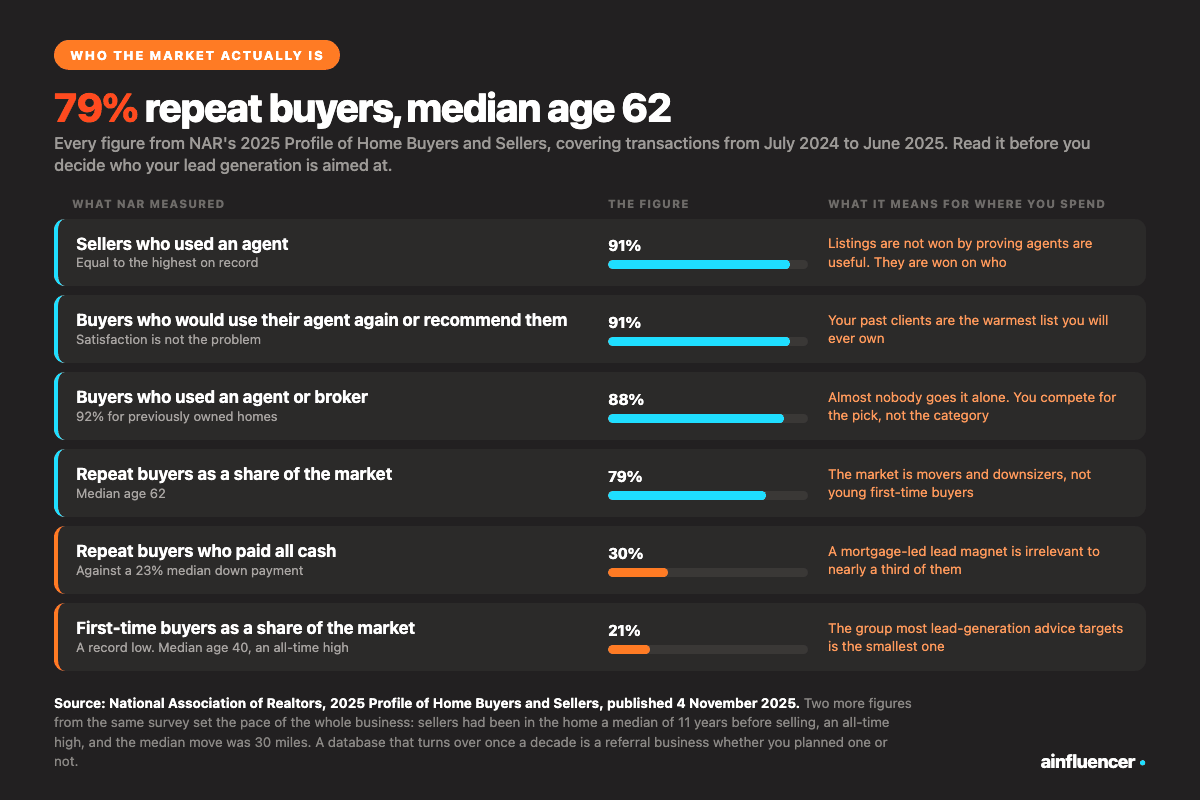
Three of those numbers should change how you spend.
- Repeat buyers are 79% of the market, with a median age of 62. The typical transaction is a move or a downsize by somebody who has done this before and does not need the process explained
- First-time buyers fell to 21%, a record low, and their median age rose to 40, an all-time high. This group is both smaller and older than the one most lead magnets are written for
- 30% of repeat buyers paid all cash. For nearly a third of the biggest segment, every piece of financing content you produce is irrelevant
NAR also reports that sellers had been in the home a median of 11 years before selling, an all-time high, and that the median move was 30 miles. Both matter more than they look. An 11 year cycle means the person you help this year is not a repeat customer in any useful timeframe, and a 30 mile move means your market is genuinely local rather than regional.
One more piece of context from the same survey, because it explains the mood of every conversation you will have this year. NAR notes that mortgage rates averaged 6.69% while the survey was in the field, and that repeat buyers put down a median of 23% against 10% for first-time buyers. The people transacting are the ones with equity, and they are moving in spite of the rate rather than because of it. A pitch built on how affordable borrowing is will not land with them.
The practical reading of all this: your marketing should look like it was written for a 62 year old who has sold a house before, has equity, may not need a mortgage at all, and is moving across town rather than across the country. Almost no agent’s website looks like that.
The Referral Engine the Data Actually Supports
One figure outweighs everything else in this article. NAR reports that 91% of buyers would use their agent again or recommend them to others, and that 91% of sellers used an agent, equal to the highest share on record.
Read those together and the picture is unusual. Satisfaction is near universal, and yet almost every agent describes lead generation as their hardest problem. The gap is not quality. It is that a delighted client who would recommend you is not the same thing as a client who has been asked to.
Idea 1: ask at the moment of maximum goodwill
The peak is closing day and the week after, not six months later when the memory has faded. Ask for one specific introduction rather than a general recommendation, because a general one gives the other person a task with no obvious first step.
Idea 2: build the eleven year follow-up, not the eleven week one
If the median seller moves after 11 years, a drip campaign built for a 90 day sales cycle is aimed at nobody. What works over that horizon is low frequency and genuinely useful: an annual valuation they did not ask for, a note when something sells on their street, a reminder when a tax or regulatory change affects their property.
Idea 3: treat past clients as a referral list, not a repeat list
Your past client will probably not transact again for a decade. What they will do, within weeks, is sit next to somebody at a dinner who is thinking about moving. The asset is their network, not their next purchase, and that changes what you send them.
Why the ask fails when it is vague
“If you know anyone looking to move, send them my way” asks the other person to do three things: scan their whole social circle, judge who qualifies, and then start an awkward conversation. Most people abandon that at step one, not because they are unwilling but because it has no edges.
The version that works names a group and supplies the words. Something closer to: your neighbours at numbers 14 and 18 both asked me what yours went for, would you mind if I dropped them a note and said you suggested it. That is one decision, it costs nothing, and it is answerable in a sentence.
Track it the same way. A referral programme that is not written down anywhere is a set of good intentions, and the reason most agents cannot tell you their referral rate is that nobody recorded the asks, only the wins.
Ideas That Work on Repeat Buyers and Downsizers
Since this group is 79% of the market, it deserves its own tactics rather than the first-time buyer playbook with the word changed.
- Idea 4: lead with the sell side. A repeat buyer is almost always a seller first, and their real anxiety is sequencing, not finding a house. Content about selling and buying in the same month outperforms anything about how to get a mortgage
- Idea 5: build a downsizing resource that is honest about cost. Moving after 11 years in a home is an enormous logistical job. The agent who has a real answer about clearing, storage and timing is the one who gets called
- Idea 6: speak to the cash buyer. With 30% of repeat buyers paying cash, a track record of handling cash purchases and fast closes is a genuine differentiator and almost nobody advertises it
- Idea 7: farm the street, not the city. A 30 mile median move means your next client already lives near your last one. Geographic farming is unfashionable advice that the distance data supports better than any digital channel
A note on tone for this segment, because it is where most marketing misfires. Somebody who has bought and sold three times does not want the process explained and will read an explainer as a sign you have mistaken them for a beginner. What they want is judgement: whether to list before they find somewhere, what their street is really achieving against the asking prices, and what will go wrong with the chain. Expertise is the product here, not reassurance.
Digital Real Estate Lead Generation Ideas Worth the Effort
Not every online tactic survives contact with the figures above. These four do, because they match either the age of the buyer or the length of the cycle.
- Idea 8: rank for the sell-side question. Searches about whether to sell first, what a home is worth and what selling costs come from exactly the 79% segment. The buy-side keywords are more competitive and attract the smaller group
- Idea 9: a valuation tool that gives a real number. One that withholds the figure until a form is filled converts worse and damages trust with an audience that has sold before and knows what the tactic is
- Idea 10: video walkthroughs aimed at the mover. Not the glossy listing film. The useful version answers what the street is like, where the parking is and what the neighbours are, which is what someone moving 30 miles cannot judge for themselves
- Idea 11: outreach to the businesses your buyers use. Solicitors, removal firms, surveyors, financial advisers and probate specialists all meet your next client before you do. This is a business to business channel, and it is the one agents most consistently ignore
That last idea is a different kind of work from the rest. It is systematic outreach to local firms rather than marketing to consumers, and it runs on a list and a pitch. If you want to do it at any scale, the mechanics are the same as any other business to business programme, and contact form marketing covers how to run one without burning the relationships you are trying to build. Ainfluencer’s contact form marketing tool automates the sending part so the research stays with you.
The one metric to hold every digital idea to
Not traffic and not form fills. The number that matters is conversations with people who are actually within a year of moving, and most digital tactics in this industry are optimised for a different number entirely. A valuation tool that collects two hundred emails from people idly curious about their equity has produced a list, not a pipeline, and the cost of working that list is paid in the hours you do not spend on the four people who were serious.
This is also why response time beats almost every other optimisation. The same enquiry answered in ten minutes and in ten hours is not the same enquiry, because in the interval the person contacted two of your competitors. If you have to choose between more leads and faster answers, the data on this channel has pointed the same way for years.
Idea 12: the Partner Network Nobody Builds
Worth its own section because it compounds and almost nothing else in this list does.
A referral partnership with a complementary local business is not a logo swap. It is an agreement that each of you will make a specific introduction when a specific trigger happens. The trigger is the part that makes it work and the part everyone leaves out.
- Probate and family solicitors know about a sale months before the market does, and the family usually has no agent in mind
- Removal firms get the call the moment a move becomes real, and they talk to both ends of it
- Financial advisers are already discussing the downsizing decision with the 62 year old median repeat buyer, often years early
- Letting agents meet landlords who will eventually sell, and they are not competing with you for that transaction
Make it concrete or it will not happen. Agree what each side sends, what the introduction says, and how you will tell each other it worked. A partnership with no named trigger is a conversation, and conversations do not generate leads.
Two practical warnings. First, keep the number small. Four partnerships you actually maintain beat twenty logos on a page, and maintenance means a conversation every quarter rather than an agreement signed once. Second, be careful about anything that looks like a payment for an introduction, because the rules on referral fees differ by jurisdiction and by profession, and a solicitor in particular may be barred from accepting what you are offering. The durable version is reciprocal and unpaid.
What to Stop Doing
A list of ideas is only useful if it also says what to cut, because the constraint is your time rather than your imagination.
- First-time buyer lead magnets as your main offer. That audience is 21% of the market, at a record low. Keep the content if it already exists, stop building the strategy around it
- Mortgage-led content aimed at everyone. Irrelevant to 30% of your largest segment before you account for the rest
- High frequency nurture to past clients. On an 11 year cycle, weekly contact reads as noise and gets you muted, which costs you the referral you were actually there for
- Paid leads you cannot follow up within the hour. Buying them and answering tomorrow is worse than not buying them, because you pay for the lead and still lose it
If you want the same reasoning applied to a different profession, lead generation for lawyers runs it through legal services, where the referral dynamic is similar and the cycle is shorter.
The common thread in that list is that each one is a tactic borrowed from a market that no longer exists. They were reasonable when first-time buyers were a third of transactions, borrowing was cheap and people moved every six or seven years. On the current figures they are expensive habits, and the cost is not the money. It is that every hour spent on them is an hour not spent asking a delighted past client for one specific introduction.
Sequencing: What to Do in the First 90 Days
Twelve ideas is too many to start at once, and an agent who tries will finish the quarter with twelve half-built things. The order below is deliberate: it front-loads the ideas that cost nothing and pay fastest, and defers the ones that need budget.
- Weeks 1 to 2: write down every past client. Name, address, closing date, and how they came to you. Most agents discover at this point that the list exists only in a phone and a mail archive, which is itself the finding
- Weeks 3 to 4: make ten specific asks. Not a campaign. Ten individual messages naming one introduction each. This is the cheapest test in the whole article and it tells you whether your goodwill converts
- Weeks 5 to 8: fix the sell-side content. One honest piece on sequencing a sale and a purchase, one on what selling actually costs. These serve the 79% and almost nobody writes them well
- Weeks 9 to 12: open two partner conversations. Pick the two from the partner list whose clients most resemble yours, and agree a named trigger with each. Two is the target, not ten
Notice what is not in the first 90 days: paid leads, a new website, a video series and a social media schedule. Those are not wrong, they are just the things that cost the most and prove the least, and starting with them is how an agent spends a quarter’s budget before learning anything about their own market.
At the end of the 90 days you will have one number that no amount of advice could have given you: the share of your past clients who, when asked plainly, actually made an introduction. If it is high, the rest of your lead generation is a rounding error next to scaling that. If it is low, you have learned something important about your client relationships that no channel spend would have fixed.
Frequently Asked Questions
What is the single best real estate lead generation idea?
On the published data, asking past clients for a specific introduction at closing. NAR reports 91% of buyers would use their agent again or recommend them, which means the willingness already exists and the ask is the missing step. Nothing else in this list starts from a 91% base.
Are first-time buyers worth targeting at all?
Yes, but not as the centre of your strategy. They were 21% of buyers in NAR’s 2025 survey, a record low, and their median age has risen to 40. Treat them as a segment rather than as the default picture of a buyer.
How often should I contact past clients?
Infrequently and usefully. With a median of 11 years in the home before selling, the goal is to still be remembered in a decade, not to stay top of mind this quarter. An annual valuation and occasional genuinely local news does more than a weekly newsletter.
Do paid portal leads work?
They can, but only with a response time measured in minutes and a real follow-up sequence. The failure is almost never the lead source. It is buying volume you do not have the capacity to answer.
Is business to business outreach really a real estate tactic?
It is the least used one on this list. Solicitors, removal firms, financial advisers and letting agents all meet your next client before you do, and none of them is competing with you for the commission.
How do I know which idea is working?
Ask every new client how they came to you and write the answer down in the same place every time. Attribution in this business is a question, not a dashboard, because the referral chain happens offline where no tracking reaches.