Contact Form Marketing: How It Works, the Rules and What to Write
Sending your pitch through the contact form on a company’s own website. What the channel is, whether it is legal, what to write with annotated examples, and how to measure it.
Contact form marketing means sending your pitch through the “Get in touch” form on a company’s own website instead of into an inbox address you found somewhere else. It is a small channel with little published data, and most of what is written about it comes from the companies selling software for it. This guide explains how it works, answers whether it is legal using the regulators’ own pages, shows three annotated messages, covers measurement and the places it fails, and says plainly where the evidence stops. One disclosure first: Ainfluencer, which publishes this page, makes contactID, a tool for this channel.
What Is Contact Form Marketing?
The channel fits in one sentence. You build a list of companies, open the contact page each one publishes, and submit your message in the box they provide for enquiries. There is no address to guess, no mail server to warm up and no sender score to protect. The message reaches the company as a notification from its own website, usually in the inbox of whoever owns enquiries, and it looks like an enquiry rather than a campaign.
How Contact Form Marketing Works, Step by Step
1. Choose the companies
Start from a signal that a company has the problem you solve, not from a category. The list is the part of the channel you cannot automate away.
2. Find and fill the form
Open each site’s contact page and complete the fields. Every site builds its form differently, so this is where the time goes by hand.
3. The site forwards it
The company’s own system sends the submission to an inbox, a CRM or a ticket queue. Where it lands is the company’s choice, not yours.
4. Replies find you
Replies go to the email address you typed into the form. Nothing tracks opens, so replies and meetings are the only signal.
You will also see the channel called contact form outreach, contact form submission or a contact form blast. They all mean the same thing: a message you send through someone else’s form, as opposed to a message a visitor sends through yours.
Contact Form Marketing vs Form Marketing on Your Own Site
The phrase has two meanings, and search results mix them. “Form marketing” often means using forms on your own website to capture leads: design the form, shorten the fields, follow up fast. That is inbound, and it is a different job. This guide is about the outbound meaning, where you are the one submitting a form on somebody else’s site. If you came for the inbound sense, the tools in our guide to contact form automation tools include six built for the forms on your own site.
| Outbound contact form marketing | Inbound form marketing | |
|---|---|---|
| Whose form | The prospect’s website | Your own website |
| Who starts it | You, with a message | The visitor, with an enquiry |
| Main job | Start a conversation with a chosen company | Capture and answer people who found you |
| What to measure | Replies and meetings per 100 sites | Time to first response and lead to meeting rate |
Contact Form Marketing vs Cold Email
It is tempting to treat a form as another delivery route for the same cold email. Teams that do get poor results and decide the channel does not work. The two differ in four ways that change what you should write.
The reader is a gatekeeper
Cold email aims at the decision maker. A form submission rarely reaches one on the first hop, so your message has one job: be worth forwarding.
There is no subject line
The highest-leverage element in email does not exist here. Its work moves into the first sentence, where most senders waste it on a greeting.
Length is punished harder
A form submission is usually read once, in a notification, by someone deciding in seconds whether to forward it. Anything past a short screen goes unread.
There is no feedback signal
No opens, no clicks and no bounce. You learn it worked only when someone replies, which is why measurement gets its own section below.
| Cold email | Contact form marketing | |
|---|---|---|
| Setup | Domains, inboxes, authentication and warm-up | A list and a message, plus software if you automate |
| Sender rules to meet | Gmail and Yahoo require SPF, DKIM and DMARC for bulk senders, one-click unsubscribe and a spam rate under 0.3% | No sending reputation involved, but anti-spam law may still apply |
| Where it lands | The recipient’s inbox, subject to filters | The company’s own enquiry channel |
| Volume | Thousands a day, limited by deliverability | Far fewer, limited by research per company |
| Feedback | Opens, bounces, replies | Replies only, plus a status per site if your tool gives one |
| Benchmark | Instantly’s dataset for January to December 2025 reports a 3.43% average reply rate (vendor data) | No published benchmark |
The practical consequence is that a message that performs well as a cold email is usually a bad form submission, because it is written to be opened rather than to be passed on. Rewrite instead of repurposing.
Does Contact Form Marketing Work?
It can, and nobody has published the numbers to prove it. We looked for independent reply-rate or conversion data for outbound form submissions and found none. Every figure we saw came from a company selling a tool, and the ranges quoted, such as response rates of 5% to 15%, name no source. We do not repeat them as fact.
What the structure of the channel does tell you is where it should work and where it should not. It should work when the buyer is a company with an enquiry inbox somebody reads, when your first line can show you looked at that company, and when your offer fits in a few sentences. It should fail when any of those is missing. The honest way to find out for your offer is a test: send one message to 100 well-chosen companies and count replies and meetings, then compare with your own cold email numbers.
Is Contact Form Marketing Legal?
This is the part of the channel that gets hand-waved, usually with a confident claim in one direction or the other. The accurate answer is that the main anti-spam rules are written for email and other named channels, and that none of the pages we read names website contact forms. That is not a loophole and not permission. Nothing here is legal advice.
United States: CAN-SPAM
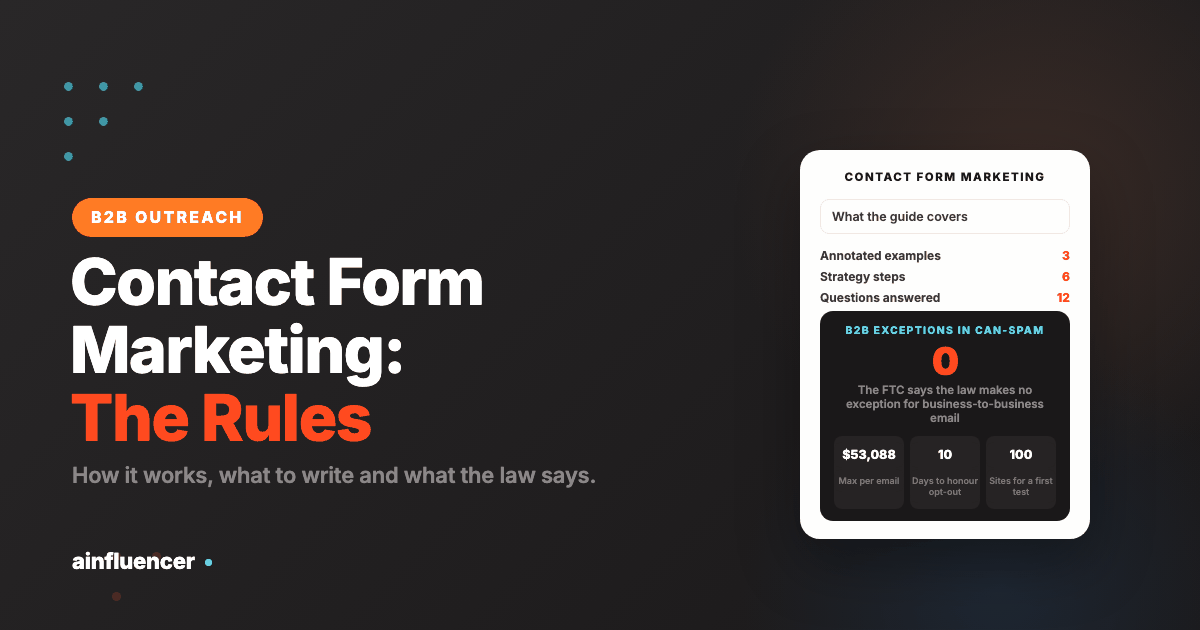
The FTC’s CAN-SPAM guide states that the law makes no exception for business-to-business email. It covers all commercial messages, which it defines as an electronic mail message whose primary purpose is the commercial advertisement or promotion of a product or service, including email that promotes content on commercial websites. Its requirements include accurate header information, no deceptive subject lines, identifying the message as an advertisement, a valid physical postal address, a working opt-out that can process requests for at least 30 days after you send, and honouring opt-outs within 10 business days.
The penalty figure is the reason people pay attention: up to $53,088 for each separate email in violation, on a page the FTC last edited in January 2024. The page also says both the company whose product is promoted and the company that sends the message may be held legally responsible. The guide is about email. It does not contain the words contact form, web form, website form or inquiry form.
Canada: CASL
The Government of Canada describes its anti-spam law as covering commercial electronic messages without consent, including email, social media and text messages, with penalties for the most serious violations of up to $1 million for individuals and $10 million for businesses. The Competition Bureau’s FAQ calls the law technology neutral and lists websites among the means of telecommunication it captures. The pages we read do not address business-to-business consent or name website contact forms, so Canadian prospects need specific advice.
United Kingdom and the EU
The UK’s PECR rules work channel by channel, and the consent rule for electronic mail marketing treats companies differently from individuals and sole traders. UK GDPR applies as soon as you handle a named person’s data. We could not re-read the ICO’s pages for this update because the site blocks automated reading, so read the ICO’s business marketing guidance directly. EU rules differ by member state.
What to do while the line stays unclear
Behave as though the email rules applied anyway. Say who you are, say what you want, make it trivially easy to be told no, and keep a suppression list even though nothing currently obliges you to. Respect any site that says it is not open to sales messages. None of this costs a reply, and all of it is what you would wish you had done if the rules catch up.
Who Should Use Contact Form Marketing, and Who Should Not
| Good fit | Poor fit |
|---|---|
| B2B companies selling to other companies with a website and an enquiry inbox | Anyone selling to individual consumers, who have no corporate form to submit to |
| Agencies, consultants and software teams with a defined target list | Low price products that need thousands of customers |
| Partnership and collaboration requests, including creator and brand deals | Large enterprises whose forms route to a support queue |
| Teams that can write one sharp first line per company | Teams with nothing specific to say about the recipient |
The same logic applies to creator and partnership outreach: a brand writing to a small company about a collaboration is a legitimate form message. If creators are your market rather than companies, our B2B influencer marketing guide covers the other side, and influencer marketing vs contact form marketing compares the two channels directly.
Contact Form Marketing Strategy: Six Steps
A workable contact form outreach strategy is mostly restraint: one offer, a short list, one honest message and a test before any scale.
Pick one offer and one kind of company
A message for everyone persuades no one. Choose the company type that feels the problem most, such as dental clinics for a booking offer or logistics firms for a dispatch tool.
Build a list worth sending to
Start from a buying signal, check the form exists and works, and remove anyone you cannot serve. A thousand chosen companies beat fifty thousand scraped ones.
Write one message with a real first line
Say why this company, what you do, one checkable claim and one small ask. The next section gives the shape and three examples.
Test with 100 companies
Send a small batch before you scale. Count replies and meetings, and compare with your cold email numbers.
Send, then leave it alone
One message per company per campaign. Do not automate a follow-up to a company that did not reply. A reply that says no goes on your suppression list.
Review and change one thing
Change the opening line first, because it does most of the work. Read the results by line, not by total.
What to Write: a Contact Form Message That Gets Forwarded
A form submission has one purpose: to be forwarded to the person who can say yes. Everything in it should serve that. The shape that works, in order:
- A first line that says why this company. Not flattery, a fact you could only write having looked at them. It does the job your subject line used to do.
- One sentence on what you do, in the words their industry uses rather than the words your category uses.
- One concrete, checkable claim. A number, a named client in their sector or a result with a timeframe. Vague superlatives are what the gatekeeper is screening for.
- A small ask. Not a meeting. The right ask is usually to be pointed at the right person, because a gatekeeper can do that without authority.
- Your name, company and a real way to reply, every time, with an easy way to say no.
Contact Form Marketing Examples
These three are illustrative, with invented companies and the facts in brackets that you would replace with something true. Each follows the shape above.
Example 1: an agency writing to a local clinic
Why you: I noticed that [Cedar Valley Dental] only shows online booking on a second page, so a first-time visitor may not see it.
What we do: We help clinics put booking on the first screen of the website.
Proof: [One clinic you helped, with the result and the months it took].
Ask: Could you point me to whoever looks after the website?
Sign-off: Maya Torres, BrightPath, [email protected]. If this is not relevant, no reply is needed and I will not follow up.
Example 2: a software team writing to a logistics firm
Why you: [Your careers page lists three dispatch roles that have been open since September], which usually means the schedule is built by hand.
What we do: RouteLedger turns a day’s orders into driver routes in minutes.
Proof: [A named customer in freight, with the hours saved per week].
Ask: Who owns dispatch tools at your company?
Sign-off: Dan Kruger, RouteLedger, [email protected].
Example 3: a brand writing to a creator’s business about a collaboration
Why you: [Your studio’s video on sourdough scoring] is the clearest we have seen, and our customers keep asking about it.
What we do: We make bakery tools used by [number] home bakers.
Proof: [A past collaboration with the format, the fee range and what happened].
Ask: Who handles brand partnerships for the studio?
Sign-off: Priya N., Loaf & Co, [email protected]. A no is fine and I will not write again.
What to Leave Out
Attachments you cannot send anyway, three paragraphs of company history, a calendar link in the first message and anything that reads as though it was merged from a spreadsheet. The merge is the tell: if the only personal element is the company name in the greeting, the reader has seen that pattern a hundred times.
Forms fight you. Many have a category dropdown with no fitting option, a short message limit or a required “how did you hear about us” field. Pick the honest option rather than the one most likely to be routed to sales: choosing Support to get a faster reply is the kind of small dishonesty that decides how the whole channel gets regulated later. For short, answerable formats, our outreach message templates show the same discipline on the creator side.
Building a List Worth Sending To
The channel’s constraint is volume, so the list carries more weight here than in any email programme.
- Start from a real buying signal. Companies hiring for a role your product makes unnecessary, companies that just announced funding, companies whose site shows the problem you solve. The signal is what your first line is built from.
- Check the form exists and works first. A meaningful share of contact pages are broken, behind a login or route to a ticket system that auto-closes.
- Exclude anyone you cannot serve. Wrong geography, wrong size or wrong regulatory environment produces complaints, not pipeline.
- Keep a record of what you sent and when. The second submission to a company that already said no is the one that turns an annoyance into a complaint.
- Keep a suppression list. Every no, every unsubscribe request and every site that says it does not want sales messages goes on it and is never contacted again.
Our playbooks for specific audiences show the same list logic applied: B2B SaaS lead generation, local lead generation and lead generation for lawyers.
What Happens After You Submit, and the Honest Limits
After you press send, the company’s own system takes over. It may email the submission to an inbox, push it into a CRM or open a ticket, and the site may show a thank-you message or nothing at all. You do not control any of that.
- Some forms never confirm. Without a thank-you page you cannot be sure a submission went through. contactID marks a site Sent only when a confirmation appears, and shows Sent, not confirmed when it does not.
- CAPTCHAs and honeypots exist to stop automated submissions. Software can handle some of them, and a site that uses one may well not want unsolicited messages. Many senders skip those sites, and full-page bot checks should be left alone.
- Some forms reject links or require fields you do not have, so keep the first message link-free and write it so it works without the extras.
- There is rarely a named recipient. You are writing to a role, so your message has to make sense to whoever reads it first.
- Replies can come later and from someone else. A reply from a different name than the form would reach usually means your message was forwarded, which is the channel working as intended.
How to Measure Contact Form Marketing
Because the channel gives no opens and no clicks, most teams measure it badly, usually by counting submissions and feeling productive. These numbers are worth tracking, and only the first is about volume.
| Metric | How to read it | What to do with it |
|---|---|---|
| Confirmed sends out of sites attempted | Shows whether the list and the tool work | A low figure usually means a poor list, with dead sites or no form, not a poor message |
| Reply rate, split by first line | Replies per 100 submitted forms | Test the opening sentence in blocks of a few hundred, or you are reading noise |
| Forward rate, inferred | Replies that come from a different person than you wrote to | A better quality signal than raw replies |
| Meetings per 100 sites | The number that pays for the channel | Compare with your cold email meetings per 100 |
| Complaint and block rate | Angry replies, abuse reports and sites that start rejecting you | The early warning that your list or your copy is wrong |
| Cost per reply | Total spend divided by replies | Easy to calculate when pricing is per confirmed send |
Two traps. Replies often arrive days later and from another address, so last-click reporting credits them to whatever the person touched most recently, frequently your own website. And if you judge the channel on a dashboard built for paid media, it will look like it produced nothing. To tie replies to a campaign, use a distinct reply address or a distinct sign-off per campaign, and note it in your CRM.
Where Contact Form Marketing Fails
- When your buyer is not reachable through a company. Selling to individual consumers, or to anyone without a corporate website, means there is no form to submit to.
- When your deal size is small. The channel is deliberately low volume, so thousands of low-price customers will not come from it.
- When the enquiry inbox is not the way in. Large enterprises route forms to a support queue that never touches a buyer, and above a certain company size named outreach takes over.
- When you have nothing specific to say. The most common failure and the least discussed. The channel amplifies whatever your first line is worth, so a generic line just produces more ignoring, faster.
There is a version of this channel that is simply spam with extra steps, and it is easy to build by accident. The test is not legal, it is whether a specific person at a specific company would reasonably be glad you wrote. If you cannot answer that for the company at the top of your list, the problem is the list.
Contact Form Marketing Software: What to Look For
Contact form marketing software, sometimes called a contact form submitter or a bulk contact form submission tool, does the repetitive part for you. By hand you are capped at a few dozen a day, and most of that time goes on opening pages and filling boxes. Software removes that, not the thinking. When comparing tools, check these points:
| Feature | Why it matters |
|---|---|
| Finds the form on each site | Some sites hide the form behind a pop-up or a Contact link |
| Status per site, with the reason | You need to know which sends were confirmed, which failed and which had no form |
| What a failed send costs | Some tools charge half or full credits for a failure |
| List building | A tool that only sends leaves the hard part to you |
| Message personalization | A line written per site is the difference from a merge |
| Acceptable-use terms | Responsibility for compliance usually sits with the sender |
We compare ten tools, four for this channel and six for inbound forms, in the best AI contact form automation tools. contactID, ours, finds the form, fills it, solves CAPTCHAs, submits it and marks a site Sent only after a confirmation. You pay $0.15 per confirmed website pay as you go, or from $29.99 a month on a plan, and failed sends cost nothing. Find websites builds a list from Google Maps listings in 20 countries. Details are on the contactID contact form automation page.
Contact Form Marketing Against the Alternatives
| Channel | What it is good at | What it costs you | Where it breaks |
|---|---|---|---|
| Contact form marketing | Reaching companies with no findable address | Time per submission and a ceiling on volume | Large enterprises, consumer buyers, generic messages |
| Cold email | Volume, sequencing and measurable opens | Deliverability work, domain reputation and legal overhead | Filters that never show your message |
| LinkedIn outreach | Reaching a named decision maker directly | Connection limits and platform risk | Industries that are not on the platform |
| Paid search | Capturing demand that already exists | Cost per click that rises with competition | Categories nobody searches for yet |
| Influencer and creator work | Trust and reach you cannot buy directly | Longer timelines and softer attribution | Niches with no credible creators |
Most programmes that work combine two of these. The pairing that comes up most is forms for the companies you cannot find an address for and named outreach for the ones you can. For the inbox side, see our email marketing for small business guide.
Frequently Asked Questions
What is contact form marketing?
Contact form marketing is B2B outreach in which you send your message through the contact form on a company’s own website, instead of emailing an address you found. The company’s own system forwards it to whoever reads enquiries.
Is contact form marketing legal?
No rule we found names website contact forms, but that is not permission. The FTC says CAN-SPAM makes no exception for business-to-business email, and Canada’s anti-spam law covers email, social media and text messages. Identify yourself, make it easy to say no and keep a suppression list. This is not legal advice.
Is contact form marketing spam?
It can be. The difference is the list and the first line. A researched message to a company you can genuinely help is not spam in any sense that matters, while the same template merged across thousands of scraped domains is, whatever channel carries it.
Does contact form marketing work?
It can for B2B companies selling to firms with a monitored enquiry inbox, but no independent reply-rate data has been published. Vendor ranges such as 5% to 15% name no source. Test 100 companies with one message and compare with your own cold email results.
How is contact form marketing different from cold email?
A form message arrives through the company’s own channel, so there is no sending domain to warm up, no subject line and no opens to track. It is read by a gatekeeper, so it must be short and worth forwarding. Cold email reaches the inbox directly but must meet sender rules such as authentication and one-click unsubscribe.
What should a contact form message say?
A first line that proves you looked at the company, one sentence on what you do, one checkable claim, a small ask such as being pointed to the right person, and your name, company and reply address, with an easy way to say no.
How many contact forms can I send in a day?
Far fewer than emails, and that is the point. Each one needs a form found, fields filled and a first line that refers to something real. Programmes that push past a few hundred a day usually drop the research, which is the part that made the channel work.
Can I automate contact form marketing?
Yes. Software can find each form, fill it and submit it, and report a status per site. Automation handles the typing, not the list or the first line. See the tools compared in our guide to contact form automation tools.
How much does contact form marketing cost?
By hand it costs time. With software, prices run from $0.15 per confirmed website on contactID pay as you go, to as low as $0.025 per submission at volume on Contact Form Blaster, to a one-time $97 for GSA Website Contact. Prices read on the vendors’ own pages on 9 November 2026.
Do I need consent to send a contact form message in the UK?
PECR’s consent rule for electronic mail marketing treats companies differently from individuals and sole traders, and the regulations do not address contact forms directly. UK GDPR applies once you know a person’s name. Read the ICO’s business marketing guidance or take advice.
What is form marketing?
The phrase often means using forms on your own website to capture leads. Contact form marketing in the sense of this guide is the outbound version, where you submit a message through a form on another company’s website.
What should I measure?
Confirmed sends out of sites attempted, replies per 100 submitted forms split by opening line, the share of replies from a different person than you wrote to, meetings per 100 sites and your complaint rate. Submissions sent is an activity number, not a result.
Key Takeaways
- Contact form marketing is outbound outreach through a company’s own website form, and it is read by a gatekeeper, so write to be forwarded.
- No independent reply-rate data exists. Test 100 companies and compare with your own cold email numbers.
- The FTC says CAN-SPAM has no business-to-business exception, and none of the guidance we read names website contact forms. Behave as though the email rules applied.
- The list and the first line decide the result. Software handles the typing.
- Keep a suppression list and honour every no.
- contactID, ours, is one tool for the channel and the page for it is the place to test it free.
Published on the Ainfluencer Blog. Ainfluencer is an AI-powered influencer marketing marketplace that also makes contactID, a contact form outreach tool.