Digital marketing in 2026 is a fast-evolving landscape, with channels from social media to email and search working together to help businesses reach audiences. Among these, influencer marketing and contact form marketing stand out as highly effective outreach strategies. Both pursue similar goals: increasing visibility, building trust, and driving engagement. Businesses explore multiple outreach methods to stay competitive, reach target audiences, and ensure they capture every opportunity in a crowded digital world.
Contact form marketing only becomes repeatable with software behind it. An automated contact form submission tool finds the form on every site in your list, fills it with your pitch and submits it, so the channel stops depending on how many forms a person can fill in an afternoon.
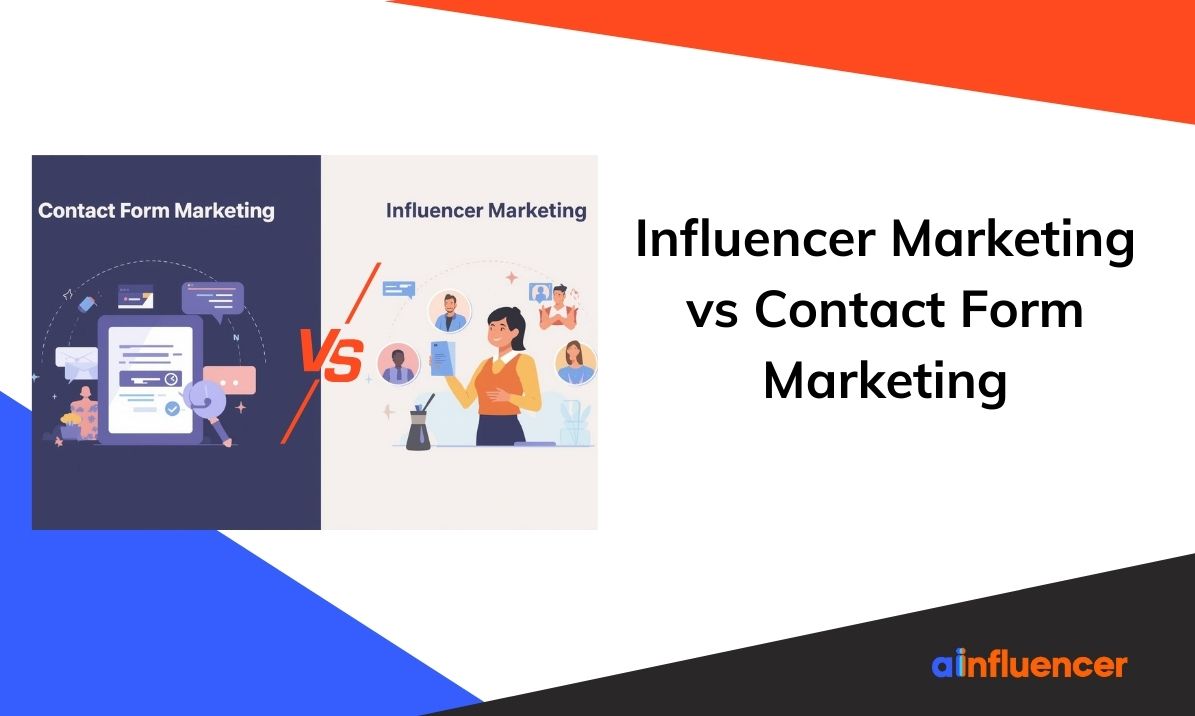
This post dives into how influencer marketing and contact form marketing work, their strengths and limitations, and the types of businesses that benefit most from each. By understanding both strategies, businesses and marketers can make smarter choices and maximize revenues. Keep reading to discover how combining these approaches can help your business achieve better growth and stronger connections.
What Is Influencer Marketing?
Influencer marketing is a way brands work with popular people on social media to promote their products or services. These popular people, called influencers, have lots of followers and can influence what their followers buy. Influencers can be content creators, UGC creators, or online personalities whose opinions really matter to their audience. This type of marketing has grown a lot and is now a big part of many business plans. By 2025, the global influencer market was worth about $32.55 billion, growing from $1.7 billion in 2016 and $21.1 billion in 2023.
More than three out of four brands now use influencer marketing because it helps them get more attention, engagement, and sales. Research shows that influencer posts often get better results than regular brand posts, and many companies earn several dollars for every dollar they spend on creating influencer marketing campaigns.
How Influencer Marketing Works?
Digital influencer marketing works by helping businesses team up with online creators who already have fans. Instead of showing ads that people skip, it shares fun and useful content that followers actually want to watch. The brand’s message is added naturally, which makes people trust it and pay attention without feeling annoyed.
Businesses use this method to find brand ambassadors who can honestly represent their products or services. Therefore, everyone benefits: creators make content that their fans enjoy, followers get interesting material, and brands get noticed and trusted. This is why influencer marketing is now one of the strongest ways for businesses to reach their target audience online.
Key Benefits of Influencer Marketing
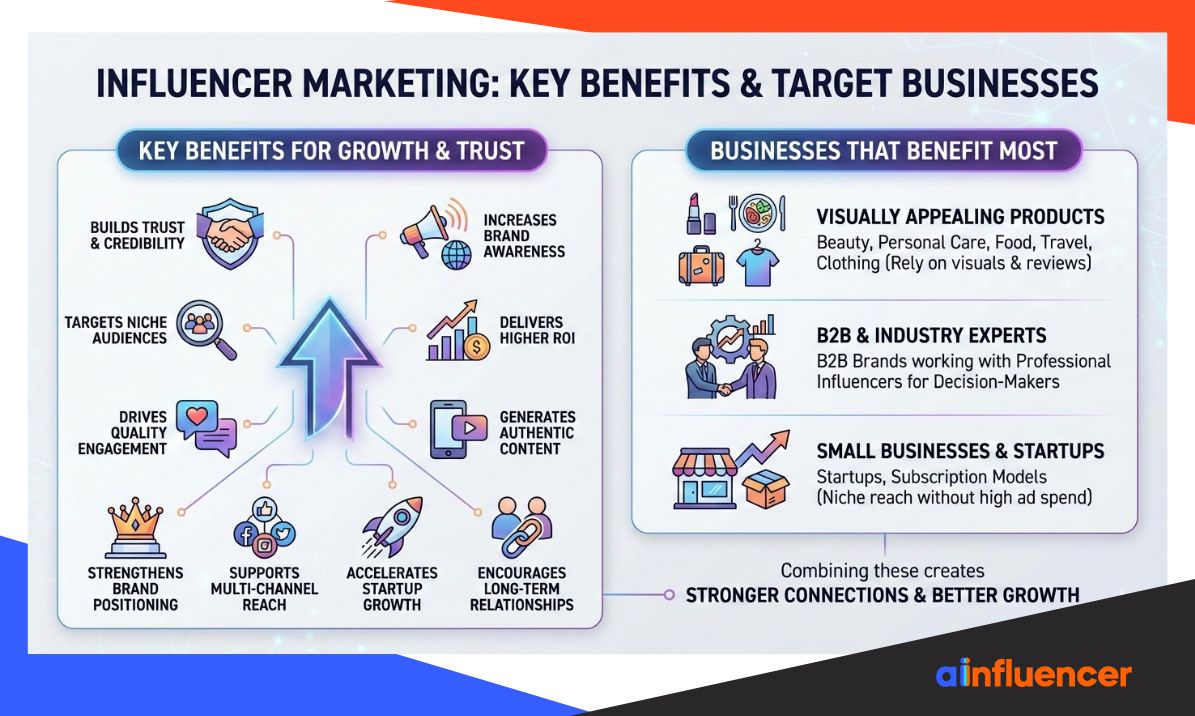
Influencer marketing has become a powerful tool for businesses and startups, especially in the B2B space, because it focuses on trust, authenticity, and targeted engagement rather than broad, impersonal advertising. By forming influencer partnerships, brands can reach engaged target audiences, driving awareness, credibility, and conversions in ways traditional ads often cannot. For startups, this approach is particularly valuable as it builds visibility and trust quickly with minimal budgets. Here are some key benefits of influencer marketing for startups and b2b businesses:
- Builds Trust and Credibility: Influencer mentions feel personal, making audiences more likely to believe and engage with the brand.
- Increases Brand Awareness: Content shared by trusted creators introduces the brand to new, relevant audiences.
- Targets Niche Audiences: Micro and nano-influencers connect businesses with highly engaged, specific communities.
- Delivers Higher ROI: Influencer marketing campaigns often outperform traditional ads in engagement, conversions, and cost efficiency.
- Drives Quality Engagement: Influencer content sparks comments, shares, and discussions.
- Generates Authentic Content: Creators produce relatable, audience-focused content that brands can repurpose.
- Strengthens Brand Positioning: Repeated endorsements build social proof and authority.
- Supports Multi-Channel Reach: Influencer content spans platforms like LinkedIn, Instagram, and TikTok, increasing visibility.
- Accelerates Startup Growth: Early partnerships help startups gain trust and enter markets faster.
- Encourages Long-Term Relationships: Strategic influencer partnerships can offer ongoing value, creating loyal brand advocates.
Businesses That Benefit Most From Influencer Marketing
Businesses that benefit most from influencer partnerships usually sell products or services that look good or are easy to show online. These businesses rely on trust, reviews, and real experiences. Research shows that beauty, personal care, food, travel, and clothing brands often get better results from influencer marketing. It also shows that B2B influencer marketing can be effective. In B2B, brands usually work with industry experts or professional B2B influencers to reach business decision-makers.
Small businesses, startups, and subscription companies can also benefit from influencer partnerships. They can reach the right audience without spending a lot on ads. While consumer brands still spend the most on influencers, more B2B companies are now working with niche creators and experts. This strategy helps them build trust, share useful knowledge, and generate better-quality leads.
Pros & Cons of Influencer Marketing
Influencer marketing offers strong advantages, but it also comes with risks. Let’s take a quick look at the pros and cons of influencer marketing:
Pros of Influencer Marketing
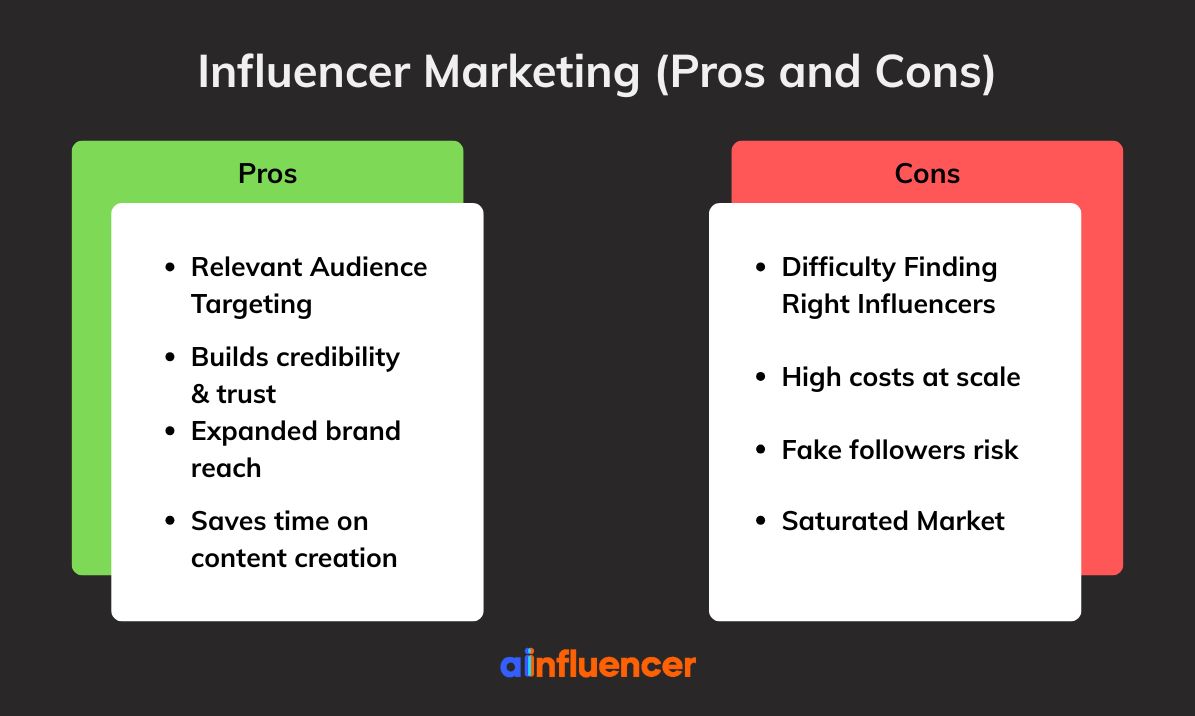
- Relevant Audience Targeting
Influencers already speak to niche audiences that align with specific products or services. This increases trust and conversion potential.
- Builds credibility & trust
Influencer endorsements act as social proof. Followers value recommendations from creators they trust.
- Higher engagement over raw reach
Influencers with strong engagement rates often outperform larger accounts with passive followers.
- Expanded brand reach
Influencers help brands access new audiences quickly through established communities.
- Cost-effective options
Micro-influencers can deliver strong results at lower costs than traditional ads.
- Saves time on content creation
Influencers handle content production, reducing workload.
- Measurable performance
Tools make it easier to track influencer marketing KPIs and ROI.
Cons of Influencer Marketing
- Difficulty finding and managing the right influencers
Vetting influencers for authenticity, audience fit, and consistent engagement, and then tracking their performance over time, can be challenging without the right tools and processes.
- High costs at scale
Top influencers can be expensive, especially for long-term campaigns.
- Fake followers risk
Some influencers inflate numbers, leading to poor results.
- Audience fatigue
Over-promotion can reduce trust and engagement.
- Saturated market
Competition for attention makes authenticity more important than ever.
How Can Ainfluencer Help?
Ainfluencer can be a powerful answer for brands struggling to find and manage the right influencers. It is a free, AI-powered influencer marketing platform where brands can search and filter through millions of creators based on niche, audience, engagement, and location, helping you discover influencers whose audiences truly align with your goals. Once you identify good fits, you can manage collaboration details, negotiate, and track deliverables through Ainfluencer’s comprehensive built-in tools, reducing manual work and improving campaign oversight.
Ainfluencer shows real-time analytics and reviews from past influencer partnerships, so businesses can assess influencer performance and engagement before committing. On costs and risk, Ainfluencer helps brands overcome high costs at scale and fake-follower issues by offering access to influencers of all sizes and holding payments in escrow until content is posted, as agreed, ensuring accountability and reducing wasted spend. Because the platform supports direct data insights, communication, and secure transactions without upfront fees, businesses can balance budgets more effectively and focus on authentic engagements rather than inflated metrics. It also allows brands to nurture long-term influencer partnerships and ambassador programs.
What Is Contact Form Marketing
Once you explore the strengths of influencer marketing for boosting brand visibility and engagement, many businesses look for equally effective ways to generate direct leads and outreach opportunities. While influencer marketing excels at building awareness and social proof, contact form marketing is another outreach method that is super beneficial for B2B businesses and brands, helping them connect with key contacts and boost their b2b sales.
Contact form marketing is a B2B outreach strategy where you use the “Contact Us” or inquiry forms on company websites to send personalized messages directly to businesses’ primary communication channels.
Instead of hunting for email addresses and hoping your message avoids spam folders, this direct outrech method delivers your message through the site’s built-in contact us form, often routed straight to the inbox of sales or leadership teams.
Because these contact form submissions come through official website channels, they can achieve higher visibility, better response rates, and more meaningful lead engagement than some traditional cold email outreach or ads.
Key Benefits of Contact Form Marketing
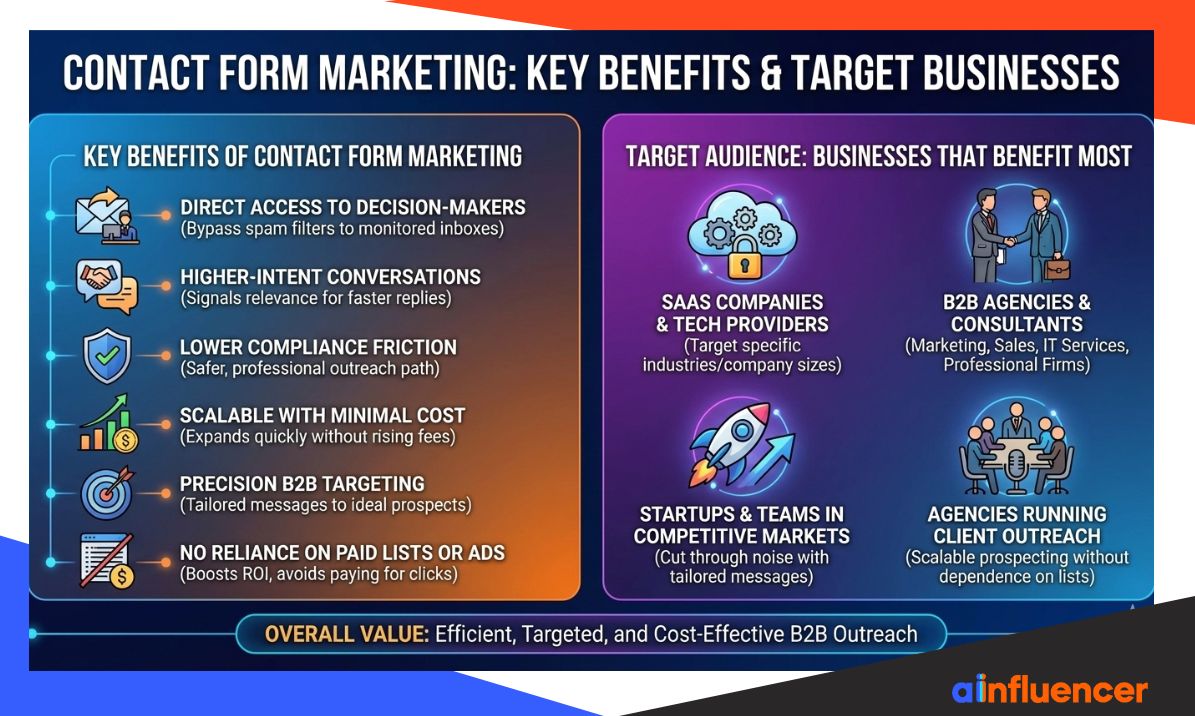
Contact-form marketing gives businesses and agencies a direct, compliant, and budget-friendly way to start real B2B conversations. It reaches decision-makers where they expect inquiries and removes common barriers, like spam filters and ad fatigue. Here’s why it’s a smarter way to reach b2b buyers:
- Direct access to decision-makers: Messages sent through official site forms are routed to monitored inboxes, increasing visibility and response rates compared to cold email.
- Higher-intent conversations: Using a company’s own inquiry channel signals relevance and respect, leading to stronger engagement and faster replies.
- Lower compliance friction: Contact form submissions are not bulk emails. Therefore, they offer a safer outreach path when messages are professional and relevant.
- Scalable with minimal cost: by choosing the right contact form marketing software, this outbound outreach can expand quickly without caps, warmups, or rising platform fees.
- Precision B2B targeting: Brands can hand-pick ideal companies and send tailored, highly relevant messages through each company’s “Get in Touch” form.
- No reliance on paid email lists or ads: You avoid buying databases or paying for clicks, which boosts ROI and keeps budget costs low.
Who Should Use Contact Form Marketing?
Undoubtedly, contact form marketing is most effective for B2B businesses and agencies that sell high-value services and rely on direct conversations with key decision-makers. It works especially well for SaaS companies, marketing and sales agencies, consultants, IT service providers, and professional firms that target specific industries or company sizes. Because these businesses often pursue outbound outreach, contact form submissions allow them to reach prospects through official website channels designed for inquiries.
Agencies running outreach on behalf of clients also benefit strongly from contact form marketing. It enables scalable prospecting without dependence on email lists, paid ads, or social platforms. Businesses entering competitive or saturated markets can use this method to cut through noise by delivering tailored messages directly to relevant companies. For start-up B2B teams and agencies focused on efficient outbound strategies, contact form marketing also offers a cost-effective, compliant, and targeted way to generate qualified leads.
Pros & Cons of Contact Form Marketing
Contact form marketing delivers a direct, budget-friendly way to increase B2B sales and reach millions of key business owners, but it also has operational limits. Understanding both sides helps brands and agencies decide when it fits their outbound strategy. So, let’s review the pros and cons of contact-form marketing:
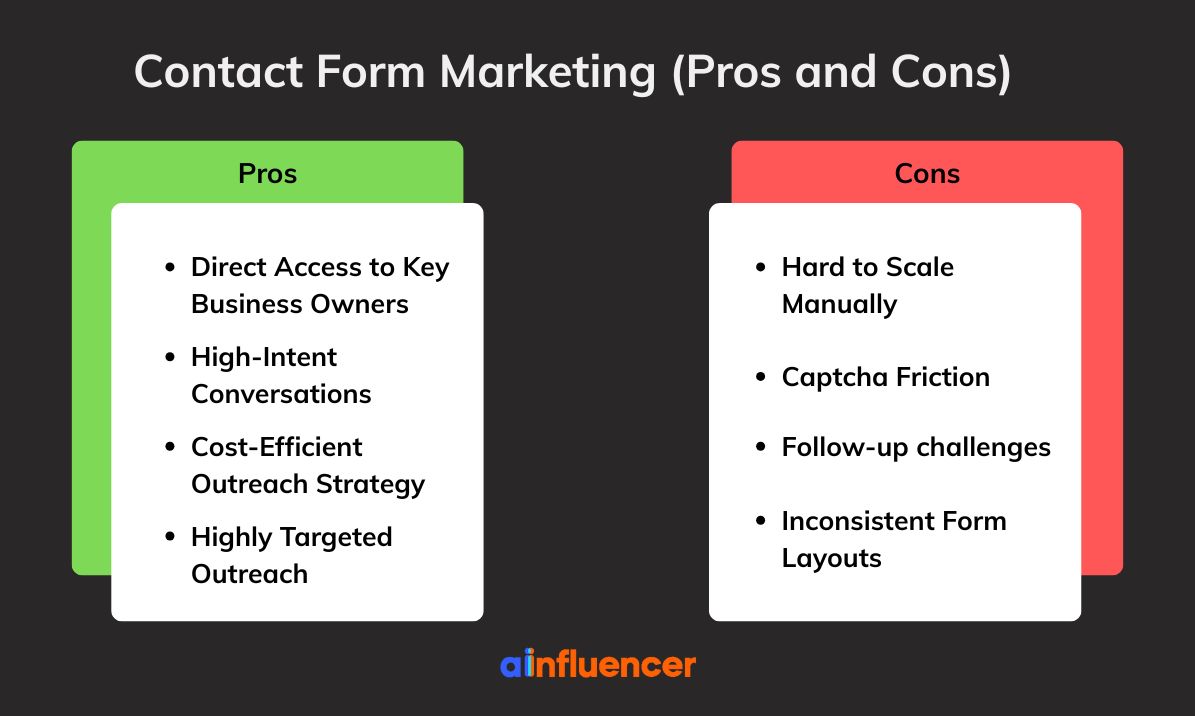
Pros of Contact Form Marketing
- Direct access to key decision-makers
Messages sent through an official contact form on a website often reach monitored inboxes, bypassing email spam filters and increasing visibility.
- High-intent conversations
Using a company’s own inquiry channel signals relevance, leading to higher open and reply rates than cold email outreach.
- Cost-efficient outreach strategy
No need for email lists or ad spend, helping teams maintain strong ROI and lean budgets.
- Legally safer communication
Contact Form submissions are not bulk emails, reducing compliance friction when outreach is respectful and relevant.
- Highly targeted outreach
Businesses can hand-pick ideal prospects and tailor each message for maximum relevance.
Cons of Contact Form Marketing
- Hard to scale manually
Finding website contact forms, filling fields, and solving CAPTCHA is very time-consuming without automation.
- Captcha friction
Frequent reCAPTCHA, hCaptcha, and similar verification steps slow outreach to a crawl, making large-scale manual contact-form submissions impractical.
- High risk of human error
Manual entry can lead to typos, broken links, or misdirected messages.
- Inconsistent form layouts
Every website contact form is different, making manual customization slow and error-prone.
- Limited scalability without automation
Manually reaching a large number of prospects via content-form marketing takes significant time and manpower, which quickly slows outreach and drives up costs.
- Follow-up challenges
Without automation, replies and follow-ups can be missed, reducing conversion potential.
How Can brandID’s Bulk Cold Outreach with AI Contact Us Form Submission Chrome Extension Help?
Bulk Cold Outreach with AI Contact Us Form Submission makes contact form marketing faster, cheaper, and far more scalable for B2B businesses and agencies. Instead of manually finding forms and filling them one by one, brandID’s Contact Us form submitter automates the entire process, helping teams reach high‑intent prospects through each company’s own contact form on the website. This removes spam risks, cuts labor costs, and turns a powerful but time‑consuming strategy into a repeatable growth channel.
Watch this quick video tutorial to see this Chrome extension in action and discover how easily the tool automates your outreach.