B2B SaaS Lead Generation: a Proven 2026 Playbook
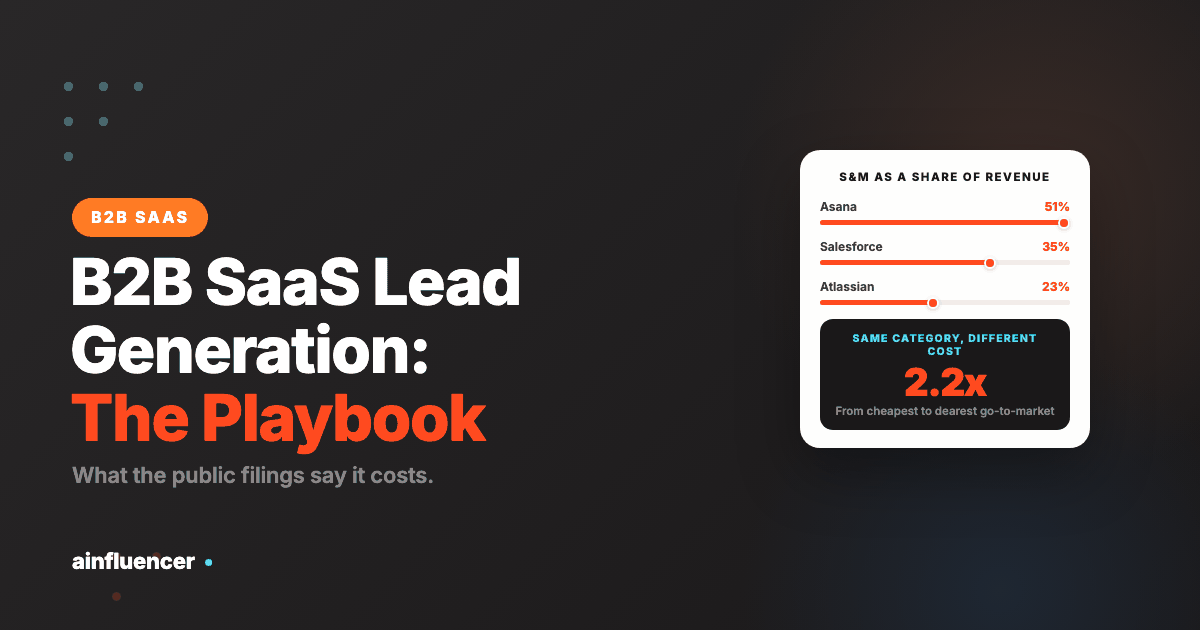
Nine public software companies spend between 23% and 51% of revenue getting customers. The gap between them is the only strategy question that matters.
Every article about B2B SaaS lead generation lists the same channels. Almost none of them mentions what those channels cost, which is strange, because the companies that run them publish the number every quarter.
What Lead Generation Actually Costs a SaaS Company
Public software companies have to disclose selling and marketing expense separately from everything else. Pull it against revenue for the most recent full financial year, from their own filings to the SEC, and the range is wider than the advice suggests.
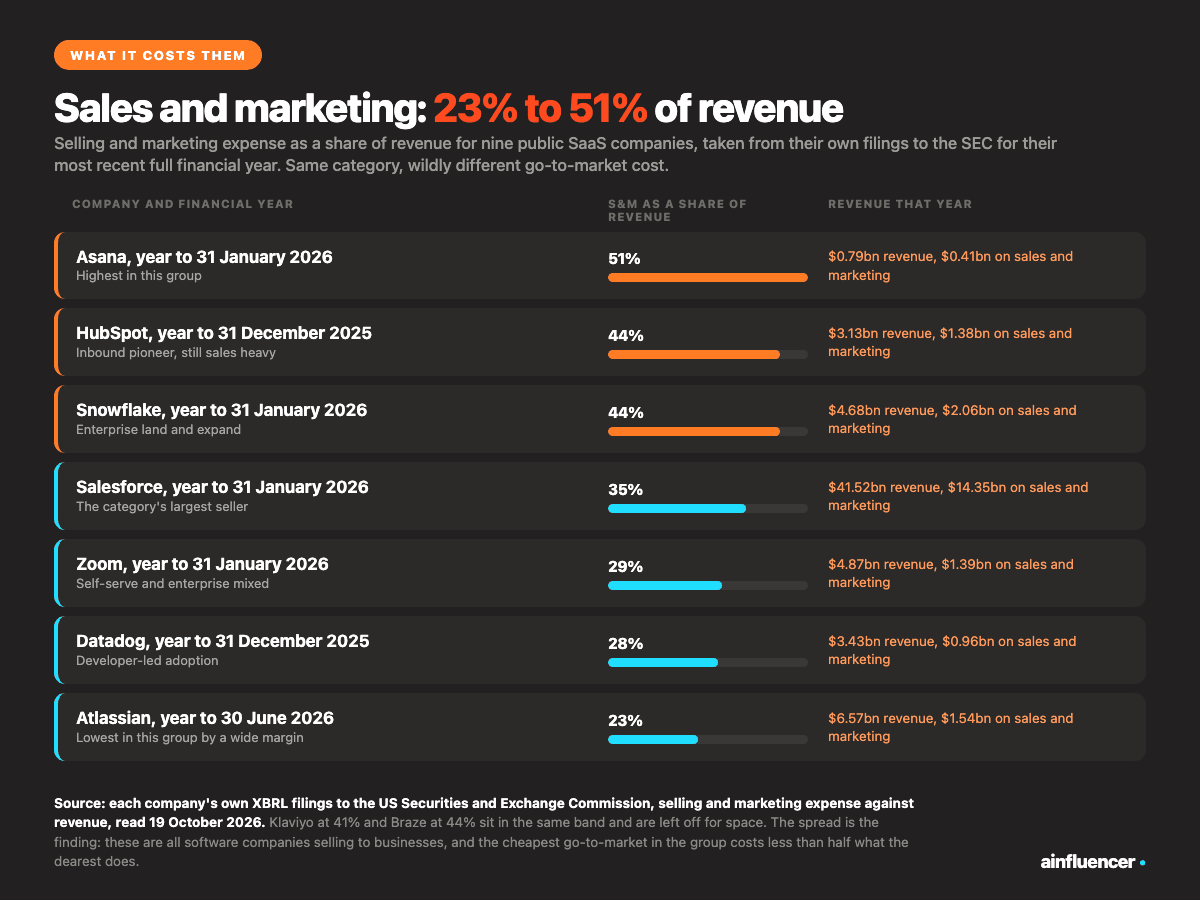
Read the top and the bottom together. Asana spent 51 cents of every revenue dollar on sales and marketing. Atlassian spent 23. Both sell software to businesses, both are category leaders, and one of them runs a go-to-market that costs less than half as much.
That is not an efficiency story about one company being better run. It is two different machines. The expensive end buys attention and pays people to convert it. The cheap end built a product that is adopted before anyone is sold to, then charges for it later. Neither is free: the cheap end paid for it in years of engineering that did not look like marketing.
The number worth carrying into every decision below is yours, not theirs. Work out what share of revenue you currently spend on getting customers, and then ask which of these two machines you are actually building. Most teams discover they are paying enterprise go-to-market prices for a product that was supposed to sell itself.
Worth noting where the rest of the group lands, because the middle is as instructive as the edges. HubSpot and Snowflake both sat at 44%, Klaviyo at 41%, Braze at 44%, Salesforce at 35%, Zoom at 29% and Datadog at 28%. The companies at the lower end are not the smallest or the newest. Datadog and Atlassian are both large, mature businesses that acquire customers through the product being adopted by practitioners before a salesperson is involved.
Why the number is higher than founders expect
Selling and marketing expense is not the advertising budget. It includes the fully loaded cost of every salesperson, every sales engineer, commissions, the marketing team’s salaries, events, tooling and advertising. When a founder says they spend 10% on marketing, they are usually describing the advertising line and excluding the people, which is where most of the money is in this category.
That is why the comparison is useful rather than discouraging. If your own ratio looks far below the range above, the most likely explanation is not that you are unusually efficient. It is that your founders are doing the selling and nobody is costing their time.
The Two Machines, and How to Tell Which One You Have
Nearly every argument about B2B SaaS lead generation is really a disagreement about which machine the company is building, conducted by people who have not noticed they disagree.
The sales-led machine
Leads are generated so that a human can work them. The product is complex, the buyer is a committee, the contract is annual, and nothing closes without a conversation. Content exists to start conversations, not to deliver value on its own.
- Tell-tale sign: the pricing page says Contact us
- What lead generation means here: filling a pipeline of named accounts with enough context for a salesperson to open a credible conversation
- Where it goes wrong: generating volume that the sales team cannot work, then blaming lead quality
The product-led machine
The product is adopted by one person, spreads sideways, and only later meets a salesperson. Lead generation is mostly about getting the right individual to try the thing, and the activation experience does the selling.
- Tell-tale sign: somebody can sign up and get value without talking to you
- What lead generation means here: reach to practitioners, and an onboarding that proves the point within one session
- Where it goes wrong: bolting an enterprise sales motion on top of a self-serve product and paying for both
The expensive mistake is running the second machine’s marketing with the first machine’s cost base, or the reverse. A free trial with a 51% sales and marketing ratio behind it is a business that has not decided what it is.
The hybrid, and why it is harder than either
Most companies past a certain size run both: self-serve at the bottom, sales-led at the top. It is a legitimate model and it is considerably harder to operate than either pure version, because the two machines compete for the same budget and measure success differently. The self-serve side wants friction removed, the sales side wants the lead captured, and the fight over whether to gate the pricing page is that disagreement wearing a smaller costume.
If you run both, the discipline that keeps it sane is a stated threshold. Above this deal size, a human is involved and we accept the cost. Below it, nobody is, and we fix the product instead. Teams without that line spend sales time on accounts that will never justify it, which is the single clearest way to drift toward the top of the spending range.
Channels That Still Work for B2B SaaS Lead Generation
With that framing, the channel list becomes shorter and more honest. Each of these is good at something specific, and each is terrible at something else.
- Search for problem-aware queries. Not your category name, which is searched by people who already shortlisted you, but the problem described in the words of someone who has not yet realised software exists for it. Slow, compounding, and the only channel that keeps producing after you stop paying
- Product-led acquisition. A free tier or trial that reaches value without a call. Cheapest per customer by a wide margin, and only available if the product can actually be understood alone
- Outbound to named accounts. Expensive per conversation and the only reliable way to reach a specific company on a specific timeline. Worth it when deal size supports it and wasteful when it does not
- Integrations and marketplaces. Consistently underrated. Being in the place your buyer already works puts you in front of qualified users at near zero marginal cost, and it is engineering spend rather than marketing spend
- Communities where practitioners actually are. Not posting into them, being useful in them. Unscalable, which is exactly why it still works
- Partner and referral programmes. Other companies selling to your buyer are the shortest path to trust you have not earned yet
- Events, narrowly. A category conference is usually a brand expense pretending to be lead generation. A dinner for twelve named accounts is not
Two that people expect to see here and should be treated carefully: paid social, which can buy attention but rarely buys intent in B2B, and cold email at volume, which now competes with every other vendor doing the same thing to the same list.
Pick two to run properly rather than seven to run badly. The failure mode in this category is almost never choosing the wrong channel. It is spreading a small team across six, none of which gets the sustained attention it needed to start working, and then concluding that B2B SaaS lead generation is hard in general rather than that it was attempted six ways at once.
A reasonable default for an early company: one compounding channel and one immediate one. The compounding channel is usually search or community and will produce nothing for two quarters. The immediate one is usually outbound and pays the bills while the first one matures. Running only the immediate one is how companies end up unable to stop spending.
Reaching Companies You Cannot Email
Outbound has a specific failure that nobody plans for. A meaningful share of the accounts worth reaching have no findable address for the person you need, either because the company is small enough that nobody is listed or because it is careful enough that nobody is.
The contact form on their own website is the route most outbound programmes ignore. It has no deliverability problem, it lands with somebody who reads it, and it reaches companies that are invisible to every email-based tool. It is also low volume by nature, which makes it a complement to outbound rather than a replacement.
We cover the mechanics, including the compliance position, in contact form marketing, and the tooling in the best AI contact form automation tools. Ainfluencer’s contact form marketing tool handles the sending so the research stays with you, which in this channel is the only part that determines whether it works.
The Metrics That Decide Whether Any of It Works
Three numbers, in the order they should be looked at. Most SaaS teams report them in reverse.
- Payback period. How many months of gross profit it takes to recover what you spent acquiring a customer. This is the number that determines whether growth is funded by your customers or by your investors, and it is the first thing a board asks about
- Net revenue retention. Lead generation is a leaking bucket problem before it is a filling problem. A company retaining under 100% is spending to stand still, and no channel optimisation fixes that
- Pipeline conversion by source, not volume by source. The channel producing the most leads is routinely the channel producing the fewest customers, and reporting volume hides it
Then there is the reporting trap specific to this category. In a product-led business the first touch is frequently an individual who was not the buyer, months before a purchase, from a channel that gets no credit in last-touch attribution. If your dashboard says content produces nothing and sales produces everything, check whether it is measuring the sequence or only the end of it.
One more measurement worth building early, because it is cheap at the start and nearly impossible to reconstruct later: ask every closed customer how they first heard of you, in their own words, and keep the raw answers. The attribution system records the last link clicked. The customer will tell you about a conference talk, a colleague at a previous job, or a thread they read eighteen months ago, and those answers are where the compounding channels show up.
Where B2B SaaS Lead Generation Goes Wrong
Four failures that account for most wasted spend, each of which looks like a channel problem and is not.
- Buying volume the sales team cannot work. If a rep can hold forty live conversations, the fiftieth lead is not an asset. It is a cost plus a morale problem
- Content written for the category, not the problem. Pages about your software category are read by people already in a buying process, which is a much smaller audience than the one with the problem
- Treating free trial signups as leads. They are usage, not intent. Chasing a trial user who has not activated is the fastest way to teach a sales team that marketing sends junk
- Changing channel every quarter. Search and community both take longer than a quarter to pay anything. A company that rotates strategy on a quarterly reporting cycle will never hold either long enough to find out
The pattern underneath all four is impatience with the cheap channels and tolerance for the expensive ones, because the expensive ones produce numbers immediately. That preference is exactly what the 51% end of the chart above looks like from the inside.
The failure that is actually a product problem
If net revenue retention is below 100%, no amount of lead generation will produce growth, because you are refilling faster than the bucket drains and paying full price for every replacement. Teams in this position almost always diagnose it as a top-of-funnel problem, because that is the part with a budget attached and a vendor willing to take it. The honest sequence is to fix retention first, then spend on acquisition, and the reverse order is how a company reaches the expensive end of the chart above without ever deciding to.
Related, and worth the same scepticism: if the sales cycle has lengthened for two consecutive quarters while lead volume held, the problem is downstream of marketing. More leads will make the chart look busier and the revenue line flat.
How the Spending Range Should Change by Stage
The 23% to 51% band is drawn from large, public, mature companies. A company at a few million in revenue is not operating under the same physics, and copying the ratio directly is a mistake in both directions.
- Pre product-market fit. The right spend on lead generation is close to nothing, because the thing being tested is whether anyone wants this, and paid acquisition will answer that question expensively and unreliably. Founder-led selling is not a stopgap here, it is the instrument
- Early repeatable sales. The ratio will look terrible and that is expected. You are paying for learning, not efficiency, and the number to watch is whether payback is shortening rather than whether it is good
- Scaling. This is where the published range starts to apply, and where a company decides which machine it is. Spending 50% of revenue here is defensible if net revenue retention is strong, and alarming if it is not
- Mature. The ratio should fall, and if it does not, growth is being bought rather than earned. Atlassian at 23% is what the bottom of that looks like after a decade of investing in the other machine
The common error is a company at stage two measuring itself against stage four benchmarks and cutting the spend that was buying it the information it needed. The second most common is a company at stage four still spending like stage two and calling it growth.
A simple test that cuts through all of it. If you stopped all paid acquisition tomorrow, what happens to new customer volume in ninety days? A number near zero means you have bought a channel rather than built one, which is fine as long as everybody knows that is the arrangement and prices it accordingly.
Frequently Asked Questions
How much should a B2B SaaS company spend on lead generation?
There is no single right answer, but there is a published range. Across nine public software companies, selling and marketing ran from 23% of revenue at Atlassian to 51% at Asana for their most recent full financial year. If you are near the top of that range, you are running a sales-led motion whether you intended to or not.
What is the cheapest channel for B2B SaaS?
Product-led acquisition, when the product allows it, followed by integrations and marketplaces. Both move cost out of marketing and into engineering, which is why they look free on a marketing budget and are not.
Does cold email still work for SaaS?
It works where the list is narrow and the message is specific. At volume it now competes with every other vendor doing the same thing to the same people, and the economics have moved against it.
How long before a new channel shows results?
Search and community take two to four quarters to produce anything meaningful. Outbound and paid can produce conversations in weeks. Judging the slow channels on the fast channels’ timeline is the most common reason good channels get cut.
Should we hire an agency or build in-house?
Build in-house for the channels that compound, because the knowledge is the asset. Use outside help for the ones that are mostly execution. The reverse, which is more common, means paying to rent the thing you most needed to own.
What is the single most useful number to track?
Payback period. It tells you whether the growth you are buying is self-funding, and it is the only one of the common metrics that cannot be made to look good by changing the channel mix.