Local Lead Generation: a Proven 2026 Playbook
Google names three factors behind local results and says plainly that none of them is for sale. Here is what that leaves you to work with.
Local lead generation is unusual in marketing: the platform that decides most of it has published how it works. Google says what moves local results and says explicitly that you cannot buy your way up. Most of the advice in this category ignores both statements.
What Google Says Decides Local Results
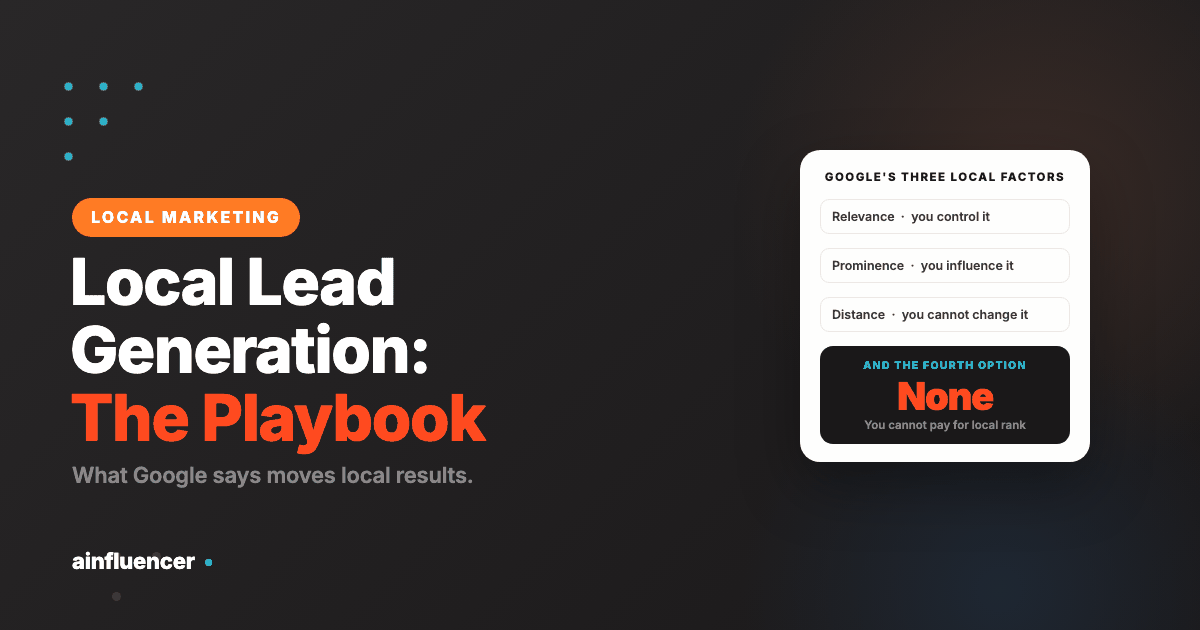
Start with the source rather than with a theory. Google’s guidance on improving local ranking states that “Local results are mainly based on relevance, distance, and popularity”, then defines each one.
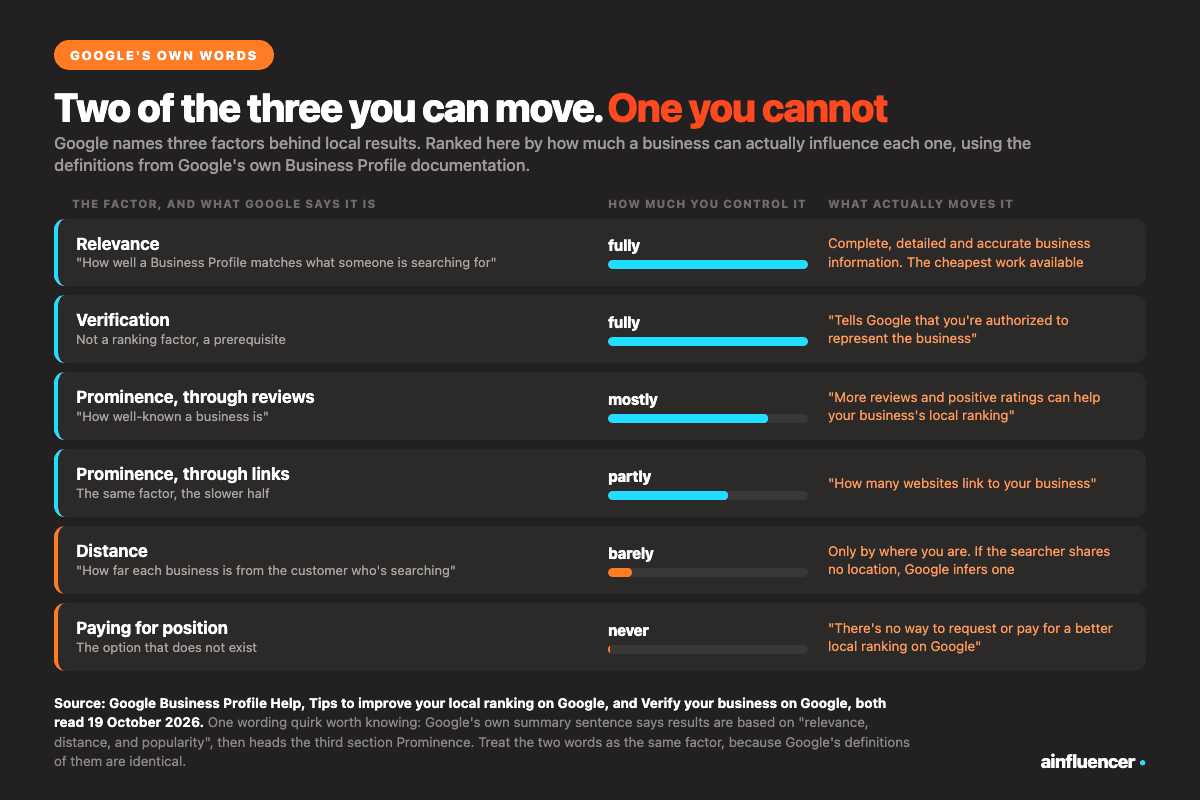
- Relevance is “how well a Business Profile matches what someone is searching for”. Google’s advice for improving it is unglamorous: provide complete and detailed business information
- Distance is “how far each business is from the customer who’s searching”, and if the customer does not share a location, “Google uses what it knows about their location”
- Prominence is “how well-known a business is”, based partly on “how many websites link to your business and how many reviews you have”. Google adds that “More reviews and positive ratings can help your business’s local ranking”
One quirk to know about, because it causes arguments. Google’s summary sentence says popularity and the section heading beneath it says prominence. The definitions are the same, so treat the two words as one factor and ignore anyone building a theory on the difference.
The sentence that should end most sales calls
In an Important callout on the same page, Google writes: “There’s no way to request or pay for a better local ranking on Google.” It adds that it keeps algorithm details confidential “to make the ranking system as fair as possible for everyone.”
Keep that line to hand. The local marketing industry contains a steady supply of people offering guaranteed map pack placement, and the platform that owns the map pack has written down that the product does not exist.
What each factor is worth doing something about
Rank the three by how much a business can actually change them and the work schedules itself. Relevance is entirely yours and costs an afternoon: category, hours, service list, attributes, description, all complete and all accurate. Prominence is partly yours and takes months, because reviews accumulate at the speed of your actual customers and links at the speed of your actual presence in the area. Distance is not yours at all.
That ordering explains why so much local marketing money is wasted. Teams buy campaigns aimed at the factor they cannot move, while the profile itself has an empty description, one photo and the wrong primary category. Google states the consequence directly: “If your business info isn’t accurate, your Business Profile might not show up for relevant searches in your area.”
Verification Comes Before Any of It
Verification is not a ranking factor, it is the gate. Google states that verifying tells it you are authorised to represent the business, and on the ranking page puts the consequence plainly: it is “more likely to show up in search results”.
Four operational details that catch people out:
- You do not choose the method. Google states that verification methods “are automatically determined by Google and can’t be changed”, depending on business type, public information, region and hours
- It is not instant. Reviews take up to five business days, and a postcard code usually arrives within 14 days and expires after 30
- Nobody from Google will ask for the code. Google says so directly, and adds that you should not share it even with the people who manage your profile. Every request for that code is a hijack attempt
- Re-verification is a signal, not a glitch. If the Get verified button reappears, Google could not completely verify the business, and ignoring it risks the profile
The rule that applies to lead generation specifically
Google’s guidelines for representing your business contain a line aimed squarely at this industry: “Sales associates or lead generation agents for corporations aren’t individual practitioners and aren’t eligible for a Business Profile.” The same guidelines state that “There should only be one profile per business”.
So the classic local lead generation model, standing up profiles for territories or for individual agents and funnelling the calls, is not a grey area. It is addressed. Build the profile for the business that actually serves the customer at that address.
Worth adding what the same guidelines say about service areas, because it shapes how far this channel reaches. Google sets a practical limit on how wide a service area can be, framed in driving time rather than in miles. A business advertising national coverage from one address is not describing something the local results are built to show.
Reviews Are the Lever Most Businesses Underuse
Of everything Google names, reviews are the one that is both explicitly confirmed to help and almost entirely within reach of a small business today.
The common mistakes are predictable:
- Asking once, by email, weeks later. The moment of goodwill is at completion, in person or in the message thread where the work happened
- Asking everyone at once. A sudden burst after months of nothing looks exactly like what it looks like. Steady beats spiky
- Ignoring the replies. Google notes that “Positive reviews and helpful replies can help your business stand out”, and a reply is the only part of a review you control
- Treating a bad review as a disaster. A visible, calm, specific reply to a complaint persuades more readers than the complaint loses you
Incentivised and fake reviews are a separate matter and not worth the risk. In the UK they are now a banned practice under consumer law rather than merely a platform violation, which is a change many local businesses have not registered.
A review request that actually gets used
The failure is almost always friction rather than willingness. Somebody who is pleased with the work will leave a review if it takes thirty seconds and will not if it takes five minutes and a password reset. Send the direct link, send it while you are still standing there, and say what would be useful to mention rather than asking for a review in the abstract.
One thing worth measuring that almost nobody does: the ratio between jobs completed and reviews received. Most local businesses assume theirs is poor because customers are indifferent. It is usually poor because nobody asked, and the two have completely different fixes.
The Part of Local Lead Generation That Is Not Google
Treating this channel as entirely a Google problem is the most common strategic error, because the one factor you cannot influence is the one Google weights most heavily for a searcher standing somewhere specific.
If distance decides a large share of who gets shown, then a business competing outside its immediate radius needs demand that does not start with a map search. Four routes that work:
- Referral relationships with adjacent trades. The plumber who recommends an electrician is a lead source with no distance penalty and no cost per click
- Local business to business outreach. Property managers, letting agents, facilities companies and offices all buy repeatedly and are invisible in consumer search. This is a list and a pitch, not a map listing
- Community presence that produces links. Sponsoring, hosting or supplying a local organisation often produces exactly the thing Google counts under prominence, which is other websites linking to yours
- Direct response to the surrounding streets. Unfashionable, measurable, and still effective in trades where the job is urgent
The second of those is the one most local businesses never systematise. It is ordinary business to business outreach, and the mechanics are the same wherever you do it: a list that is actually local, a first line that proves you looked, and a way to reach firms whose decision maker has no published address. We cover that in contact form marketing, and Ainfluencer’s contact form marketing tool handles the sending so the research stays with you.
There is a scale point hiding in this as well. The US Census Bureau notes that the majority of all business establishments in the United States are nonemployers, which is to say businesses with no paid staff at all. If you sell to local businesses, most of your market is one person with a phone, no marketing department and no published address for anyone except a generic enquiries form. That is the practical reason the outreach route above exists.
The referral dynamic in this section is not unique to trades. It is the same mechanism that dominates property, where real estate lead generation ideas shows 91% of clients saying they would recommend their agent, and professional services, where lead generation for lawyers runs the same logic. In every one of them the warm introduction outperforms the paid click, and in every one of them it is the channel nobody has a budget line for.
How to Tell Whether It Is Working
Local lead generation produces the most misleading dashboards in marketing, because the valuable actions mostly happen off your website.
- Count calls and direction requests, not sessions. A profile that generates calls without website visits is working, and a website-only view will report it as nothing
- Track by search term, not by total. Appearing more often for your own business name is not growth, it is the same people finding you. Appearing for the service plus the place is
- Ask every caller where they found you, and record it the same way every time. In a business this local, the honest attribution system is a question
- Watch review velocity, not review count. The count is history. The rate is the thing you can still change
One structural caution. The map pack shows a small number of results and the composition shifts with where the searcher is standing, so two people in the same town will see different lists. Rank tracking from a single point will tell you a story that is true nowhere except that point.
The lagging measure that settles arguments
Over a quarter, compare the number of enquiries you received against the number of jobs you could actually have taken. Local businesses routinely invest in generating more demand while turning work away for capacity reasons, which is an expensive way to raise your own stress. If the constraint is delivery rather than demand, the correct lead generation strategy that quarter is to raise prices, and no channel spend substitutes for it.
The flip side matters too. If enquiries are plentiful but the conversion to booked work is poor, the problem sits in response time and quoting, not in visibility. More searches will not fix a business that takes two days to return a call, and in a category where the customer is phoning three numbers in a row, it will simply raise the cost of losing.
Buying Local Leads, and When It Makes Sense
Most local businesses eventually get sold leads by somebody, whether that is a directory, a matching platform or an agency running ads on their behalf. It is a legitimate option with one specific economics problem that nobody selling it will raise.
- You are usually not buying exclusivity. The same enquiry is frequently sold to three or four businesses, which means you are paying for a race rather than for a customer
- The asset does not accumulate. Stop paying and the flow stops the same week. Reviews and links keep working, which is why the cheap channels are worth the patience they demand
- Your own profile still decides the outcome. A bought lead will look you up before calling back, and lands on the same listing, with the same reviews, as an organic one
- Response time becomes the whole game. In a shared-lead model the business that answers first usually wins, regardless of who is better at the job
The reasonable use is as a bridge. Buy leads while the slow channels mature, with a clear view of the cost per booked job rather than the cost per lead, and a plan for the point at which you stop. The unreasonable use, which is far more common, is buying them for years as a substitute for building anything, at which point the directory owns your customer relationship and prices accordingly.
One number makes the decision for you. Work out what a booked job is worth over its lifetime, including repeat work and referrals, then divide your monthly lead spend by booked jobs rather than by leads. Businesses that run that calculation honestly often find the channel is fine and their conversion is the problem, which is a much cheaper thing to fix.
If you sell software or services to local businesses rather than being one, the economics are different again and worth reading separately: B2B SaaS lead generation costs the same question out of public company filings.
A 30-Day Plan for a Business Starting From Nothing
The order matters more than the effort, because the cheap work unlocks the expensive work and almost everybody does it the other way round.
- Days 1 to 3: verify, and complete the profile. Primary category chosen carefully, every service listed, hours correct including holidays, description written for a customer rather than for a search engine, and real photographs
- Days 4 to 10: fix the information everywhere else. Name, address and phone identical on your website, your social profiles and every directory you are already listed in. Inconsistency here is the most common invisible problem in local marketing
- Days 11 to 20: build the review habit. Not a campaign. A direct link, sent at completion, every single job, by whoever did the work
- Days 21 to 30: make two local relationships. One adjacent trade and one business that buys what you sell repeatedly. Agree what each of you sends the other and when
Nothing in that list costs money, which is deliberate. A business that has done all four and still cannot generate work has learned something real about its market or its pricing, and is now in a position to spend on advertising knowing what the spend is compensating for.
The reverse order, which is what most businesses do, means paying to send traffic to an incomplete profile with four reviews on it. The money is not wasted exactly. It is just buying a much worse version of the result the free work would have produced.
Frequently Asked Questions
Can I pay Google for a better local ranking?
No. Google’s own documentation states that “There’s no way to request or pay for a better local ranking on Google.” Paid search ads are a separate product and do not move the organic local results.
What are the three local ranking factors?
Relevance, distance and prominence. Google defines relevance as how well your profile matches the search, distance as how far you are from the searcher, and prominence as how well known the business is, influenced by links and reviews.
Can I create a Business Profile for each area I serve?
Google’s guidelines say there should only be one profile per business, and that lead generation agents and sales associates acting for corporations are not eligible for their own profiles. Territory profiles are the practice those rules exist to stop.
How long does verification take?
Google says verification reviews take up to five business days. A postcard code usually arrives within 14 days and expires after 30. Verification by video is recommended by Google where the business is eligible.
How many reviews do I need?
There is no published threshold. Google only says that more reviews and positive ratings can help. In practice the useful comparison is not a number but the businesses already ranking for your service in your area.
Does local lead generation work for businesses without a storefront?
Yes, through service area settings, but the distance factor still applies and Google’s guidelines limit how far a service area can reasonably extend. Beyond that radius you need demand that does not begin with a map search.