On this page
Incrementum Digital Review 2026: The Only Agency Here With a Real Review Base
After reviewing nine affiliate and Amazon agencies, one thing is consistent: almost none of them can be checked. Public review counts run from four to thirty, which is not enough to judge anything.
Incrementum Digital is the exception. It carries a reported 4.8 out of 5 across more than 120 Trustpilot reviews, which is four times the largest sample of any other agency we have looked at. That alone makes it worth a separate article.
The evidence gap, closed
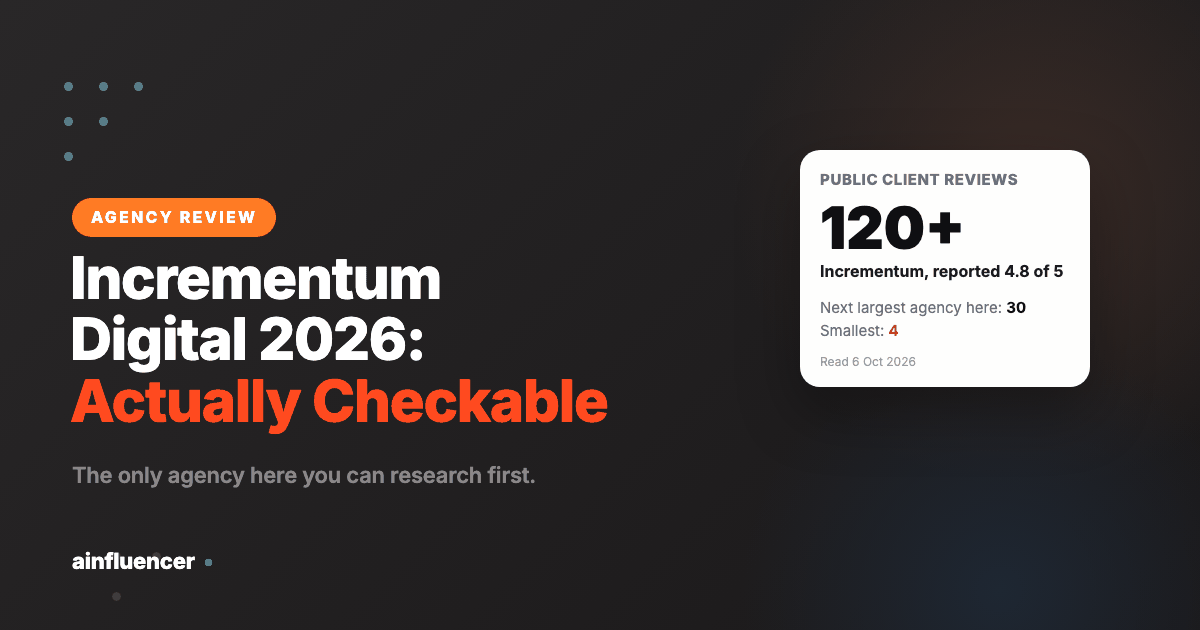
Public client reviews, agencies compared
Verified or reported client reviews as each platform states them, read 6 October 2026. Incrementum’s figure is from Trustpilot and is reported rather than verified first hand, because Trustpilot serves an anti-bot challenge we did not attempt to bypass. The others are Clutch and G2 counts.
Why the sample size changes the decision. A 4.8 from 120 reviews and a 5.0 from nine are not comparable claims. The first survives a few unhappy clients and still reads 4.8; the second cannot contain a single bad experience by definition. When you are committing a five-figure annual budget, the larger number tells you far more about what a typical engagement looks like.
One caveat, stated plainly: Trustpilot collects reviews differently from Clutch. A Clutch review requires a verified client interview, which is a higher bar per review but produces far fewer of them. Both have value, and 120 of the easier kind still beats nine of the harder kind for understanding typical outcomes.
The retail media footprint, which is the real differentiator
Most “Amazon agencies” mean Amazon. Incrementum covers a retail media map that is unusually wide.
| Channel | Why it is notable |
|---|---|
| Amazon | The core practice |
| Walmart | Common second channel, covered by most rivals |
| Target | Less common |
| TikTok Shop | Growing fast, few agencies have depth |
| Instacart | Rare. Matters for grocery and CPG |
| Kroger | Rare. Grocery retail media |
| Ulta | Rare. Beauty specific |
| Chewy | Rare. Pet category specific |
Instacart, Kroger, Ulta and Chewy are the interesting four. If you sell groceries, beauty or pet products, those are the retail media networks where your competitors are buying and where most agencies cannot help you. That is a narrower and more defensible pitch than “we do Amazon”.
What it costs
Pricing starts from a reported $2,500 a month, with full rates on request. That places it level with Advertise Purple as the most accessible entry point in this set, and below the $4,000 to $5,000 floors common elsewhere.
For an agency serving 500+ brands with a named client list including Ruggable, Martha Stewart, Samsonite and Faber-Castell, a $2,500 floor is low. That usually means tiered service levels, so the question is what $2,500 actually buys versus what those named clients are paying.
Data Owl, and what to ask about it
Incrementum provides Data Owl, a real-time ASIN-level reporting platform, to clients. ASIN-level granularity is the right unit for Amazon work: aggregate account reporting hides the fact that three products are carrying the account and forty are losing money.
The question to ask. As with any agency proprietary platform, find out what happens to your dashboards and historical data when the engagement ends. Reporting you cannot take with you is reporting you are renting.
What retail media actually means for your budget
The coverage list above is the differentiator, and it is worth being concrete about why it costs more and when it is worth paying for. Retail media networks are the ad platforms run by the retailers themselves, and they behave differently from search or social in three ways that decide whether an agency needs specific experience in them.
- The inventory is closed. You are bidding for placement inside one retailer’s own site and app, against other sellers of the same category, with no option to take that budget elsewhere and reach the same shopper at the same moment
- The reporting is the retailer’s. Each network measures differently, attributes differently and refreshes on its own schedule, so a blended cross-network report is assembled by hand rather than pulled from one dashboard
- The levers are narrow. Much of what works on other channels, creative testing at volume, audience building, granular geography, is either unavailable or heavily constrained, which puts the weight on catalogue hygiene and bid discipline instead
Which gives you a straightforward test for any agency quoting on this work. Ask which networks they have spent in during the last twelve months, not which they can support, and ask what the reporting cadence looks like across more than one. An agency that has only run one network is learning the others on your budget.
Red flags in an agency pitch for this work
Five things that should slow you down, none of which means the agency is bad, all of which mean ask a second question before signing.
- Results shown without the spend behind them. A 6x return is meaningless without knowing whether it was on $5,000 or $500,000. The second is a much harder achievement and a much more relevant one if your budget is large
- Case studies from a category unlike yours. Supplements and industrial parts are not the same problem. Ask for the closest comparable account they have run and listen for how close it actually is
- No named day-to-day contact in the proposal. If the document names only the agency, ask who the person is and meet them before you sign
- No mention of who is responsible for compliance. If an agency will be running creator or affiliate content on your behalf, the FTC is explicit that delegating the work does not delegate the responsibility, and that your company is ultimately answerable for what others do on its behalf. An agency that raises this before you do has run campaigns that were audited
- A quote that arrives without questions. Anyone who can price this work without asking about your margins, your catalogue size and your seasonality is pricing a template
- Reluctance about a short initial term. A confident agency will usually accept a three month engagement with a review. One that insists on twelve is telling you something about its retention
The counterpart to all of that, and the thing worth actively looking for rather than merely looking out against: an agency that tells you plainly what it would not take on, and why. The best signal available in any pitch is a competent refusal, because it means the other things they said yes to were genuinely assessed rather than quietly assumed.
When an in-house hire beats any agency
A review page should say when the category itself is the wrong purchase, because for a meaningful share of readers it is, and no agency is going to volunteer it.
The honest comparison is not agency fee against agency fee. It is the agency fee against what the same money buys you as salary, and the answer flips depending on four things:
- How many channels you run. One channel, run continuously, is a job. Five channels, each needing specialist knowledge and each moving independently, is a team, and hiring that team is considerably more expensive than retaining one
- Whether the work is continuous or seasonal. A salaried person costs the same in your quiet quarter. An agency retainer can often be scaled down, and a project engagement can be stopped entirely
- Whether you can manage the work. This is the one people skip. An in-house specialist with nobody above them who understands the channel will drift, and you will not know for two quarters. An agency at least arrives with its own quality control, however imperfect
- How much the knowledge matters after they leave. An employee takes the account history with them when they go. An agency takes it too, but you were never relying on holding it
Where this lands for most readers of a page like this: if you run a single channel at consistent spend and you have someone senior who genuinely understands it, hiring is usually cheaper and better. If you run several, or your spend is seasonal, or nobody internally can tell good work from bad in that channel, an agency is doing something you cannot replicate by hiring one person.
The worst outcome, and a common one, is hiring one generalist to cover work that needs three specialists, then concluding after a year that the channel does not work for your business. It was not the channel.
What to put in the brief before you ask for a number
Agency quotes in this space vary enormously for the same scope, and most of that variance is the brief rather than the agency. Four things settle the price, and leaving any of them vague guarantees a quote you cannot compare with anyone else’s.
- Which networks, by name. “Retail media” is not a scope. A list of three named networks is
- Who owns the creative. Agencies price very differently depending on whether they are producing assets or deploying yours
- What reporting you need and how often. A monthly summary and a live cross-network dashboard are different products at different prices
- Whether media spend is included. A percentage-of-spend model and a flat retainer stop being comparable the moment your budget moves, so ask for both numbers at your current spend and at double it
One question worth asking every agency on your shortlist, because the answers differ more than you would expect: who actually works on the account day to day, and how many other accounts does that person hold? The pitch team is rarely the delivery team, and that gap is the most common source of disappointment in agency relationships, well ahead of price.
What to press on
| Complaint | What reviewers describe | What to do about it |
|---|---|---|
| Trustpilot is a different standard | 120+ reviews at a reported 4.8 is the largest sample here, but Trustpilot reviews are self-submitted rather than verified client interviews like Clutch’s. | Use the volume for a read on typical outcomes and still ask for two references at your spend level. Volume and verification are different things and you want both. |
| $2,500 floor against enterprise clients | A reported $2,500 entry alongside clients such as Martha Stewart and Samsonite implies tiered service, and the floor tier is not what those brands buy. | Ask exactly what the entry tier includes, how many hours it assumes, and who staffs it. The gap between tiers is where disappointment lives. |
| Breadth across eight channels | Covering Amazon, Walmart, Target, TikTok Shop, Instacart, Kroger, Ulta and Chewy is a wide surface for one agency. | Ask how many clients they run on the specific network you care about. Capability on a list is not the same as depth in practice, especially on the rarer four. |
| Data Owl is proprietary | Reporting and ASIN-level analysis live in a platform you do not own. | Get the data portability answer in writing before you start. |
| Full pricing on request | Only the floor is public, so the real cost still requires a sales conversation. | Set your ceiling before the call. The published floor at least lets you decide whether the call is worth having, which is more than most agencies here offer. |
Incrementum Digital pros and cons
Pros
- A reported 4.8 out of 5 from more than 120 Trustpilot reviews, four times the largest sample of any agency here
- Retail media beyond Amazon including Instacart, Kroger, Ulta and Chewy, which few agencies cover
- Reported entry from $2,500 a month, among the lowest floors in this comparison
- More than 500 brands served
- Named clients including Ruggable, Martha Stewart, Samsonite and Faber-Castell
- Data Owl provides real-time ASIN-level reporting, the right granularity for Amazon
- Creative content production alongside advertising management
- TikTok Shop coverage, where depth is still scarce
Cons
- Trustpilot reviews are self-submitted rather than verified client interviews
- Only the $2,500 floor is published; full rates require a sales conversation
- A $2,500 entry next to enterprise clients implies tiered service with a real gap between tiers
- Eight retail media networks is a wide surface, so depth on the rarer ones needs checking
- Data Owl reporting is proprietary and not portable by default
Who Incrementum Digital suits
A good fit if you sell in grocery, beauty or pet categories where Instacart, Kroger, Ulta or Chewy matter, or if you want an Amazon agency you can actually research before committing. On evidence available to a buyer, it is the best documented agency in this comparison.
A poor fit if you need the verified-interview standard that Clutch provides, or if you are only on Amazon and would rather have a pure specialist than an eight-network operator.
Incrementum Digital alternatives
| Option | Entry | Choose it when |
|---|---|---|
| SalesDuo | No published rate | You want an ex-Amazon team across many marketplaces |
| Acadia | No published rate | You need Vendor Central as well as Seller Central |
| Envision Horizons | From around $4,000/mo | You sell beauty and want vertical depth |
| Levanta | $750/mo plus 3.5% | You want Amazon creator and affiliate revenue rather than ad management |
The verdict
Incrementum Digital solves the problem that makes this whole category hard to shop in. Every other agency asks you to commit tens of thousands of dollars on the strength of fewer than thirty reviews. This one has more than 120, a published floor, named clients and a retail media footprint that covers networks almost nobody else touches.
None of that guarantees a good outcome on your account, and the usual diligence still applies: ask what the entry tier buys, how many clients they run on your specific network, and what happens to your Data Owl data when you leave. But you can at least start that conversation already knowing what a typical client thinks, which is more than this category usually allows.
How much does Incrementum Digital cost?
Pricing is reported to start from $2,500 a month, with full rates available on request. That is among the lowest published floors of any Amazon agency, and well below the $4,000 to $5,000 minimums common elsewhere. Only the floor is public, so the real figure still needs a conversation.
Which retail media networks does it cover?
Amazon, Walmart, Target, TikTok Shop, Instacart, Kroger, Ulta and Chewy. The last four are the differentiator: if you sell grocery, beauty or pet products, those are networks most Amazon agencies cannot help you with.
Is the Trustpilot rating trustworthy?
It is the largest sample in this category by a wide margin, a reported 4.8 across more than 120 reviews, against four to thirty for every other agency we checked. The caveat is that Trustpilot reviews are self-submitted rather than verified client interviews like Clutch’s, so use the volume for a read on typical outcomes and still take two references.
What is Data Owl?
Incrementum’s proprietary real-time ASIN-level reporting platform, provided to clients. ASIN-level granularity is the right unit for Amazon, because account-level reporting hides which individual products are carrying the account. Ask what happens to your dashboards and historical data if the engagement ends.