RocketReach Alternatives: A Review of Its Pricing and Limits, and 10 Options
RocketReach sells named contacts by the export, on an annual cap. This guide reads its own pricing page, works out what an export costs, says what we could not verify, and compares ten alternatives, including our own contactID for business lists.
RocketReach is one of the best known B2B contact databases, and most people who search for its alternatives want one of three things: a lower price per contact, phone numbers without a larger plan, or a different kind of data altogether. This guide is both a RocketReach review and a list of RocketReach competitors. It reads RocketReach’s own pricing page, turns the printed export caps into a cost per export, says plainly which parts we could not check, and then compares ten alternatives. Two disclosures. First, contactID and Ainfluencer, the first two cards, are our own products, and each card says what it cannot do. Second, RocketReach’s website and the main review sites (Trustpilot, G2 and Capterra) block automated reading, so the RocketReach prices below come from its pricing page as captured on 10 November 2026, and we quote no review scores. Everything we could not verify is listed in its own section.
What RocketReach Is
RocketReach is a database of professional contact details. You search for people by company, title or other filters, and it returns emails and, on higher plans, phone numbers. Its homepage describes the product as verified contact data, and puts the size of the data at 700 million profiles, 60 million companies and 1 billion emails, trusted by over 26 million users and 95% of the S&P 500. Those are RocketReach’s own figures, and we have not verified them.
| Part of the product | What the page says it does |
|---|---|
| Contact search | Find people and companies, and reveal verified emails and, on Pro and Ultimate, mobile and direct phone numbers |
| Messages and Autopilot | Send email from the product (Essentials allows up to 500 a day) and run automated jobs: 10 active on Pro, 25 on Ultimate |
| Browser extension | Look up contacts while you browse |
| Contact Data API and MCP | Listed on all three plans |
| Integrations | Salesforce, HubSpot, Salesloft, Outreach and Bullhorn on Pro and Ultimate, with Salesforce custom mapping on Ultimate |
| Signals and extra data | Technographics, news and org charts on Pro. Intent data and healthcare data on Ultimate |
The important point for the rest of this guide: RocketReach sells people, meaning named contacts with a role at a company. That is the right product for a seller who needs a named buyer. It is not the product for someone who needs a list of local businesses, and it is not the cheapest route to a contact if you only need an email.
RocketReach Pricing in 2026
RocketReach’s pricing page shows three plans on an annual or monthly toggle, with a badge on the annual option that says Save 50%. The page was captured with annual billing selected, so the prices below are the annual-billing prices. We did not capture the monthly-billing prices, and the badge suggests they are higher, so check them on the page before you decide.
| Plan | Data | Price per month, billed annually | Billed per year | Exports per year |
|---|---|---|---|---|
| Essentials | Email only | $19 | $229 | 1,200 |
| Pro (labelled Best Value) | Email and phone | $52 | $619 | 3,600 |
| Ultimate | Email and phone | $115 | $1,379 | 20,000 |
| Teams | Custom packages, company exports, premium support | Talk to sales | Plans start at $6K | Not printed |
Two more details from the same page. Every plan lists unlimited verified emails, and Pro and Ultimate list unlimited phone numbers, but each also carries an annual export cap, so the cap is the number that limits you. Extra seats are discounted: the page offers Add 1 Seat with a saving of 5%.
What One RocketReach Export Costs
Dividing each annual price by its export cap gives a ceiling on the cost of one export. This is our arithmetic from the printed figures, and it assumes you use every export.
| Plan | Billed per year | Exports per year | Exports per month | Cost per export if all are used |
|---|---|---|---|---|
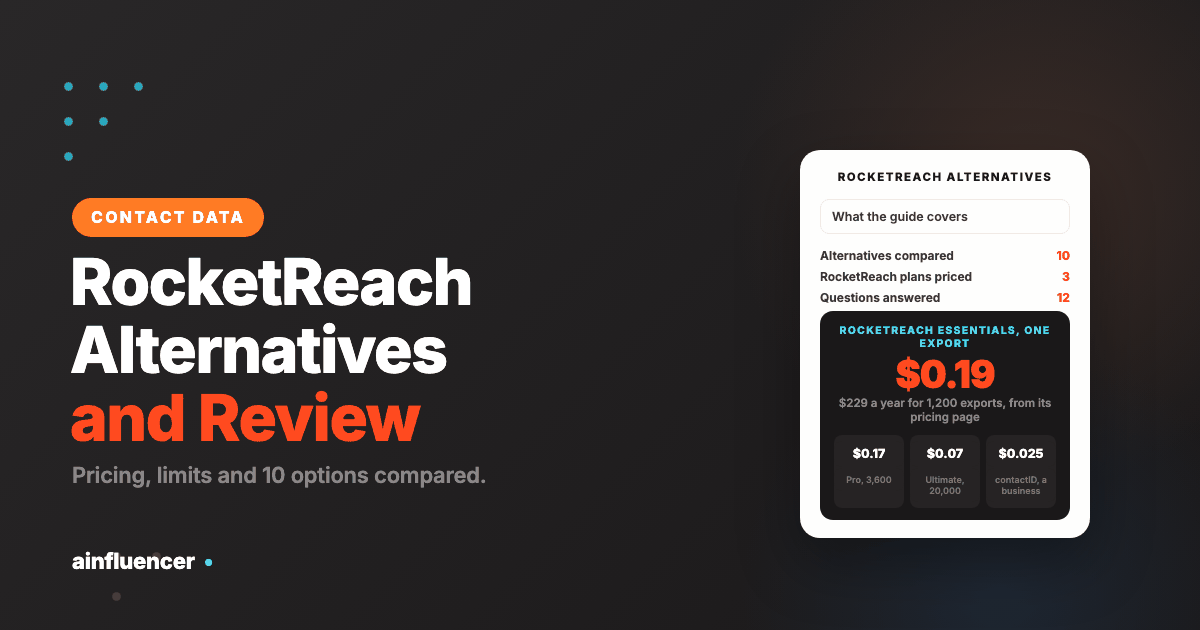
| Essentials | $229 | 1,200 | 100 | $0.19 |
| Pro | $619 | 3,600 | 300 | $0.17 |
| Ultimate | $1,379 | 20,000 | 1,667 | $0.07 |
Two things follow. Moving from Essentials to Pro costs 2.7 times as much ($619 against $229) and triples the exports, and phone numbers start there. The cheap per-export figure on Ultimate only holds if you actually use close to 20,000 exports a year. We could not read the rule that defines an export, for example whether revealing one person’s email and phone counts as one or two, so confirm that on RocketReach’s page before you buy.
RocketReach Review: What It Does Well
A named person, not a company
It returns people with a role at a company, which is what an account executive needs to start a conversation.
Plenty of connections
Pro and Ultimate list Salesforce, HubSpot, Salesloft, Outreach and Bullhorn, and every plan lists API and MCP access.
Extra data on higher plans
Technographics, news and org charts on Pro, and intent and healthcare data on Ultimate, are listed on the pricing page.
Its price ladder is also printed in full for the three standard plans, which is more than some rivals do. ZoomInfo, for one, prints no price. Printing the numbers lets you do the arithmetic in the section above, which is the first thing to do with any contact data vendor.
RocketReach Review: Where It Falls Short
These points come from the pricing page itself, so each is checkable.
- The entry plan is email only. Essentials is labelled Email Only. Phone numbers need Pro, at $619 a year.
- Exports are capped per year, not per month. Essentials gives 1,200 a year, about 100 a month, which a single outbound campaign can use in a week.
- The prices shown assume an annual commitment. The cheaper view is annual billing, so you pay for a year up front.
- Teams move to sales-led pricing. The page says team plans start at $6K a year, so a growing team leaves the self-serve price list.
- It does not give you business lists. If you sell to local businesses, a database of named professionals is the wrong shape of data.
What Reviewers Say, and What We Could Not Verify
Third-party roundups and review summaries describe a split: praise for finding contact information on one review site, and complaints on another, mostly about annual plans renewing, refund requests being declined, and records that turn out to be out of date. We could not open Trustpilot, G2 or Capterra, because they serve a bot challenge to automated reads, and we do not bypass those challenges, so we quote no score and cannot confirm any count. Several of the roundups are written by competitors that sell alternatives, so treat their statistics with care. What you can do with the themes is turn them into checks before you buy:
- Find the renewal and refund terms before you pay for an annual plan, and put the renewal date in your calendar.
- Test accuracy yourself: look up fifty people whose email you already know and count how many are right.
- Ask what counts as an export, and whether a failed or invalid lookup uses one.
Is RocketReach Legit?
It is a working product with a public price list, named integrations and a large customer claim. The doubt people usually mean is narrower: whether the data is accurate enough and whether billing is easy to control. We could not verify RocketReach’s accuracy or its renewal terms from a first-party page, and its accuracy figure is not one we can check. The honest answer is to treat it like any contact vendor: pilot it on contacts you know, read the renewal terms, and do not pay annually until the pilot passes.
Rules check: Contact data is personal data. France’s data protection authority, the CNIL, says B2B prospecting can rest on legitimate interest with conditions, and that if you acquire data from third parties you must make sure the person was informed. The FTC says CAN-SPAM makes no exception for business-to-business email, and requires a valid physical postal address and honoring opt-outs within 10 business days, and Canada’s anti-spam law carries penalties up to $10 million for businesses. A database vendor’s compliance statement does not move that duty to you. This is not legal advice.Why People Look for RocketReach Alternatives
| Reason | What it looks like on the pricing page | What to look for instead |
|---|---|---|
| Cost per contact | Essentials works out near $0.19 an export if all are used | A published per-contact price, or a free allowance to test |
| Phones cost a bigger plan | Phone numbers start on Pro, 2.7 times the Essentials price | A tool that prints what a phone costs in credits |
| Annual commitment | Prices shown are for annual billing | Monthly billing, or pay as you go |
| Annual export cap | 1,200, 3,600 or 20,000 a year | Credits that you buy when you need them |
| Wrong shape of data | People at companies, not local businesses | A list built from business listings |
| Team pricing | Team plans start at $6K a year | Per-seat or usage pricing you can forecast |
Pick the row that matches your reason first. Most disappointment with contact data comes from buying the right tool for the wrong job.
Which Alternative Fits Which Need
| What you need | Kind of data | Alternatives in this list |
|---|---|---|
| Local or small business lists with websites | Business listings | contactID |
| Creators to promote a product | Creator profiles | Ainfluencer |
| Named contacts at companies, with a free tier | People and companies | Apollo, Amplemarket, ZoomInfo |
| Only the email, verified | Email finding and checking | Hunter, Snov.io |
| Direct phone numbers | Profile lookups | Lusha |
| Your own list enriched from many sources | Enrichment and research | Clay, Lemlist |
Our guide to B2B prospecting tools sorts the wider field by the same idea, the kind of data a tool sells, and our B2B sales tools guide covers the stack after the list.
contactID: A RocketReach Alternative for Business Lists
contactID is our own tool, so read this section as a vendor describing its product, and read the limits at the end. It is not a one-for-one replacement for RocketReach, because it sells a different kind of data. It does two connected jobs: it builds lists of businesses, and it reaches them through the contact form on each company’s own website.
The Business Lists It Builds
The Find websites feature builds lead lists from Google Maps business listings. You choose a country, the type of business and the place, and it returns businesses that are open and have a website.
| Setting | What it covers |
|---|---|
| Countries | 20: Canada, United States, United Kingdom, Australia, Germany, France, Spain, Italy, Netherlands, Ireland, New Zealand, Sweden, Belgium, Switzerland, Austria, Portugal, Poland, Mexico, Brazil and India |
| Search size | Up to 5 business types per search, up to 15 places per list, up to 5,000 businesses per place |
| Who is included | Only open businesses with a website, and by default only those with a contact page |
| Filters | Minimum rating (3, 3.5, 4 or 4.5), minimum reviews (5, 20, 50 or 100), has a phone number, claimed listing |
| Plan-only filters | Has an email on its website, has a Facebook, Instagram or LinkedIn page, and state or county level search |
Counting the businesses a search would return, and drafting a lead list, are free. You pay only when you unlock a list, and you can rerun a list later to pick up new places while skipping any business you already hold.
The Data You Get, and What It Costs
An unlocked list shows each business name, category, city, rating, website, contact page, phone and email. The CSV export adds address, state, postal code, country, whether the listing is claimed, the technologies the site uses, its language and its coordinates. Unlocking costs one lead credit per business delivered with a website, and credits for businesses that were not delivered are refunded. Lists never include a business you have already unlocked, so you do not pay twice for the same record.
| Lead credit pack | Price | Credits | Cost per business |
|---|---|---|---|
| Small | $5 | 100 | $0.05 |
| Medium | $20 | 500 | $0.04 |
| Large | $60 | 2,000 | $0.03 |
| Bulk | $250 | 10,000 | $0.025 |
Lead credits are separate from the credits used for sending, and no plan includes monthly lead credits, so you buy lead data when you need it. A second product, Enrich my file, takes a spreadsheet of up to 5,000 rows, matches each row by website or phone, and costs one credit per matched row. Rows it cannot match are free.
Reaching the Businesses
A list can go straight into contactID’s send lists with merge fields for the business name and city, and a check tool shows whether you have already contacted a business. contactID then sends your message through the contact form on each company’s own website: it finds the form, fills it, handles cookie banners and CAPTCHAs, submits it, and marks the site Sent only after a confirmation. A sending credit is used only for a send that is confirmed.
| Sending plan | Price | Websites included |
|---|---|---|
| Pay as you go | $0.15 per website | Packages: $10 for 66, $25 for 200, $50 for 400, $100 for 800, $200 for 1,600 |
| Starter | $29.99 a month ($290.99 a year) | 200 |
| Growth | $99.99 a month ($799.99 a year) | 833, with MCP and 2 users |
| Pro | $149.99 a month ($1,200 a year) | 3,333, with Search and add websites, MCP and priority support |
| Scale | $399.99 a month ($2,999.99 a year) | 19,999, with unlimited team, full API and white label |
contactID Compared With RocketReach
| RocketReach | contactID | |
|---|---|---|
| What you get | Named people with a role at a company, with email and phone | Businesses from map listings, with website, contact page, phone and email |
| Best fit | Sales to named roles at mid-sized and large companies | Sales to local and small businesses |
| Pricing shape | Annual plans with a yearly export cap | Credits you buy when needed, with no monthly lead allowance |
| Cost of one record | About $0.07 to $0.19 per export if all are used | $0.025 to $0.05 per business, by pack size |
| Reaching them | Emails, calls and Autopilot | The company’s own contact form, with no email address needed |
| Free to test | No free plan on the page we read | Counting and drafts are free, plus 10 free websites with no card |
The cost row is not a like-for-like comparison, because a named decision maker and a business listing are different records. It shows only that the two products are priced in different shapes: a yearly cap against credits you buy when you need them.
Rules check: contactID does not give named decision makers or job titles, and it does not read replies: replies go to the address you give your agent. It runs in your own Chrome, Edge or Brave. Written solicitation rules can apply to targeted messages in some professions and countries, so check the rules for your market before you send.The 10 Best RocketReach Alternatives
Each card says what kind of data the tool sells, so you can tell whether it replaces RocketReach or sits beside it. Where a vendor’s page printed no price, the card says so. Prices were read on each vendor’s own site on 9 and 10 November 2026.
contactID
contactID builds lead lists of businesses from Google Maps listings in 20 countries and sends your message through the contact form on each company’s own website. Lists are priced in lead credits, from $5 for 100 businesses to $250 for 10,000, and sending is priced separately. The full detail is in the section above. It is ours, so weigh this card accordingly.
It gives you businesses, not named decision makers. That suits a seller to local or small businesses and does not suit a team that needs a VP of Finance at a 500-person company.
- Find websites: lists by business type and place, with rating, review and phone filters
- Lead credits from $0.025 to $0.05 per business, and counting and drafts are free
- Enrich my file: match up to 5,000 of your own rows by website or phone
- Sends through each company’s own contact form, with A/B testing and analytics
- No email address needed to reach a business
- You buy lead credits only when you need a list
- 10 free websites with no card, and failed sends are free
- Businesses and websites only, not named contacts by job title
- Runs in your own Chrome, Edge or Brave and stops when the browser closes
- Written solicitation rules can apply in some professions and countries
Ainfluencer
Ainfluencer is the influencer marketplace we run. It replaces RocketReach in one case only: a brand looking for creators to promote its products rather than companies to sell to. Its page says a brand can see full profiles with engagement stats, content samples and audience insights before reaching out, from a database it puts at more than 5 million creators. It is ours, so weigh this card accordingly.
It is not a database of company contacts. Outreach happens inside its inbox, and a free Chrome extension, the AI DM Inviter, drafts a DM from a creator’s profile for Instagram and TikTok.
- Creator profiles with engagement stats and audience insights before you invite
- A built-in inbox with bulk invitations, templates and in-app negotiation
- Username reveals and analytics reports, with a monthly quota by plan
- Escrow and automatic affiliate payouts in the same place
- A free plan to try it, with no card
- Search, conversation and payment in one place
- You can pay on commission, so cost follows results
- Creators only, not company contacts
- Invites are capped by plan: 2 a month on Free, 25 on Starter, 250 on Pro and unlimited only on Ultimate
- A fee on creator payments, from 35% on Free down to 3% on Ultimate
Apollo.io
Apollo is the alternative most rival lists put first. It is a B2B contact and company database that it puts at over 240 million contacts and 30 million accounts, with enrichment, sequences and a dialer. Credits are pooled across the team and expire each cycle, and the page labels its prices introductory.
Rules check: Apollo says it provides tools for GDPR, CAN-SPAM and do-not-call compliance and lists SOC 2 Type II and ISO 27001. Its data page says customers are responsible for lawful use of the data.
- 240M+ contacts and 30M+ accounts with filters and enrichment
- Sequences, a dialer and call recording
- AI research and scoring, with an MCP connection
- Salesforce and HubSpot integrations
- A free plan with no time limit
- Data and outreach in one login
- Easy per-seat forecasting
- Credits expire with no rollover
- Its 98% email accuracy claim has no stated method
- Organization is annual only with a three seat minimum
Lusha
Lusha reveals contact details for people you find, through a browser extension and a workspace. Its pricing page states credit costs: a verified email costs 1 credit and a phone number costs 5, and the free plan gives up to 40 credits a month. That makes it the closest match if your complaint about RocketReach is the cost of phone numbers.
Its page shows a rating of 4.3 out of 5, which is the vendor’s own figure. Paid plan prices are not in the page text we read.
- A browser extension and a workspace
- Intent and buying signals, and lead prioritization
- CRM sync and an API
- Credit-based pricing with a stated cost per email and phone
- Credit costs per email and per phone are printed
- A free plan for 40 credits a month
- Cancel any time, with credits kept to the end of the period
- Paid prices are not printed in the page text we read
- A phone number costs five times an email
- The free allowance is small
Hunter
Hunter finds and verifies professional email addresses and sells an outreach tool beside it. Its pricing page states the cost of data in credits: an email found costs 1 credit and an email verified costs half a credit, and credits reset monthly and do not roll over. If you used RocketReach mainly for the email, this is the cheapest comparison to make.
The free plan gives 50 credits a month and the Starter plan 2,000, billed monthly or yearly.
- Email finder and verifier
- Domain search and B2B database filters
- Auto-verification and lead enrichment on Starter
- Sequences to send cold emails
- Credit costs are printed plainly
- A free plan for 50 credits a month
- Yearly billing is cheaper
- Credits do not roll over
- It finds emails but not phone numbers on the pages we read
- The free plan is small
Snov.io
Snov.io combines an email finder and verifier with database search and outreach campaigns. Credits can be split between finding and verifying emails, and unlimited prospect storage is listed on every plan.
LinkedIn account slots are not included in the price. They are bought separately at $69 a month per slot, according to its page.
- An email finder and verifier with shared credits
- Database search by company and role
- Unlimited prospect storage
- Annual billing with a 25% discount
- Finding and sending in one tool
- A free trial
- A published five-tier price ladder
- LinkedIn slots cost extra, $69 a month each
- Credits are shared between finder and verifier, so you must plan the split
- The Ultra tier is $738 a month
Clay
Clay does not own one database. It pulls data from many vendors into tables, runs AI research agents it calls Claygent, and fills your list with whatever you ask. That makes it a research layer for a list you already have, not a one-for-one swap for RocketReach.
Two usage meters, Actions and Data Credits, set the bill, and Claygent is priced by token usage.
- Tables that combine data from many vendors
- Claygent research on custom questions about each account
- Workflows that push results to a CRM or sender
- A free plan with 500 actions and 100 data credits a month
- Answers questions a standard database cannot
- A free plan to test
- A 14 day Pro trial is stated
- Two meters make the bill hard to forecast
- Its pricing page contradicts itself on rollover and on Launch data credits
- No compliance statement was readable
Lemlist
Lemlist adds a lead database and an email and phone finder to its outreach tool. Its page gives two figures for the database, 650M+ and 600M+, and sells data as credits: its own example is that 2,000 credits buys 400 emails or 100 phone numbers.
We price all three of its meters in our Lemlist alternatives guide.
- A lead database and an email and phone finder
- Enrichment credits, with rollover while you stay subscribed
- Buying intent signals as a separate pack
- Email, LinkedIn, calls, WhatsApp and SMS outreach
- Data and sending in one login
- Credits are charged only for successful results
- Credit rollover while subscribed
- Enrichment is an add-on on top of the plan
- Its page gives two database sizes
- A phone number costs four times an email in its own example
Amplemarket
Amplemarket combines a database it puts at 200M+ contacts with AI research and signals it calls Duo, multichannel sequences and deliverability tools. Only the Startup plan is priced on the page.
The free trial leads to a demo form, and its trial length is not stated.
- A 200M+ contact database updated weekly
- Duo AI agents for research and signals
- Email, LinkedIn, WhatsApp and SMS sequences
- SOC 2 Type II and GDPR and CCPA alignment stated
- Database, signals and sequences in one product
- Compliance statements are on the page
- Covers more channels than most sequencers
- No monthly price, only an annual term on Startup
- Trial length is not stated and goes through a demo form
- A 2024 footer sits on 2026 content
ZoomInfo
ZoomInfo is the large-company option and the tool most rival lists put first. Its pricing page offers a free trial and a way to get pricing, and prints no price.
Its own blog ranks itself first among prospect research tools, which is the vendor’s view. Plan on a sales call before you can compare it with RocketReach’s printed prices.
- Contacts and companies with enrichment
- Buying intent and signals
- CRM and workflow integrations
- A free trial listed on its pricing page
- Built for large teams and large databases
- A free trial exists
- Often the benchmark other tools are compared to
- No printed price at all
- Quote-based pricing makes it hard to compare
- More than a small team needs, which is our view
RocketReach vs Its Competitors at a Glance
| Tool | Kind of data | Free option | Entry price printed on its own page |
|---|---|---|---|
| RocketReach | Named people, email and phone | None on the page we read | $229 a year Essentials, email only ($19 a month billed annually) |
| contactID | Business lists from maps | 10 free websites, free counts and drafts | Lead credits from $5 for 100. Sending from $0.15 per website |
| Ainfluencer | Creator profiles | Free plan, 2 invites a month | Starter $149 a month |
| Apollo.io | Contacts and companies | Free plan | Basic $49 per seat a month, billed annually |
| Lusha | Emails and phones | 40 credits a month | Not printed in the page text we read |
| Hunter | Verified emails | 50 credits a month | EUR 49 a month for 2,000 credits |
| Snov.io | Emails with outreach | Free trial | $39 a month |
| Clay | Enrichment | 500 actions and 100 data credits a month | $167 a month, billed annually |
| Lemlist | Database inside a sender | 200 trial credits | $69 a month Email plan. Data from $20 a month |
| Amplemarket | Contacts, signals, sequences | Trial through a demo form | $600 a month, annual term |
| ZoomInfo | Contacts, companies, intent | Free trial | Not printed |
Our own arithmetic on the credit tools, assuming you spend every credit on one type of data: a Hunter email costs EUR 0.0245 on its monthly Starter plan (EUR 49 for 2,000 credits), and a Lemlist email costs $0.05 ($20 for 2,000 credits at 5 credits each). A Lusha phone number costs 5 credits against 1 for an email.
How to Choose a RocketReach Alternative
Name the kind of data you actually need
Named people, business listings, emails only, or an enriched copy of your own list are different products. Use the table near the top.
Pilot on contacts you already know
Look up fifty people or companies where you know the right answer. Count the correct ones before you pay for a year.
Price one contact, not one plan
Divide the price by the credits or exports you will really use. Include verification, because an email that bounces costs more than it saves.
Check the credit and renewal rules
Do credits roll over, reset monthly or expire? What happens at renewal, and how do you cancel? Read it before you pay annually.
Check where the data goes next
It should flow into your CRM or sender, or you will copy it by hand.
Mistakes When Switching From RocketReach
Trusting accuracy claims
Every vendor’s accuracy figure is its own. Test a sample before you scale.
Paying annually before a pilot
An annual price is cheaper per month and costs more if the data disappoints. Pilot on the free or monthly option first.
Skipping verification
Sending to unverified emails raises bounces and harms your domain. Verify first.
Swapping people data for business data blindly
A business list is a different record from a named decision maker. Make sure the new data fits who you really sell to.
Stale data
People change jobs and companies close. Refresh before every campaign.
Ignoring the rules
Third-party data and cold email both carry duties that stay with you, whatever the vendor says.
For the strategy around finding customers, see our guide to B2B SaaS lead generation, and for what comes after the list, our AI sales tools guide.
What We Could Not Verify
You should know where this guide stops, so here it is.
- RocketReach’s monthly-billing prices. The pricing page was captured with annual billing selected.
- What counts as an export, and whether failed lookups use one.
- RocketReach’s renewal, cancellation and refund terms.
- RocketReach’s data accuracy. The homepage figures for profiles, companies and emails are the vendor’s own claims.
- Review scores and complaint counts on Trustpilot, G2 and Capterra, which block automated reads. We quote none.
- Paid plan prices for Lusha, and any price for ZoomInfo, which did not print one in the page text we read.
Conclusion: Which RocketReach Alternative Should You Choose?
If you sell to local businesses
Build the list and send the first message with contactID, and test it on 10 companies for free.
If you need named contacts
Start with Apollo’s free plan or Hunter’s, pilot on fifty people you know, and verify before you send.
If you are a brand looking for creators
Search creator profiles in Ainfluencer before you invite them.
Frequently Asked Questions
What is the best RocketReach alternative?
It depends on the data you need. Apollo suits named contacts with a free plan, Hunter suits verified emails, Lusha suits phone numbers, Clay suits enriching your own list, and contactID suits lists of local businesses with their websites and contact details.
What are RocketReach competitors?
The closest are Apollo, ZoomInfo, Lusha, Hunter, Snov.io, Lemlist and Amplemarket for named contacts and emails. contactID and Ainfluencer cover different data: business listings and creator profiles.
Is there a free alternative to RocketReach?
Yes. Apollo has a free plan with no time limit, Hunter’s free plan gives 50 credits a month, Lusha’s gives 40, Clay’s gives 500 actions and 100 data credits, and contactID gives 10 free websites with no card, with counting and lead list drafts free.
How much does RocketReach cost?
On its pricing page with annual billing selected, Essentials is $19 a month ($229 a year), Pro is $52 a month ($619 a year) and Ultimate is $115 a month ($1,379 a year). Team plans start at $6K a year. Monthly-billing prices were not captured, so check the page.
How many exports do I get with RocketReach?
Essentials includes 1,200 exports a year, Pro 3,600 and Ultimate 20,000. Dividing the annual price by those caps gives about $0.19, $0.17 and $0.07 per export if every export is used.
Does RocketReach give phone numbers?
Its pricing page lists phone numbers on Pro and Ultimate. Essentials is labelled Email Only.
Is RocketReach legit?
It is a working product with published prices and named integrations. What we could not verify from a first-party page is its data accuracy and its renewal terms, so pilot it on contacts you know and read the renewal terms before paying for a year.
RocketReach vs Apollo: which is cheaper?
Apollo has a free plan and prints Basic at $49 per seat a month on annual billing. RocketReach’s cheapest printed plan is $19 a month billed annually, but it is email only and capped at 1,200 exports a year. The database sizes each quotes are their own claims and are counted differently.
RocketReach vs ZoomInfo: what is the difference?
RocketReach prints three standard plan prices and starts team plans at $6K a year. ZoomInfo prints no price, offers a free trial and sells by quote.
Can contactID replace RocketReach?
Only if you sell to businesses rather than named individuals. contactID builds lists of businesses from map listings with website, contact page, phone and email, and reaches them through their contact forms. It does not give named decision makers or job titles.
How much does a contactID lead list cost?
Counting and drafting a list is free. Unlocking costs one lead credit per business delivered with a website, and credit packs run from $5 for 100 credits to $250 for 10,000, which is $0.05 down to $0.025 per business.
Is it legal to use a B2B contact database?
It depends on the country. The CNIL says B2B prospecting can rest on legitimate interest with conditions and that you must make sure people were informed when data comes from third parties. The FTC says CAN-SPAM makes no exception for business-to-business email, and Canada’s anti-spam law carries penalties up to $10 million for businesses. This is not legal advice.
Key Takeaways
- RocketReach sells named people. Its pricing page, read with annual billing selected, shows Essentials at $229 a year (email only), Pro at $619 and Ultimate at $1,379, with export caps of 1,200, 3,600 and 20,000 a year.
- Dividing price by cap gives about $0.19, $0.17 and $0.07 per export if every export is used, and phone numbers start on Pro.
- We could not verify its monthly prices, the definition of an export, its renewal terms or any review score, and this guide says so.
- The right alternative depends on the kind of data: Apollo or ZoomInfo for named contacts, Hunter or Snov.io for emails, Lusha for phones, Clay for enrichment.
- contactID and Ainfluencer are ours. contactID builds business lists from map listings in 20 countries, with lead credits from $0.025 to $0.05 per business, and does not give named decision makers. Ainfluencer covers creators only.
- Pilot any tool on fifty contacts you know, and read the renewal terms before you pay for a year.