Shopify CRO Agency: Fees, Testing Minimums and 12 Compared (2026)
Shopify CRO agency guide: how much traffic you need to test, what 12 agencies charge, Shopify Rollouts, tool prices and a CRO audit checklist.
Shopify conversion rate optimization (CRO) is the work of getting more of the visitors you already have to buy. A Shopify CRO agency finds where a store loses them, tests changes and keeps the ones that win. It is the one agency job where the store can be too small to start, because a test needs enough orders to tell a win from luck.
So this guide starts with the decision most pages skip: whether your store is big enough to test at all. Then come the published conversion rates and why they disagree, Shopify’s own testing tools, the tools you would pay for, the audit, twelve agencies read on their own sites, what they charge and how to choose. Every agency figure is that agency’s claim, and every Shopify figure was read on Shopify’s own pages on 9 November 2026.
What Is Shopify Conversion Rate Optimization?
Shopify’s help center describes conversion rate as the percentage of sessions that resulted in a purchase, and its funnel report counts three steps: sessions with cart additions, sessions that reached checkout and sessions that completed checkout. The report can be an open funnel, where visitors may enter at any step, or a closed funnel, where they must pass every step in order. A CRO program changes the store to move one of those step rates and then checks whether it moved.
One change to know about: Shopify’s own report page says the Shopify Analytics session measurement rollout ran from 21 to 23 September 2026 and that sessions and conversion rate might look different afterwards. If your rate shifted in late September, check that before blaming a theme change.
CRO vs Redesign, Development and Ads
CRO changes what shoppers see and do on pages that already exist, one measured change at a time. A redesign replaces the look of the whole store at once, so you cannot tell which part helped. If the store itself needs rebuilding, read the Shopify web design agency guide first and bring CRO in after launch, when there is a baseline to beat.
What Is a Good Shopify Conversion Rate?
Shopify publishes no average conversion rate of its own. Its blog pages repeat third-party figures, and those figures disagree with each other, partly because they count different things.
Conversion rate figures printed on Shopify’s own pages (read 9 November 2026)
| Figure | Named source | What it measures | Caveat |
|---|---|---|---|
| 1.4% | Statista, on Shopify’s conversion rate guide (22 August 2026) | Share of global ecommerce visits that ended in a purchase, Q1 2026 | Counts visits across all ecommerce, not Shopify stores only |
| 2.66% | Dynamic Yield, same guide | Global average across more than 400 brands | A brand panel, not every store |
| 2% to 3% | None named, same guide’s FAQ | ‘Globally’ average | No source, no date |
| 2.5% to 3% | None named, Shopify’s CRO statistics page (updated 22 October 2026) | Average ecommerce conversion rate | Contradicts the 1.4% on the other Shopify page |
| 3.7% desktop, 2% mobile | Contentsquare, same guide | Retail conversion by device | Retail data, not Shopify-specific |
The same guide gives Dynamic Yield’s June figures by industry: food and beverage 4.58%, beauty and personal care 5.32%, fashion 2.77%, home and furniture 1.29% and luxury and jewelry 0.63%. Its FAQ gives 5.29% for food and beverage and 0.94% for luxury and jewelry from the same source, and the page does not explain the gap. Treat those two industries with care and quote the table, not the FAQ, if you must quote either.
The useful number is your own rate over time, split by device and by traffic source. A rate that is below a published average tells you little, since the averages differ by almost a factor of two. One figure is steadier: Baymard Institute’s average cart abandonment rate is 70.22%, the unweighted average of 50 studies published from 2006 to 2025, as its page stated on 9 November 2026.
Is Your Store Big Enough to A/B Test? Traffic and Order Minimums
A test splits visitors into two groups and asks which group bought more. Too few orders and the difference is noise. Nobody agrees on the minimum, so here is what each source prints.
Testing minimums as each source states them
| Source | Rule it prints | What it counts |
|---|---|---|
| Shopify’s A/B testing guide (14 May 2026) | At least 1,000 visitors per variation, run for two weeks, 95% confidence or higher | Visitors |
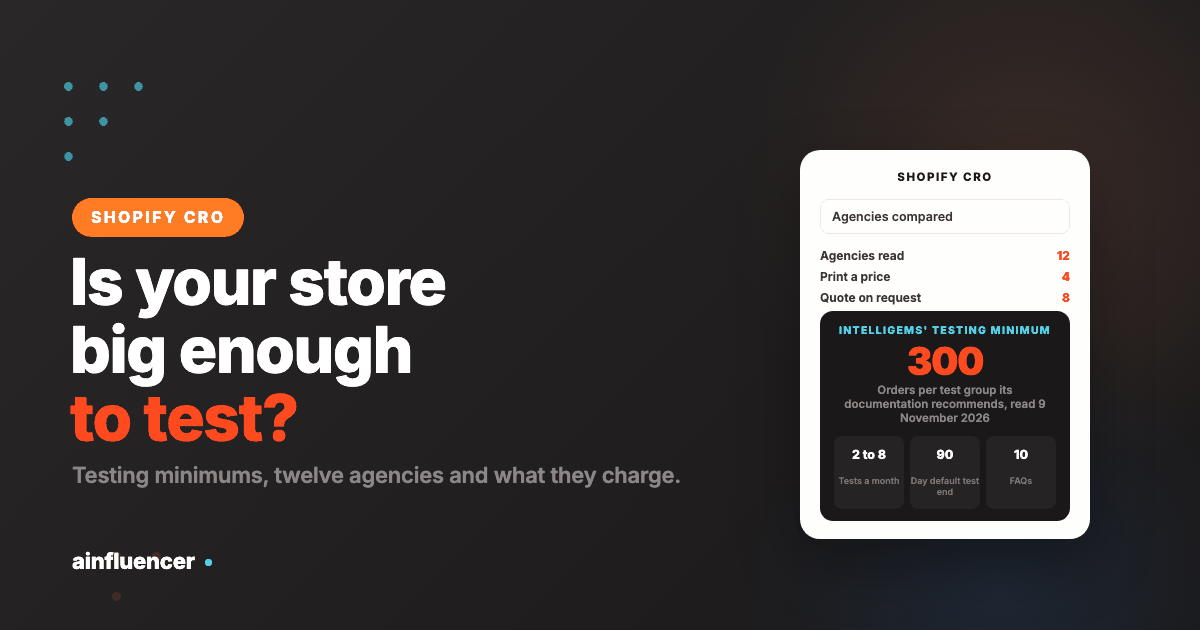
| Intelligems documentation | 300 or more orders per test group and 7 or more days | Orders |
| An outside expert quoted on Convert’s blog | Not less than 100 conversions per variation, 95% significance, a minimum of two weeks whenever significance is reached | Conversions |
| Charle (agency) | 10,000 or more monthly sessions recommended | Sessions |
| Clean Commit (agency) | 30,000 or more sessions required | Sessions |
| Blend Commerce (agency) | About $1 million a year and around 50,000 sessions a month for its audit, 50,000 sessions for conventional A/B testing | Revenue and sessions |
| DTC Pages (agency) | As a rule of thumb, 100,000 sessions a month on a tested page | Sessions on one page |
| SplitBase (agency) | Stores doing at least 3,000 orders a month, because tests take too long below that | Orders |
The rules do not fit together, and a little arithmetic shows why. Take a store converting at 2% with 10,000 sessions a month. That is 200 orders, or about 100 per group. Shopify’s 1,000 visitors per variation would be met in days but would hold only about 20 orders in each group, far below Intelligems’ 300. At 100 orders per group a month, Intelligems’ bar takes about three months for one test. This is our arithmetic on the published rules, not a figure from any source.
What to Do If Your Store Is Below the Line
SplitBase says that below 3,000 orders a month tests take too long to reach a reliable result. DTC Pages says that on lower traffic it prioritizes high-impact qualitative wins, which means fixing what research shows is plainly broken instead of testing it. Start with the checkout, speed and mobile checks in the audit section below. If traffic is the real shortfall, our Shopify PPC agency guide covers the paid side, and more traffic is also what lets you test later.
Shopify A/B Testing: Rollouts, Apps and Tool Prices
Shopify Rollouts and Experiments
Shopify now runs tests itself. Its help center says Rollouts are available on the Basic plan or higher and that Experiments are available on the Grow plan or higher. A new Experiment splits traffic 50% to control and 50% to treatment by default and ends 90 days after it starts. A rollout can test two entirely different themes or checkout and customer account setups, and mutually exclusive experiments let several run at once. The limits matter: Shopify’s requirements page says you cannot change Liquid templates as part of a rollout, cannot apply rollouts to vintage themes, and cannot test headless or custom storefront checkouts.
Shopify’s own product page says it offers statistical analysis with confidence metrics, but we found no plan tier, minimum traffic or duration for Rollouts there. The 1,000 visitors and two weeks above come from Shopify’s separate blog guide. Rollout analytics measure visitors on the online store, cart and checkout only, so headless storefronts and Shopify POS visitors are not in the results.
Shopify A/B Testing Apps and What They Cost
Apps cover what Rollouts cannot, such as price, shipping and offer tests. Each of these is priced on its own page and the prices do not always match.
A/B testing tools, as priced on each vendor’s own pages (read 9 November 2026)
| Tool | Printed price | What the price is based on | Note |
|---|---|---|---|
| Intelligems | Pricing page: Unlimited $2,894 a month, or $1,279 a month billed annually. Its FAQ says custom plans start at $69 a month at the lowest order volume | Orders per month | Its Shopify App Store listing shows Unlimited at $349 a month, and we could not reconcile the two. Built for Shopify only. |
| Shoplift | App Store: Core $99, Advanced $399, Pro $999 a month. Pricing page: Core $99, Advanced $299 on the annual view | Monthly unique visitors | The two pages disagree on Advanced and on the visitor limits |
| Convert | Growth $399 a month or $299 billed annually, Pro $599 or $420, Enterprise on request | Tested users: 100,000 a month on Growth and Pro | Not Shopify only. Lists Shopify theme, price and shipping testing, with the plans unclear |
| VWO, AB Tasty, Optimizely | No price printed on the pages we read | Quote on request | AB Tasty’s own pricing page redirected and was not read |
Google Optimize is no longer an option: Google’s page says it ended on 30 September 2023. Ask any agency which tool it uses and who pays for it, because the subscription is a separate bill from the agency’s fee.
What Does a Shopify CRO Service Include?
Agencies describe the work in nearly the same loop. Netalico calls it a continuous cycle of research, hypotheses, A/B tests and rollouts. DTC Pages lists ideation, design, development, testing, reporting and deployment. Mgroup splits the offer into an audit, a three-month sprint and a six-month program, which shows the usual order: look first, then test.
The stages of a CRO program as agencies describe them (the output column is our recommendation)
| Stage | What happens | Output you should receive |
|---|---|---|
| Audit | Funnel, speed, checkout, mobile and tracking review. Mgroup says three to four weeks. | A ranked list of problems with the evidence for each |
| Hypotheses | Each change is written as a prediction, such as moving a shipping message above the button will lift checkout starts | A backlog ordered by expected impact and effort |
| Build and test | The change is designed, built and split between two groups in a testing tool. Stated cadence is two to eight tests a month. | A live test with a stated end condition |
| Roll out | A winner is published to every visitor. A loser is logged so nobody repeats it. | A change in the live store and a note in the test history |
| Report | Results by test, not only a monthly total | Each test’s start, end, group sizes and result |
Shopify CRO Expert, Freelancer or Agency?
A solo CRO expert can run the same loop, but the traffic minimums and the testing tool bill are identical, so the real differences are how many tests one person can build in a month and who covers design and development. Ask a solo expert the same questions as an agency: the minimum, the tool, how a win is counted and who owns the test history.
Shopify CRO Audit: What It Covers and What It Costs
An audit is a one-off review that ends in a ranked list of changes. Mgroup prints $3,500 for one, taking three to four weeks. Most agencies print nothing, and the other audit prices we saw were search snippets we could not confirm, so none are stated here. Whoever does it, check that it covers the areas below, each tied to a figure you can verify yourself.
What a Shopify CRO audit should check
| Area | What to look at | Fact to hold it to |
|---|---|---|
| The funnel | Where sessions drop between cart addition, checkout and purchase, split by device and source | Shopify’s behavior report defines each step. The rate you start from is your own. |
| Speed | Real-user speed on the home, collection and product pages | Google’s good thresholds: largest content within 2.5 seconds, interaction response of 200 milliseconds or less, layout shift of 0.1 or less, measured at the 75th percentile of page loads |
| Checkout | Fields, payment methods, shipping surprises and what your plan lets you change | Standard checkout customization is on Basic and above, advanced customization on Plus only, per Shopify |
| Accelerated payments | Shop Pay, Apple Pay, Google Pay and others available at checkout | Shopify claims Shop Pay lifts conversion up to 50% over guest checkout, from an unnamed consulting study dated April 2023, so treat it as a vendor claim |
| Mobile | Product page, cart and checkout on a phone | Contentsquare’s retail data on Shopify’s guide: 2% mobile against 3.7% desktop |
| Measurement | Whether orders, sessions and events are tracked the same way across tools | The September 2026 Shopify session change above |
Shopify Checkout Optimization: What Your Plan Allows
Much CRO advice assumes you can edit checkout, and that depends on the plan. Shopify’s help center says standard checkout customizations are available on all pages for Basic and above, and advanced features only on Plus. Shopify’s developer documentation says checkout.liquid is available only to Plus merchants and was sunset for the Thank you and Order status pages on 28 August 2025. A change an agency proposes for checkout should name the plan it needs. For Plus stores, the Shopify Plus agency guide covers who builds on that platform.
Shopify Speed and Core Web Vitals
Shopify’s web performance reports use Google’s bands: good means the largest content in 2.5 seconds or less, interaction response of 200 milliseconds or less and layout shift of 0.1 or less. They are based on real user data from the past 30 days, can be delayed by up to 36 hours and keep only the last 90 days. Shopify’s overview says at least 75% of page loads need Good scores on all three. Fix speed before testing anything else, because a slow page makes every test result noisier.
Shopify CRO Agencies: 12 Compared
These twelve were read on their own sites on 9 November 2026. We looked for agencies where CRO is the main business and Shopify is named. Four more that sell CRO beside email, ads and builds are on the Shopify marketing agency guide: Rocket CRO Lab, eCommerce Today, Eastside Co and Fuel Made.
Who they are and who they say they fit
| Agency | Where | What it is | Fit it states |
|---|---|---|---|
| Blend Commerce | Henley-in-Arden, UK, per Shopify’s directory | A Shopify CRO specialist with an in-house team | About $1M a year and 50,000 sessions a month for its audit |
| Blue Stout | Portland, per Shopify’s directory | Shopify Plus partner with a CRO program | A $5M to $100M+ Shopify brand |
| DTC Pages | Fully remote, no address | Shopify-only CRO and landing pages | 100,000 sessions a month on a tested page as a rule of thumb |
| SplitBase | Not stated | CRO programs, founded 2015 | At least 3,000 orders a month |
| Prismfly | Dallas and New York | Shopify Plus partner with CRO beside development and email | Not stated |
| Charle (SiteLab) | London, Manchester, New York | Full-service Shopify agency with a CRO service | 10,000 or more monthly sessions recommended |
| Netalico | Not stated | Shopify Plus development first, CRO one service | Brands doing $2M to $50M GMV |
| Mgroup | Zhytomyr, Ukraine, 20 or more specialists | Says Shopify exclusive, CRO as audit, sprint and program | Brands past $500,000 a year |
| ClickMint | Malibu, California | Experiments, mostly Shopify, also WooCommerce and Adobe Commerce | Not stated |
| Clean Commit | Remote, six people on its team page | CRO testing agency | 30,000 or more sessions required |
| Convertibles | New York and Sofia | All client work on Shopify | Plus brands at $2M or more, typically $50,000 a month in paid ads |
| Conversion Rate Store | Hong Kong address, 45 employees in 2024 | Not a Shopify specialist | Strategy sessions for businesses over $1M a month |
What they print about fees and cadence, and what to question in their results
| Agency | Price printed | Tests and terms | What to question |
|---|---|---|---|
| Blend Commerce | None | Not stated | Its best case, Six Brothers Beef at 177% higher conversion, is a year-on-year aggregate. The page says it is not a controlled test, and sessions fell 24% and order value fell 30%. Jackson’s is 88% on one page and 61% on another. |
| Blue Stout | None, ‘contact for pricing’ in Shopify’s directory | Money back if the program does not 2x the investment | Claims a 10x average ROI and a win rate above 70%. Mountain House has three different results on its pages. |
| DTC Pages | None, ‘priced by scope’ | Averages 4 tests a month, month to month, 6-week money-back guarantee | A testimonial says a 70% win rate while its own blog says 37.9% of 1,379 tests. |
| SplitBase | $8,500 to $15,000 a month on its homepage, programs start at $8,500 on its Shopify page | Minimum commitment not stated | Hyperice’s 78x ROI has no period given. |
| Prismfly | None | 2 to 5 tests a month as a starting point | Primal Kitchen is a redesign and does not name Shopify as the platform. |
| Charle (SiteLab) | None, depends on scope | Shoplift is the main tool | The headline +182% and +38% results are not on the linked case pages, and one shows zeros. |
| Netalico | Retainer $2,700 to $10,000 a month, average client about $4,500 | Not stated | Its one stated result is 1.75% to 2.4% conversion, and its audit page was unreadable. |
| Mgroup | Audit $3,500, 3-month sprint $12,000, 6-month program $30,000 | Sprint is 2 to 4 tests a month | No named CRO case with a result. Claims both Select and Gold partner status. |
| ClickMint | Performance-based, no figures | Not stated | Its one named case says detailed results are not published. |
| Clean Commit | $5,950 a month after a free first month | 4 to 8 tests a month for stores over 50,000 sessions, month to month | Claims a 42% win rate while its cases show 31%, 19.2% and 50% or more. |
| Convertibles | None | 2 to 4 experiments a month | Rejects win rate as a measure. Its named results carry no figures. |
| Conversion Rate Store | None | Not stated | None of its 26 case studies names Shopify. |
Win rates in this table run from 31% to over 70%, and they are not comparable, because each agency decides what counts as a win and how many tests it counts. DTC Pages’ own blog figure is the only one with a stated number of tests. Only Blend’s best case both names Shopify and admits it is not a controlled test, which is the kind of caveat you want to see. Shopify’s partner directory was read for Blend and Blue Stout only, so every other badge is the agency’s own claim.
How Much Does a Shopify CRO Agency Cost?
Four of the twelve print a fee, and they point to a few thousand dollars a month at the low end and more than ten thousand at the high end. Fuel Made, which is on the marketing guide and not among the twelve, prints a fifth figure in its FAQ: CRO retainers start at $7,500 a month.
- Netalico: $2,700 to $10,000 a month, with the average client around $4,500.
- Clean Commit: $5,950 a month, with the first month free.
- SplitBase: $8,500 to $15,000 a month.
- Mgroup: a $3,500 audit, a $12,000 three-month sprint and a $30,000 six-month program. By our arithmetic that is $4,000 a month for the sprint and $5,000 a month for the program.
The testing tool is extra and is billed to you, as the tool table shows. Eight agencies print no price at all, and three of them offer something other than a plain retainer: DTC Pages prices by scope with a money-back guarantee, Blue Stout offers its money back if the program does not double the investment and ClickMint calls its pricing performance-based without a figure.
How to Check a CRO Retainer Pays for Itself
Divide the monthly fee by the profit on one extra order to see how many extra orders the program must add. With made-up inputs: a $5,000 fee, an $80 average order and a 40% margin after costs leaves $32 per order, so the program must add about 156 orders a month before it breaks even ($5,000 divided by $32). Put your own numbers in, and compare the result with your current order count. If 156 extra orders would be a large share of your monthly total, a retainer will take a long time to pay back. When the findings call for a rebuild, the Shopify development agency guide covers who does that work.
How Long Does Shopify CRO Take to Show Results?
No agency can promise a lift, and none of the twelve gave a timeline we could confirm. What the published rules do give you is a ceiling on how much can be learned. Shopify’s default Experiment ends after 90 days, Shopify’s guide says to run each test for two weeks, and agencies state two to eight tests a month. At the stated cadence a program runs roughly 6 to 12 tests in its first quarter, and Clean Commit’s range of 4 to 8 a month applies only to stores above 50,000 sessions. Agencies’ own win rate claims run from 31% to over 70%, so some tests in every program lose. Expect a handful of wins in the first 90 days, not a steady climb.
How to Choose a Shopify CRO Agency: Questions to Ask and Red Flags
- What is the minimum? Ask for the order or session floor in writing. If your store is below it, you are paying for a program you cannot run.
- How many tests a month, on which tool, and who pays for it? The stated cadence is two to eight, and the tool bill is yours.
- How do you count a win? Ask for the number of tests behind any win rate and what threshold calls one a win.
- Show me a Shopify store with a baseline. A result with no starting figure, no period or no mention of Shopify is not proof.
- Who owns the test history? The tool account, the hypotheses and the results should be in your name when you leave.
- Do you also sell redesigns? An agency paid to rebuild your store has a reason to find that it needs rebuilding.
- Red flag: a promised percentage lift before it has seen your analytics.
- Red flag: results with no control group. Blend says plainly that its headline case is not one.
If you are choosing between an agency and one specialist, the guide to hiring Shopify experts covers freelancers and consultants.
Frequently Asked Questions About Shopify CRO Agencies
What is Shopify CRO?
Shopify conversion rate optimization is changing a store to raise the share of sessions that end in a purchase. Shopify’s help center defines conversion rate as the percentage of sessions that resulted in a purchase.
How much does a Shopify CRO agency cost?
Four of the twelve print a fee: Netalico $2,700 to $10,000 a month, Clean Commit $5,950 a month, SplitBase $8,500 to $15,000 a month and Mgroup $3,500 for an audit or $12,000 for a three-month sprint. Fuel Made also says CRO retainers start at $7,500 a month. The testing tool is billed separately.
What is a good Shopify conversion rate?
Shopify publishes no average of its own. Its blog pages repeat 1.4% from Statista, 2.66% from Dynamic Yield and an unsourced 2.5% to 3%, so compare your rate with your own history by device and source.
How much traffic do I need to A/B test a Shopify store?
Sources disagree. Shopify’s guide says at least 1,000 visitors per variation for two weeks, Intelligems’ documentation says 300 or more orders per test group, and agencies print floors from 10,000 to 100,000 sessions a month.
Does Shopify have built-in A/B testing?
Yes. Shopify Rollouts are available on the Basic plan or higher and Experiments on the Grow plan or higher. A new Experiment splits traffic 50/50 and ends 90 days later by default. Liquid template changes, vintage themes and headless checkouts are not supported.
What is a Shopify CRO audit and what does it cost?
It is a one-off review that ends in a ranked list of fixes covering the funnel, speed, checkout, mobile and tracking. Mgroup prints $3,500 for one, taking three to four weeks. Most agencies print no audit price.
How long should an A/B test run on Shopify?
Shopify’s guide says two weeks at a 95% confidence level, and an expert quoted by Convert says a minimum of two weeks whenever significance is reached. Shopify’s default Experiment ends after 90 days.
Which Shopify plan do I need for checkout changes?
Shopify says standard checkout customizations are available on Basic and above, and advanced features only on Shopify Plus. checkout.liquid is available only to Plus merchants.
What is the average cart abandonment rate?
Baymard Institute puts it at 70.22%, the unweighted average of 50 studies published from 2006 to 2025.
What should I ask a Shopify CRO agency before hiring?
Ask for its minimum, tests per month, which tool it uses and who pays, how it counts a win, a Shopify case with a baseline, and who owns the test history when you leave.
If you are still deciding which kind of agency your store needs, our guide to the types of Shopify agency sorts them by job.