The Best Creator Economy Tools in 2026: A Curated Roundup
The creator economy runs on software. This curated roundup maps the best creator economy tools across every category that matters, from content and community to payments, courses, and AI, so you can find the right platform for whatever you are building.
Creator economy tools are the software platforms that let independent creators build, grow, and monetize an audience, spanning content creation, scheduling, community, memberships, courses, payments, brand deals, and AI. Together they let one person run what used to take a whole team.
This roundup is organized by category, not by hype, so you can quickly find the right kind of tool for whatever you are working on. It is broad by design: think of it as a map of the whole creator economy rather than a single stack. For a tighter, day-to-day operational toolkit, pair this with our focused guide to the best tools for influencers.
Let’s walk the map, one category at a time, with the standout options in each.
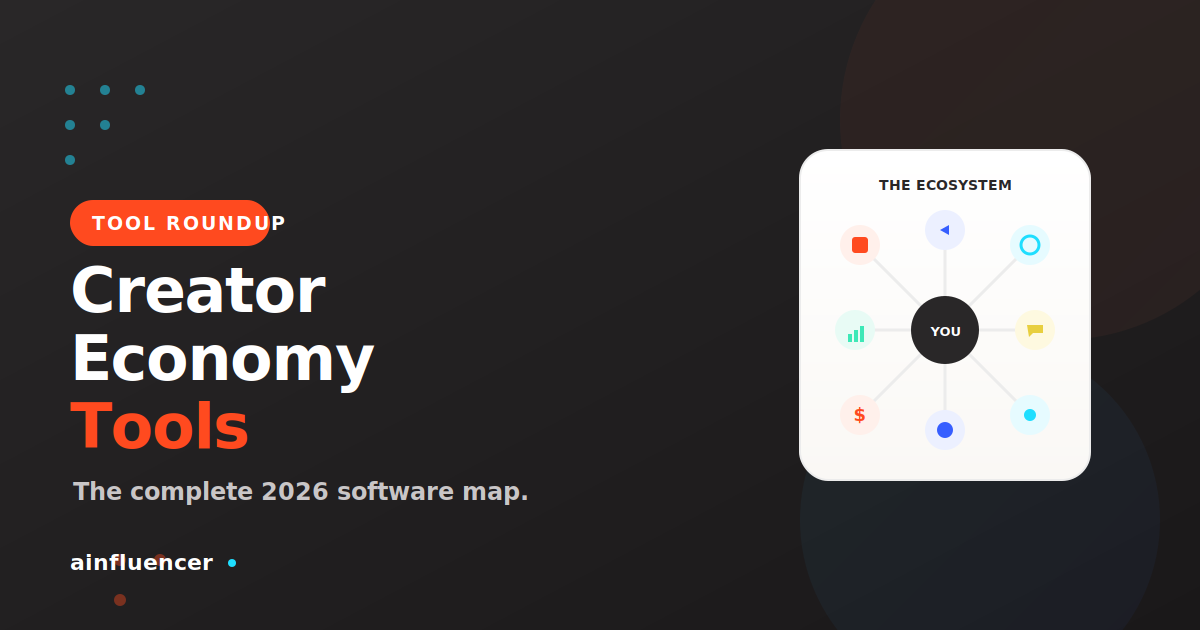
01 / OverviewThe 8 Categories of Creator Economy Tools
The creator economy has matured into distinct software categories, each solving a specific part of the creator business. Understanding these categories is the fastest way to make sense of the hundreds of creator economy tools competing for your attention.
How to read this roundup
Where a category is dominated by one or two names, we link to the full review rather than repeat it here. Popular Pays, now part of Lightricks, is one of those.
You will not need every category at once. Early on, focus on content and monetization; as you grow, layer in community, memberships, and courses. Pick one tool per category that fits your platform and stage, and ignore the rest until you actually need them. The best way to use this roundup is as a reference you return to as your business grows: bookmark it, and each time you hit a new bottleneck, come back and pick the one category of creator economy tools that solves it. That way your toolkit expands in step with your audience and income rather than all at once, which keeps both your costs and your learning curve manageable.
The Creator Economy Tool Landscape
02 / Category 1Content Creation Tools
Everything in the creator economy starts with content, so creation tools are where most creators begin. This category covers graphic design, video editing, and increasingly AI-assisted content, the software that turns your ideas into publishable posts.
Standout options
Canva dominates graphic design with templates for every format. CapCut leads short-form video editing on mobile, while DaVinci Resolve offers free professional desktop editing. To keep everything on-brand across these tools, define your identity first using our guide on how to build a personal brand as a creator.
03 / Category 2Scheduling and Publishing Tools
Once you can make content, you need to publish it consistently. Scheduling tools let you batch and auto-post across platforms, one of the highest-leverage categories of creator economy tools because it directly buys back your time.
Standout options
Later and Buffer are the creator favorites, with visual calendars and best-time suggestions. Later is especially strong for visual, Instagram-first creators. Consistent scheduling underpins the steady presence that grows your account over time.
| Category | Example Tools | What It Does |
|---|---|---|
| Content Creation | Canva, CapCut | Design + video editing |
| Scheduling | Later, Buffer | Plan + auto-publish |
| Analytics | Native, trackers | Measure growth |
| Community | Discord, DM tools | Engage your audience |
| Memberships | Patreon | Recurring income |
| Courses | Teachable, Gumroad | Sell digital products |
| Payments | Linktree, Stripe | Collect income |
| Brand Deals | ainfluencer | Get sponsored |
04 / Category 3Analytics and Growth Tools
Data tells you what to make more of. Analytics tools reveal which content performs, when your audience is active, and how engagement trends, so your decisions are driven by evidence rather than guesswork. Every serious creator relies on this category.
Standout options
Native platform analytics are free and powerful; start there. As you scale, dedicated trackers give deeper audience and engagement insight. These are the same metrics brands review, so knowing them also helps when you understand how they use influencer tracking tools to evaluate partnerships.
05 / Category 4Community and Engagement Tools
A loyal community is the most durable asset in the creator economy. Community tools help you manage conversations, run a dedicated space, and automate repetitive replies so engagement scales with your audience instead of drowning you.
Standout options
Discord is the go-to for dedicated creator communities, while DM automation handles FAQs and link requests at scale. See what is possible with our guide to Instagram DM automation tools, then keep the personal conversations for your most engaged fans.
06 / Category 5Membership and Subscription Tools
Recurring revenue is the holy grail of a creator business, and membership tools make it possible. They let your most dedicated fans support you monthly in exchange for exclusive content, perks, or access, turning an audience into predictable income.
Standout options
Patreon is the best-known membership platform, letting creators offer tiered perks and exclusive posts. Others build memberships directly into their own site or Discord. The key is having enough of a trusting community first, which comes back to a strong content strategy.
07 / Category 6Course and Digital Product Tools
If you have expertise, packaging it into a course or digital product is one of the highest-margin ways to earn in the creator economy. This category of creator economy tools handles hosting, selling, and delivering your knowledge products.
Standout options
Teachable and Thinkific host full online courses, while Gumroad is ideal for simpler digital products like templates, presets, and ebooks. Start with a small product to validate demand before building a full course.
Payment and link-in-bio tools
Payment tools turn attention into income. A link-in-bio hub like Linktree or Beacons organizes everything you promote, while Stripe and similar processors handle checkout for your products. Together they make sure every piece of content has a clear path to revenue.
Brand deal and sponsorship tools
For most creators, brand deals are the biggest income source, and this is the category that connects you to them. A free creator marketplace like ainfluencer matches you directly with brands searching for creators, so you can find, pitch, and manage sponsorships in one place instead of cold outreach.
These last two categories are where the creator economy actually pays out. You can have the best content tools in the world, but without a way to collect payments and land brand deals, the business does not close the loop. Prioritize them early, even while your audience is still growing, using resources like our guide to performance-based partnerships.
08 / How to ChooseHow to Pick the Right Creator Economy Tools
With so many options, the real skill is choosing well. You do not need the most tools; you need the right one per category for your platform, stage, and goals. Here is how to build a lean, effective toolkit.
Do This
- Start with free plansBuild your whole starter toolkit for free, then pay only for what earns its keep.
- One tool per categoryA single strong tool per job beats a pile of overlapping apps.
- Prioritize monetizationSet up payments and brand deals early, even while growing.
- Match your platformPick tools built for where you actually post and sell most.
Avoid This
- Tool overloadMore apps means more cost, logins, and distraction, not more growth.
- Paying too earlyDo not buy premium tiers before you know you will use them.
- Ignoring monetizationGreat content with no payment path never becomes a business.
- Chasing every new appShiny new tools rarely fix a problem your current stack cannot.
09 / ChecklistYour Creator Economy Toolkit Checklist
Use this checklist to make sure your toolkit covers the whole creator business without bloat. If every box is ticked, you have a complete, lean stack.
The Complete Toolkit Checklist
- Content creation coveredYou have a design tool and a video editor you know well.
- Scheduling in placeYour posts can be planned and published on a consistent rhythm.
- Analytics reviewedYou track what works using native or dedicated tools.
- Community nurturedYou have a way to engage your audience at scale.
- Monetization set upYou can collect payments and sell products or memberships.
- Brand deals connectedYou are on a marketplace that puts you in front of brands.
Where AI fits in the modern toolkit
No roundup of creator economy tools in 2026 is complete without AI. AI assistants now speed up nearly every category on this map: they draft captions and scripts, generate thumbnail concepts, repurpose one long video into a dozen clips, suggest posting times, and even summarize your analytics into plain-language next steps. The smart way to use them is as accelerators, not replacements. Let AI handle the first draft or the repetitive edit, then add your own voice, judgment, and personality on top, because that human layer is exactly what your audience follows you for. Treat AI as one more category in your stack, powerful, cheap, and improving fast, but keep yourself firmly in the creative driver’s seat so your brand still sounds unmistakably like you.
10 / FAQCreator Economy Tools: FAQ
What are creator economy tools?
Creator economy tools are software platforms that help independent creators build, grow, and monetize an audience. They span content creation, scheduling, analytics, community, memberships, courses, payments, and brand deals, together letting one person run a business that once required a full team.
What tools do I need to start in the creator economy?
Start lean: a design tool like Canva, a video editor like CapCut, a scheduler like Later, and a way to reach brands such as a free creator marketplace. Add community, membership, and course tools only once your audience and income justify them.
Are there free creator economy tools?
Yes. Most categories have strong free options, including Canva, CapCut, native analytics, Gumroad for simple products, and free creator marketplaces for brand deals. You can build a complete starter toolkit at no cost, then upgrade only the tools that clearly pay for themselves.
How do creators make money with these tools?
Creators earn through brand deals, memberships, courses and digital products, affiliate income, and tips or subscriptions. The right tools handle each stream, but the largest for most creators is sponsorships, which a marketplace like ainfluencer helps you find and manage directly.
What is the difference between free and paid creator tools?
Free tiers usually cover the essentials and are perfect for starting out. Paid tiers add automation, deeper analytics, more scheduling slots, and team features that save time as you scale. Upgrade only when a tool clearly buys back hours or directly grows your income.
Do I need a tool for every category?
No. Start with content creation and brand deals, then add categories like community, memberships, and courses as your audience and business grow. One strong tool per category you actually use beats a sprawling toolkit that adds cost and complexity without results.
Great tools create content. This one gets it paid.
Whatever creator economy tools you use to make and grow, ainfluencer is how you monetize. Build a free creator profile, set your niche and rates, and connect with brands running campaigns right now.