YouTube Influencers
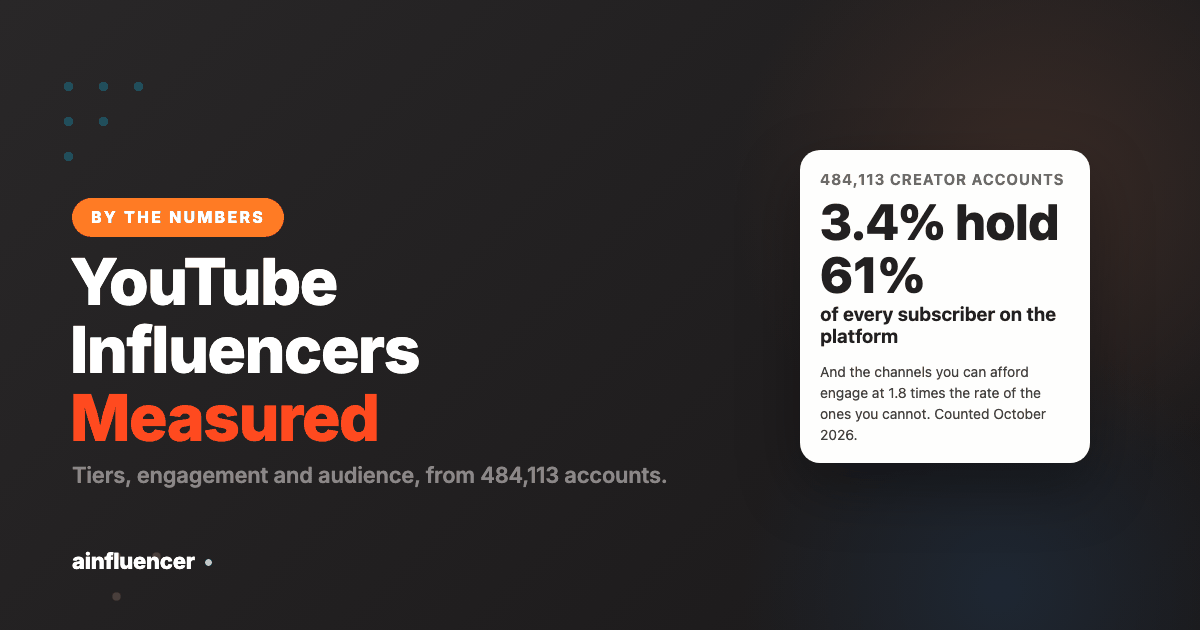
The top 3% of YouTube channels hold 61% of all subscribers, and small channels engage 1.8x better. Tier, engagement and audience data.
Most articles about YouTube influencers are a list of the twenty biggest channels on earth, which is useless if you are a brand with a budget, because none of them will take your call. This one is built from the actual population: 484,113 YouTube creator accounts in the Ainfluencer marketplace, counted on 9 October 2026, broken down by size, engagement and where their audiences live.
The two findings that should change how you shop: the subscribers are extraordinarily concentrated, and the channels you can actually afford get nearly twice the engagement of the ones you cannot.
How Many YouTube Influencers Are There?
In this marketplace, YouTube is the largest of the three networks: 484,113 creator accounts against 417,694 on Instagram and 181,950 on TikTok. Here is how they are distributed by subscriber count.
YouTube creator accounts by subscriber tier, October 2026
| Tier | Subscribers | Accounts | Share of accounts |
|---|---|---|---|
| Nano | 1,000 to 10,000 | 163,964 | 33.9% |
| Micro | 10,000 to 100,000 | 213,034 | 44.0% |
| Mid | 100,000 to 500,000 | 75,495 | 15.6% |
| Macro | 500,000 to 1 million | 14,618 | 3.0% |
| Mega | 1 million and above | 16,673 | 3.4% |
| Below the usual floor | Under 1,000 | 329 | 0.1% |
Micro is the biggest tier by a wide margin. Nearly half of all YouTube creators here sit between ten thousand and a hundred thousand subscribers, and together with nano they are 78% of the whole population. The mega channels that fill every listicle are 3.4%.
The Top 3% Hold 61% of the Subscribers
Add up the subscriber counts across all 484,113 accounts and you get 89.07 billion. Of that, 54.34 billion, or 61.0%, sits inside the 16,673 channels with a million subscribers or more.
Where the subscribers actually are
| Share of channels | Share of subscribers | |
|---|---|---|
| 1 million and above | 3.4% | 61.0% |
| Everything below 1 million | 96.6% | 39.0% |
One caveat worth stating before anyone quotes that 89 billion back at us: it is a sum of subscriber counts, not a headcount. One person subscribes to dozens of channels, so this measures the shape of the market, not its size in people.
The shape is the point. YouTube attention follows a power law far steeper than most brands assume when they budget. If your shortlist is built from a top YouTube influencers article, you are competing for 3.4% of the supply against everyone else who read the same article, and paying the premium that implies.
Smaller Channels Get Nearly Twice the Engagement
This is the part that makes the concentration survivable. Engagement falls monotonically as channels grow, across more than 440,000 accounts with a recorded rate.
Recorded engagement rate by tier
| Tier | Engagement rate | Accounts measured |
|---|---|---|
| 1K to 10K | 5.82% | 148,125 |
| 10K to 100K | 4.45% | 192,612 |
| 100K to 500K | 3.98% | 70,418 |
| 500K to 1M | 3.46% | 13,862 |
| 1M and above | 3.22% | 15,863 |
The smallest tier engages at 1.8 times the rate of the largest. That ratio is the robust finding here and it holds at every step of the ladder without a single reversal. Treat the absolute percentages as the platform’s recorded rate rather than as a universal benchmark, since different tools compute engagement against different denominators.
Put the two findings together and the arithmetic for a brand is uncomfortable for the obvious strategy. A mega channel costs more per placement, is harder to book, and its audience responds at roughly half the rate. The case for going big is reach and prestige, not efficiency, and it should be made deliberately rather than by default. Our guide to micro influencers covers how to run the alternative properly.
Where Their Audiences Actually Are
Audience country matters more on YouTube than most planners expect, because it drives both who sees the video and what the placement is worth.
Primary audience country of 483,898 YouTube creator accounts
| Market | Share of creators |
|---|---|
| India | 33.7% |
| United States | 27.5% |
| Brazil | 9.3% |
| Japan | 4.3% |
| Germany | 3.7% |
| France | 3.3% |
| Canada | 2.6% |
| Everywhere else | 15.6% |
India is the largest single market, ahead of the United States. For a brand that sells only in North America or Europe, that means a material share of any unfiltered creator list is reach you cannot convert, and it is the first filter to apply rather than the last. For a brand that does sell in India, it is the cheapest attention on this page.
It also decides the creator’s own economics, which shapes what they will accept from you. We worked that through in how much YouTube pays per view: the same hundred thousand views is worth around $15 to an Indian audience and up to $1,500 to a US one, which is exactly why creators in lower-paying markets rely on brand deals rather than ad revenue.
Reading this from the other side, as a creator rather than a brand? We counted 204,281 brand offers against the size of the creator who received each one in how to become a YouTube influencer: 77% went to channels under 100,000.
Which Tier You Can Actually Work With
Matching the tier to the job
| Tier | Best for | The honest catch |
|---|---|---|
| Nano, 1K to 10K | Product seeding, volume testing, genuine community niches | Production quality varies enormously and you will manage many relationships to get meaningful reach |
| Micro, 10K to 100K | The default for most brands. Real engagement, reachable, negotiable | Still needs vetting one by one. The tier is large because it is where most working creators sit |
| Mid, 100K to 500K | A flagship placement without enterprise pricing | Often managed, so expect a slower process and a rate card |
| Macro and mega, 500K plus | Reach and credibility at launch moments | Half the engagement rate, agency gatekeepers, and lead times measured in months |
The practical shortlist for almost everyone is micro plus a small number of mid, which is both where the supply is and where the engagement is.
Finding and Vetting Them
Two things are worth saying about any YouTube influencer database, including this one. Every directory carries accounts that have gone quiet, so recency is a filter you apply yourself: of the 484,113 accounts here, 251,326 had their data refreshed in the last 90 days. And a subscriber count tells you almost nothing without views to go with it, because subscribers accumulate and views do not.
- Check views against subscribers, not subscribers alone. A channel with 200,000 subscribers and 4,000 views per video has an audience that left
- Read thirty comments. Generic praise and the same few accounts on every video is the clearest signal there is, and no tool reads it better than you
- Confirm the audience country before you book, not after. Ask for the creator’s own analytics screenshot, which is the real data every third-party tool is estimating
- Check the last upload date. A dormant channel still appears in every database
The full procedures are in how to find influencers on YouTube, auditing an influencer profile and vetting influencers. For the campaign side, start with YouTube influencer marketing, and if you would rather hand it over, we reviewed the YouTube influencer marketing agencies.
What YouTube Influencers Cost
YouTube is the most expensive channel per creator, and the reason is production rather than greed. A dedicated video is days of work, not an afternoon, and an integration inside an existing video is priced against the channel’s typical view count rather than its subscriber count. That second point is why two channels with identical subscriber numbers quote very different fees.
Our measured figures are in influencer rates. On Ainfluencer the rate is whatever you and the creator agree: there is no subscription, the minimum collaboration is $10, and the platform takes a percentage of the deal, from 25% on the free plan down to 3% on the top plan. Creators are on the platform to receive offers, which is the difference between messaging them here and cold emailing an address scraped from an about page.
Frequently Asked Questions
How many YouTube influencers are there?
In the Ainfluencer marketplace there were 484,113 YouTube creator accounts in October 2026, making it the largest of the three networks ahead of Instagram at 417,694 and TikTok at 181,950. Across the wider platform the true number is unknowable, since there is no public register of who counts as an influencer.
What counts as a YouTube influencer?
In practice, any creator a brand can pay to feature a product. The usual tiers are nano at 1,000 to 10,000 subscribers, micro at 10,000 to 100,000, mid at 100,000 to 500,000, macro at 500,000 to a million and mega above that. Micro is by far the largest tier at 44% of accounts.
Do smaller YouTube channels get better engagement?
Yes, consistently. Across more than 440,000 accounts, the recorded engagement rate falls at every step as channels grow: 5.82% at 1,000 to 10,000 subscribers down to 3.22% above a million. The smallest tier engages at roughly 1.8 times the rate of the largest.
Which YouTube influencer tier should a brand work with?
Micro, 10,000 to 100,000 subscribers, suits most brands. It is the largest tier, it is reachable without an agency, rates are negotiable, and the engagement is well above what mega channels deliver. Add a small number of mid channels when you need a flagship placement.
Where are most YouTube influencers’ audiences?
India is the largest single market at 33.7% of creator accounts, ahead of the United States at 27.5%, then Brazil at 9.3%, Japan at 4.3% and Germany at 3.7%. If you do not sell in a market, filter it out before you build a shortlist rather than after.
How much do YouTube influencers charge?
More than other channels, because a dedicated video is days of production. Integrations inside an existing video are usually priced against the channel’s typical view count rather than its subscriber count, which is why two channels of the same size quote very differently.
Is it worth working with mega YouTube influencers?
Only for reach and credibility at a launch moment. They are 3.4% of channels but hold 61% of subscribers, so they are expensive and heavily contested, and their audiences engage at about half the rate of micro channels. It is a deliberate trade, not the default.