Influencity Alternatives
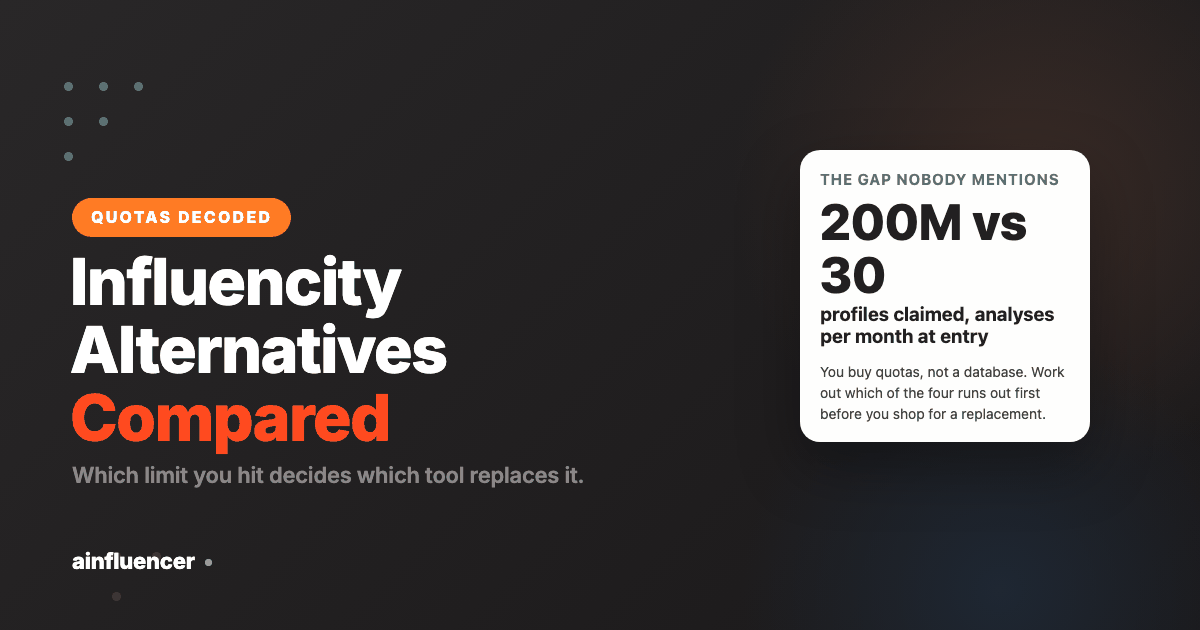
Influencity sells a 200M profile database through quotas, reportedly 30 analyses a month at entry. The alternatives, by the limit you actually hit.
Influencity advertises a database of more than 200 million creator profiles. The entry plan is reported to let you run 30 analyses a month. Both things are true at once, and the gap between them is why people end up here.
So this is not a feature comparison. What you buy from Influencity is a set of quotas, and the useful question is which one you will hit first, because that decides whether a cheaper tool would actually have been enough.
What You Are Actually Buying
Reported pricing, and the sources disagree enough that you should confirm on the vendor’s own page before budgeting. There is no permanent free plan, only a trial, reported at 7 days.
Influencity tiers and the quotas attached to them, as reviewers report them
| Tier | Reported price | What the quota actually is |
|---|---|---|
| Basic | About $168 to $198 a month | Search plus 30 analyses a month, one list, no reports |
| Professional | About $348 to $398 | Unlimited search, report exports, campaign access, around 600 influencers per campaign |
| Business | About $698 to $998 | 25,000 monthly results and 500 analyses, multi-campaign |
| Discover | Listed separately | 5,000 discovery results and 30 insight tokens a month, one user |
| Enterprise | Quoted | Custom limits |
Annual billing is reported to save about 20%. Entry prices quoted elsewhere range from $148 to $318, which is a wide enough spread that any single figure, including ours, should be treated as an estimate. Our Influencity review covers the product itself.
The Four Quotas, and Which Runs Out First
Most platforms meter one thing. Influencity meters four, and they fail in different ways. Work out which is your binding constraint before you shop, because the right alternative is different for each.
Find your binding constraint
| The quota | You hit it when | What that means for a replacement |
|---|---|---|
| Analyses | You look closely at more than about 30 creators a month on the entry tier | You need a tool that does not charge per profile opened. This is the most common wall |
| Discovery results | Your searches return more than the monthly results allowance | You need unmetered search, or a smaller index you can actually work through |
| Creators per campaign | A campaign needs more than roughly 600 creators | This is an enterprise-scale problem and a cheaper tool will not solve it |
| Seats | More than one person needs to log in | Per-seat pricing is where mid-market platforms get expensive fastest |
The honest test: if you are hitting the analyses quota, you were never using the 200 million profile database. You were using a few hundred profiles a year, and almost every tool below covers that for less.
Alternatives That Do Not Meter Discovery the Same Way
These are genuine like for like swaps: creator databases with audience data, priced monthly. Reported figures, which should be confirmed with each vendor.
- Modash covers Instagram, TikTok and YouTube, reported at $299 a month for Essentials and $599 for Performance, with a 14 day trial. Narrower on networks, deeper on audience data. See Modash alternatives
- Heepsy is the budget option, reported from about $89 a month with a free tier. Thinner data and tightly limited lower tiers, which is the trade you are making
- HypeAuditor is reported at about $299 for Basic and $499 for Pro on annual billing. Choose it if the real job was audience authenticity rather than discovery breadth. HypeAuditor alternatives covers which check you need
- Upfluence is broader on networks and more expensive to start, from a reported $649 a month on a three month commitment. See Upfluence alternatives
Note what none of these fixes: they are all still subscriptions, so a quiet quarter costs the same as a busy one. If your usage is seasonal, that is the actual problem and a different category solves it.
If Outreach Was the Problem, Not Discovery
This is the complaint that comes up most in reviews and it is worth separating from the quota question. Influencity’s outreach is email based, with no in-app chat. You find the creator, you export or compose, and then you are cold emailing a stranger.
That matters more than it sounds. A database of public profiles is a list of people who never agreed to hear from you, so whatever its size, your reply rate is your cold email reply rate. Buying a bigger index does not fix a reply-rate problem; it makes the list of people ignoring you longer.
Two ways to reach a creator
| Database plus email | A marketplace | |
|---|---|---|
| How they hear from you | A cold email to an address found or inferred | An offer inside a platform they joined to receive offers |
| Who starts it | You, every time | Either side. Creators also apply to campaigns |
| What you pay for | Seats and quotas, whether or not anyone replies | A percentage of the collaborations that actually happen |
| Where it is weaker | Nothing, if your outreach already converts | A smaller pool than a 200 million profile index |
On Ainfluencer there is no subscription and no quota on anything: you search, filter by audience country and size, message creators and agree terms inside the platform, and the only cost is a fee on each collaboration, from 25% on the free plan down to 3%, with a $10 minimum. For a team running campaigns in bursts rather than continuously, that removes the question the quotas create.
Cheaper Alternatives, Honestly Assessed
Two of the tail queries that lead here are explicitly about price, so here is the straight answer rather than a list.
- Cheaper and genuinely comparable: not really. Influencity sits in the mid-market band with Modash and HypeAuditor at a reported $299, and the gap is not large once you match quotas
- Cheaper and narrower: Heepsy, from a reported $89. You lose depth of audience data and run into limits sooner, which may be fine
- Cheaper because there is no subscription: a marketplace. You pay per collaboration instead, so the comparison is against your actual deal volume rather than against a monthly fee
- Free: nothing credible at this level. Free tiers in this category are demos. Searching platforms directly is the real free option, and finding creators manually covers doing it properly
If you are moving up rather than down, CreatorIQ, Aspire and Traackr are the enterprise tier, and that raises the floor rather than lowering it. CreatorIQ alternatives sets out what that costs.
How to Check Before You Switch
A test that answers the quota question
| Step | What to do |
|---|---|
| 1. Count last month’s analyses | How many creator profiles did you actually open in detail? If it is under 30, the entry tier was never your constraint and price is the only issue |
| 2. Count the creators you contacted | And how many replied. If the reply rate is the problem, no database fixes it and you are shopping in the wrong category |
| 3. Run the same three searches everywhere | Your real niche, country and size band, in every shortlisted tool. Compare what comes back, not what the feature page claims |
| 4. Check the index where you actually work | A 200 million profile claim is a global number. What matters is depth in your country and niche, which is usually far smaller |
| 5. Price against collaborations, not seats | If the subscription is a large fraction of what you pay creators, the ratio is the problem |
| 6. Avoid annual billing in year one | A reported 20% saving is not worth locking into a quota you have not tested |
For the wider field across every category rather than this one comparison, influencer marketing platforms ranks 15 in depth, and YouTube influencer marketing platforms covers the same question for a single channel.
Frequently Asked Questions
What is the best Influencity alternative?
It depends which quota you were hitting. For comparable discovery and audience data, Modash at a reported $299 a month or HypeAuditor at about the same. For a cheaper and narrower tool, Heepsy from around $89. If the problem was outreach replies rather than discovery, a marketplace is a different category and usually the right one.
How much does Influencity cost?
Reported entry pricing ranges from about $148 to $198 a month depending on the source, with Professional around $348 to $398 and Business around $698 to $998. Annual billing is reported to save about 20%. There is no permanent free plan, only a trial reported at 7 days. Confirm with the vendor, because published third-party figures disagree widely.
Is there a cheaper alternative to Influencity?
Heepsy is cheaper at a reported $89 a month and narrower. Modash and HypeAuditor sit at a similar price rather than below it. The genuinely cheaper route for teams that run campaigns in bursts is a marketplace with no subscription, where you pay a percentage of each collaboration instead.
Does Influencity really have 200 million profiles?
That is the company’s own claim and it is self-reported, like every database size figure in this category. The number that matters is not the global total but the depth in your country and niche, and your plan’s monthly quota for analysing them, which on the entry tier is reported at 30.
Why does my Influencity plan run out so quickly?
Because it meters four separate things: analyses, discovery results, creators per campaign and seats. Most teams hit the analyses quota first. Work out which one is binding before you upgrade, because upgrading for the wrong quota is the most common way this gets expensive.
Does Influencity have in-app messaging?
Reviewers report outreach as email based with no in-app chat, which is the complaint that comes up most often. If creators not replying is your bottleneck, a larger database will not help and a marketplace where creators opted in to receive offers is the category that does.
Is there a free Influencity alternative?
No credible free equivalent exists at this level; free tiers in this category are effectively demos. Searching the platforms directly is the real free option, and a marketplace removes the subscription without being free, since you pay a fee per collaboration instead.