The 15 Best Influencer Marketing Platforms in 2026 (Compared by Price and Use Case)
Most platform roundups list features. This one compares what each tool is actually for, what it costs to start, and which of them run real AI rather than a renamed filter, so you can pick one without a month of demos.
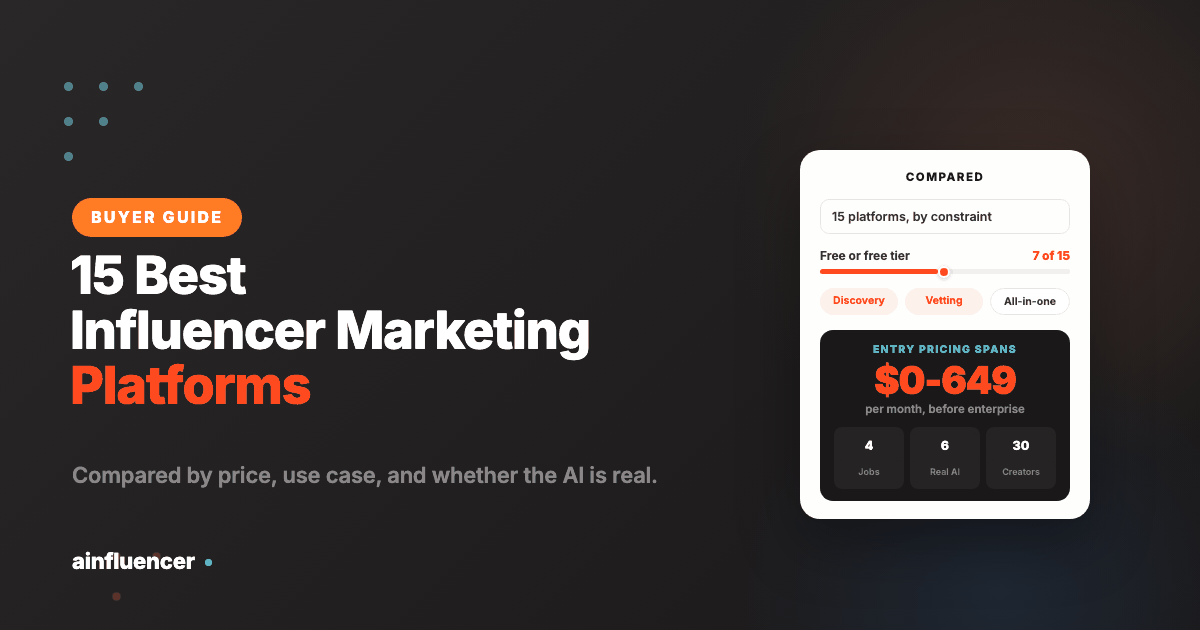
An influencer marketing platform does four jobs: it finds creators, it checks whether their audiences are real, it manages the campaign, and it pays people. Almost no tool does all four well, and the ones that try charge accordingly. This guide compares 15 platforms by what they are genuinely best at, what they cost to start, and where each one stops.
Prices below are the entry tier at the time of writing and move often, so treat them as an order of magnitude rather than a quote. If budget is the deciding factor, we covered what is genuinely free in free influencer marketing tools, and if you would rather understand the category before comparing vendors, AI tools for influencer marketing sorts the market by the job the software is doing.
Quick CompareThe 15 Platforms, Side by Side
Ranked by how broadly useful each one is rather than by size. The full breakdown of every platform, with pricing, features, pros and cons, follows below.
| # | Platform | Best for | Starts at | Free tier |
|---|---|---|---|---|
| 1 | Ainfluencer | brands wanting inbound applications | Free | Free |
| 2 | Influencer Hero | Best all in one for DTC ecommerce programmes | ~$649/mo | Demo |
| 3 | Upfluence | ecommerce brands with a Shopify catalogue | ~$478/mo | Free tools |
| 4 | Modash | discovery and audience vetting at speed | ~$299/mo | 14-day trial |
| 5 | HypeAuditor | fraud detection before you commit budget | ~$399/mo | Free tools |
| 6 | Influence.co | small teams starting on Instagram | ~$600/mo | Free plan |
| 7 | Afluencer | cheap inbound collabs at low volume | ~$49/mo | Free creator plan |
| 8 | Intellifluence | gifting and product seeding campaigns | ~$99/mo | Free plan |
| 9 | Heepsy | budget discovery with rate estimates | ~89 euro/mo | Free plan |
| 10 | StoryClash | seeing which creators your competitors use | ~750 euro/mo | Limited free tools |
| 11 | BuzzSumo | content research before you brief anyone | ~$199/mo | 30-day trial |
| 12 | Audiense | audience research on X | ~1,199 pounds/mo | Free plan |
| 13 | Gatsby | turning existing customers into creators | ~$199/mo | 7-day trial |
| 14 | Influencity | multi platform discovery on a mid budget | ~$398/mo | 7-day trial |
| 15 | Traackr | enterprise teams that need governance | Enterprise | On request |
01 / Platform1Ainfluencer: Best for brands wanting inbound applications
Ainfluencer inverts the usual model. Instead of paying for a database and searching it, you publish a campaign brief and creators apply to you. That changes the economics of discovery, because you are filtering people who already want the deal rather than messaging people who may not reply. AI matching runs across more than twenty filters including niche, location and audience, and there is no subscription.
Key features
- Publish a brief and receive creator applications
- AI matching across 20+ filters including niche and location
- Direct chat and negotiation inside the platform
- Escrow, so payment releases on delivery
- Unlimited campaigns and unlimited creators
- No seat licences and no annual contract
Pros
- Free, so there is no minimum spend to justify
- Inbound applications remove the reply rate problem
- Escrow protects both sides on every deal
- Scales from one campaign to a continuous programme
Cons
- Self service, so there is no fully managed option
- Instagram, TikTok and YouTube only
Buyer tip: Write the brief as though a creator will read it, because one will. Briefs that state the budget openly attract far better applications than briefs that say competitive rates.
02 / Platform2Influencer Hero: Best all in one for DTC ecommerce programmes
Influencer Hero is the closest thing here to a single system for running creators at scale: discovery, outreach, gifting, contracts, affiliate tracking and payouts in one workflow, rather than four tools stitched together with a spreadsheet. It starts from a 450M+ creator database with 20+ filters, sends AI-personalised outreach that averages a 43% response rate, and then automates what happens after a creator says yes. Campaign Board Automations ship products, send contracts and issue discount codes when a creator moves stage, and 45+ integrations tie every post back to sales in your store.
Key features
- 450M+ creator database with 20+ filters and AI lookalike search
- AI-personalised outreach sequences with a 43% average response rate
- Campaign Board Automations: trigger-based product sends, contracts and codes
- Product gifting through $0 orders on Shopify, WooCommerce, Amazon and more
- Affiliate links, discount codes, UTM tracking and automated creator payouts
- AI Content Wall that collects creator posts and organic brand mentions
- Chrome extension showing fake follower %, growth and EMV on any profile
- 45+ integrations across ecommerce, email, support and e-signature tools
Pros
- Genuinely all in one, which removes tool sprawl and manual handoffs
- The largest creator index on this list
- Automations cut the admin that grows with every added creator
- Sales, clicks and EMV reported per creator, not just reach
- Built for ecommerce rather than adapted to it
Cons
- No free plan, and plans carry a 3-month minimum term
- More platform than a team running a handful of creators a year needs
Buyer tip: Ask the demo to run your real workflow end to end, from finding a creator to shipping product and issuing a code, on your own store integration. The time saved on the steps after discovery is where an all in one earns its price.
03 / Platform3Upfluence: Best for ecommerce brands with a Shopify catalogue
Upfluence is built around ecommerce, and its strongest feature is identifying creators who are already your customers by matching your store data against its creator index. For a DTC brand that is a genuinely different starting point from a cold database search, because the creator already bought the product.
If the Shopify side is the only part you would use, the price is the usual sticking point. We compare the cheaper routes in Upfluence alternatives.
Key features
- Customer to creator matching from your store data
- Shopify and WooCommerce integrations
- Affiliate and discount code tracking built in
- Campaign workflow from outreach to payment
- Around 3 million indexed creators
Pros
- Customer matching is a real advantage for DTC
- Ecommerce integrations are deep rather than cosmetic
- Handles affiliate and one off campaigns in one place
Cons
- Pricing starts high for a small programme
- Most of the value depends on having store data to match against
Buyer tip: If you do not run Shopify or WooCommerce you are paying for the half of this product you cannot use. Check that before the demo, not after.
04 / Platform4Modash: Best for discovery and audience vetting at speed
Modash indexes essentially every creator above a small follower floor, which makes it the tool to reach for when the shortlist has to come from outside the usual names. Audience data is its strength: location, age, gender and credibility on any profile, without needing the creator to connect an account.
Key features
- Around 250 million indexed creators
- Audience demographics without creator opt in
- Fake follower and credibility scoring
- Content monitoring for live campaigns
- Exportable lists for handover to an agency
Pros
- The widest index here by a wide margin
- Audience data quality is consistently good
- Clean, fast interface with little training needed
Cons
- Discovery and monitoring only, with no payments layer
- Per seat pricing adds up on a larger team
Buyer tip: Use the audience location filter before the follower filter. A creator with the right audience in the wrong size band is fixable; the reverse is not.
05 / Platform5HypeAuditor: Best for fraud detection before you commit budget
HypeAuditor is the specialist in the one check most teams skip under deadline pressure. Its authenticity reports score follower quality, engagement patterns and audience credibility against a large population, which is the comparison a person auditing a single profile cannot make.
Key features
- Audience Quality Score on any public profile
- Fraud and engagement pod detection
- Audience demographics and interest breakdown
- Competitor and market benchmarking
- Free single report tools for spot checks
Pros
- The strongest fraud detection in this list
- Reports are detailed enough to justify a rejection internally
- Free tools are genuinely usable for occasional checks
Cons
- Discovery is weaker than Modash or Influencity
- Custom pricing means a sales call before you see numbers
Buyer tip: Agree your suspicious follower threshold before you build the shortlist. Under 10% is normal for any account, above 25% the burden of proof sits with the creator.
06 / Platform6Influence.co: Best for small teams starting on Instagram
Influence.co is a creator community with a light brand layer on top, which makes it useful at the very start of a programme when you want to browse and contact creators without committing to a database subscription. It is Instagram centred and shallow compared to the enterprise tools, and for a first campaign that is often the right trade.
Key features
- Browse creator profiles with stated rates
- Post opportunities creators can respond to
- Free plan with basic search
- Profiles maintained by creators themselves
Pros
- Low commitment way to see the market
- Creator stated rates give a useful reality check
- Free plan is enough to test the approach
Cons
- Instagram only
- Pro pricing is high for what the paid tier adds
Buyer tip: Treat creator stated rates here as an opening position rather than a price list. They tend to sit above what a well briefed campaign actually pays.
07 / Platform7Afluencer: Best for cheap inbound collabs at low volume
Afluencer is the cheapest paid option here by a wide margin and works on the same inbound principle: post a collaboration and creators apply. The network is small, around twenty thousand creators, so it suits a brand testing the channel rather than one running continuous campaigns.
Key features
- Post collaborations creators apply to
- Brand plans from around $49 a month
- Direct messaging with applicants
- Gifting and paid campaign formats
Pros
- The lowest paid entry point in this list
- Inbound model, so no cold outreach
- Simple enough to run without training
Cons
- Around 20,000 creators, far smaller than the databases
- Thin analytics and no real reporting layer
Buyer tip: Good for a first test of whether inbound works for your category. If it does, the constraint becomes network size quite quickly.
08 / Platform8Intellifluence: Best for gifting and product seeding campaigns
Intellifluence is built around product seeding rather than paid posts, with a network of roughly 258,000 creators who have opted in to receive products. For a brand with physical stock and a modest cash budget that is a different and often better trade than paying for reach.
Key features
- Opt in creator network for gifting campaigns
- Amazon and ecommerce oriented workflows
- Built in payment handling for paid deals
- Multi channel including YouTube and blogs
Pros
- Product cost instead of cash fees on many deals
- Creators have opted in, so reply rates are high
- Reasonable entry price for the network size
Cons
- Creator quality varies widely on a gifting network
- Not suited to large paid campaigns
Buyer tip: Gifting works when the product is genuinely wanted and fails when it is not. Test with a category people already buy before scaling it.
09 / Platform9Heepsy: Best for budget discovery with rate estimates
Heepsy is a search tool rather than a full platform, and it is priced accordingly. Its estimated cost per post figures are useful early, when the question is what a campaign of this shape is likely to cost before anyone has been contacted.
Key features
- Filtered creator search by location, niche and size
- Estimated cost per post on each profile
- Authenticity indicators on search results
- Exportable lists
Pros
- Cheap enough to run alongside another tool
- Rate estimates help build a budget before outreach
- Simple, fast search
Cons
- No campaign management or payments
- Estimates are estimates, not quoted prices
Buyer tip: Use it to size a budget, not to set an offer. Estimated rates ignore usage rights and exclusivity, which are usually where the real cost sits.
10 / Platform10StoryClash: Best for seeing which creators your competitors use
StoryClash is a monitoring product first. Its AI visual search finds creators by what appears in their content rather than by keyword, and its brand tracking shows which creators are already posting about competitors. For a brand entering a crowded category that competitive view is the reason to buy it.
Key features
- AI visual search across creator content
- Competitor brand monitoring and creator overlap
- Around 120 million creators indexed
- Story tracking, including content that disappears
- Free ROI and brand ranking tools
Pros
- Competitive intelligence no other tool here matches
- Visual search finds creators keywords miss
- Story monitoring covers what screenshots do not
Cons
- The most expensive non enterprise option here
- Monitoring focus means lighter campaign management
Buyer tip: Before your first campaign, run your three closest competitors through it. The creators appearing on all three are the category’s proven performers.
11 / Platform11BuzzSumo: Best for content research before you brief anyone
BuzzSumo is not an influencer platform and it earns a place here anyway. It tells you which topics and formats already perform in your category, which is the input to a brief that works. Briefing creators without it is guessing about the content, however good the creator is.
Key features
- Top performing content by topic and format
- Author and journalist discovery
- Trend and question research
- Alerts on brand or topic mentions
Pros
- Makes briefs specific instead of generic
- Useful well beyond influencer marketing
- Long trial to evaluate properly
Cons
- No creator database, campaign tools or payments
- An addition to a stack, never the stack
Buyer tip: Run your product category through it before writing a brief. The angle that already performs beats the angle you assumed would.
12 / Platform12Audiense: Best for audience research on X
Audiense does one thing that nothing else here does well: it segments an audience on X into interest based clusters, so you can see which communities actually surround a topic. For B2B and for categories where the conversation lives on X rather than Instagram, that is the research step before any creator is chosen.
Key features
- Audience segmentation into interest clusters
- Influencer identification inside each segment
- Personality and interest insights
- Free tier covering 20 profiles
Pros
- The only real audience intelligence tool in this list
- Genuinely useful for B2B categories
- Free tier is enough to evaluate it
Cons
- X only, which rules it out for most consumer brands
- Pro pricing is enterprise level
Buyer tip: Worth an hour even if you never buy it. The free tier will tell you whether your category has a real community on X at all.
13 / Platform13Gatsby: Best for turning existing customers into creators
Gatsby finds the creators already in your customer list. It connects to your ecommerce platform, identifies which customers have a meaningful following, and automates the offer to them. That is the cheapest creator acquisition there is, because the relationship already exists.
Key features
- Identifies influencers inside your customer list
- Ecommerce integrations for automated offers
- UGC collection and rights tracking
- Automated reward and discount flows
Pros
- Customers who already bought convert far better
- Automation suits high volume, low touch programmes
- Cheaper per creator than any database
Cons
- Only as good as the size of your customer list
- Instagram and TikTok only
Buyer tip: This is the first tool to try if you already have thousands of customers. It is the last one to try if you do not.
14 / Platform14Influencity: Best for multi platform discovery on a mid budget
Influencity covers more platforms than most tools at this price, including Twitch, and matches identities across them so one creator is one record rather than four. For a brand running on several channels at once that consolidation is worth more than it sounds.
Key features
- Cross platform identity matching
- Instagram, YouTube, Facebook and Twitch coverage
- Audience overlap analysis between creators
- Campaign management and reporting
- Modular pricing by feature
Pros
- Broadest channel coverage at this price point
- Audience overlap analysis prevents paying twice for one audience
- Modular pricing avoids paying for unused features
Cons
- Interface takes longer to learn than Modash
- Modules add up quickly once you need several
Buyer tip: Run the audience overlap report before signing three creators in one niche. Overlap of 40% or more means you are buying the same people twice.
15 / Platform15Traackr: Best for enterprise teams that need governance
Traackr is built for organisations running influencer marketing across many markets and needing consistent measurement, spend governance and audit trails across all of them. It is the wrong tool for a single brand running quarterly campaigns and the right one for a group managing dozens of programmes.
Key features
- Multi market, multi brand campaign management
- Standardised measurement across markets
- Budget governance and spend tracking
- Competitive benchmarking
- Compliance and audit workflows
Pros
- Consistent measurement across markets, which nothing cheaper offers
- Governance features real procurement teams require
- Mature reporting suitable for a board
Cons
- Enterprise pricing and enterprise sales cycle
- Substantial overkill below several markets
Buyer tip: The question that decides this one is not features, it is whether you need one number that is comparable across twelve countries. If you do, nothing cheaper does it.
AIWhich of These Are Actually AI Platforms
Almost every platform above now describes itself as AI powered, and most of the time the phrase covers an ordinary database filter that was renamed. The distinction matters because you are choosing between a search box and something that ranks, scores or classifies, and only the second one saves you work.
Here is what the AI is genuinely doing on the platforms above.
| Platform | What the AI does | What that means in practice | Free tier |
|---|---|---|---|
| Ainfluencer | Matching | Ranks applicants against your brief across 20+ filters | Free |
| Influencer Hero | Outreach personalisation and content scoring | Writes creator-specific openers from recent posts and rates UGC for visual quality and product visibility | Demo |
| StoryClash | Visual search | Finds creators by what appears in their content, not by keyword | Limited |
| HypeAuditor | Fraud detection | Scores authenticity against a large account population | Free tools |
| Modash | Audience estimation | Infers demographics from follower signals, no opt in needed | Trial |
| Upfluence | Discovery and scoring | Ranks a database against a brief rather than filtering it | Free tools |
| Influencity | Identity matching | Resolves one creator across four platforms into one record | Trial |
How to tell real AI from a renamed filter
Four questions separate them, and any vendor can answer all four in a sentence if the answer is good.
- Does it rank, or does it filter? A filter returns everything matching your criteria in whatever order the database held. A model returns a ranked list and can tell you why the third result is third.
- Does it improve as you use it? If accepting and rejecting creators changes what you are shown next, something is learning. If it does not, the AI is a label.
- What sits behind the audience estimates? Every platform estimates audience demographics from a sample. The sample size varies enormously and almost nobody publishes it. Ask.
- Can it explain a score? An authenticity score with no components shown is a number you cannot act on or argue with.
What AI on a platform will not do
Worth setting expectations before you pay for a tier because of an AI feature. No platform’s AI can tell you whether an audience will buy, only whether it is real. None of them can judge whether a creator’s tone suits your brand, which is the failure that ends up in a screenshot. And detection quality falls sharply in languages the underlying models saw little of, so a market you are not fluent in still needs a native reviewer regardless of what the dashboard says.
Buyer tip: ask for a trial on your own shortlist, not on the vendor’s demo data. A demo is tuned to look good. Ten creators you already know will tell you in twenty minutes whether the scoring agrees with your judgement.
We go deeper on each of these elsewhere. AI tools for influencer marketing sorts the wider market by the job the AI is doing, AI powered influencer vetting explains why two platforms score the same creator 85 and 62, and influencer marketing AI agents covers the newer product shape that takes an instruction and runs the whole task rather than returning a list. For the overview, see AI in influencer marketing.
Shopping for one channel rather than all of them? YouTube influencer marketing platforms sorts the same field by what each product actually is, a database, a marketplace, a creator CRM or audience analytics, and checks which ones genuinely index YouTube rather than listing it on a feature page.
Wider Market26 More Platforms, and Who They Suit
The fifteen above are the ones most teams should shortlist from. The category is larger than that, and several of the platforms below will appear in any competitive search you run, so it is worth knowing what each is for before a sales call frames it for you.
Pricing is omitted here deliberately. Most of these quote on request and the published figures go stale within a quarter, so an out of date number is worse than none. Each name links to our full review.
For the six most price-checked names on this page we have a dedicated guide each, and every one is organised around the specific reason teams leave that platform rather than being the same list six times: CreatorIQ alternatives sets the field against a $37,000 median annual contract, GRIN alternatives covers the 2026 repricing to usage-based credits that most comparison sites have not noticed, Upfluence alternatives sorts by which part of the suite you actually used, HypeAuditor alternatives by which check you need to run, Emplifi alternatives by which module you are replacing, and Modash alternatives by where its index runs out., and BuzzSumo alternatives by what you can still get for free now that its free plan is gone. And Influencity alternatives works through which of its four usage quotas you are actually hitting, which decides whether a cheaper tool would have done.
| Platform | Known for | Suits |
|---|---|---|
| GRIN | Creator management for DTC ecommerce | Ecommerce brands |
| CreatorIQ | Enterprise creator programme management | Large brands and agencies |
| Aspire | Campaign workflow and creator marketplace | Mid market brands |
| Collabstr | Marketplace where you hire creators directly | Small teams and one off campaigns |
| Klear | Discovery and analytics, now part of Meltwater | Brands already using Meltwater |
| Linqia | Managed service with performance guarantees | Brands wanting it run for them |
| NeoReach | Data heavy discovery and managed campaigns | Enterprise and agencies |
| Tagger | Social listening plus creator discovery, part of Sprout | Data led teams |
| Captiv8 | Enterprise creator and commerce platform | Large brand teams |
| Emplifi | Social suite with influencer marketing included | Teams consolidating tools |
| Skeepers | Micro and nano creator community for UGC | Brands wanting volume UGC |
| Insense | UGC and creator ads, strong on paid amplification | Performance marketers |
| Brandwatch | Social listening first, influencer as a module | Research led teams |
| Later | Scheduling suite with an influencer layer | Teams already scheduling in Later |
| Onalytica | B2B influencer and expert identification | B2B brands |
| Qoruz | Creator discovery with strong India coverage | Brands targeting South Asia |
| Humanz | Discovery and campaign management with fraud focus | Brands worried about authenticity |
| Popular Pays | Content production through creators, part of Lightricks | Brands buying content, not reach |
| Julius | Curated creator database, part of Triller | Teams wanting vetted lists |
| Open Influence | Managed campaigns with creative production | Brands wanting full service |
| Webfluential | Self serve marketplace with creator rate cards | Smaller budgets |
| BrandBacker | Gifting and product seeding network | Brands with physical product |
| Trendhero | Instagram analytics and fake follower checks | Spot checking a shortlist |
| Keyhole | Hashtag and campaign tracking | Measuring an already running campaign |
| Scrunch | Creator discovery and audience data | Agencies managing several brands |
| PEG | Creator discovery with YouTube depth | Brands prioritising YouTube |
Two patterns are worth noticing in that list. Several of these are social suites that added an influencer module rather than influencer platforms in their own right, which usually means the discovery is thinner than a specialist tool and the integration with the rest of your stack is better. And a number are managed services rather than software, so the comparison is not against a subscription, it is against an agency retainer.
How to ChoosePick by Constraint, Not by Feature List
Every platform on this list demos well. The way to choose between them is to start from the thing you cannot change: your budget, your channel, or the data you already hold.
If you have no budget yet
Start inbound. Publish a brief on a free marketplace and let creators apply, rather than paying for a database to search. It removes the reply rate problem entirely, and it costs nothing to find out whether creators want to work with your brand. Everything else on this list can wait until you know that.
If you already have customers
Look at Gatsby or Upfluence before any database. A customer with a following converts better than a stranger with a bigger one, and identifying them costs far less than discovery. This is the single most underused route in the category.
If discovery is the bottleneck
Modash for breadth, Influencity if you need Twitch or cross platform identity matching, StoryClash if the question is which creators your competitors already use. All three are discovery first, so plan to handle payment elsewhere.
If you have been burned by fake followers
HypeAuditor, and set the threshold before you build the shortlist. Our guide to auditing an influencer profile is the manual version of what it automates, and vetting influencers covers reading the result.
If you are running thirty or more creators a month
This is where an all in one earns its price. Influencer Hero for DTC and ecommerce brands that want discovery, gifting, affiliate tracking and payouts automated in one place, Traackr if you need consistent measurement across markets. At this volume the admin after discovery, not the discovery itself, becomes the bottleneck, and campaign management explains why.
What no platform replaces
Choosing the creator. Software proves an audience is real and matches it to your brief. It cannot hear whether a creator’s tone suits your brand, and that judgement is what ends up in a screenshot when it goes wrong. Shortlist with the tool, decide with a person, every time. The wider programme logic sits in our guide to influencer marketing strategy.
FAQInfluencer Marketing Platforms: FAQ
What is an influencer marketing platform?
Software that does some combination of four jobs: finding creators, checking whether their audiences are genuine, managing the campaign from brief to delivery, and paying people. Very few tools do all four well. Most are strong at one and adequate at the rest, which is why the useful comparison is by job rather than by feature count.
How much does an influencer marketing platform cost?
Entry pricing in this list runs from free to around $649 a month, with enterprise tools quoted on request. Afluencer starts near $49 and Intellifluence near $99. The mid market discovery tools sit between roughly $199 and $478. Marketplaces where creators apply to you can be free, because the economics come from the transaction rather than a subscription.
What is the best influencer marketing platform for a small brand?
For a brand without an existing programme, an inbound marketplace where creators apply to a published brief is usually the right starting point, because it costs nothing and removes the reply rate problem. Paid databases become worth their price when discovery is genuinely the bottleneck, which is normally above about thirty creators a month.
Are there free influencer marketing platforms?
Yes, though free means different things. Ainfluencer is free to use as a marketplace. HypeAuditor and Upfluence offer free single report tools. Modash, BuzzSumo, Gatsby and Influencity offer trials rather than free tiers. Afluencer and Intellifluence have genuinely free plans with limits on volume.
Do influencer marketing platforms actually use AI?
Some do and many relabel a filter. The test is whether it ranks or only filters, whether it improves as you accept and reject creators, whether the vendor can say what sample sits behind its audience estimates, and whether a score can be broken into components. On this list the AI is doing real work in matching, visual search, fraud detection and cross platform identity resolution.
What can an influencer marketing platform not do?
It cannot tell you whether an audience will buy, only whether it is real. It cannot judge whether a creator’s tone suits your brand. It cannot tell you whether they hit deadlines, because that leaves no public trace. And brand safety detection is markedly weaker in languages the underlying models saw little of, so any market you are not fluent in needs a native reviewer.
Should I use a platform or an agency?
A platform if you have someone to run it and want the relationships to belong to you. An agency if you need the work done and are willing to pay a margin for it. The middle option most teams miss is a platform plus a freelance programme manager, which usually costs less than an agency retainer and keeps the creator relationships in house.
Post a brief. Let creators apply to you.
Ainfluencer is a free influencer marketing platform with over 5 million creators. Publish a campaign, receive applications from creators who want the deal, negotiate in the platform, and pay through escrow. No seat licences and no annual contract.